



惯性聚合 高效追踪和阅读你感兴趣的博客、新闻、科技资讯
阅读原文 在惯性聚合中打开

推荐订阅源

Google DeepMind News
SecWiki News
SecWiki News
博客园 - Franky
V
V2EX
罗磊的独立博客
美团技术团队
大猫的无限游戏
大猫的无限游戏
Simon Willison's Weblog
S
Securelist
C
Cyber Attacks, Cyber Crime and Cyber Security
Hugging Face - Blog
Hugging Face - Blog
cs.AI updates on arXiv.org
OSCHINA 社区最新新闻
OSCHINA 社区最新新闻
Attack and Defense Labs
WordPress大学
WordPress大学
Webroot Blog
Webroot Blog
N
News | PayPal Newsroom
博客园 - 司徒正美
V
Vulnerabilities – Threatpost
Scott Helme
Scott Helme
N
News and Events Feed by Topic
K
KPMG report finds enterprise disconnect between AI and its ROI | CIO
Jina AI
Jina AI
腾讯CDC
Threat Intelligence Blog | Flashpoint
雷峰网
雷峰网
Hacker News - Newest:
Hacker News - Newest: "LLM"
Cloudbric
Cloudbric
AI
AI
T
Threat Research - Cisco Blogs
PCI Perspectives
PCI Perspectives
N
News and Events Feed by Topic
Recent Commits to openclaw:main
月光博客
月光博客
Latest news
Latest news
让小产品的独立变现更简单 - ezindie.com
T
Troy Hunt's Blog
Project Zero
Project Zero
Schneier on Security
TaoSecurity Blog
TaoSecurity Blog
博客园 - 【当耐特】
C
Cybersecurity and Infrastructure Security Agency CISA
量子位
P
Privacy & Cybersecurity Law Blog
博客园_首页
Last Week in AI
Last Week in AI
人人都是产品经理
人人都是产品经理
freeCodeCamp Programming Tutorials: Python, JavaScript, Git & More
J
Java Code Geeks
P
Proofpoint News Feed

School of Computer Science News

Fredrikson Earns Test of Time Award for AI Security CMU Advances Defense Manufacturing and Military Education at Pennsylvania Defense and Innovation Summit Looking Ahead: AI Needs UI Liu Receives NSF CAREER Award Carnegie Foundry, Carnegie Mellon and American Drone Manufacturers Launch Initiative to Supercharge America Stepping Toward Better Mobility Natalie Hatcher Turns Closed Doors Into Open Futures for High School Students - The Piper - Carnegie Mellon University When One Drone Isn’t Enough: CMU Builds Swarms for High-Stakes Response Efforts Carnegie Mellon’s Richard King Mellon Hall of Sciences Enters New Phase of Construction Researchers Channel AI To Solve Open Mathematical Problems Fujitsu Joins CMU Robotics Innovation Center The Missing Infrastructure for AI-Powered Robots - Robotics Institute Carnegie Mellon University CMU Partners WithOptiTrack For Motion Capture Technology in Robotics Innovation Center CMU Team Rises to Amazon Nova AI Challenge - Language Technologies Institute - School of Computer Science - Carnegie Mellon University NoRILLA Wins Global Competition Don’t Let FOMO Be Your Organization’s AI Strategy CMU Researchers Train Robots With Internet Videos - Robotics Institute Carnegie Mellon University Carnegie Mellon and Meta Partner To Develop AI Tools for Emergency Response Singing a New Tune: Computational Music — The Link - The Magazine of CMU's School of Computer Science Pathak Receives 2026 PAMI Young Researcher Award Carnegie Mellon Team Helps Farmers Fight Crop Disease With Robots EcoAssist Shows Devs Greener Ways to Code Bacteria Can Learn and Form Memories Without a Brain Sandholm Receives SIGecom Test of Time Award SURF Grant Powers Research Into the Genetics of Bipolar Disorder Chen Receives NSF CAREER Award for Research in Machine Learning Systems Vatican Calls on Waibel to Help Shape AI Ethics — The Link - The Magazine of CMU's School of Computer Science Frank Pfenning Receives Herbrand Award How Do Boomers Really Feel About AI? Decoding Muscle Fatigue With Radar - Electrical and Computer Engineering - College of Engineering - Carnegie Mellon University Listening to Your Fingertips Test of Time Award - Electrical and Computer Engineering - College of Engineering - Carnegie Mellon University Let Me Entertain You: How SCS Trains the Minds Who Shape How We Play — The Link - The Magazine of CMU's School of Computer Science Delphi Group Uses Data To Forecast the Flu and Other Epidemics Carnegie Mellon extends historic run with its fifth straight MITRE eCTF title NVIDIA Founder, CEO Jensen Huang to Carnegie Mellon University Graduates: ‘Shape What Comes Next’ CMU Researchers Develop AI System to Help Prevent Airport Collisions Kaplow Named 2026 Searle Scholar New CMU Tool Reduces Manual Work To Accelerate Medical Analysis Rosenfeld Named University Professor Work Hard and Dream Harder Xing Named 2026 ISCB Fellow CMU Tool Prevents Anxiety Spirals When Searching for Medical Advice Online Design Tweaks That Keep Students Learning Job Interviews, But Make It a Game Night CyLab study finds “privacy-preserving” tracking alternatives may still expose users Bringing Computational Sciences to Health and Human Services — The Link - The Magazine of CMU's School of Computer Science How Transformational Play Is Shaping CMU’s Next Research Frontier - Center for Transformational Play - Carnegie Mellon University Playing on Common Ground: CMU Monster Game Helps Groups Work Across Differences Fujitsu, CMU Launch Joint Center for Physical AI Pennsylvania Universities and Commonwealth Leaders Launch Keystone AI + Quantum Factory CMU Teams Recognized in Moonshots AI Competition After you’re gone, who gets your passwords? Compeau Inducted Into 2026 AIMBE College of Fellows Chan Wins AHA Career Development Award CMU Tops U.S. News Graduate CS Rankings The AI Is in the Room Bridging the Communication Gap With AI Earbuds that Listen to the Heart - Electrical and Computer Engineering - College of Engineering - Carnegie Mellon University CMU Launches Keystone Astronomy & AI Visiting Fellows Program Obituary: David J. Farber Earned Nickname 'Grandfather of the Internet' CMU Research Challenges Long-Held Ecological Belief of How Rare Species Survive Saxena, Saint Phalle Receive Stehlik Scholarship Application Opens for 2026 LearnLab Summer School AI4BIO Selects Inaugural Projects for Biomedical Discovery - Center for AI-Driven Biomedical Research - School of Computer Science - Carnegie Mellon University When an AI Bot Becomes Your Boss MSCF Program Adds Accelerated Option for CMU Undergraduates Akshat Prakash Serano Tannason
Teaching AI-Generated Scenes To Obey Physics
2026-03-19 · via School of Computer Science News
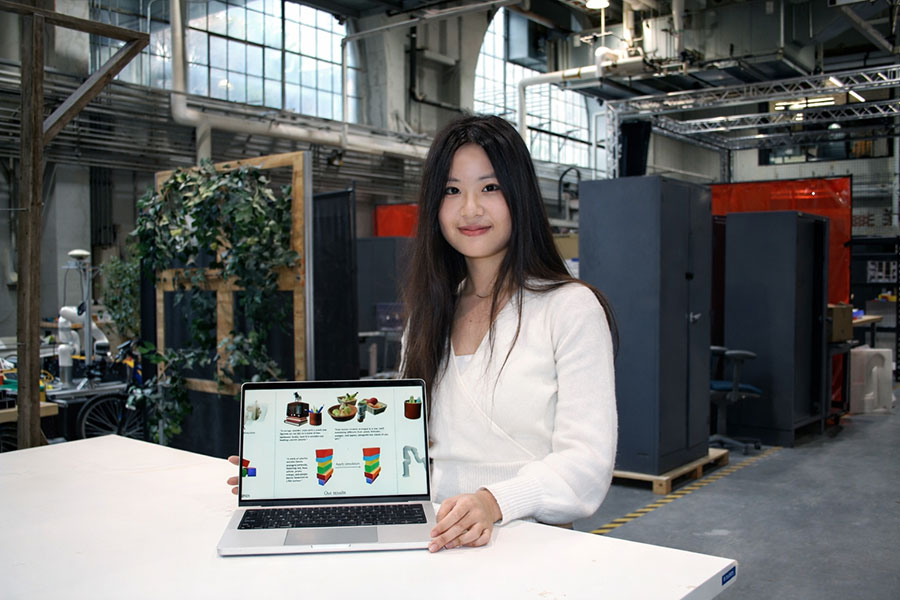
SCS researchers, including CSD's Guying Lin (shown), have developed a new scene-generation framework that creates physically realistic, simulation-ready 3D scenes from text prompts.

The Breakdown

  • PAT3D generates 3D scenes from text prompts that remain stable and realistic under physical forces like gravity.
  • The system significantly reduces the time required to manually design complex virtual environments.
  • PAT3D creates simulation-ready environments that can be used for applications such as video game design and robotics training.

***

Researchers in Carnegie Mellon University's School of Computer Science have developed a new scene-generation framework that creates physically realistic, simulation-ready 3D scenes from text prompts.

Physics-Augmented Text-to-3D Scene Generation (PAT3D) creates final products that not only look convincing but also behave correctly under real-world physical forces. The work could significantly reduce the amount of time it takes to create training simulation scenes for applications like robotics and video game design.

"PAT3D moves beyond purely visual generation by creating scenes that remain stable when interacted with under physical forces such as gravity and object contact," said Guying Lin, a Ph.D. student in CMU's Computer Science Department (CSD). "This technique makes the generated environments more useful and realistic for applications such as video game design, robotics training and simulation-based research."

Many artificial intelligence systems will instantly generate a 3D environment based on short scene descriptions that users supply: a stack of colorful blocks, a toothbrush resting in a cup or a basket filled with fruit. But those scenes often don't follow the rules of physics, like gravity. Objects may fuse together or float unnaturally in midair, while some scenes may collapse altogether.

PAT3D uses both large language and visual language models to turn a simple text prompt into a fully constructed, physically viable 3D scene. First, the large language models generate a visually plausible draft of the scene based on the user's description. Next, a visual language model analyzes the scene and extracts relationships between objects, like which objects support others or how they should be positioned relative to each other.

These relationships are then evaluated by a physics simulator. This "physics teacher" checks whether the scene follows real-world physical constraints. Based on its observations, the simulator adjusts object placements until the environment becomes physically plausible and stable. The final generated scene is then physically grounded, interactive and ready for multiple applications.

The system currently takes anywhere from 10 to 30 minutes to generate a scene, with exact times depending on the number of objects and the complexity of the prompt. This automated process is significantly faster than traditional 3D scene design, which can take designers days or weeks to build manually.

"During my undergraduate studies, I spent a lot of time manually designing game scenes, so I'm very familiar with how extensive the process can be," Lin said. "Now, during my Ph.D., I'm excited that technology like this can automate parts of that work while also benefiting fields like robotics. Since robots are often trained in simulated environments before being deployed in the real world, those simulations need to closely match physics in real life. PAT3D does just that."

The research was advised by CSD Assistant Professor Minchen Li and Jun-Yan Zhu, the Michael B. Donohue Assistant Professor of Computer Science and Robotics. Along with Lin, Li and Zhu, the PAT3D research team included Michael Liu, a CSD doctoral research assistant; Ruihan Gao, a Robotics Institute doctoral student; Hanke Chen, an SCS undergraduate student; Lyuhao Chen, an Electrical and Computer Engineering Department master's student; and Beijia Lu, a Robotics Institute master's student. Researchers from the University of Hong Kong and the Hong Kong University of Science and Technology were also involved, including Kemeng Huang, Taku Komura and Yuan Liu.

PAT3D was accepted to the 2026 International Conference on Learning Representations. Read the paper to learn more about the project.