

惯性聚合 高效追踪和阅读你感兴趣的博客、新闻、科技资讯
阅读原文 在惯性聚合中打开

推荐订阅源

P
Proofpoint News Feed
J
Java Code Geeks
WordPress大学
WordPress大学
博客园 - 【当耐特】
博客园 - 叶小钗
小众软件
小众软件
博客园 - 聂微东
宝玉的分享
宝玉的分享
量子位
人人都是产品经理
人人都是产品经理
博客园_首页
罗磊的独立博客
腾讯CDC
美团技术团队
Google DeepMind News
W
WeLiveSecurity
I
InfoQ
Engineering at Meta
Engineering at Meta
云风的 BLOG
云风的 BLOG
奇客Solidot–传递最新科技情报
奇客Solidot–传递最新科技情报
T
Threat Research - Cisco Blogs
Google DeepMind News
cs.AI updates on arXiv.org
让小产品的独立变现更简单 - ezindie.com
H
Hacker News: Front Page
B
Blog RSS Feed
L
LangChain Blog
C
Check Point Blog
Exploit-DB.com RSS Feed
G
GRAHAM CLULEY
Threat Intelligence Blog | Flashpoint
CTFtime.org: upcoming CTF events
Microsoft Azure Blog
C
CXSECURITY Database RSS Feed - CXSecurity.com
博客园 - Franky
S
Schneier on Security
Attack and Defense Labs
Microsoft Security Blog
N
Netflix TechBlog - Medium
cs.CL updates on arXiv.org
T
Tenable Blog
Simon Willison's Weblog
L
LINUX DO - 热门话题
阮一峰的网络日志
阮一峰的网络日志
Hacker News: Ask HN
Hacker News: Ask HN
A
Arctic Wolf
Schneier on Security
The Last Watchdog
The Last Watchdog
Latest news
Latest news
T
The Exploit Database - CXSecurity.com

菲兹克斯喵

Lesson 17 引力波的功率 (2) Lesson 16 引力波的功率 Lesson 8 Atmospheres Lesson 16 习题课 Lesson 15 引力波 Lesson 14 Noether 定理 Lesson 7 Evolution Lesson 7 传粉的力量 Lesson 13 作用量原理 Lesson 13 配分函数的一些应用 Lesson 12 Penrose 过程与 Hawking 辐射 Lesson 6 Homology Lesson 11 带电荷和旋转的黑洞 Lesson 6 进食行为 Lesson 11 配分函数 Lesson 10 Penrose 图 Lesson 5 Diffusion Lesson 9 微观量与宏观量的联系 Lesson 5 捕食行为 Lesson 8 Schwarzschild 黑洞 Lesson 9 Schwarzschild 黑洞 (2) Lesson 8 近独立子体系分布 Lesson 4 Ignition of the Sun Lesson 7 统计力学绪论 Lesson 4 讲座:乌贼和章鱼的行为与智能 Lesson 7 Killing 矢量场和 Lie 导数 Lesson 6 Schwarzschild 解 Lesson 6 Landau 相变理论 (二) Lesson 3 Lane - Emden Equation Lesson 5 Landau 相变理论 Lesson 3 动物的感知 Lesson 5 Einstein 场方程 Lesson 4 协变的物理定律 Lesson 3 等效原理 & 广义协变性原理 Lesson 2 Equation of State Lesson 3 热力学关系 Lesson 2 神经生物学基础 Lesson 2 度规和联络 Lesson 1 简介 Lesson 1 Lorentz 变换 Lesson 2 热力学定律 Lesson 1 Introduction & Light Lesson 1 介绍 流星监控项目 II - 树莓派配置 Lesson 15 Green 函数法 Lesson 29 散射 (二) Lesson 15 Spatial Patterns & Self-Organization Lesson 14 积分变换 Lesson 29 散射 Lesson 28 散射 (一) Lesson 27 绝热近似 Lesson 14 Dynamics of biological networks (2) Lesson 13 分离变量法总结 Lesson 26 变分法 (二) Lesson 14 Spatial Statistics Lesson 27 带电粒子和电磁场的相互作用 Lesson 13 磁性材料 & 拓扑绝缘体 Lesson 25 变分法 Lesson 13 Fast Radio Burst Lesson 13 Dynamics of biological networks Lesson 24 含时微扰 Lesson 26 相对论中的能量和动量守恒 Lesson 13 On the Intersection between Astronomy and AI Lesson 25 电磁场变换 Lesson 12 超导 Lesson 23 Zeeman Effect Lesson 12 absorbing Lesson 12 China Jingping Labs and Related Physics Lesson 24 狭义相对论的速度变换 Lesson 22 微扰论 Lesson 11 Bessel 函数 Lesson 12 Time Series Analysis Lesson 23 狭义相对论 Lesson 21 能带理论 Lesson 11 量子多体系统 Lesson 11 Molecular Motor (3) Tianwen:The Beauty of the Cosmos Lesson 10 连带 Legendre 函数 Lesson 20 多电子原子 & 固体 Lesson 11 Truncated & Censored Data Lesson 21 偶极辐射 (二) Lesson 10 离子阱量子计算 & 超快分子摄影 Lesson 10 Molecular Motor (2) Lesson 19 多粒子系统 Neutron Stars Lesson 20 偶极辐射 Lesson 9 Legendre 多项式 (二) Lesson 18 双粒子系统 Lesson 10 Clustering & Classification Lesson 19 辐射 (二) Lesson 9 引力波探测 & 原子量子计算 Lesson 17 CG 系数 「三次量子化」:宏观量子能级及其相干叠加态 —— 解读今年的 Nobel Prize Lesson 9 Molecular Motor Exoplanet Lesson 18 辐射 Lesson 16 自旋 (二) Lesson 8 Legendre 多项式 Lesson 17 波导 Lesson 9 Density Estimation
Lesson 4 热力学第三定律
2026-03-06 · via 菲兹克斯喵

我们引入一些可以观测的量:体膨胀系数、压强系数和等温压缩系数,

α=1V(∂V∂T)p,β=1p(∂p∂T)V,κT=−1V(∂V∂p)T\alpha = \frac{1}{V}\left(\frac{\partial V}{\partial T}\right)_p,\quad\beta = \frac{1}{p}\left(\frac{\partial p}{\partial T}\right)_V,\quad \kappa_T=-\frac{1}{V}\left(\frac{\partial V}{\partial p}\right)_T

小结一下利用热力学定律研究均匀系统性质的一般方法:

  • 选自变量 (直接观测量)
  • dU=TdS−pdV\text{d}U=T\text{d}S-p\text{d}V
  • 引出其他特性函数的全微分,并得到 Maxwell 关系
  • 如果仅仅涉及 SS 的偏导数,利用 Maxwell 关系和偏导法则即可
  • 如果涉及特性函数的偏导,先换到 SS 的偏导数,再回到上面一步

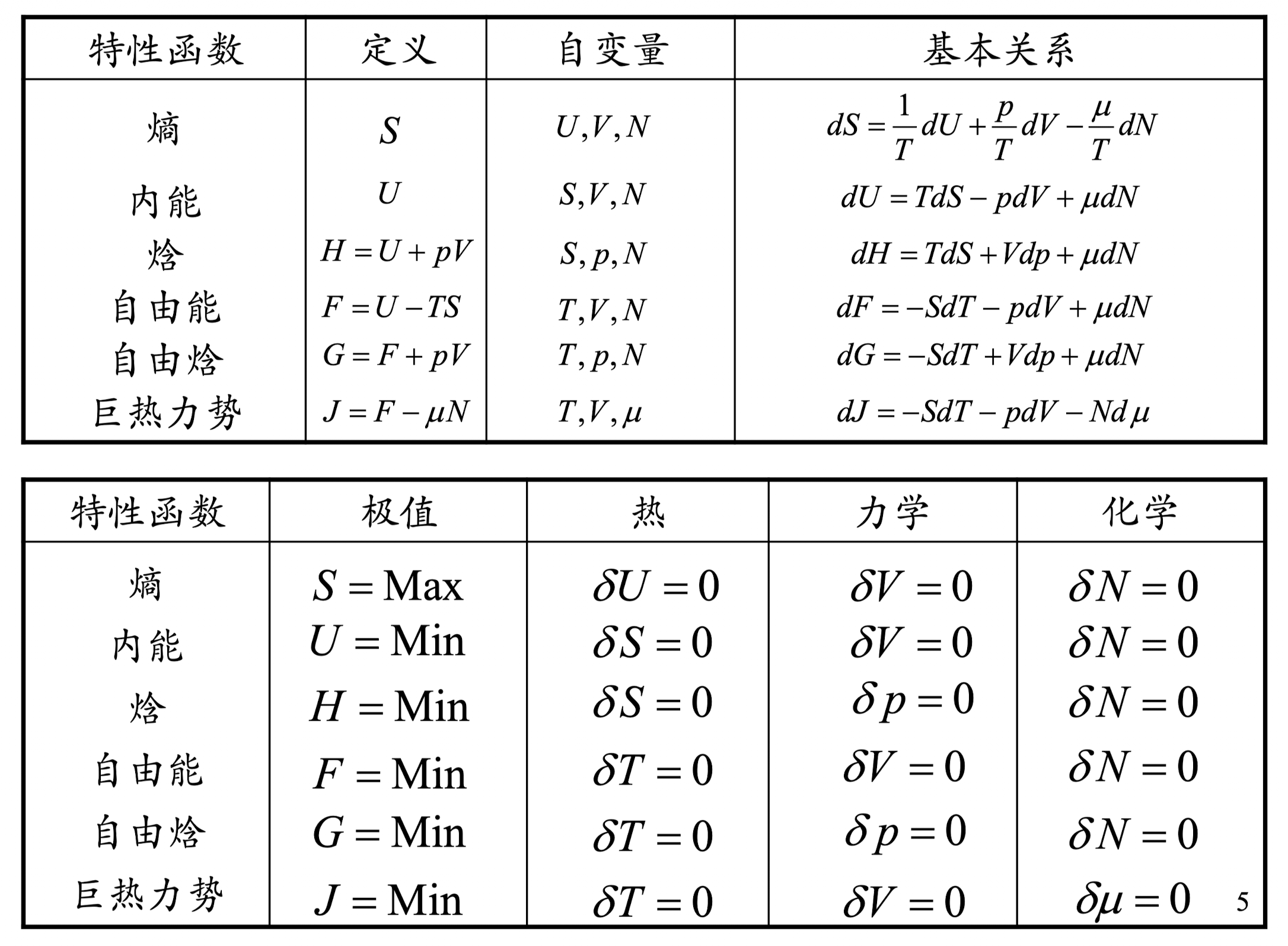
平衡态的特性函数:

热力学第三定律

从 Nernst 定理 (1906) 开始,Nernst 定理指的是等温过程中熵的改变在 T→0T\to0 下趋于零,即

lim⁡T→0(ΔS)T=0\lim_{T\to0}(\Delta S)_T = 0

1912 年,Nernst 提出 Nernst 原理,表述为:不可能使一个物体冷却到绝对温度的零度.

如果考虑热容

Cy=T(∂S∂T)yC_y = T\left(\frac{\partial S}{\partial T}\right)_y

在没有受力的情况下,能够从初始值开始计算熵的具体值,

S(T,y)=S(0,y)+∫0yCydTTS(T,y) = S(0,y)+\int_0^yC_y\frac{\text{d}T}{T}

我们可以把 S(0,y)S(0,y) 设为 00,这是 Planck 的做法. 同时根据 Nernst 原理可以证明,在 T→0T\to0 时比热必须趋于零,否则和 Nernst 原理 (或者说热力学第三定律) 矛盾.

复相系统的热力学性质

现在要考虑粒子数可变系统,设均匀系有 kk 个组元,以 T,p,{Ni}T,p,\{N_i\} 为自变量,对于 GG 这种广延量,有

G=∑i=1kNi(∂G∂Ni)T,p,Nj≠Ni=∑iNiμiG = \sum_{i=1}^k N_i\left(\frac{\partial G}{\partial N_i}\right)_{T,p,N_j\neq N_i} = \sum_iN_i\mu_i

这里用到所谓 Euler 定理:如果齐次函数

f(λx1,⋯ ,λxn)=λmf(x1,⋯ ,xn)f(\lambda x_1,\cdots,\lambda x_n) =\lambda^mf(x_1,\cdots,x_n)

∑Ixi∂f∂xi=mf\sum_Ix_i\frac{\partial f}{\partial x_i} = mf

这里定义了第 ii 组元的化学势 μi\mu_i. 新的热力学方程是

dG=(∂G∂T)p,NidT+(∂G∂p)T,Nidp+∑i(∂G∂Ni)T,p,Nj≠NidNi\text{d}G = \left(\frac{\partial G}{\partial T}\right)_{p,N_i}\text{d}T+\left(\frac{\partial G}{\partial p}\right)_{T,N_i}\text{d}p+\sum_i\left(\frac{\partial G}{\partial N_i}\right)_{T,p,N_j\neq N_i}\text{d}N_i

和封闭系统比较,上式可以用特性函数表示为

dG=−SdT+Vdp+∑iμidNi\text{d}G = -S\text{d}T+V\text{d}p+\sum_i\mu_i\text{d}N_i

可以定义 mol Gibbs 函数:

G(T,p,n)=nGm(T,p),Gm=(∂G∂n)T,p≡μm≡NAμG(T,p,n) = nG_m(T,p),\quad G_m=\left(\frac{\partial G}{\partial n}\right)_{T,p}\equiv\mu_m \equiv N_A\mu

单元复相系的平衡条件

用孤立系统来讨论,考虑两相 α,β\alpha,\beta. 要求能量、体积、粒子数都恒定,也就有

Uα+Uβ=const.,Vα+Vβ=const.,Nα+Nβ=const.U^\alpha+U^\beta=\text{const.},\quad V^\alpha+V^\beta=\text{const.},\quad N^\alpha+N^\beta=\text{const.}

平衡时,SS 取极值,δS=δSα+δSβ=0\delta S=\delta S^\alpha+\delta S^\beta=0. 也就是:

δUα+pαδVα−μαδNαTα+δUβ+pβδVβ−μβδNβTβ=0⟹(1Tα−1Tβ)δUα+(pαTα−pβTβ)δVα+(μαTα−μβTβ)δNα=0\begin{aligned} &\frac{\delta U^\alpha+p^\alpha\delta V^\alpha-\mu^\alpha\delta N^\alpha}{T^\alpha} + \frac{\delta U^\beta+p^\beta\delta V^\beta-\mu^\beta\delta N^\beta}{T^\beta}=0\\\\ \Longrightarrow&\left(\frac{1}{T^\alpha}-\frac{1}{T^\beta}\right)\delta U^\alpha+\left(\frac{p^\alpha}{T^\alpha}-\frac{p^\beta}{T^\beta}\right)\delta V^\alpha+\left(\frac{\mu^\alpha}{T^\alpha}-\frac{\mu^\beta}{T^\beta}\right)\delta N^\alpha=0 \end{aligned}

有三个平衡条件,热平衡条件 Tα=TβT^\alpha=T^\beta、力学平衡条件 pα=pβp^\alpha=p^\beta、相平衡条件 μα=μβ\mu^\alpha=\mu^\beta.

对于多元复相系,平衡条件也是上面这些. 如果存在化学反应则更复杂:以 2H2+O2⟷2H2O2\text{H}_2+\text{O}_2\longleftrightarrow2\text{H}_2\text{O} 为例,热力学习惯于写成

2H2O−2H2−O2=02\text{H}_2\text{O}-2\text{H}_2-\text{O}_2=0

一般地,写为

∑i=1kνiAi=0\sum_{i=1}^k\nu_iA_i = 0

等温等压条件下,Gibbs 自由能极小,δG=0\delta G=0. 化学平衡条件和化学反应的系数有关,

∑iνiμi=0\sum_i\nu_i\mu_i=0

相变热力学

用宏观量来描写相变,首先是 Gibbs 相律,描述相的并存:

μI(T,Y)=μII(T,Y)⟹Y=Y(T)\mu^{\text{I}}(T,Y) = \mu^{\text{II}}(T,Y)\Longrightarrow Y=Y(T)

这个 Y(T)Y(T) 称为两相共存曲线. 如果是三相共存,则可以解出一个点,这个点三相共存,称为三相点. 同理可以知道四相一般不能共存.