


惯性聚合 高效追踪和阅读你感兴趣的博客、新闻、科技资讯
阅读原文 在惯性聚合中打开

推荐订阅源

Cisco Talos Blog
Cisco Talos Blog
酷 壳 – CoolShell
酷 壳 – CoolShell
freeCodeCamp Programming Tutorials: Python, JavaScript, Git & More
Martin Fowler
Martin Fowler
Recent Announcements
博客园 - 三生石上(FineUI控件)
月光博客
月光博客
博客园 - 聂微东
N
Netflix TechBlog - Medium
B
Blog RSS Feed
T
Tailwind CSS Blog
宝玉的分享
宝玉的分享
有赞技术团队
有赞技术团队
S
SegmentFault 最新的问题
The Register - Security
奇客Solidot–传递最新科技情报
奇客Solidot–传递最新科技情报
博客园 - 司徒正美
J
Java Code Geeks
让小产品的独立变现更简单 - ezindie.com
人人都是产品经理
人人都是产品经理
Engineering at Meta
Engineering at Meta
T
The Blog of Author Tim Ferriss
C
CXSECURITY Database RSS Feed - CXSecurity.com
AWS News Blog
AWS News Blog
The Hacker News
The Hacker News
Scott Helme
Scott Helme
MongoDB | Blog
MongoDB | Blog
C
CERT Recently Published Vulnerability Notes
L
Lohrmann on Cybersecurity
C
Cybersecurity and Infrastructure Security Agency CISA
P
Proofpoint News Feed
T
The Exploit Database - CXSecurity.com
S
Securelist
MyScale Blog
MyScale Blog
A
Arctic Wolf
V2EX - 技术
V2EX - 技术
The GitHub Blog
The GitHub Blog
Simon Willison's Weblog
H
Hacker News: Front Page
D
DataBreaches.Net
S
Secure Thoughts
腾讯CDC
TaoSecurity Blog
TaoSecurity Blog
Project Zero
Project Zero
H
Help Net Security
P
Privacy International News Feed
Cloudbric
Cloudbric
博客园_首页
Latest news
Latest news
小众软件
小众软件

BloombergNEF

Sustainable Aviation Fuel Price Outlook: Leveling Off | BloombergNEF Solar Set to Rule World’s Power Supply: Three Things to Know | BloombergNEF Energy Transition Impacts: Sector and Country Impacts from a Demand-Driven Model | BloombergNEF BloombergNEF Turkey Transition Factbook 2026: Clean Power Growth Positions Turkey for the Next Phase of Its Energy Transition | BloombergNEF Competitiveness, Cost and Climate: Five Themes From the BNEF Summit Amsterdam | BloombergNEF Electric Vehicle Outlook | BloombergNEF BloombergNEF’s Electric Vehicle Outlook 2026: Global EV Sales Set For Another Record-Breaking Year, But Growth in Some Major Markets Slows | BloombergNEF Mexico Transition Factbook 2026 Have Oil Prices Already Peaked? Three Things to Know Liebreich: The Great Clean Energy Acceleration 2.0 Global Clean-Energy Trade Rebounds to $479 Billion in 2025 Despite Tariffs and Geopolitical Turmoil: BloombergNEF New Energy Outlook 2026 New Energy Outlook 2026 BloombergNEF’s New Energy Outlook 2026: Transition to Newer Technologies, Expanded Electrification to Strengthen Nations’ Energy Security Energy Transition Bank Financing Struggles to Pull Ahead of Fossil Fuels in Asia Data Centers and the Future of Energy Storage Data Centers and the Future of Energy Storage Energy Storage Enters the 100-Gigawatt Era: Three Things to Know AI Data Centers, Energy and Finance: Dispatch from the BNEF Summit New York 2026 Nuclear Fusion Powers Up for Commercial Breakthrough BNEF Talk: Copper’s World of Wires, Wheels and Worries EU Carbon Border Tariff Is Reshaping Industrial Trade Flows BloombergNEF Announces 12 Climate Innovators as Winners of its 2026 Pioneers Award NEO 2025 New Energy Outlook 1 NEO No, Iran War Won’t Boost Clean Hydrogen – Except in China The Petrochemicals Shock That Is Already Rippling Through Plastics AI Data Center Build Advances at Full Speed: Five Things to Know Iran Rattles Saudi’s Red Sea Oil Reset. Here’s What’s at Stake Bloomberg Appoints Albert Cheung CEO of BloombergNEF Oil Math of Releasing 400 Million Barrels: Three Things to Know Chinese Turbine Suppliers Seize the Spotlight as Global Wind Power Installations Hit All-Time High, BloombergNEF Report Shows New Data Center Hotspots Are Emerging: Four Things to Know Oil Products Arbs and Flows: All Eyes On Strait of Hormuz
Clean Power Is Up and Will Get a War Boost: Three Things to Know
iterhorst · 2026-04-09 · via BloombergNEF

April 9, 2026

By Vandana Gombar, Senior Editor, BloombergNEF

Clean power use is rising and will emerge stronger from the Iran war as surging prices of gas and oil and disrupted fossil fuel supplies impose severe strain on economies. The world could double down on low-carbon energy, according to one view. Batteries, or storage, will be a big part of the shift, current trends show. So will corporations, which are increasing renewable energy consumption. Power-thirsty hyperscalers for the first time made up about half of the green power purchases last year. Here are three things to watch.

1. Solar-plus-storage gains appeal in Saudi Arabia, a fossil fuel powerhouse

Solar PV-plus-storage systems in Saudi Arabia can supply nearly uninterrupted power at an affordable cost throughout the day.

For up to 65% of the year, these systems can meet demand at a lower cost than a combined cycle gas turbine, Abdullah Alkattan, BloombergNEF’s Middle East analyst wrote in the latest edition of Signposts. That means the cost of supply would be below $45 per megawatt-hour (levelized cost).

Higher reliance on solar-plus-storage would add to average costs, but not a lot. Almost 100% of power demand could be met at $70 per megawatt-hour. Favorable power economics are a key part of the kingdom’s push to become a data center hub.

2. Hyperscalers are buying ever more clean energy

Big tech companies have huge appetite for clean power. Technology giants Meta, Amazon, Google and Microsoft accounted for about half the 56 gigawatts of clean power purchase deals signed in 2025. Most of this activity was in the US, where the agreements made up 76% of the market’s total deals of about 30 gigawatts.

“Demand from corporations remains an important driver for clean energy deployment, especially for emerging clean, firm power generation technologies like enhanced geothermal, nuclear or co-located solar and storage projects,” said Nayel Brihi, BNEF’s corporate energy analyst.
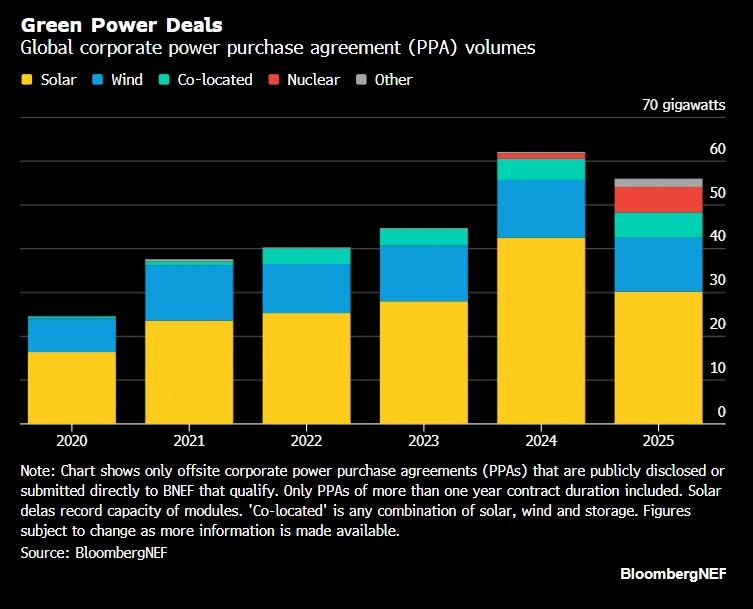
Materials companies like Egypt Aluminium and Rio Tinto also featured among the top 10 buyers of clean power in 2025. Activity slowed in mature markets like Germany and Spain amid rising power market volatility and policy uncertainty.

3. Power supply from Australia’s batteries up

Large utility-scale batteries are proliferating in Australia. A record 3.1 gigawatts/7.7 gigawatt-hours of utility-scale batteries started operating across the country in 2025, a fivefold increase over the capacity added in 2024. That is changing the dynamics of the power market.

“These installations are steadily eating the most valuable run hours of costlier gas plants, lowering evening power prices and tempering power market volatility,” said Sahaj Sood, BNEF’s Australia analyst.

Discharge from utility-scale batteries supplied 4.4% of average evening demand (7pm) in the National Electricity Market in the fourth quarter of 2025. This was up from just 0.2% in the fourth quarter of 2021.

BNEF clients can access Signposts, a quarterly highlighting trends in the energy transition.

Related Content

The latest from BloombergNEF delivered to your inbox

Sign up for BNEF’s free newsletter.