



INSIGHTS
The New Energy Outlook presents BloombergNEF’s long-term energy and climate scenarios for the transition to a low-carbon economy. Anchored in real-world sector and country transitions, it provides an independent set of credible scenarios covering electricity, industry, buildings and transport, and the key drivers shaping these sectors until 2050.
INSIGHTS
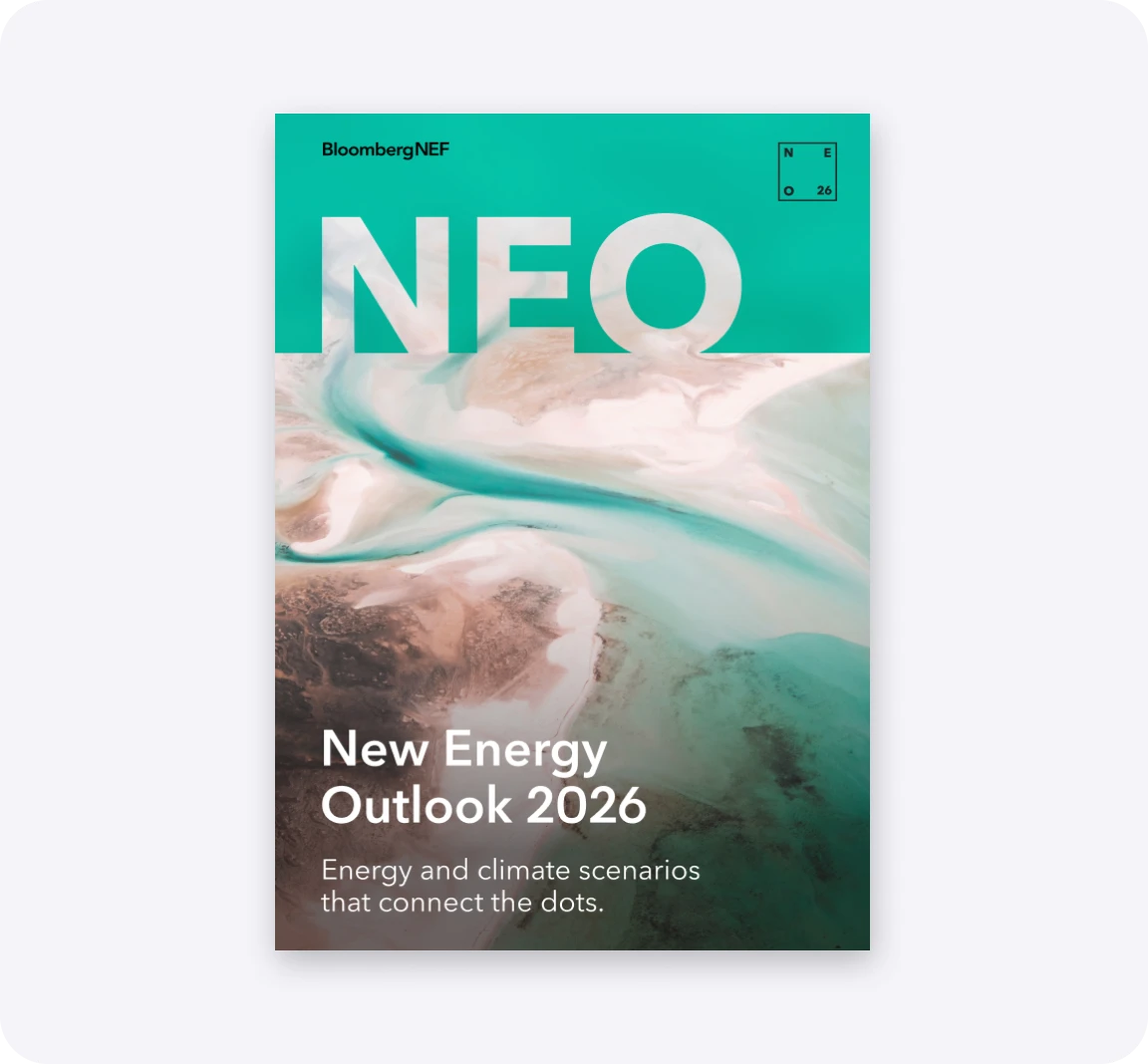
New Energy Outlook 2026
The New Energy Outlook presents BloombergNEF’s long-term energy and climate scenarios for the transition to a low-carbon economy. Anchored in real-world sector and country transitions, it provides an independent set of credible scenarios covering electricity, industry, buildings and transport, and the key drivers shaping these sectors until 2050.
INSIGHTS
New Energy Outlook 2026
The New Energy Outlook presents BloombergNEF’s long-term energy and climate scenarios for the transition to a low-carbon economy. Anchored in real-world sector and country transitions, it provides an independent set of credible scenarios covering electricity, industry, buildings and transport, and the key drivers shaping these sectors until 2050.
NEO 2026 Executive Summary Preview
The route to 2035 and beyond
The 2026 edition presents a new base-case scenario and a major update to our well-below-2C climate scenario. Against a backdrop of geopolitical tension and rising electricity demand, this year’s outlook explores how the global energy system may evolve as countries seek to balance resilience, affordability and decarbonization. The report examines how renewables, batteries, electric vehicles, nuclear and next-generation technologies are reshaping energy globally and within key markets.
The transition to new energy technologies improves resilience to fossil-fuel price shocks.
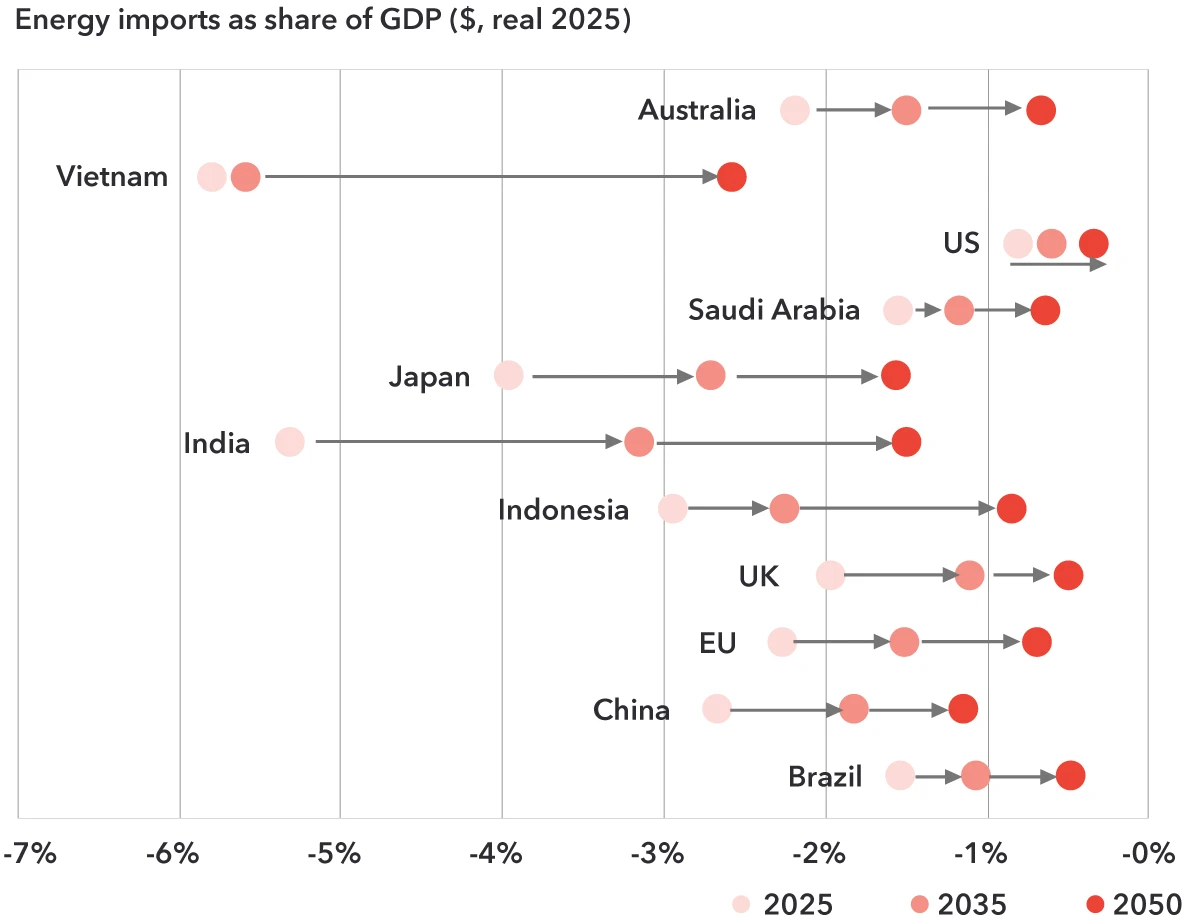
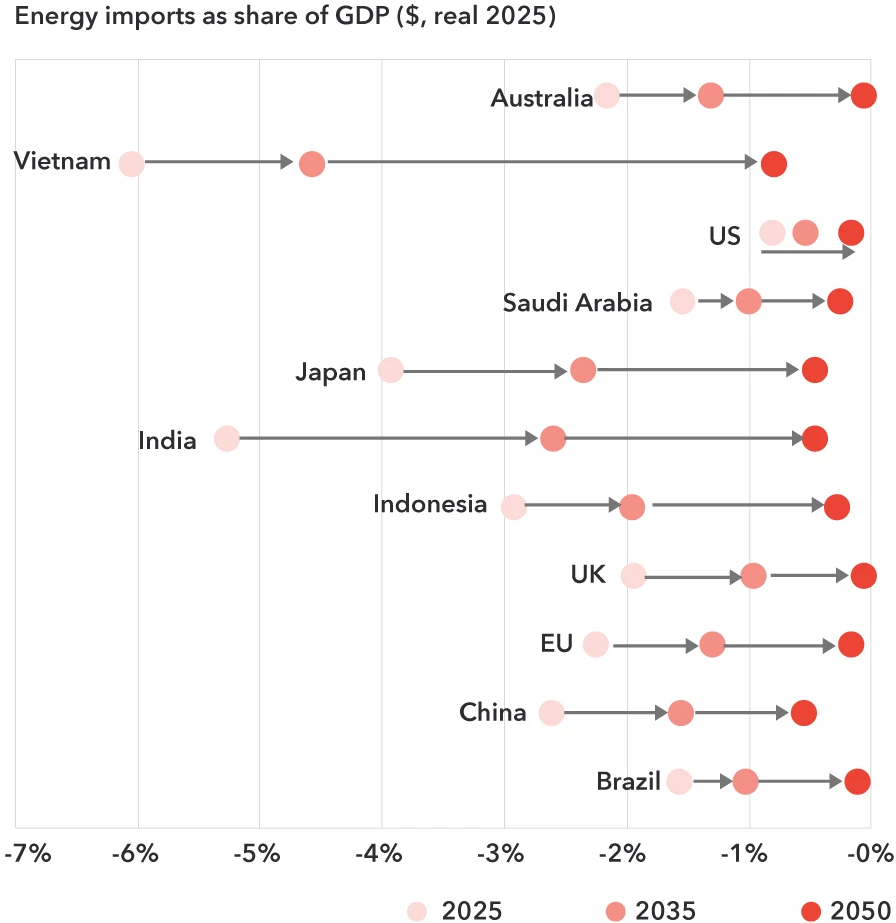
Energy security has risen to the top of the policy agenda. NEO 2026 finds that countries reliant on imported fossil fuels can materially reduce exposure to price shocks as electrification and clean power scale. As adoption of solar modules, batteries, heat pumps, electric vehicles, and other technologies accelerates, nations that are dependent on fossil fuels stand to improve their energy security under our base case. This can happen faster under the Net Zero Scenario.
Energy commodity import dependence by market and scenario in 2025, 2035 and 2050
Economic Transition Scenario
Net Zero Scenario
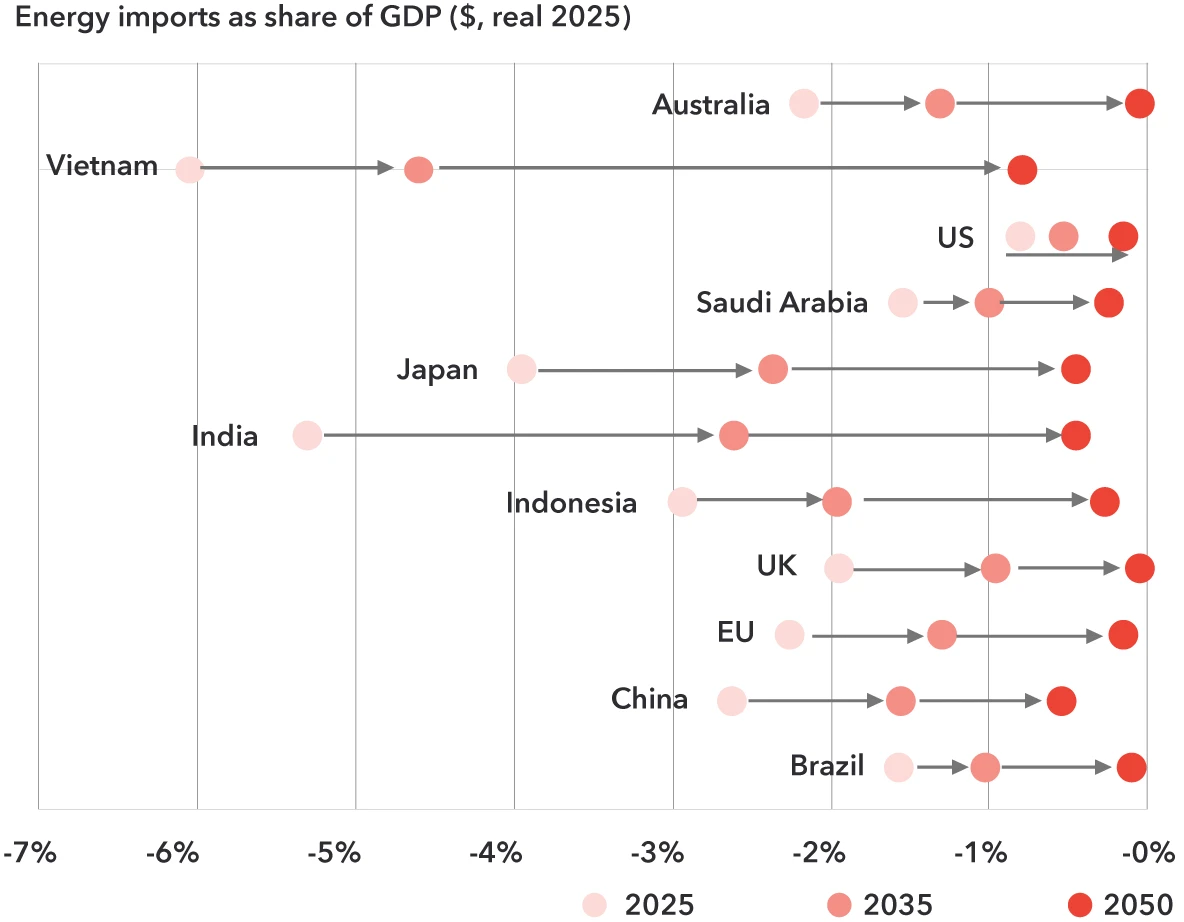
Source: BloombergNEF Trade Transition Scenario Tool, Sinoimex Global Trade Flow (GTF), GCAM. Note: Future imports scaled forward based on 2024 actuals, using domestic demand for related products and services under different scenarios. This projection assumes relative trade patterns remain static and uses the same GDP projections under both scenarios. Negative values indicate imports.
The transition to new energy technologies improves resilience to fossil-fuel price shocks.
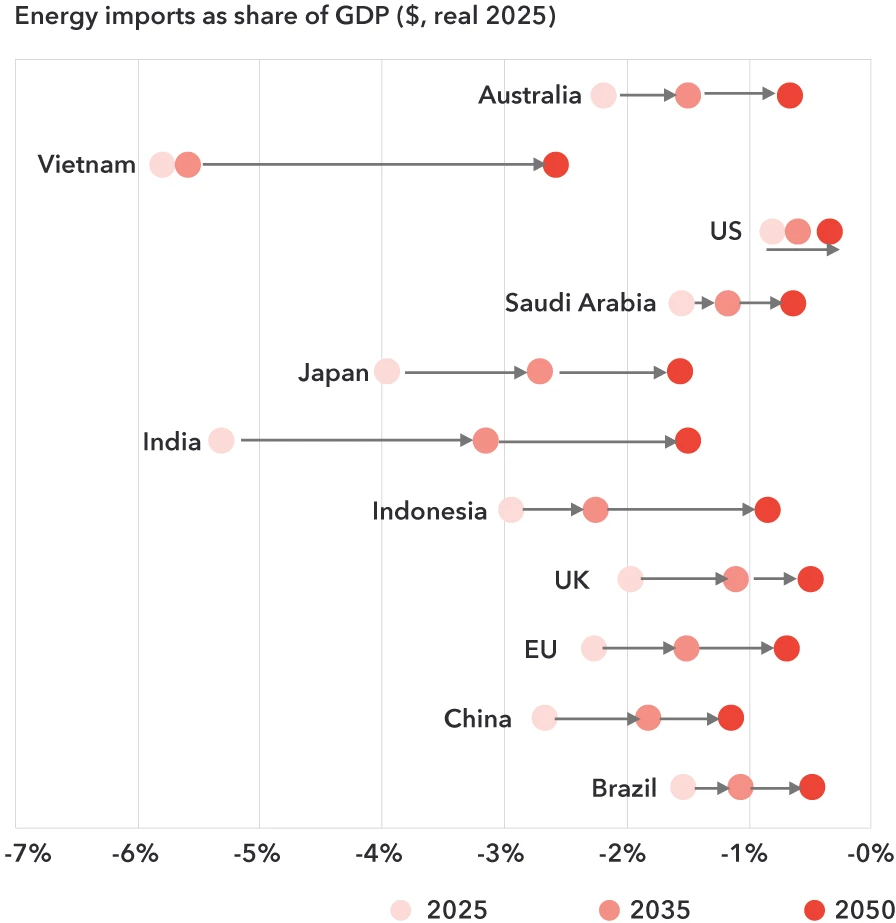
Energy security has risen to the top of the policy agenda. NEO 2026 finds that countries reliant on imported fossil fuels can materially reduce exposure to price shocks as electrification and clean power scale. As adoption of solar modules, batteries, heat pumps, electric vehicles, and other technologies accelerates, nations that are dependent on fossil fuels stand to improve their energy security under our base case. This can happen faster under the Net Zero Scenario.
Energy commodity import dependence by market and scenario in 2025, 2035 and 2050
Economic Transition Scenario
Net Zero Scenario
Source: BloombergNEF Trade Transition Scenario Tool, Sinoimex Global Trade Flow (GTF), GCAM. Note: Future imports scaled forward based on 2024 actuals, using domestic demand for related products and services under different scenarios. This projection assumes relative trade patterns remain static and uses the same GDP projections under both scenarios. Negative values indicate imports.
The transition to new energy technologies improves resilience to fossil-fuel price shocks.
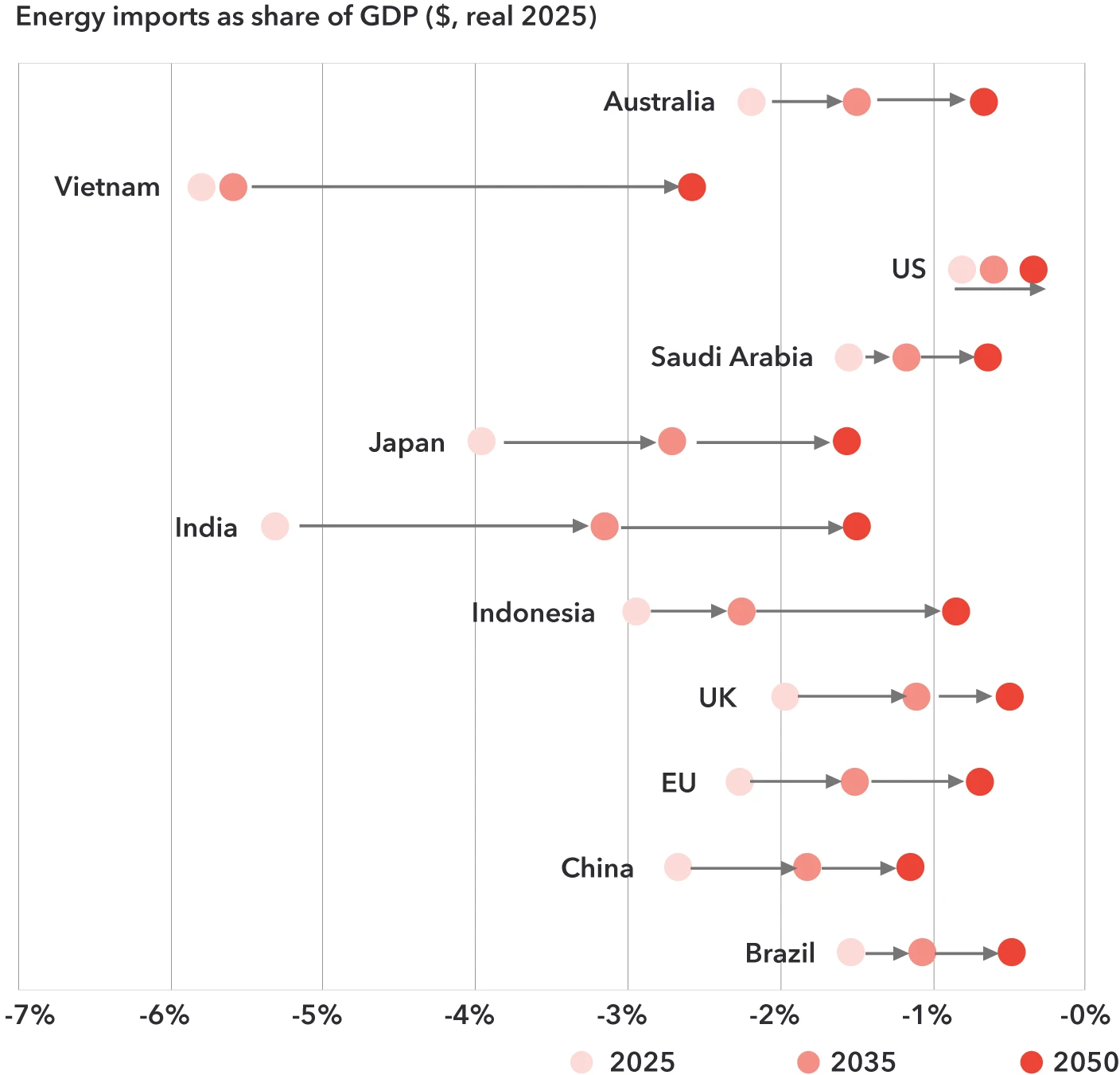
Energy security has risen to the top of the policy agenda. NEO 2026 finds that countries reliant on imported fossil fuels can materially reduce exposure to price shocks as electrification and clean power scale. As adoption of solar modules, batteries, heat pumps, electric vehicles, and other technologies accelerates, nations that are dependent on fossil fuels stand to improve their energy security under our base case. This can happen faster under the Net Zero Scenario.
Energy commodity import dependence by market and scenario in 2025, 2035 and 2050
Economic Transition Scenario
Net Zero Scenario
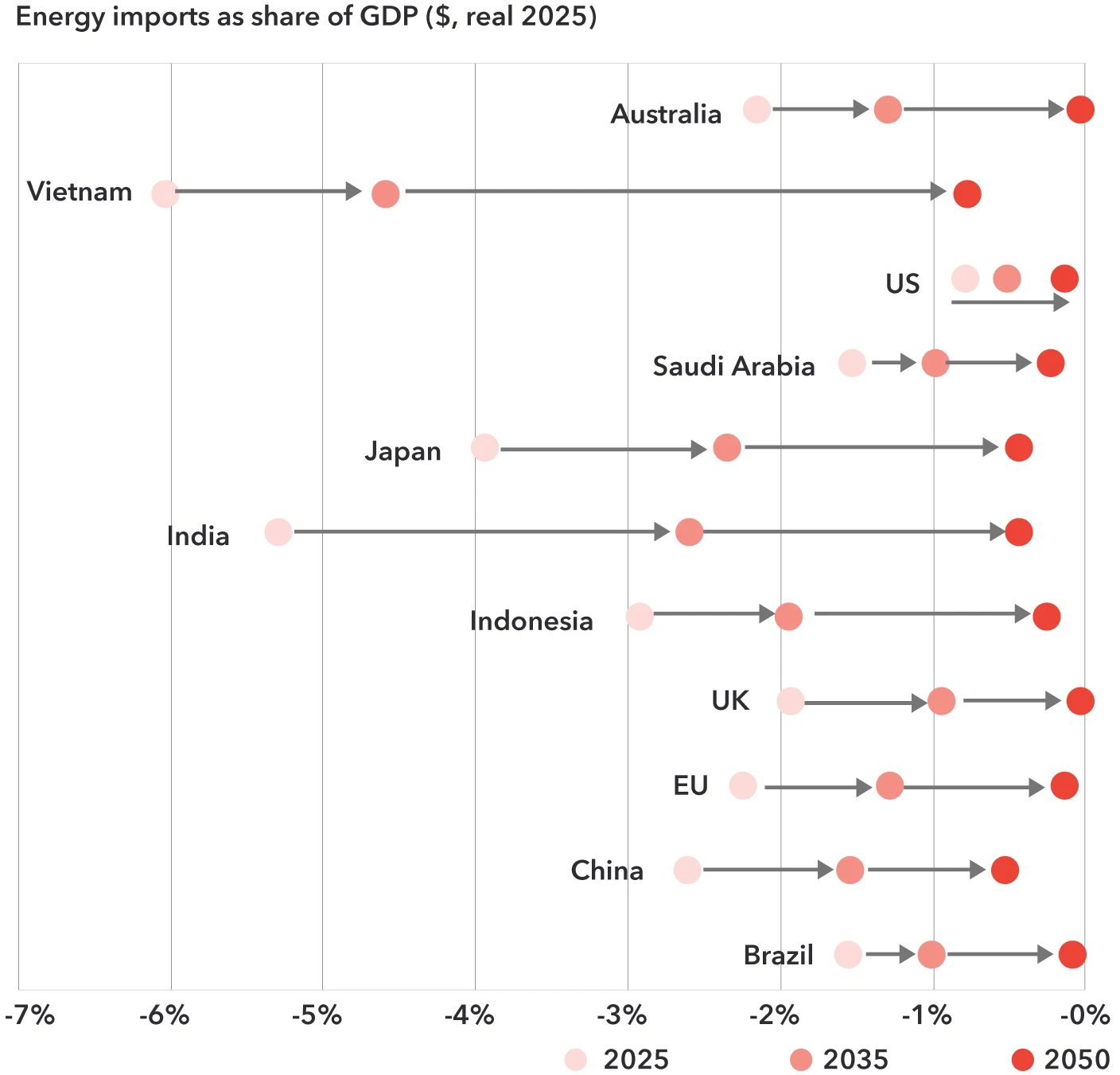
Source: BloombergNEF Trade Transition Scenario Tool, Sinoimex Global Trade Flow (GTF), GCAM. Note: Future imports scaled forward based on 2024 actuals, using domestic demand for related products and services under different scenarios. This projection assumes relative trade patterns remain static and uses the same GDP projections under both scenarios. Negative values indicate imports.
Strong fundamentals underpin growth in renewables, batteries and EVs
In the Economic Transition Scenario, emissions enter a gradual structural decline as clean technologies gain share based on economics alone. Most emissions reductions over the next decade come from clean power and electrification, with renewables displacing coal generation and electric vehicles slowing growth in oil demand. The Net Zero Scenario moves faster and further, combining accelerated deployment of renewables, batteries and EVs with large-scale use of hydrogen, carbon capture and sustainable fuels to drive deeper emissions reductions across industry, transport and buildings.
CO2 emissions reductions from fuel combustion by measures adopted, Economic Transition Scenario versus “no transition” scenario and Net Zero Scenario
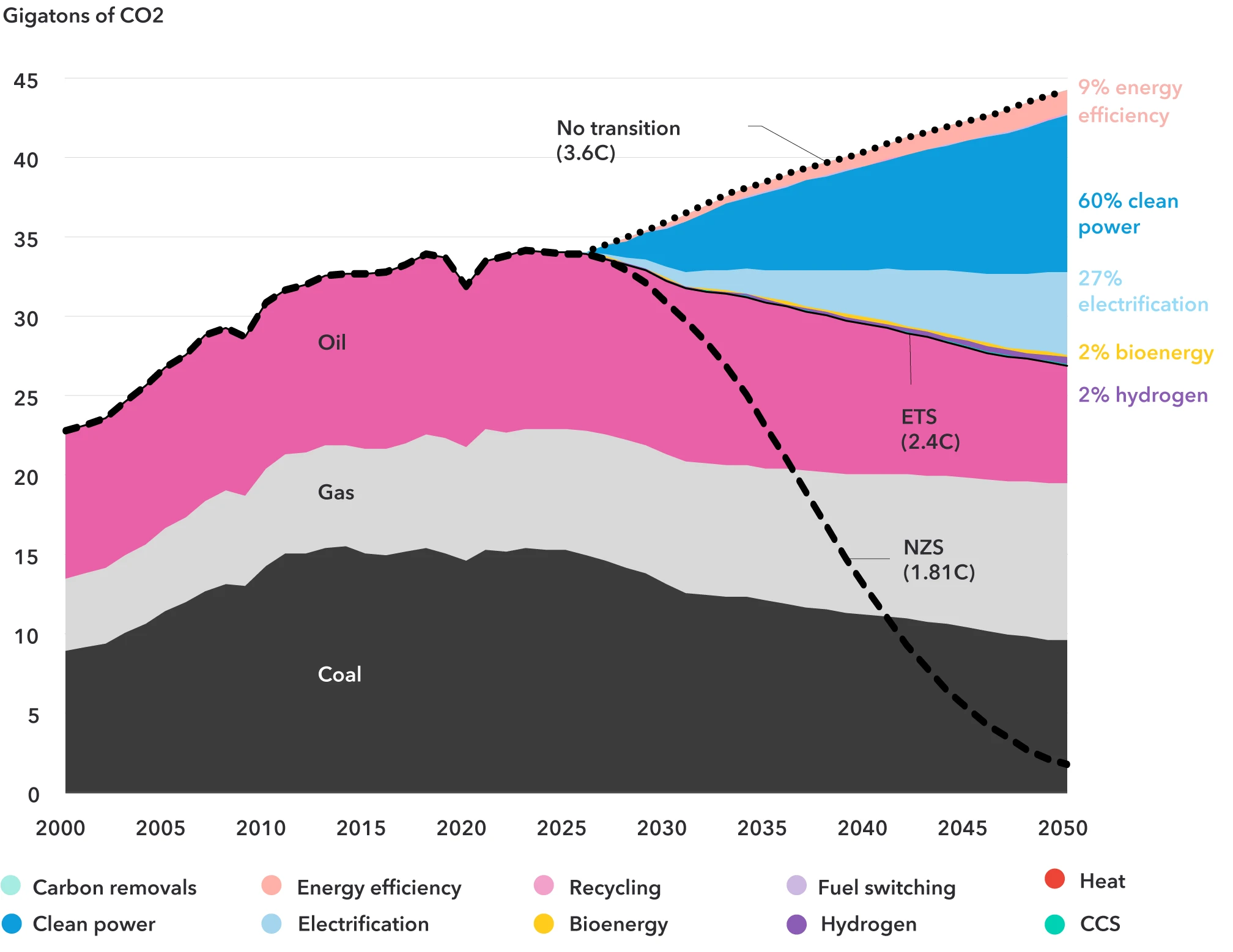
Source: BloombergNEF. Note: The “no transition” scenario is a hypothetical counterfactual that models no further improvement in decarbonization and energy efficiency. In this scenario, clean tech build for power is capped at historical limits, with costs fixed at 2026 levels and no further decline; in buildings and transport, the fuel mix remains unchanged from 2026; in industry, the uptake of recycling and alternative primary production processes is limited. “Clean power” includes renewables and nuclear, and excludes carbon capture and storage (CCS), hydrogen and bioenergy, which are accounted for separately. “Energy efficiency” covers demand-side efficiency improvements and reductions in demand.
CO2 emissions reductions from fuel combustion by measures adopted, Economic Transition Scenario versus “no transition” scenario and Net Zero Scenario
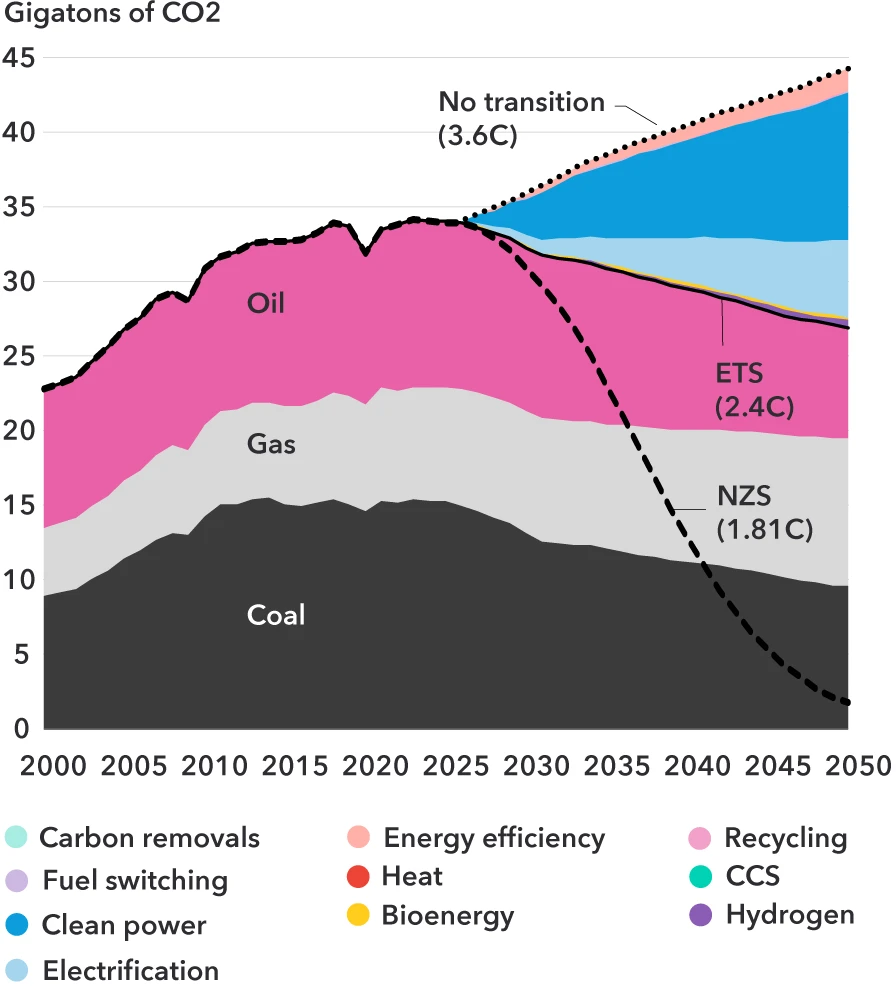
Source: BloombergNEF. Note: The “no transition” scenario is a hypothetical counterfactual that models no further improvement in decarbonization and energy efficiency. In this scenario, clean tech build for power is capped at historical limits, with costs fixed at 2026 levels and no further decline; in buildings and transport, the fuel mix remains unchanged from 2026; in industry, the uptake of recycling and alternative primary production processes is limited. “Clean power” includes renewables and nuclear, and excludes carbon capture and storage (CCS), hydrogen and bioenergy, which are accounted for separately. “Energy efficiency” covers demand-side efficiency improvements and reductions in demand.
CO2 emissions reductions from fuel combustion by measures adopted, Economic Transition Scenario versus “no transition” scenario and Net Zero Scenario
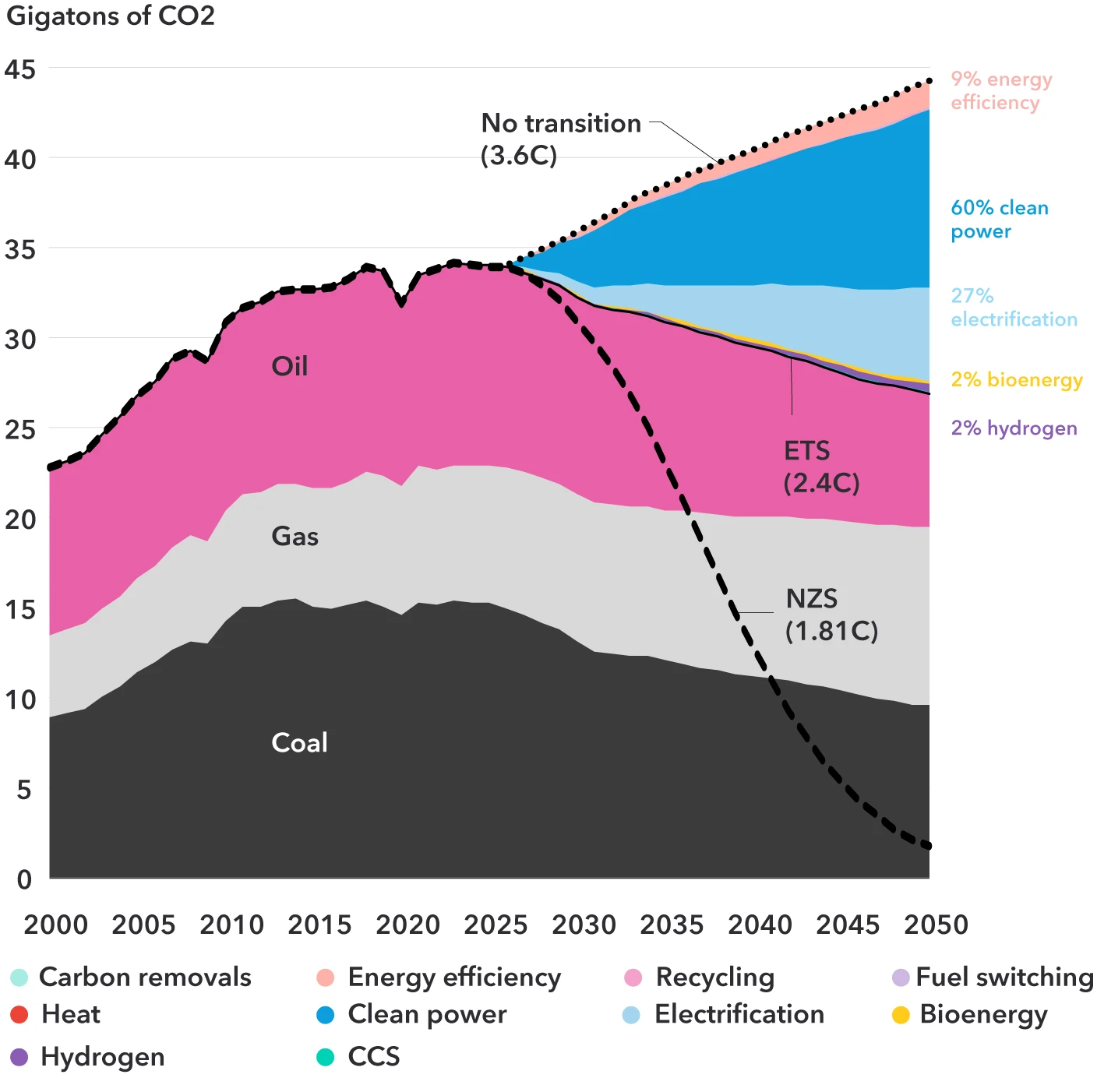
Source: BloombergNEF. Note: The “no transition” scenario is a hypothetical counterfactual that models no further improvement in decarbonization and energy efficiency. In this scenario, clean tech build for power is capped at historical limits, with costs fixed at 2026 levels and no further decline; in buildings and transport, the fuel mix remains unchanged from 2026; in industry, the uptake of recycling and alternative primary production processes is limited. “Clean power” includes renewables and nuclear, and excludes carbon capture and storage (CCS), hydrogen and bioenergy, which are accounted for separately. “Energy efficiency” covers demand-side efficiency improvements and reductions in demand.
Many, many things get electrified
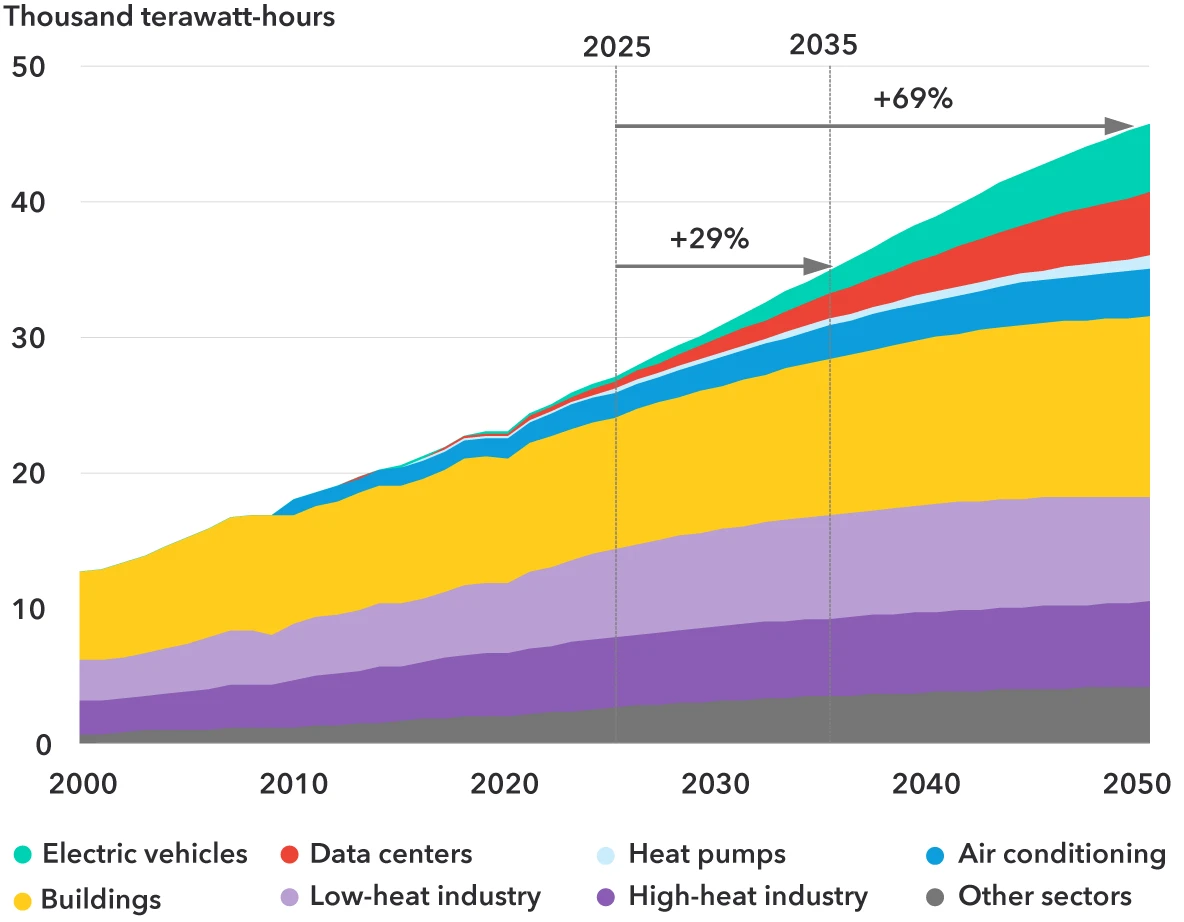
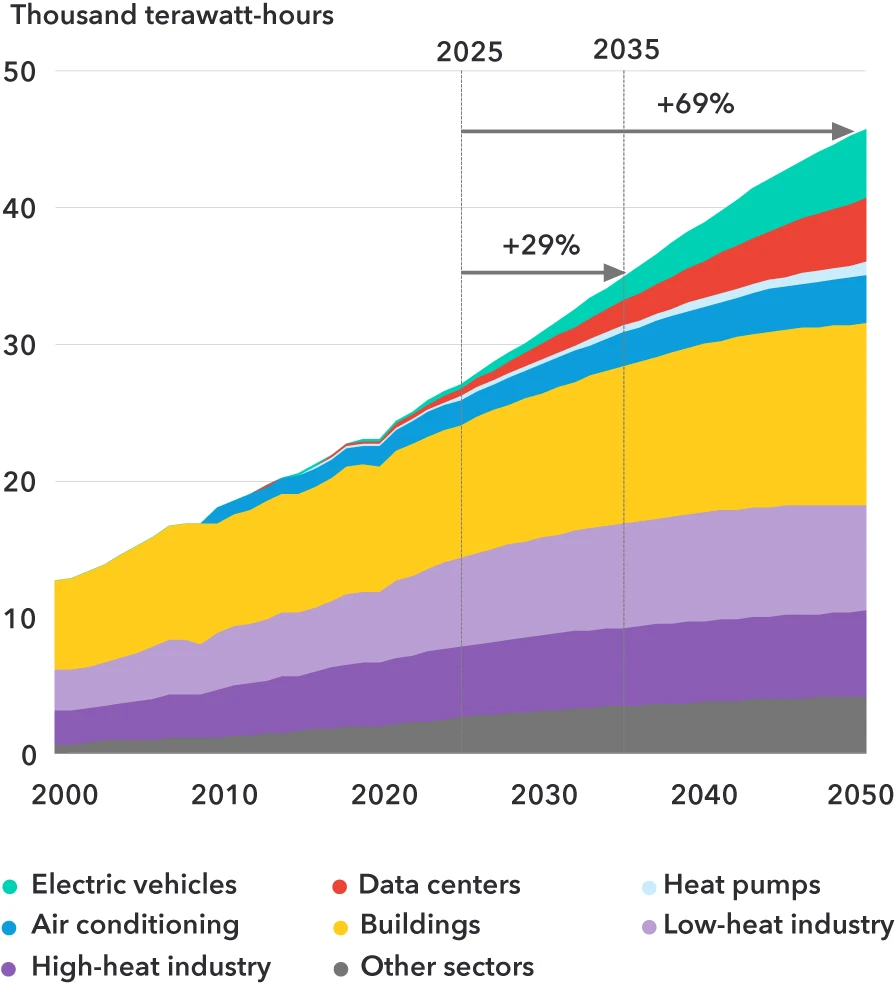
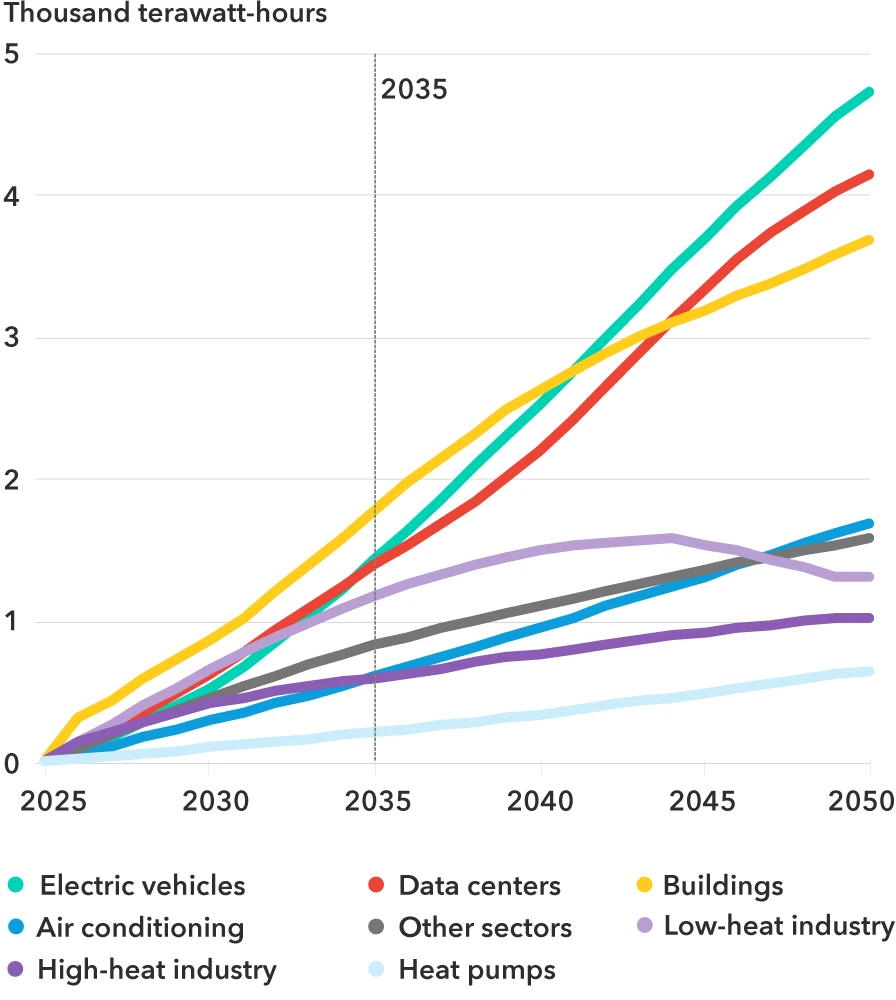
Rising demand makes electricity the world’s largest source of final energy in the coming decades in both of BNEF’s scenarios. Alongside electric vehicles and industry, data centers emerge as one of the fastest-growing drivers of new electricity demand, fueled by the rapid expansion of artificial intelligence. Meeting this demand requires a major buildout of capacity and grid infrastructure, as well as new sources of flexibility – reshaping power markets and investment priorities.
Drivers of electricity demand growth, Economic Transition Scenario
Absolute Growth
Growth Relative to 2025
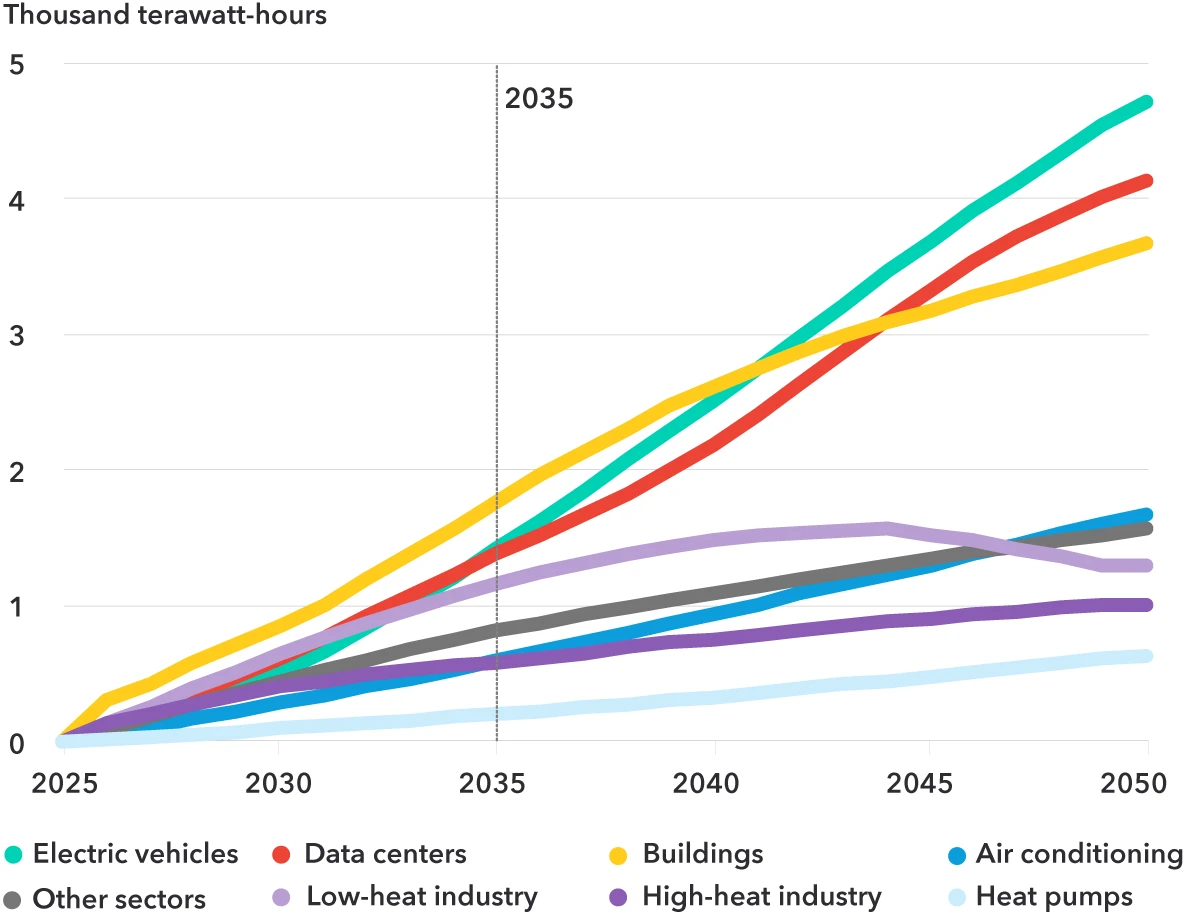
Source: BloombergNEF
Many, many things get electrified
Rising demand makes electricity the world’s largest source of final energy in the coming decades in both of BNEF’s scenarios. Alongside electric vehicles and industry, data centers emerge as one of the fastest-growing drivers of new electricity demand, fueled by the rapid expansion of artificial intelligence. Meeting this demand requires a major buildout of capacity and grid infrastructure, as well as new sources of flexibility – reshaping power markets and investment priorities.
Drivers of electricity demand growth, Economic Transition Scenario
Absolute Growth
Growth Relative to 2025
Source: BloombergNEF
Many, many things get electrified
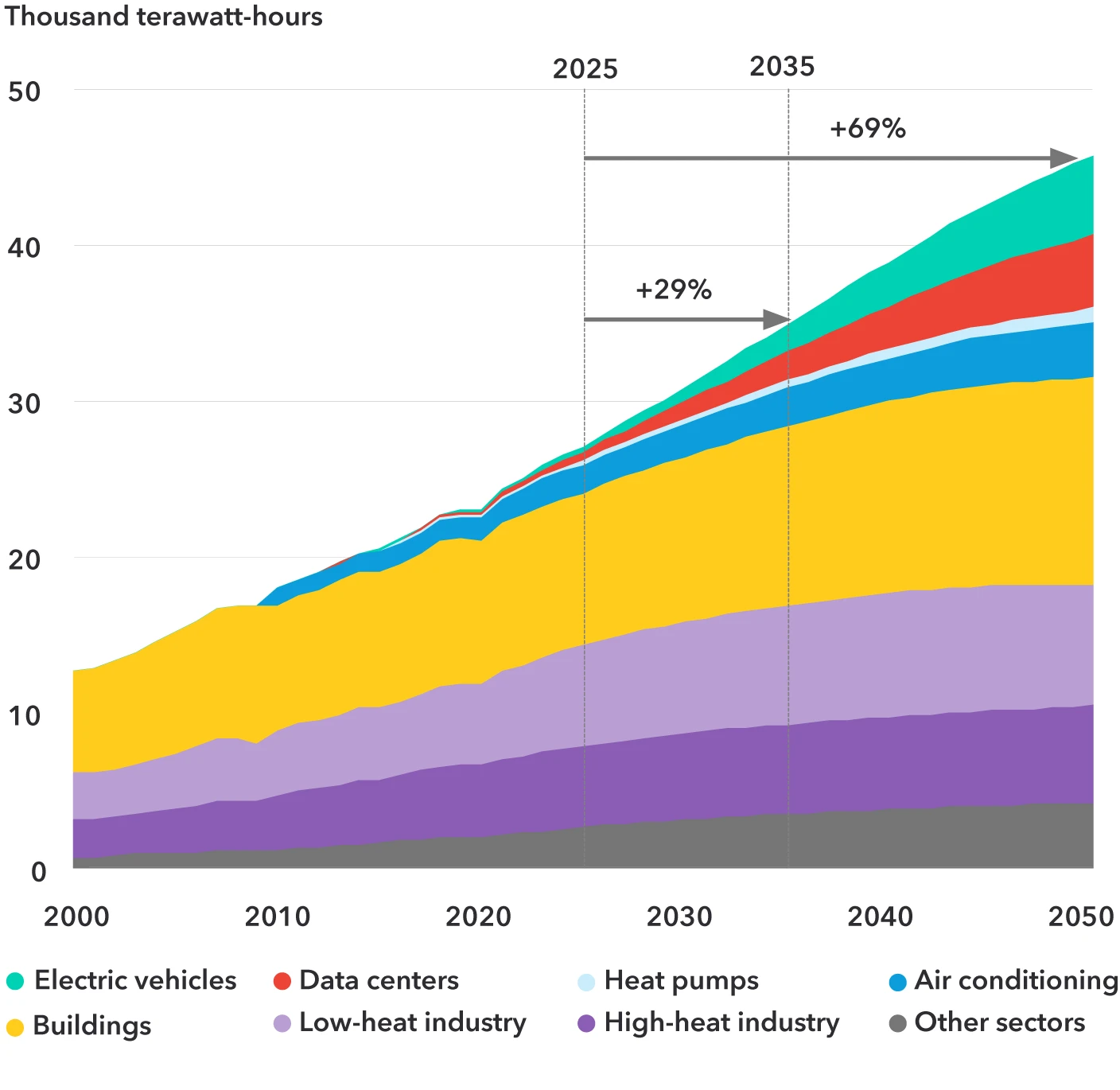
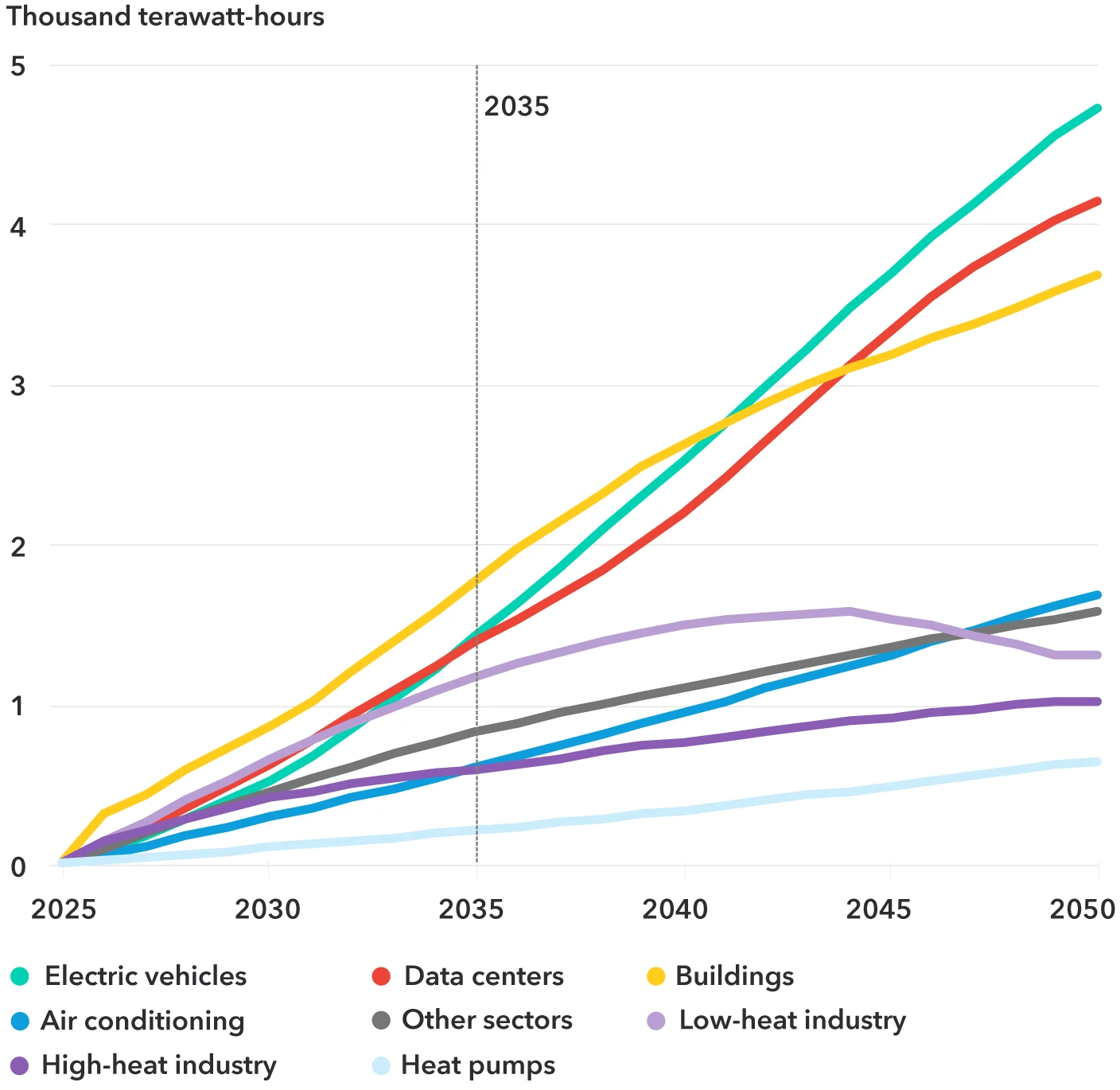
Rising demand makes electricity the world’s largest source of final energy in the coming decades in both of BNEF’s scenarios. Alongside electric vehicles and industry, data centers emerge as one of the fastest-growing drivers of new electricity demand, fueled by the rapid expansion of artificial intelligence. Meeting this demand requires a major buildout of capacity and grid infrastructure, as well as new sources of flexibility – reshaping power markets and investment priorities.
Drivers of electricity demand growth, Economic Transition Scenario
Absolute Growth
Growth Relative to 2025
Source: BloombergNEF
Download the executive summary and sample data
Stay informed
Yes, Subscribe me to receive the BNEF Month in Review, our monthly newsletter
Would you like to be contacted by a representative to learn more about BloombergNEF's solutions and services? Optional
Are you/your division responsible for setting strategy at your organization? Optional
Do you use/plan to use research services as part of your planning? Optional
Select any themes you are interested in: Optional
- Advanced transport (e.g.: electric vehicles, mobility, commercial vehicles)
- Buildings and industry (e.g.: circular economy, heating & cooling)
- Clean power (e.g.: solar, wind, storage, decentralized energy, power networks)
- Commodities (e.g.: oil and gas, metals, chemicals, agriculture)
- Cross-cutting technologies (e.g.: digitalization, hydrogen, carbon capture)
By submitting this information, I agree to the privacy policy and to learn more about products and services from Bloomberg.

David Hostert
Chief Economist, Lead author

Matthias Kimmel
Head of Energy Economics

Dr. Ian Berryman
Head of Energy Systems Modeling

Seohee Song
Energy Economics

Anushka Verma
Energy Economics

Kostas Pegios
Energy Systems Modeling

Alice He
Energy Systems Modeling

Amar Vasdev
Energy Economics

Rodrigo Quintero
Energy Economics

Allen Tom Abraham
Industry





Ethan Zindler
Summary findings
Abdullah Alkattan
Middle East
Meredith Annex
Clean Power
Tomas Butelman
Energy Economics
Forbes Chanthorn
Southeast Asia
Anastacia Davies
Renewable fuels
Ryan Fisher
Electric vehicle charging
Philip Geurts
Petrochemicals
Andrew Grant
Electric vehicles
Julia Hung
Other Asia Pacific
Dr. Ali Izadi-Najafabadi
Asia Pacific
Shantanu Jaiswal
India and Southeast Asia
Shananthan Kalaichelvan
Electric vehicles
David Kang
Japan and South Korea
Felix Kosasih
Southeast Asia
Nathalie Limandibhratha
Data centers
Claudio Lubis
Road and aviation fuels
Jinghong Lyu
Data centers
Colin McKerracher
Transport
Stephan Mothe
Latin America
Vinicius Nunes
Latin America
Rose Oates
Renewable fuels
Sofia Perelli-Rocco
Europe
Rafael Rabioglio
Latin America
Daisy Robinson
Renewable fuels
Thomas Rowlands-Rees
North America
Kesavarthiniy Savarimuthu
Europe
Kamala Schelling
Editorial
Ashish Sethia
Commodities
Dr. Nikolas Soulopoulos
Commercial transport
Yara van Ingen
Heat pumps
Nick Wang
Other Asia Pacific
William Young
Financial institutions