






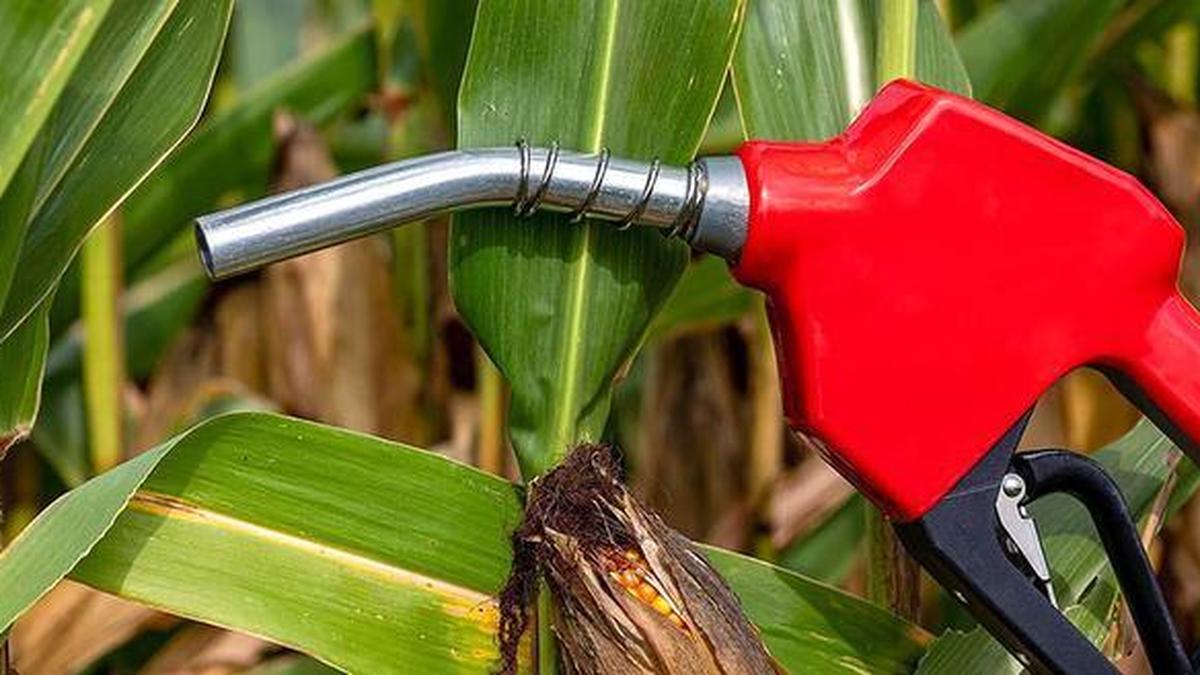
A big shift to ethanol raises questions about its impact on rice, sugarcane, pulses, millets and maize availability | Photo Credit: JJ Gouin
The conflict in West Asia has understandably lent a new urgency to the need to curb energy imports. The government is set to expedite the roll-out of flex-fuel vehicles (FFVs). While a 20 per cent ethanol-petrol blend (E20) is the current mandate, FFV engines are engineered for any mix all the way up to 100 per cent ethanol (E100).
The motivation for this push is not difficult to understand — according to a statement issued by the Centre in August 2025, ethanol blending over 11 years up to July 2025 had resulted in savings of over ₹1.4 lakh crore in foreign exchange and crude oil substitution of 245 lakh tonnes. A study by NITI Aayog claims that emissions from the use of sugarcane and maize based ethanol are much lower than those of petrol. But ethanol’s merits have been a subject of considerable global debate. A big shift to ethanol raises questions about its impact on rice, sugarcane, pulses, millets and maize availability. Recent reports suggest that the Centre is considering a lower allocation of broken rice to the public distribution system — a move that would free up 90 lakh tonnes of broken rice for ethanol use. For current levels of ethanol output (12 billion litres annually), 30-40 lakh tonnes of sugar are used, while the Food Corporation of India allocated five million tonnes of rice last year for ethanol.
Efforts to encourage broken rice use, even as close to half the ethanol produced in India is made from maize, are hard to understand. Maize, whose acreage has been rising sharply on account of ethanol demand, is less water intensive than paddy or sugarcane, but its cultivation seems to be cutting into area under millets and pulses. As ethanol ambitions rise, the costs of foodcrop diversion and the implicit energy (power and fertilizer) and water use will become harder to ignore, vis-a-vis the crude oil import bill saved. The use of new cropland makes ethanol seem more unviable. Besides, as a fuel ethanol generates less energy than petrol. Economists have, however, noted the benefits of producing ethanol from agriculture and industrial waste. India generates at least 500 million tonnes of agricultural waste, of which about 35 per cent comes from paddy alone. Using such waste as the raw material for what is referred to as 2G ethanol is already under way but needs to scale up. Recently released short duration maize varieties would help maintain the cropping balance.
Ethanol vehicles can be considered as an element in the auto mix, especially to offset the dependency on critical minerals for EV batteries. However, research suggests that solar-powered EVs are 180-250 times more efficient than ethanol vehicles. Meanwhile, EV batteries are evolving rapidly in terms of capacity and recyclable ability. It is best that auto policy develops a well considered, consistent position, that incentivises the use of EVs produced from renewables and FFVs produced by ethanol from residues in particular. The rest is smoke and noise.
Published on April 28, 2026
此内容由惯性聚合(RSS阅读器)自动聚合整理,仅供阅读参考。 原文来自 — 版权归原作者所有。