





Anthropic’s new inference hooks give enterprises a native enforcement point before prompts ever reach the model. Combined with Check Point Workforce AI Security, organizations get a real-time allow-or-deny decision on every prompt, with no proxy in the path.
Enterprise AI adoption has moved well past experimentation. Employees draft documents, write code, summarize meetings, and query enterprise knowledge through large language models every day.
The challenge was never understanding that AI introduces risk. It was finding a practical enforcement point. Web gateways and Data Loss Prevention (DLP) tools were designed for websites and SaaS applications, not conversations with AI models. Until now, putting a security decision in front of an AI assistant meant owning the path to it: a forward proxy, TLS interception, an agent on every laptop. Each one is a deployment project, and each one breaks somewhere.
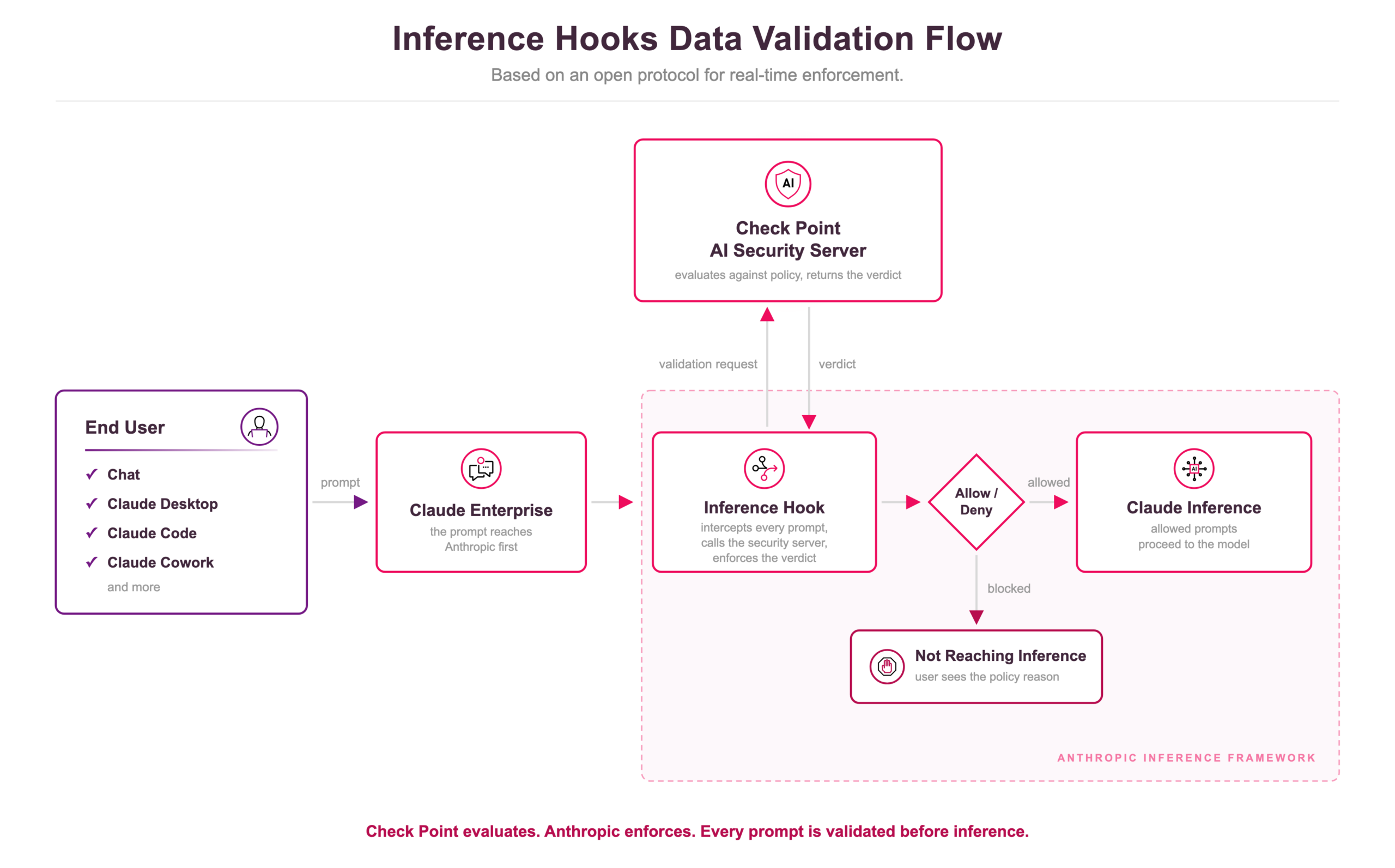
On August 5, Anthropic released inference hooks for Claude Enterprise, now in beta. It is an openly published protocol that lets an external security server evaluate every prompt and tool call before Claude processes it, and return a verdict in real time: allow or deny. A denied request never reaches the model, and the user sees exactly which policy stopped it. We built our integration against the protocol the next day.
Check Point Workforce AI Security connects to inference hooks in a five-minute exchange. Copy your tenant’s hook endpoint URL into your Claude Enterprise settings, paste the signing secret Claude generates back into the portal, done. No proxy, no TLS interception, no endpoint agents. The check runs inside Anthropic’s own infrastructure.
From that moment, every prompt and tool call across Claude on web and desktop, Claude Code, and Claude Cowork is evaluated against the DLP and attack protection rulebase you already enforce on your network and other AI tools. One policy set, everywhere. Every verdict lands in your Events page with the matched rule.
Not ready to enforce on day one? Start in shadow mode: live traffic flows through your policies and verdicts are logged without blocking anyone. Tune the rulebase, then switch to enforcing. Gradual rollout by percentage and role-based exclusions are built in, and you choose whether the integration fails open or closed.
If you already use our Claude Compliance API integration, the two work as a pair. The Compliance API audits what happened; inference hooks stop violations before they happen.
We believe in telling you exactly what a control does. Verdicts are allow or deny; the protocol does not rewrite or redact prompts. Coverage today is prompt-side on Claude Enterprise plans, including tool calls through MCP connectors, skills, and plugins. Model responses, voice conversations, and image-only content are not yet inspected. If coverage expands, your integration inherits it, because there is nothing deployed.
Anthropic’s announcement is more than another API. It signals a shift toward security embedded directly in AI platforms. As AI vendors open native enforcement points, security teams move from reactive monitoring to proactive governance. Check Point Workforce AI Security is ready for that shift today, with one consistent policy across employees, AI applications, and whatever comes next.
Talk to an expert
Put Your Security Policy Inside Claude
Check Point AI Security connects to Claude Enterprise inference hooks in about five minutes: no proxy, no TLS interception, no endpoint agents. Talk to an AI Security expert about enforcing the rulebase you already run on every prompt your employees send.
此内容由惯性聚合(RSS阅读器)自动聚合整理,仅供阅读参考。 原文来自 — 版权归原作者所有。