

惯性聚合 高效追踪和阅读你感兴趣的博客、新闻、科技资讯
阅读原文 在惯性聚合中打开

推荐订阅源

The GitHub Blog
The GitHub Blog
云风的 BLOG
云风的 BLOG
T
Threatpost
WordPress大学
WordPress大学
CTFtime.org: upcoming CTF events
PCI Perspectives
PCI Perspectives
T
The Exploit Database - CXSecurity.com
Y
Y Combinator Blog
雷峰网
雷峰网
爱范儿
爱范儿
The Hacker News
The Hacker News
Last Week in AI
Last Week in AI
Simon Willison's Weblog
T
Tor Project blog
S
Securelist
宝玉的分享
宝玉的分享
L
LangChain Blog
O
OpenAI News
AI
AI
P
Privacy International News Feed
L
LINUX DO - 最新话题
D
DataBreaches.Net
Exploit-DB.com RSS Feed
Attack and Defense Labs
罗磊的独立博客
M
MIT News - Artificial intelligence
Security Archives - TechRepublic
月光博客
月光博客
博客园 - 【当耐特】
T
Tailwind CSS Blog
C
Cybersecurity and Infrastructure Security Agency CISA
H
Help Net Security
freeCodeCamp Programming Tutorials: Python, JavaScript, Git & More
博客园_首页
K
KPMG report finds enterprise disconnect between AI and its ROI | CIO
Hacker News - Newest:
Hacker News - Newest: "LLM"
腾讯CDC
Jina AI
Jina AI
The Last Watchdog
The Last Watchdog
K
Kaspersky official blog
Webroot Blog
Webroot Blog
奇客Solidot–传递最新科技情报
奇客Solidot–传递最新科技情报
Blog — PlanetScale
Blog — PlanetScale
MyScale Blog
MyScale Blog
MongoDB | Blog
MongoDB | Blog
P
Proofpoint News Feed
Recorded Future
Recorded Future
Threat Intelligence Blog | Flashpoint
博客园 - 三生石上(FineUI控件)
The Cloudflare Blog

Check Point Blog

AI Appreciation Day: Let's Be Honest About What We're Appreciating - Check Point Blog AI Security Is Never Finished: Building the Continuous Red Teaming Loop  - Check Point Blog AI Security Threats in 2026: Annual Insights from Check Point Research - Check Point Blog AI Agents are Only As Effective as Their Harness - Check Point Blog Email Agent Hijacking: The Hidden Threat That Breaks Post-Delivery Security - Check Point Blog How Check Point Email Security Stopped a Student Job Scam Before It Reached the Inbox - Check Point Blog Redefining the CISO Contract: From Securing the Business to Securely Doing Business - Check Point Blog A New Ransomware Leader Emerges as June 2026 Attack Volumes Climb Worldwide How Unified Policies Close Security Gaps - Check Point Blog Under Pressure: Insights from the 2026 Exposure Gap Report - Check Point Blog When AI Invents the Attack: Browser-Native Ransomware - Check Point Blog Check Point and the AWS European Sovereign Cloud: Securing Europe’s Digital Future - Check Point Blog Shadow AI Is Not a Tool Problem. It's a Timing Problem. - Check Point Blog AI Is Changing Cyber Careers. NICE 2026 Showed What Students Need Next - Check Point Blog 90% of the World's Businesses are SMEs and MSMEs and AI Is Reshaping Both Their Future and Their Risk - Check Point Blog Prevention Before the Inbox: Reading the Microsoft Defender Benchmark Report in Context - Check Point Blog ClickFix: The Attack That Turns Users Into Their Own Attackers - Check Point Blog From Prompt Testing to AI Red Teaming at Enterprise Scale - Check Point Blog AI Has Moved From Assistance to Action. Is Your Security Model Ready? AI Security Governance: How to Secure AI Agents, Copilots, and Autonomous AI in 2026 - Check Point Blog OpenAI Frontier AI Models Powering Check Point's Leading Cyber Security Solutions The Operational Reality of Zero Trust- And How You Can Change It - Check Point Blog Amazon Prime Day 2026: Bargains Begin June 23 — and So Do the Scams - Check Point Blog Securing AI Agent Behavior with Amazon Bedrock AgentCore and CheckPoint AI Security - Check Point Blog What Successful Exposure Management Deployments Had in Common in 2026 - Check Point Blog From Stars to Upvotes: The Fake Reputation Economy Behind a Crypto Clipboard Hijackers - Check Point Blog AI Red Teaming Makes the Unknowns Known - Check Point Blog Check Point and Illumio Expand Partnership to Secure Hybrid Environments - Check Point Blog The NCSC Patch Wave Is Coming. Do You Know Where Your Risk Lives? - Check Point Blog NCSC Warns of AI-Driven Patch Wave: Is Your Attack Surface Ready? Energy, Healthcare, and Finance: Why Midwest Industries Are Facing Surging Cyber Attacks - Check Point Blog Midwest Cyber Attacks Surge in 2026: Energy, Healthcare, and Finance Under Growing Threat Travel Phishing and Cyber Attacks are Surging in 2026, Growing 122% over the last 3 years. Here's What Cyber Criminals Are Actually Doing - Check Point Blog Travel Phishing Scams Surge 122%: How Cybercriminals Are Targeting Travelers in 2026 The AI Your Security Team Can’t See Is the One You Should Worry About Check Point Engage Public Sector 2026: AI Is the New Battlefield Check Point Joins OpenAI’s Trusted Access for Cyber Program and Daybreak Initiative When Your AI Agent’s Memory Becomes a Security Liability AI Agents Are Becoming Enterprise Workers. Who Secures Them? Global Cyber Attacks Ease in May 2026, But Ransomware Surges 48% As Threats Reorganize Security Advisory – Action Required – Active Exploitation of Check Point VPN Authentication Bypass (CVE-2026-50751) Fraud, Ransomware, and Fake Apps Are Already Targeting FIFA 2026 The AI Defense Plane: Securing the New Enterprise Execution Layer The Meta AI Account Recovery Incident Wasn’t Just a Chatbot Problem Check Point Lays the Groundwork for the Future of AI Factory Security with NVIDIA - Check Point Blog Check ... The 2026 U.S. Midterms Have a Cyber Problem, But it’s Not at the Ballot Box The Server Seizure That Affects Also Iran’s Cyber Operations The Autonomous Security Platform Built for Attacker Speed Check Point Frontier AI Models Readiness Program – Security Update 2026 Cloud Security Report: Why Traditional Network, Cloud, and Security Architecture Are Lagging Behind t ... AI Attacks Are No Longer Experimental: Key Findings from the March-April 2026 AI Threat Landscape - Check ... Protect GenAI Chatbots with Check Point WAF The Network Security Problem No One Could Solve – Until Now. Hacktivists, Ransomware, and a 124% Surge Across DACH The Case for a Vulnerability Operations Center Before the First Whistle: How Cyber Criminals Are Targeting World Cup 2026 - Check Point Blog World Cup 20 ... When the Ransomware Gang Gets Hacked: What the Gentlemen Leak Reveals About Modern Ransomware Risk - Check ... Cyber Threats Spike in April 2026 as Ransomware Expands and Attack Volumes Climb After Short-Lived Moderation Q1 2026 Ransomware Report: Fewer Groups, Higher Impact - Check Point Blog World Password Day 2026: Why "Strong Passwords" Can’t Save You from AI, Infostealers, and the Telegram Underground - Check Point Blog Resilient by Design: When the Network Itself Becomes the Target AI Threat Readiness: Defending Against Attacks Powered by Frontier AI Models Check Point Cyber Security Now Available Across All Levels of U.S. Government - Check Point Blog Check Poi ... VECT Ransomware: Why Paying Won’t Get Your Files Back Check Point WAF Leads Application Security-Validated by Frost & Sullivan Check Point WAF Leads Application ... From Access Control to Outcome Control: Securing AI Agents with Check Point and Google Cloud Experience AI-Powered Check Point Firewall at Google Cloud Next AI Finds Every Gap: How Many Can Your Network Survive? The Gentlemen RaaS Is Surging in 2026 The Phishing Paradox: The World’s Most Trusted Brands Are Cyber Criminals’ Entry Point of Choice World Quantum Day 2026: The Harvest Has Already Begun, Are You Prepared? Why Manufacturing Cyber Security is Becoming More Complex as Cyber Attacks Accelerate March 2026 Cyber Threat Report: Ransomware & GenAI Risk PS Private Training: Turning Cyber Complexity into Operational Control Tax Season 2026: How Cyber Criminals Are Preparing Their Attacks Months in Advance Claude Mythos Wake-Up Call: What AI Vulnerability Discovery Means for Cyber Defense Iran-nexus Password Spray Campaign Targeting Cloud Environments, with a Focus on the Middle East ROI of Hybrid Mesh Network Security (IDC Study 2026) Operation TrueChaos: TrueConf Zero‑Day Supply‑Chain Attack ChatGPT Data Leak (Fixed Feb 2026): Key Takeaways Spring Cleaning Has Arrived: Meet the New Check Point Portal Experience North America’s Cyber Security Threat Reality in 2026
The State of Hybrid SASE: Built-In vs. Bolted-On - Check Point Blog
lizwu@checkpoint.com · 2026-07-17 · via Check Point Blog

Hybrid SASE is not a label – it is an architectural commitment.

Many enterprises pay twice for SASE: once for the platform, and again for the overhead of integrating and managing components never designed to work as one architecture. Check Point’s Hybrid SASE takes a different path: a single operating model that unifies access and policy. That distinction decides whether traffic is secured and routed predictably – or whether teams spend years working around architectural seams.

Take a typical workday. A remote employee connects from a managed laptop, a branch office user accesses a private application, and a contractor opens a corporate app from an unmanaged device. If each path depends on a different product, policy model, console, or tunnel architecture, “hybrid” becomes another integration project. Hybrid-by-design SASE avoids that trap by applying one operating model across users, devices, branches, applications, gateways, and private connectivity.

This is where the difference between hybrid as a deployment option and hybrid as an architectural principle becomes clear.

The Hybrid SASE Confusion

For many vendors, “Hybrid SASE” means little more than supporting cloud gateways for some users and on-premises appliances for others. That definition treats hybrid as a connectivity option, not an architectural principle. A more useful way to assess maturity is across three tiers:

  • Hybrid in Name Only: Multiple user types are supported, but policies are siloed, visibility inconsistent, and management differs by environment.
  • Hybrid by Integration: Components work together via connectors, synchronization workflows, and traffic-steering rules. Coverage improves; complexity does not.
  • Hybrid by Design: Networking and security operate across the SASE Agent, Cloud Edge Gateways, Private Access, Internet Access, and private connectivity (private network transport across the backbone between configured regions). Enforcement roles are explicit, and a unified operating model spans users, devices, branches, applications, networks, gateways, tunnels, policies, and security

The third model treats networking and security as one architecture, not a collection of integrated components.

When vendors retrofit cloud or mesh capabilities onto an existing architecture, whether it began as a pure-cloud proxy, a hub-and-spoke appliance stack, or an SD-WAN-first overlay, the result often inherits constraints:
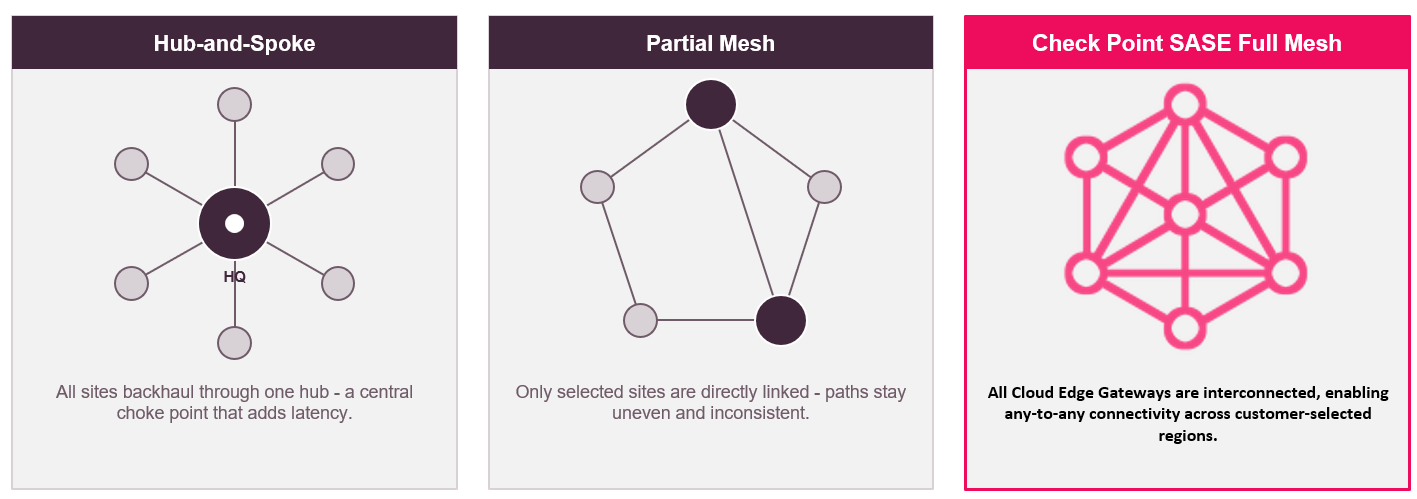
  • Hub-and-spoke bias that adds latency and operational dependency on central inspection points
  • Partial mesh that optimizes only selected paths instead of consistently connecting configured regions
  • Greater dependence on the public internet, with more exposure to jitter, packet loss, and routing variability
  • Operational friction as users, branches, and clouds scale

Check Point SASE Full Mesh: A customer-selected region, backed by the global PoP footprint, hosts Cloud Edge Gateways that terminate tunnels, enforce Private Access, and route traffic over policy-authorized backbone paths between entry and destination regions.

Check Point’s Hybrid SASE: Built for Scale and Simplicity

Check Point SASE takes a hybrid-by-design approach supporting secure access for remote and branch office users to private applications, SaaS, and the internet through unified SASE architecture.

Three foundational capabilities characterize the platform:

  1. Full mesh private connectivity across a global footprint: Check Point SASE operates across a global infrastructure footprint of 85+ Points of Presence, which provide network presence and backbone connectivity for customer-selected regions. The SASE backbone interconnects this infrastructure, so private traffic travels between configured regions across the backbone instead of the public internet. Unlike platforms where full-mesh capabilities may depend on added tiers or separate architecture choices, this connectivity is part of the core platform design.
  2. Distributed security enforcement: The SASE Agent enforces Internet Access controls and malware protection on the endpoint. Cloud Edge Gateways enforce identity-based Private Access, Check Point’s ZTNA capability for private applications, along with firewall policy, DNS filtering, routing, tunnels, and threat prevention powered by ThreatCloud AI. For unmanaged and BYOD devices, Check Point Enterprise Browser extends the same protection without a persistent agent, running corporate sessions in an isolated, Chromium-based workspace that is wiped at session end.
  3. Unified operations: A single policy engine and console span managed and unmanaged access, on-device enforcement, Cloud Edge Gateways, private connectivity, tunnels, monitoring, and security events. Policies are defined once and enforced everywhere, so teams no longer maintain separate rule bases or consoles per environment. Logs and events land in one place, giving security and network teams a consistent view across users, branches, applications, and traffic flows, with a single audit trail for investigations.

Why this matters for performance: Users connect to the nearest PoP rather than backhauling to a central site, and private traffic travels Check Point’s private backbone along the most efficient path instead of the public internet. The platform continuously monitors latency, jitter, and packet loss. Built-in redundancy, autoscaling, and high-availability tunnels mean no single point of failure, for a more predictable experience and a simpler operating model.

Why this matters for security: Because enforcement happens where it is most effective, on the endpoint via the SASE Agent and at Cloud Edge Gateways (rather than being funneled through a single choke point), security scales with the architecture instead of fighting it. That prevention-first design is confirmed by independent testing: the 2026 Miercom Hybrid Mesh Network Security Benchmark ranked Check Point No. 1 for the fourth consecutive year, with 99.8% overall security effectiveness, 99.9% malware prevention, 100% phishing protection, and 99.9% protection against known exploited vulnerabilities.

Read the full report here: 2026 Miercom Hybrid Mesh Network Security Benchmark

Hybrid SD-WAN, Without the Bolt-On

Branches connect via secure tunnel to selected Check Point SASE regions and tenant Cloud Edge Gateways. Policy determines whether private, SaaS, or internet traffic is routed through Check Point SASE, while existing SD-WAN can continue to handle underlay path selection. Check Point SASE recognizes more than 10,000 applications for routing and policy decisions, with automated steering and link failover. For traffic routed through the SASE architecture, security controls and private connectivity can apply based on policy, topology, and configuration. This allows organizations to modernize branch access without treating SD-WAN and SASE as disconnected architectures.

The Economics of Built-In

A full mesh, hybrid-by-design SASE architecture can reduce operational complexity and may reduce network and cloud connectivity costs by:

  • Reducing unnecessary VPN backhaul
  • Reducing dependency on centralized inspection hubs
  • Reducing reliance on some dedicated cloud-connectivity patterns where Check Point SASE private connectivity meets the organization’s performance, security, and data residency requirements
  • Managing Private Access, Internet Access, DNS Security, firewall policy, threat prevention, users, devices, networks, gateways, tunnels, and security events through one unified SASE operating model

Actual savings depend on topology, traffic mix, data residency needs, configuration, and existing contracts. The point is architectural: when full mesh private connectivity and unified security are built into the platform, customers do not need to assemble multiple components to achieve one operating model.

Architecture vs. Features

Real Hybrid SASE requires networking and security to operate consistently across users, devices, branches, applications, networks, and cloud resources. Check Point SASE delivers this through one operating model – Private Access, Internet Access, SASE Agent enforcement, Cloud Edge Gateways, private connectivity, branch integration, policy controls, threat prevention, monitoring, and security events. That is what separates built-in Hybrid SASE from bolted-on approaches: consistent policy and unified operations by design.