












Sign up to see the future, today
Can’t-miss innovations from the bleeding edge of science and tech
Researchers at Caltech are gearing up to begin construction on what could become the most sensitive and fastest radio telescope array ever built.
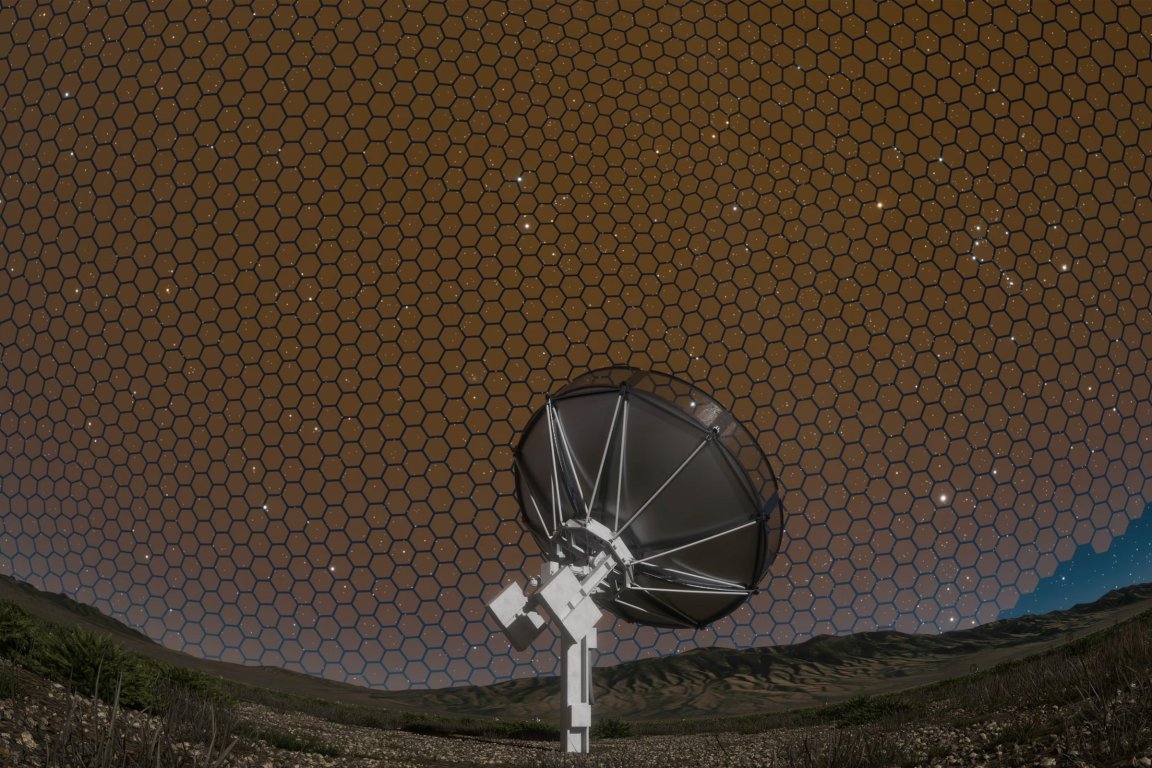
The ambitions are staggeringly vast. Once completed in 2029, the Deep Synoptic Array (DSA) will feature a whopping 1,650 radio dishes, each measuring just shy of 20 feet across, spanning an area of 12 by 10 miles in a remote Nevada desert valley.
To put those numbers into perspective, New Mexico’s Very Large Array, one of the largest radio telescopes, is made up of just 27 radio dishes.
Arrays made up of large numbers of dishes have a key advantage: they can dramatically improve the spatial resolution of deep space observations by effectively acting as one enormous instrument. However, one drawback is that they are far less sensitive to light than one giant dish, making them only suitable for luminous astronomical objects, like pulsars, the highly magnetized remains of dead stars, and fast radio bursts, brief flashes of powerful radio waves.
To reduce the chance of radio frequency interference — unwanted external electromagnetic signals or “noise” that have plagued astronomers for decades — the team chose an extremely remote part of the Nevada desert, not far from Great Basin National Park.
Scientists behind the DSA promise that the new array will improve on the sensitivity of existing radio telescope arrays while dramatically speeding up the process of scanning wide swathes of the night sky.
“The DSA will survey the entire visible sky several times in its first five years at unprecedented speeds,” said Caltech astronomy professor and DSA principal investigator Gregg Hallinan in a statement. “While all other radio telescopes combined have so far found about 20 million radio sources, the DSA will match that in the first day of operations.”
“By the end of its initial survey, it will have discovered about 1 billion new radio sources,” he added.
Researchers are hoping to use the array to study mysterious and little-understood phenomena like fast radio bursts, as well as much broader concepts, like how dark energy influences the expansion of the universe.
“Radio astronomy is about to go from sketch to photograph,” said DSA co-principal investigator and Caltech astronomy professor Vikram Ravi in the statement.
The speed of the DSA also offers a key advantage: it will give astronomers access to data in near-real-time, allowing them to start processing it almost immediately. Best of all, the public will have unfettered access from the get go.
“We want the whole world to also have access to the data just as quickly as we do,” DSA lead project manager Katie Jameson explained. “The DSA functions like a photo lab that is developing these radio images in real time for all to use.”
To keep costs down, Caltech researchers turned to a highly unusual manufacturing partner: cake pan maker Fat Daddio’s. The team contracted the company to produce thousands of baking pans — which turned out to be the perfect shape to help convert electromagnetic waves to electrical signals.
“It’s all about metal fabrication, and this is something Fat Daddio’s has a lot of experience in!” DSA lead project engineer Francois Kapp explained.
More on radio telescopes: Scientists Release Results After Scanning 3I/ATLAS for Alien Signals