
惯性聚合 高效追踪和阅读你感兴趣的博客、新闻、科技资讯
阅读原文 在惯性聚合中打开

推荐订阅源

雷峰网
雷峰网
奇客Solidot–传递最新科技情报
奇客Solidot–传递最新科技情报
博客园 - 三生石上(FineUI控件)
博客园 - 聂微东
OSCHINA 社区最新新闻
OSCHINA 社区最新新闻
Hugging Face - Blog
Hugging Face - Blog
Apple Machine Learning Research
博客园 - Franky
MyScale Blog
MyScale Blog
A
About on SuperTechFans
博客园_首页
B
Blog RSS Feed
Martin Fowler
Martin Fowler
大猫的无限游戏
大猫的无限游戏
Cyber Security Advisories - MS-ISAC
Vercel News
Vercel News
C
Check Point Blog
H
Hackread – Cybersecurity News, Data Breaches, AI and More
博客园 - 【当耐特】
M
MIT News - Artificial intelligence
宝玉的分享
宝玉的分享
T
Tailwind CSS Blog
I
InfoQ
罗磊的独立博客

Futurism

Earth May Have Had a Larger Cousin that the Sun Devoured Scientists Baffled by Bizarre "Anomaly" Deep Beneath the Surface of Mars NASA's Powerful New Space Telescope, Just Cleared for Launch, Was Developed by an Intelligence Agency to "Spy on America's Adversaries" Scientists Warn That New Satellites Could Cause Eye Damage for People on the Ground SpaceX Achieves Its First Moon Landing by Accidentally Crashing Into It at 5,400 Miles Per Hour, Causing Huge Explosion and 60-Foot Crater NASA Mars Rover Discovers Field of Mesmerizing Polygons Scientists Discover Massive Alien "Exosatellite" Astronomers Thrilled After Discovering Best Spot Yet to Look for Alien Life You'll Never Guess What Tasty Molecule Astronomers Just Detected In Space Astronomers Horrified by Enormous Mirror Satellite That Reflects Sunlight Back Down to Earth at Night Scientists Say They've Identified an Earth-Like Planet Right Next Door NASA Prepping to Launch Extremely Risky Rescue Mission NASA Has a Major Problem Threatening Its Entire Moon Plans NASA Rover Finds "Complex Organic Matter" on Mars Saturn's Icy Moon Is the Perfect Place to Settle, NASA Scientist Argues Scientists Building World's Most Powerful Radio Telescope Deep in the Nevada Desert NASA Loads Moon Rocket onto Giant Trump-Branded Train NASA’s Next Moon Mission Is a Rube Goldberg Machine of Corporate Failure Points Scientists Release Results After Scanning 3I/ATLAS for Alien Signals Catholic Church Boots Exorcist After He Said UFOs Are Demons NASA’s James Webb Discovers That 3I/ATLAS Let One Rip as It Passed Through Solar System Scientists Find Chunk of Lost Planet in Desert Paper Claims the “Asteroid” Japan’s Probe Is Approaching Is Actually a Derelict Spacecraft Scientists Say They’ve Cracked Mystery Behind a Dozen Strange Signals From Deep Space Scientists Say They’ve Found Fungi That Turn Dead Martian Soil Into Fertile Cropland The Blue Moon Is Fake. You Are Being Deceived Jeff Bezos’ Rocket Explodes Into Mushroom Cloud, Dealing Massive Blow to NASA’s Moon Plans NASA Releases Sweeping Plans for Moon Base SpaceX Announces Plans to Put Billionaire on First Rocket to Mars James Webb Spots Strange Structure at Core of Distant Galaxy
Scientists Detect Weird Anomalies in Clouds of Venus
Frank Landymore · 2026-05-17 · via Futurism

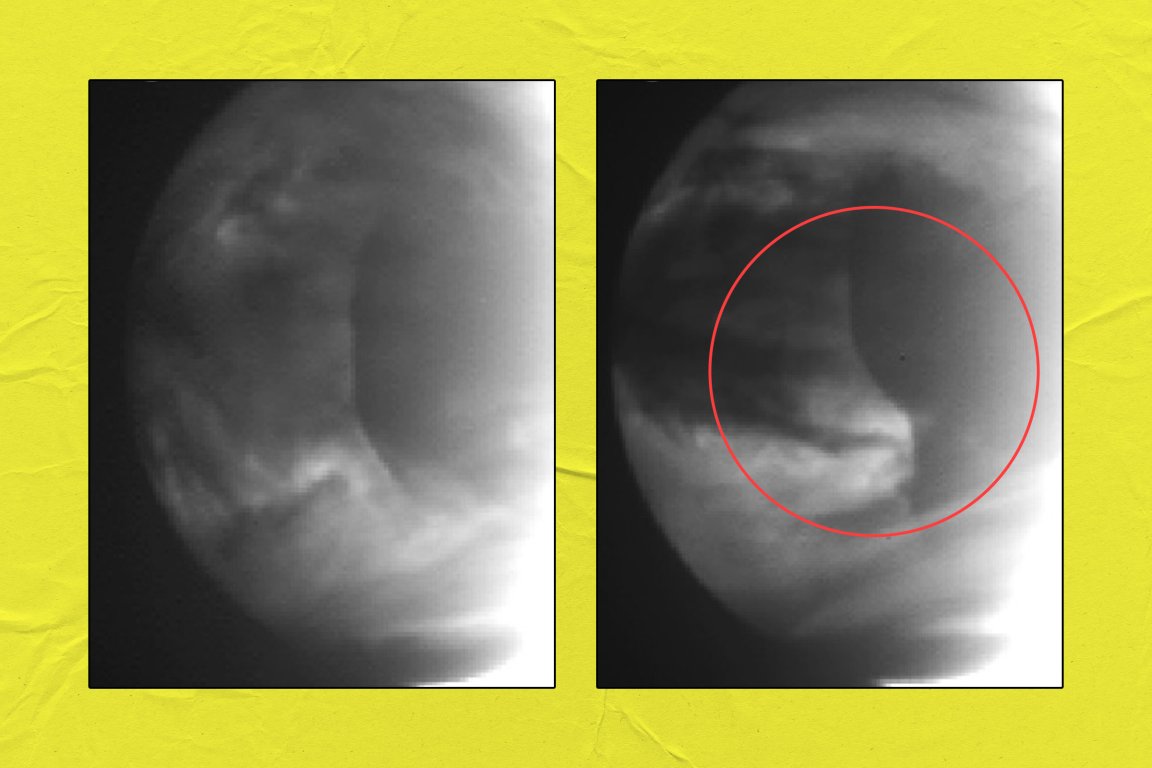
Two black-and-white images of a planet with a crescent shape, showing cloud formations. The right image has a red circle highlighting a specific area on the planet's surface. The background is yellow.

Imamura et al.

Sign up to see the future, today

Can’t-miss innovations from the bleeding edge of science and tech

Mysteries abound on our planetary neighbor Venus, not least of all because it’s permanently shrouded in a thick and nigh-impenetrable layer of clouds.

But when the Japanese Aerospace Exploration Agency’s Akatsuki space probe visited the steaming hot world in 2016, it managed to spot something anomalous in the atmospheric veil obscuring the planet’s inscrutable surface: an enormous wave tearing through the atmosphere for days at a time, creating a cloud that stretched up to 3,700 miles across. What possibly could’ve been responsible for this monstrosity was unclear.

Now, astronomers have an answer about what they glimpsed. In a new study published in Journal of Geophysical Research: Planets, a team led by researchers from the University of Tokyo suggest that the atmospheric behemoth was spawned by turmoil in a lower cloud layer, in a phenomenon known as a “hydraulic jump” that burst to the surface.

“We identified the phenomena, but for years we couldn’t understand it,” said lead author Takeshi Imamura at the University of Tokyo in a statement about the work. “However, thanks to this research, we’re now able to show that this cloud disruption is caused by the largest known hydraulic jump in the solar system.”

The Venusian atmosphere is primarily made of carbon dioxide, creating an extreme greenhouse effect that’s responsible for the planet’s hellish temperatures. Within this atmosphere are three distinct cloud layers. The clouds are composed of sulfuric acid, and their sheer celerity puts them in a class above Earth’s. Unlike the ponderous, floating balls of cotton we associate with clouds on our planet, Venus’ “superrotate,” meaning they swirl around the planet 60 times faster than the planet itself turns. To astronomers, Venus’s persistent and extreme clouds provide a way of probing fleeting atmospheric phenomena on Earth.

But even by Venus’s standards, a giant acid cloud bank thousands of miles across was extreme. Enter hydraulic jumps: you can see phenomenon in the kitchen sink, when water from the tap hits the basin and appears shallow but spreads quickly, then slows and rises in depth.

Now blow that up to a planetary scale. On Venus, an atmospheric wave in its lower cloud layers can abruptly destabilize and slow down as a result, the team found. This creates a powerful updraft that blasts sulfuric acid vapor into the topmost layer, where it condenses into a massive but lumbering cloud bank which moves slower than its surroundings, creating a distinct wave front. The astronomers say it’s the first example of a hydraulic jump seen on another planet.

“Venus has three distinct cloud layers, and the dynamics of the lower and middle layers are not so well understood,” Imamura said in the statement. “Our discovery of a hydraulic jump on Venus connecting a very large-scale horizontal process with a strong localized vertical wave is unexpected, as in fluid dynamics these are usually disconnected.”

More on space: Scientists Spot Huge Cave on Venus