
惯性聚合 高效追踪和阅读你感兴趣的博客、新闻、科技资讯
阅读原文 在惯性聚合中打开

推荐订阅源

H
Help Net Security
宝玉的分享
宝玉的分享
The Cloudflare Blog
Apple Machine Learning Research
V
Visual Studio Blog
Last Week in AI
Last Week in AI
Hugging Face - Blog
Hugging Face - Blog
博客园 - 司徒正美
博客园 - 三生石上(FineUI控件)
A
About on SuperTechFans
MyScale Blog
MyScale Blog
aimingoo的专栏
aimingoo的专栏
Microsoft Security Blog
D
Docker
Cyber Security Advisories - MS-ISAC
Recent Announcements
大猫的无限游戏
大猫的无限游戏
IT之家
IT之家
P
Proofpoint News Feed
L
LangChain Blog
Blog — PlanetScale
Blog — PlanetScale
The GitHub Blog
The GitHub Blog
博客园 - 【当耐特】
Martin Fowler
Martin Fowler

Futurism

Earth May Have Had a Larger Cousin that the Sun Devoured Scientists Baffled by Bizarre "Anomaly" Deep Beneath the Surface of Mars NASA's Powerful New Space Telescope, Just Cleared for Launch, Was Developed by an Intelligence Agency to "Spy on America's Adversaries" Scientists Warn That New Satellites Could Cause Eye Damage for People on the Ground SpaceX Achieves Its First Moon Landing by Accidentally Crashing Into It at 5,400 Miles Per Hour, Causing Huge Explosion and 60-Foot Crater Scientists Discover Massive Alien "Exosatellite" Astronomers Thrilled After Discovering Best Spot Yet to Look for Alien Life You'll Never Guess What Tasty Molecule Astronomers Just Detected In Space Astronomers Horrified by Enormous Mirror Satellite That Reflects Sunlight Back Down to Earth at Night Scientists Say They've Identified an Earth-Like Planet Right Next Door NASA Prepping to Launch Extremely Risky Rescue Mission NASA Has a Major Problem Threatening Its Entire Moon Plans NASA Rover Finds "Complex Organic Matter" on Mars Saturn's Icy Moon Is the Perfect Place to Settle, NASA Scientist Argues Scientists Building World's Most Powerful Radio Telescope Deep in the Nevada Desert NASA Loads Moon Rocket onto Giant Trump-Branded Train NASA’s Next Moon Mission Is a Rube Goldberg Machine of Corporate Failure Points Scientists Release Results After Scanning 3I/ATLAS for Alien Signals Catholic Church Boots Exorcist After He Said UFOs Are Demons NASA’s James Webb Discovers That 3I/ATLAS Let One Rip as It Passed Through Solar System Scientists Find Chunk of Lost Planet in Desert Paper Claims the “Asteroid” Japan’s Probe Is Approaching Is Actually a Derelict Spacecraft Scientists Say They’ve Cracked Mystery Behind a Dozen Strange Signals From Deep Space Scientists Say They’ve Found Fungi That Turn Dead Martian Soil Into Fertile Cropland The Blue Moon Is Fake. You Are Being Deceived Jeff Bezos’ Rocket Explodes Into Mushroom Cloud, Dealing Massive Blow to NASA’s Moon Plans NASA Releases Sweeping Plans for Moon Base SpaceX Announces Plans to Put Billionaire on First Rocket to Mars James Webb Spots Strange Structure at Core of Distant Galaxy Scientists Detect Weird Anomalies in Clouds of Venus
NASA Mars Rover Discovers Field of Mesmerizing Polygons
Frank Landymore · 2026-07-31 · via Futurism

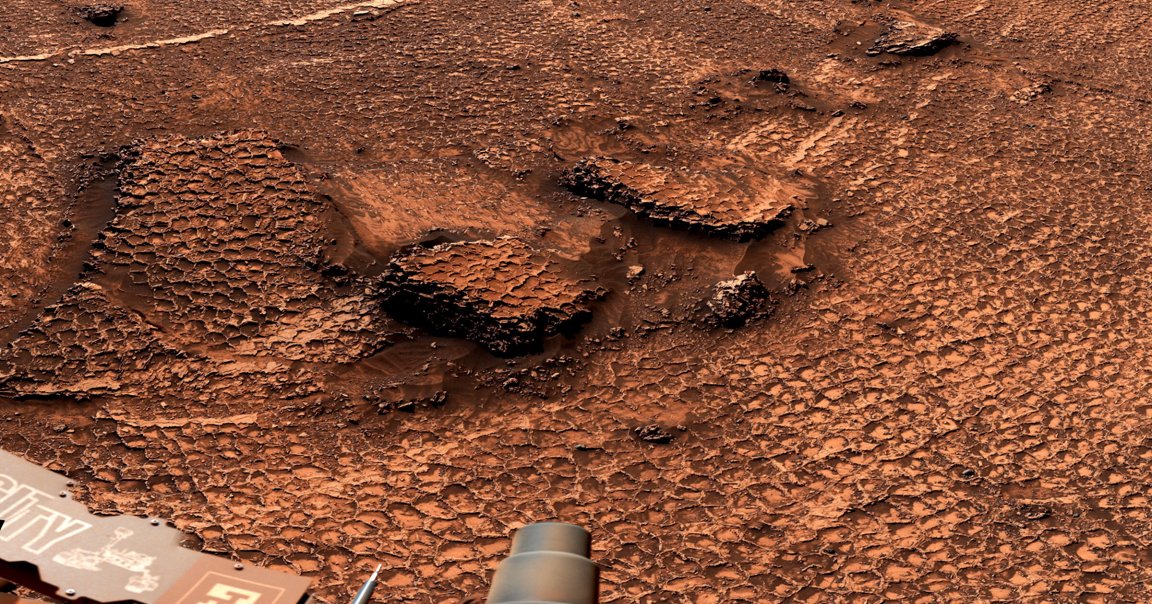
A 360-degree view of an expanse of Martian terrain covered in surface features called polygons, taken by NASA's Curiosity Mars rover.

NASA

Sign up to see the future, today

Can’t-miss innovations from the bleeding edge of science and tech

A vast field of mesmerizing polygons has left Mars scientists enthralled.

Don’t be mistaken: NASA didn’t send a robot across the solar system so its eggheads could get a rundown in basic geometry. Instead, the Curiosity rover stumbled upon a stretch of the Martian valley called “Valle Grande” where the landscape is defined by honeycomb-shaped patterns ranging two to four inches in diameter.

These so-called “polygonal fractures” have been spotted elsewhere on the Red Planet, but never texturing an entire landscape at such a scale.

“We’ve seen a lot of fascinating landscapes through Curiosity’s eyes, but this sea of polygons took our breath away,” project scientist Ashwin Vasavada at NASA’s Jet Propulsion Laboratory said in a statement. “We measured their shapes and chemistry carefully and are hopeful there are clues in the data as to how these features formed.”

Curiosity has delivered a new 360-degree panorama from Mars. “We’ve seen a lot of fascinating landscapes through Curiosity’s eyes, but this sea of polygons took our breath away,” said the mission’s project scientist. 1/2 pic.twitter.com/G7sV6Xafkq

— NASA Mars (@NASAMars) July 29, 2026

The Curiosity rover stumbled on the polygon field while ascending the foothills of a three-mile-high mountain called Mount Sharp, where it’s been roaming since 2014. Captured with its Mastcam instrument, a panorama composed of 340 images taken back on June 19 show the hexagons dominating a huge stretch of the landscape. 

On Mars, polygonal textures are generally mud cracks. What created them hints at the planet’s fascinating geological history: the honeycombs can form as a result of water drying up and causing sediments to shrink, or they can be carved out by extreme temperature swings. By studying these features, scientists hope to piece together how flowing water once helped shape the Red Planet’s surface.

More on Mars: NASA Rover Finds “Complex Organic Matter” on Mars