




Sign up to see the future, today
Can’t-miss innovations from the bleeding edge of science and tech
Scientists have discovered a puzzling object in a distant star system that defies classification.
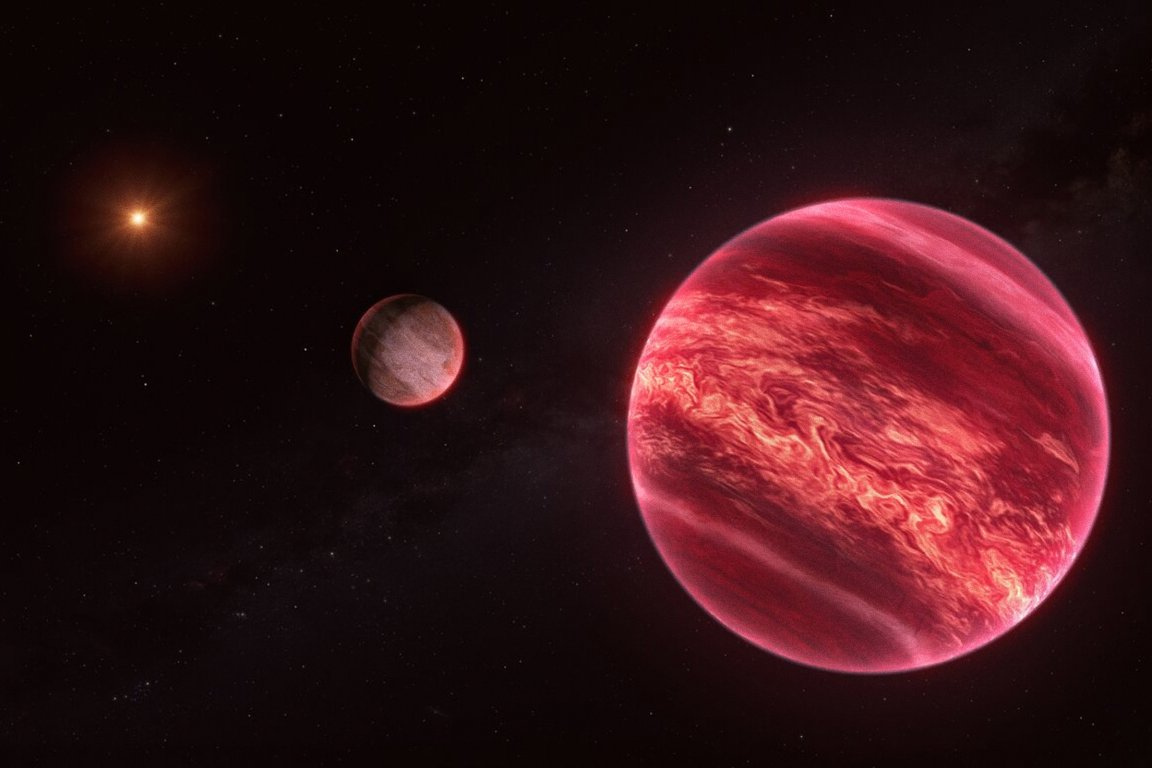
Hear us out. The object in question orbits a brown dwarf. A brown dwarf is a substellar type of object that larger than a gas giant but smaller than the smallest stars. And this brown dwarf, in turn, orbits the system’s main star.
Since the newly-identified object doesn’t orbit a planet, it technically isn’t a “moon” by any normal definition, but it’s not clearly a planet either, making its classification elusive.
“This system is somewhat hard to define using Solar-System-based words like ‘planet’ and ‘moon,'” said European Southern Observatory (ESO) student Kevin Hoy, lead author of a new study published in the journal Nature, in a statement.
“More than 6,000 exoplanets being discovered, no exomoon has ever been confidently detected,” Hoy and his colleagues noted in the paper. “Although there are candidates, they lack confirmation and remain controversial.”
“This is the first time, to our knowledge, this technique has produced evidence of satellites around a companion brown dwarf,” the paper continues.
The system’s main star, CD-35 2722, is roughly half the mass of our Sun and is located around 72 light-years from our solar system.
Hoy and his colleagues are now trying to come up with a new label for the strange object. One moniker that has stuck is “exosatellite,” an object with at least the mass of Jupiter, while the brown dwarf has more than 30 times the mass of the gas giant.
“The exosatellite is clearly massive enough to be a planet, but it does not orbit a star, though it orbits an object that orbits a star,” Hoy explained in the statement. “Being the third wheel in this system makes us want to call it a moon, even if it is nothing like the small, rocky moons we have in our system.”
“We have a clear delineation between the planets and the Sun in the Solar System, so defining things like moons is simple,” added the paper’s coauthor and Universidad Diego Portales professor Alice Zurlo. “In the CD-35 2722 system, where we are blurring the lines between stars, planets, and moons, the whole thing becomes more complicated to describe.”
The team used the ESO’s Very Large Telescope (VLT) to observe tiny wobbles in the brown dwarf’s orbit caused by the presence of the mysterious object in its vicinity.
The discovery is striking up a heated debate over what we define a “moon.” As Sky and Telesecope notes, there currently is no official definition set by the International Astronomical Union.
And not everybody agrees with the researchers’ new “exosatellite” nickname.
“I would definitely not call it an exomoon or exosatellite,” University of Cambridge astrophysics professor Roman Rafikov, who was not involved in the research, told Sky and Telescope, adding that similar arragements have already been identified.
“I don’t think there is any ambiguity here,” he added. “I call the star–brown dwarf system a ‘binary,’ and the new object a ‘planet’ around one of the binary components.”
“I strongly believe the newly found object is the failed core of a star, and to me the entire system is only a system of three substellar bodies,” added University of Hawai’i astronomer Nader Haghighipour, who was also not involved. “The Jupiter-mass body is not a satellite.”
More on exoplanets: Astronomers Thrilled After Discovering Best Spot Yet to Look for Alien Life