



Jeff Dean and Sanjay Ghemawat are leaving Google after more than a quarter-century, as you know. Outside the industry, the pair may not be well-known, but theirs was “the friendship that made Google huge.” Jeff and Sanjay are the reason why billions of us have been able to use Google over the past 20 years. Their work on distributed systems, in particular, is why the search engine could handle decades of growth. “Sanjay and I sped up Google Search by 10% today,” Dean once told his daughter.
They weren’t alone. DeepMind’s founder and Nobel Laureate Demis Hassabis also wanted to leave the company, according to well-grounded reports. He was persuaded to stay in a chair role for the sake of the share price. Koray Kavukcuoglu, an executive more closely associated with product delivery and commercial integration, will run the organization.
Losing your very best talent in a short span, both homegrown in the case of Dean and Ghemawat, and acquired in the case of Hassabis, looks like bad news. Superstars like to be on the winning team, after all.
This is what the market believed, and Alphabet’s share price dropped 4% in a day.
But in our view, this is as much a signal about capital and compute allocation as it is about talent.
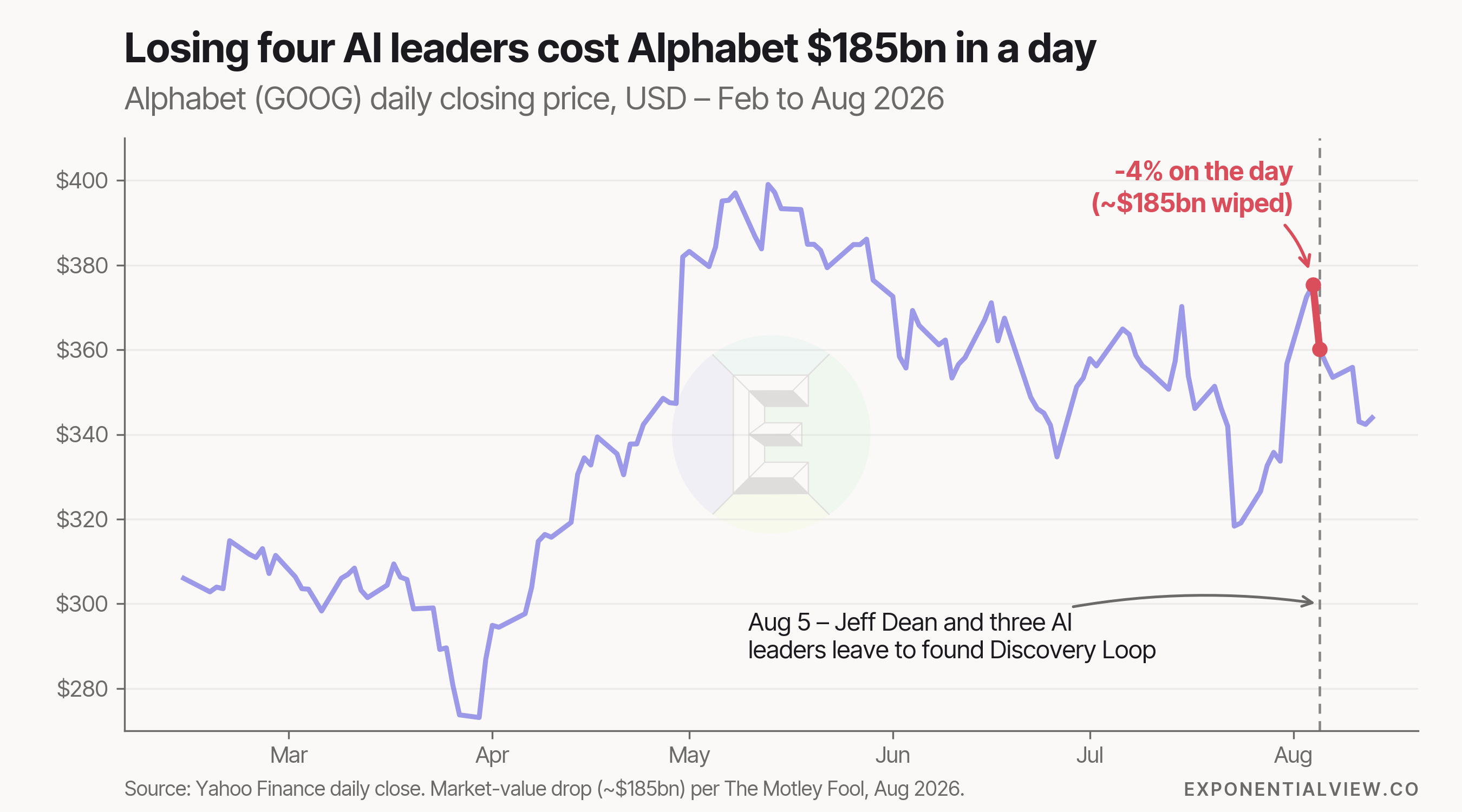
That matters because Alphabet is not an ordinary incumbent. Google built the most formidable system in corporate history for stewarding uncertain ideas from the demands of its cash-generating core. Think of 20% time; it’s moonshot factory, X; the Alphabet corporate structure; and an extraordinary appetite to acquire.
If even Google now allows the engineers who built its very foundations to leave, something about the way it allocates capital has changed. The question is what. Are researchers leaving Alphabet because they lost faith in the firm’s AI prospects? Or because every TPU can earn such an attractive return serving today’s bread-and-butter models that open-ended research fails to clear the hurdle?
These imply opposite positions in the AI capital cycle.
Below, we identify how Google’s compute has moved, examine what demand for old chips reveals about the economic lives of AI chips, and identify the four signals that would tell us the infrastructure cycle has finally turned.
Markets viewed these departures as a crisis. We think they tell us more about the capital-compute axis.
The full essay includes seven charts showing:
How Google’s latest models fare on the Pareto frontier
How it has shifted compute away from research
What Google Cloud’s growth and economics reveal about infrastructure demand.
Where we are in the AI infrastructure cycle… and the four signals that would tell us it has finally turned.
Upgrade to continue reading.
此内容由惯性聚合(RSS阅读器)自动聚合整理,仅供阅读参考。 原文来自 — 版权归原作者所有。