









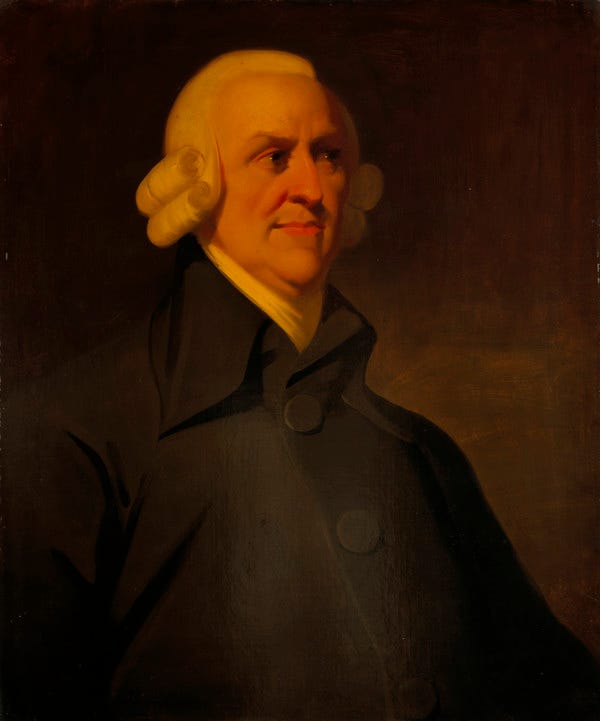
Adam Smith is one of our greatest philosophers. His adoption by the market-oriented right has narrowed how we see him. He was, first and foremost, a moral philosopher. His first major work, The Theory of Moral Sentiments, explored how moral judgment emerges from living with others. It gives rise to our capacity for sympathy, our desire for approval, and our ability to examine ourselves through someone else’s eyes. Self-interest is part of human nature, but so too is concern for others.
This foundational notion of cooperation underpins his most famous work, The Wealth of Nations. Here, Smith examined how our efforts to increase specialization and exchange could generate increasing prosperity almost from nothing. It could be positive-sum; one person’s gain need not be another’s loss. This idea that wealth could grow from within society by people developing their skills, improving their technologies, and organizing themselves better was radical.
I was in Edinburgh, where Smith spent his final 12 years, this week, as chaos over AI erupted in the public sphere. My wife asked me, “How would Adam Smith have made sense of AI?” I reckoned he’d love the technology as a productivity tool; he’d be skeptical about companies working together on any issue; and he’d be concerned about giving moral agency to machines.
As I thought this through at the airport, I figured I could go one better. So I configured R Adam Smith, an Astra-based persona loaded up with his work and the recent AI debates of risk and pacing. Below you’ll see the back-and-forth between us. It’s a digital simulacrum of a long-past thinker but deeply illuminating nonetheless.
Azeem
Note: This post may register as AI-written – I am sharing R Adam Smith’s responses below without any alterations.
R Adam Smith: Potentially. Though your machine may go beyond my pin factory. There, a workman became more productive by confining himself to a narrower task. Yours appears to make one man more productive by granting him access to many specialties at once.
I praised the machines that “facilitate and abridge labor, and enable one man to do the work of many.” (Wealth of Nations, I.i)
If your artisan may now obtain assistance with his design, his accounts, his correspondence and his selling, he may undertake enterprises formerly beyond his means. The consequence would be not only greater production, but a greater number of persons able to become producers at all.
Yet I would measure the achievement by the abundance it brings into ordinary households. Does it make useful things cheaper? Does it open trades to newcomers? Does a laborer’s wage purchase more conveniences than before?
Show me those effects, and you have shown me an improvement deserving of considerable enthusiasm.
R Adam Smith: Their fears may be sincere. Sincerity does not abolish self-interest.
此内容由惯性聚合(RSS阅读器)自动聚合整理,仅供阅读参考。 原文来自 — 版权归原作者所有。