




There are decades when nothing happens. This week, I am allowing myself that cliché. I believe we’ll look back on the week of 6th September as the moment we felt the curve of AI turn upwards and strain many of our previously held assumptions. It’s like when we entered March 2020 with only a couple of countries in lockdown, and left the month with more than a hundred.
But so much happened, pulling in so many directions, it is utter chaos. Here is what I thought was most important and how I’m making sense of it.
I spoke to 250 IT executives in Las Vegas last week, and I asked my usual question: “How many of you have serious, meaningful results from your AI initiatives?” A year ago, a room like this would have had a quarter of the hands go up. This year, nearly every single hand went up; I estimate some 95%. Every one of them plans to spend more next year than they have this year. And amongst these firms was a panoply of experiences, from the century-old American institution that had shifted entirely to open-weight models to the hospital using a mix of OpenAI and Anthropic models.
It’s a qualitative signal, and perhaps it’s no surprise that our latest revenue numbers show AI revenue grew faster in August than in July, and faster in July than in June.
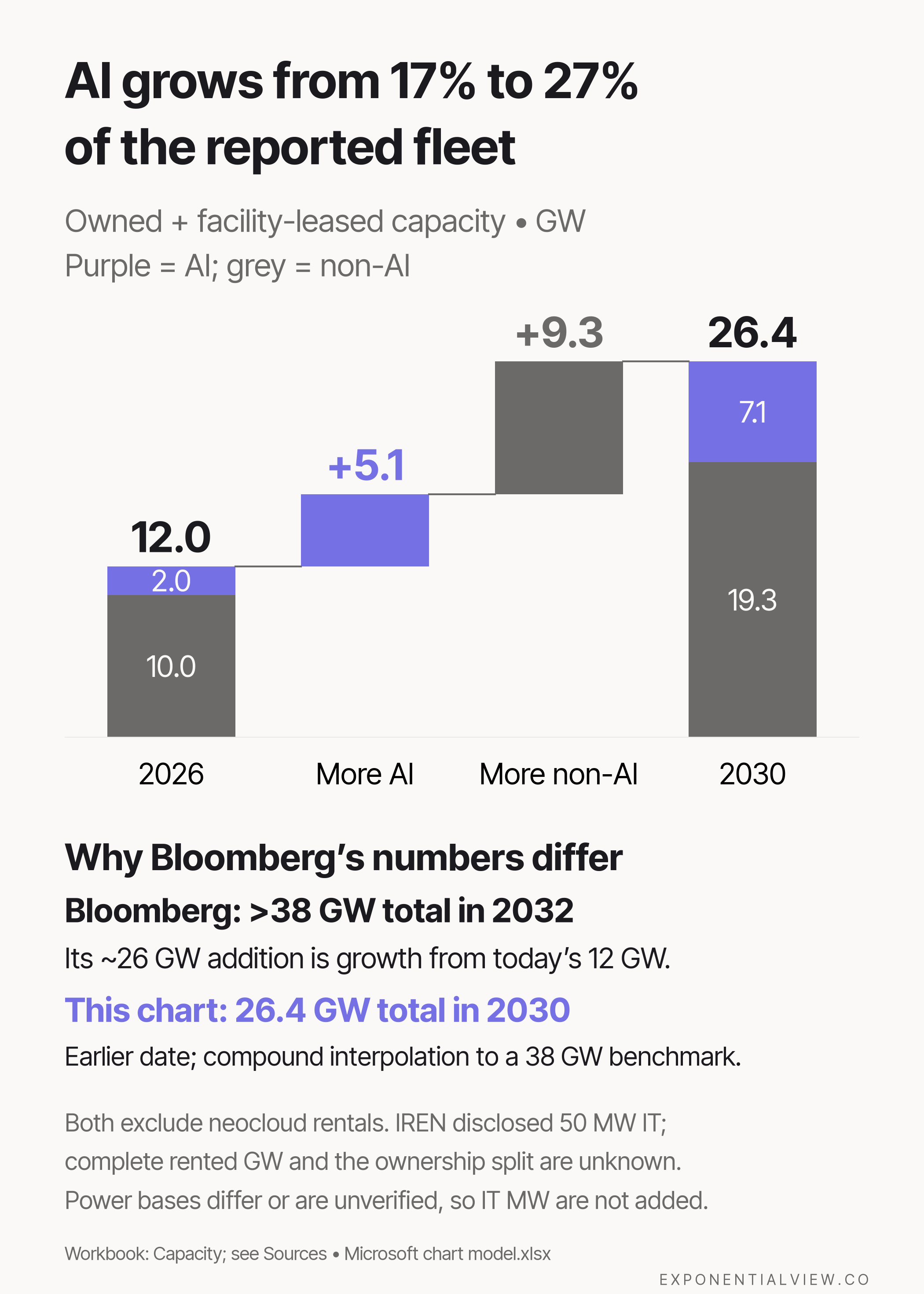
I’m not the only one to see an avalanche of customers. Bloomberg reports that Microsoft made plans to increase its capacity to serve AI from about 2 GW today to nearly 13 GW by 2032 – part of a fleet going from 12 GW to 38 GW. That 26 GW of new capacity would imply they expect demand they currently cannot serve.
Anthropic released a helpful set of scenarios for what further AI adoption might mean for the economy. Our own models land closer to Anthropic’s “substantial scenario,” where AI adds about 8.3% to US GDP by 2030, so its impact is initially slightly lower than the Internet’s at its peak before picking up rapidly. There is a shift of growth away from labor to capital, the modern Engels’ Pause and a rise in unemployment, mostly concentrated around knowledge workers.
Anthropic’s model lets you play around with either end of the distribution, from an AI wave that falls flat to one that takes off like a rocket. Their extreme scenario sees GDP rising by an additional 32.4% while unemployment doubles.
The reason why I don’t expect the extreme scenarios is, basically, reality. Even in a world that is speeding up, it takes time to make changes inside a firm, let alone across an economy. You also need to consider reflexivity: benchmark AI performance isn’t the only thing that drives outcomes in the world.1 The faster unemployment grows, the more political pressure will come to bear. This has enough outlets in the United States, whether it's datacenters, AI safety or existential risk, to attenuate the pace of change, even if it doesn’t lead to reforms in the social contract. When Ronald Reagan crushed the labor movement in the 1980s, he did so after a decade of weakening union power2 and on the back of an extraordinary electoral mandate. America isn’t so singularly behind a leader willing and capable to put the interests of AI-capitalism ahead of every other concern.
Then there’s the breakthrough in Navier–Stokes. It was a decades-old problem concerning a 200-year-old set of equations, one that a large share of humanity’s finest minds have spent themselves trying to crack. Setting aside the ugly saga around it for a moment, the end result is eye-watering. OpenAI enlisted 10,000 agents using an unreleased model to address it. Across 2,700,000 messages and 130 billion tokens, it took 88 hours to get a solution.
Cost-wise? Probably only a few million dollars today. In two years’ time, that will cost a few tens of thousands of dollars. And a few years after that, just a few dollars.
The proof AI produced runs to more than 500 pages and will not be intelligible to any human. That is a strange milestone in our history, in philosophy, in science and in mathematics that could fundamentally change our relationship with knowledge – humans won’t be able to inspect the proof, or understand it at all.
Terence Tao made the point that “[t]echnically, one of the most prominent open problems in mathematics would now be solved; but there would be almost no value added to mathematics as a consequence.” (In the meantime, Tao and twenty-four other Field Medalists signed a public declaration warning that the way AI is used in mathematics is misaligned with what mathematics is for.)
Beyond this, if Professor Buckmaster’s claims are true that OpenAI mobilized an internal team and model on the same narrow problem, after a year of his and others’ work inside Codex3, without clear disclosure about overlap or data use, we have to wonder how innovation and discovery can continue while trust and openness degrade.
Erik Hoel called the outcome a dark forest (invoking Liu Cixin’s The Three-Body Problem), everyone working in secrecy, because anything you expose can be reproduced by somebody else before you have finished making it any good. In Liu’s trilogy, disclosure is the worst kind of exposure.
OpenAI had Astra for six months before anyone outside could access it. The model behind the Navier–Stokes work is newer, and almost nobody outside has seen it. This secrecy is an advantage built on some of the exceptional compute resources AI labs use. For now, they turn this on to scientific endeavours, but I wonder when (and if) the labs withhold their best capabilities for last commercial benefit.

Box surveyed more than 1,600 leaders for its 2026 State of AI report.
83% of surveyed organizations say they already run AI agents. Four in five report moderate or significant ROI, and half saw business impact within six months of approving a project.
The agents work, but what varies is how much firms get out of them. The report shows that top adopters put people in charge of agents, sort out the content AI draws on and build systems that adapt as models improve.
Download the report for data, benchmarks and tips for AI adoption.
Let’s turn to recursive self-improvement and the 160-million-plus-view tweet

Jacob Coxon@hilbertspaess
I resigned from Anthropic today. I spent the last three years doing pretraining research at both OpenAI and Anthropic. Neither company is acting responsibly. They are racing straight to self-improving superintelligence and gambling with our lives. More thoughts below.
12:04 AM · Sep 9, 2026 · 162M Views
18.9K Replies · 158K Reposts · 768K Likes
The people building AI earnestly believe that it could kill us all by the end of the decade. This is not a marketing stunt. If anything, many executives and senior researchers will couch their phrasing in the press to sound sensible - but I hear the same people express fear privately. No other human activity poses this level of danger.
These safety concerns were normalised inside the AI community long before the labs themselves were built. Back in 2016, two then-OpenAI employees, Jack Clark and Dario Amodei, wrote that reinforcement learning might be difficult to make safe.

Roy E. Bahat@roybahat
Meanwhile, two guys at OpenAI worried about these kinds of misaligned reward functions... a decade ago. (Their names were Dario and Jack.)
openai.com
Faulty reward functions in the wild

10:20 PM · Sep 12, 2026 · 15.6K Views
9 Reposts · 110 Likes
When Anthropic goes public, one of the risk factors on its S1 ought to be that reasonably senior executives believe there is a significant chance the company will kill all of humanity. Whether that is good or bad for the company is unclear at this point.
But the net result has been what can best be described as a coordinated agreement between OpenAI and Anthropic to “pace the frontier”, as Amodei put it. Altman agreed. The proposals would include giving independent evaluators employee-level access to internal systems.
OpenAI and two of Anthropic’s cofounders have known about the problem of aligning RL-based systems for a decade. They have since become oligopolistic powers in an emerging industry. They have brand recognition, capital depth, technical momentum and resources. And now they realise they need to collaborate to slow down technical development (and by extension, raise the cost of entry for future competitors)?
I’m in Edinburgh this weekend, and I walked past Adam Smith’s grave yesterday. This brought to mind the philosopher’s remarks in The Wealth of Nations,
People of the same trade seldom meet together … but the conversation ends in a conspiracy against the public, or in some contrivance to raise prices.
此内容由惯性聚合(RSS阅读器)自动聚合整理,仅供阅读参考。 原文来自 — 版权归原作者所有。