惯性聚合 高效追踪和阅读你感兴趣的博客、新闻、科技资讯
阅读原文 在惯性聚合中打开

推荐订阅源

S
Security @ Cisco Blogs
Threat Intelligence Blog | Flashpoint
T
Tenable Blog
C
CERT Recently Published Vulnerability Notes
T
Threatpost
C
Cisco Blogs
Know Your Adversary
Know Your Adversary
T
Tor Project blog
博客园 - 司徒正美
有赞技术团队
有赞技术团队
T
Tailwind CSS Blog
D
Darknet – Hacking Tools, Hacker News & Cyber Security
宝玉的分享
宝玉的分享
博客园 - 三生石上(FineUI控件)
L
LangChain Blog
C
Cybersecurity and Infrastructure Security Agency CISA
Stack Overflow Blog
Stack Overflow Blog
Microsoft Security Blog
AWS News Blog
AWS News Blog
人人都是产品经理
人人都是产品经理
P
Proofpoint News Feed
酷 壳 – CoolShell
酷 壳 – CoolShell
A
Arctic Wolf
L
LINUX DO - 热门话题
C
Cyber Attacks, Cyber Crime and Cyber Security
爱范儿
爱范儿
美团技术团队
Recent Commits to openclaw:main
Hugging Face - Blog
Hugging Face - Blog
OSCHINA 社区最新新闻
OSCHINA 社区最新新闻
C
CXSECURITY Database RSS Feed - CXSecurity.com
P
Privacy International News Feed
PCI Perspectives
PCI Perspectives
H
Heimdal Security Blog
Exploit-DB.com RSS Feed
F
Full Disclosure
SecWiki News
SecWiki News
T
The Blog of Author Tim Ferriss
Help Net Security
Help Net Security
Google DeepMind News
P
Palo Alto Networks Blog
博客园 - 叶小钗
C
Check Point Blog
Scott Helme
Scott Helme
V
Visual Studio Blog
博客园 - 聂微东
H
Hackread – Cybersecurity News, Data Breaches, AI and More
Google Online Security Blog
大猫的无限游戏
大猫的无限游戏
The Register - Security

Modular Blog

Qualcomm to Acquire Modular Modular 26.4: SOTA MoE Serving, Model Bringup via Agent Skills, Mojo 1.0 Beta 2 and More ModCon 2026: Modular’s Developer Conference Day Zero: MiniMax M3 Open Weights on Modular Cloud Modverse #55: Mojo 1.0 Beta, Community Mojo Libraries, and Real-Time Patient Conversations Powered by MAX What about OpenCL and CUDA C++ alternatives? (Democratizing AI Compute, Part 5) Why LLM Inference Needs a New Kind of Router - Part 3 Three trends from MLSys 2026 Why LLM Inference Needs a New Kind of Router - Part 2 How I built a pure Mojo app (and 10 libraries) with AI agents Hippocratic AI partners with Modular to power flexible, high-quality inference for real-time patient conversations Translating to Mojo via AI Agents Inkwell: Why Your Inference Platform Matters As Much As Your Model Why LLM Inference Needs a New Kind of Router - Part 1 Modular 26.3: Mojo 1.0 Beta, MAX Video Gen, and more Modverse #54: AMD AI DevDay, New Modular Offices, and a Community That Keeps Shipping How Frontier Coding Agents Built a Video Diffusion Pipeline on MAX TileTensor Part 1 - Safer, More Efficient GPU Kernels Modular Opens Edinburgh & San Francisco Offices Structured Mojo Kernels Part 4 - Portability and the Road Ahead Day Zero Launch: Fastest Performance for Gemma 4 on NVIDIA and AMD Modverse #54: From GTC to Edinburgh, a Community Building Momentum Software Pipelining for GPU Kernels: Part 1 - The Pipeline Problem Structured Mojo Kernels Part 3 - Composition in Practice Modular 26.2: State-of-the-Art Image Generation and Upgraded AI Coding with Mojo Modular at NVIDIA GTC 2026: MAX on Blackwell, Mojo Kernel Porting, and DeepSeek V3 on B200 Structured Mojo Kernels Part 2 - The Three Pillars Structured Mojo Kernels Part 1 - Peak Performance, Half the Code The Claude C Compiler: What It Reveals About the Future of Software BentoML Joins Modular The Five Eras of KVCache Modular 26.1: A Big Step Towards More Programmable and Portable AI Infrastructure How to Beat Unsloth's CUDA Kernel Using Mojo—With Zero GPU Experience 🔥 Modular 2025 Year in Review The path to Mojo 1.0 Modverse #52: Advancing AI Together — Community Projects & Platform Milestones Modular 25.7: Faster Inference, Safer GPU Programming, and a More Unified Developer Experience "TTS 1 Max" (powered by Modular Platform) Ranked #1 Speech Model on Artificial Analysis PyTorch and LLVM in 2025 — Keeping up With AI Innovation Achieving State-of-the-Art Performance on AMD MI355 — in Just 14 Days Modular Raises $250M to scale AI's Unified Compute Layer Modular 25.6: Unifying the latest GPUs from NVIDIA, AMD, and Apple Matrix Multiplication on Blackwell: Part 4 - Breaking SOTA Modverse #51: Modular x Inworld x Oracle, Modular Meetup Recap and Community Projects Matrix Multiplication on Blackwell: Part 3 - The Optimizations Behind 85% of SOTA Performance Matrix Multiplication on Blackwell: Part 2 - Using Hardware Features to Optimize Matmul Matrix Multiplication on Blackwell: Part 1 - Introduction Modverse #50: Modular Platform 25.5, Community Meetups, and Mojo's Debut in the Stack Overflow Developer Survey Modular Platform 25.5: Introducing Large Scale Batch Inference SF Compute and Modular Partner to Revolutionize AI Inference Economics AI Agents for AWS Marketplace Modverse #49: Modular Platform 25.4, Modular 🤝 AMD, and Modular Hack Weekend Inside Modular Hack Weekend: Top Projects and Community Highlights How is Modular Democratizing AI Compute? (Democratizing AI Compute, Part 11) Modular 25.4: One Container, AMD and NVIDIA GPUs, No Lock-In Introducing Mammoth: Enterprise-Scale GenAI Deployments Made Simple Modular + AMD: Unleashing AI performance on AMD GPUs Modverse #48: Modular Platform 25.3, MAX AI Kernels, and the Modular GPU Kernel Hackathon Exploring Metaprogramming in Mojo Modular GPU Kernel Hackathon Highlights: Innovation, Community, & Mojo🔥 Modular’s bet to break out of the Matrix (Democratizing AI Compute, Part 10) Modular Platform 25.3: 450K+ Lines of Open Source Code and pip Packaging A New, Simpler License for MAX and Mojo Why do HW companies struggle to build AI software? (Democratizing AI Compute, Part 9) Modverse #47: MAX 25.2 and an evening of GPU programming at Modular HQ What about the MLIR compiler infrastructure? (Democratizing AI Compute, Part 8) What about Triton and Python eDSLs? (Democratizing AI Compute, Part 7) MAX 25.2: Unleash the power of your H200's–without CUDA! What about TVM, XLA, and AI compilers? (Democratizing AI Compute, Part 6) Modverse #46: MAX 25.1, MAX Builds, and Democratizing AI Compute CUDA is the incumbent, but is it any good? (Democratizing AI Compute, Part 4) MAX 25.1 - Introducing MAX Builds How did CUDA succeed? (Democratizing AI Compute, Part 3) Paged Attention & Prefix Caching Now Available in MAX Serve What exactly is “CUDA”? (Democratizing AI Compute, Part 2) Modular DeepSeek's Impact on AI (Democratizing AI Compute, Part 1) Modular Hands-on with Mojo 24.6 Evaluating Llama Guard with MAX 24.6 and Hugging Face Modular Introducing MAX 24.6: A GPU Native Generative AI Platform MAX GPU: State of the Art Throughput on a New GenAI platform Understanding SIMD: Infinite Complexity of Trivial Problems Community Spotlight: Writing Mojo with Cursor Hands-on with Mojo 24.5 MAX 24.5 - With SOTA CPU Performance for Llama 3.1 Announcing stack-pr: an open source tool for managing stacked PRs on GitHub Debugging in Mojo🔥 Write hardware-agnostic custom ops for PyTorch | Modular Take control of your AI Develop locally, deploy globally A brief guide to the Mojo n-body example What's new in MAX 24.4? MAX on macOS, fast local Llama3, native quantization and GGUF support What’s new in Mojo 24.4? Improved collections, new traits, os module features and core language enhancements MAX 24.4 - Introducing quantization APIs and MAX on macOS Deep dive into ownership in Mojo What ownership is really about: a mental model approach Fast⚡k-means clustering in Mojo🔥: a guide to porting Python to Mojo🔥 for accelerated k-means clustering
Modverse #53: Community Builds, Research Milestones, and a Growing Ecosystem
No items found. · 2026-03-06 · via Modular Blog

March 6, 2026

Inaara Walji

This edition captures everything happening across the Modular ecosystem, from developers building with MAX and Mojo🔥 to the broader impact Modular is having across AI infrastructure. Here's a look at what's been happening lately.

Community Innovations

The Modular community continues to impress. From practical tooling to GPU experiments in unexpected domains, here's what developers have been creating with MAX and Mojo:

  • ArgMojo: Yuhao Zhu built a full-featured CLI argument parser for Mojo, inspired by Python's argparse, Rust's clap, and Go's cobra. It supports long/short options, flag merging, negatable flags, mutually exclusive groups, and auto-generated -help/-version. Install via pixi add argmojo.
  • EmberJSON: Lazy Parsing for Arbitrary Structs: Brian Grenier took EmberJSON further using Mojo's new type reflection utilities to add structured de/serialization and lazy parsing. Users can now defer parsing individual fields (or an entire struct) until the value is actually needed.
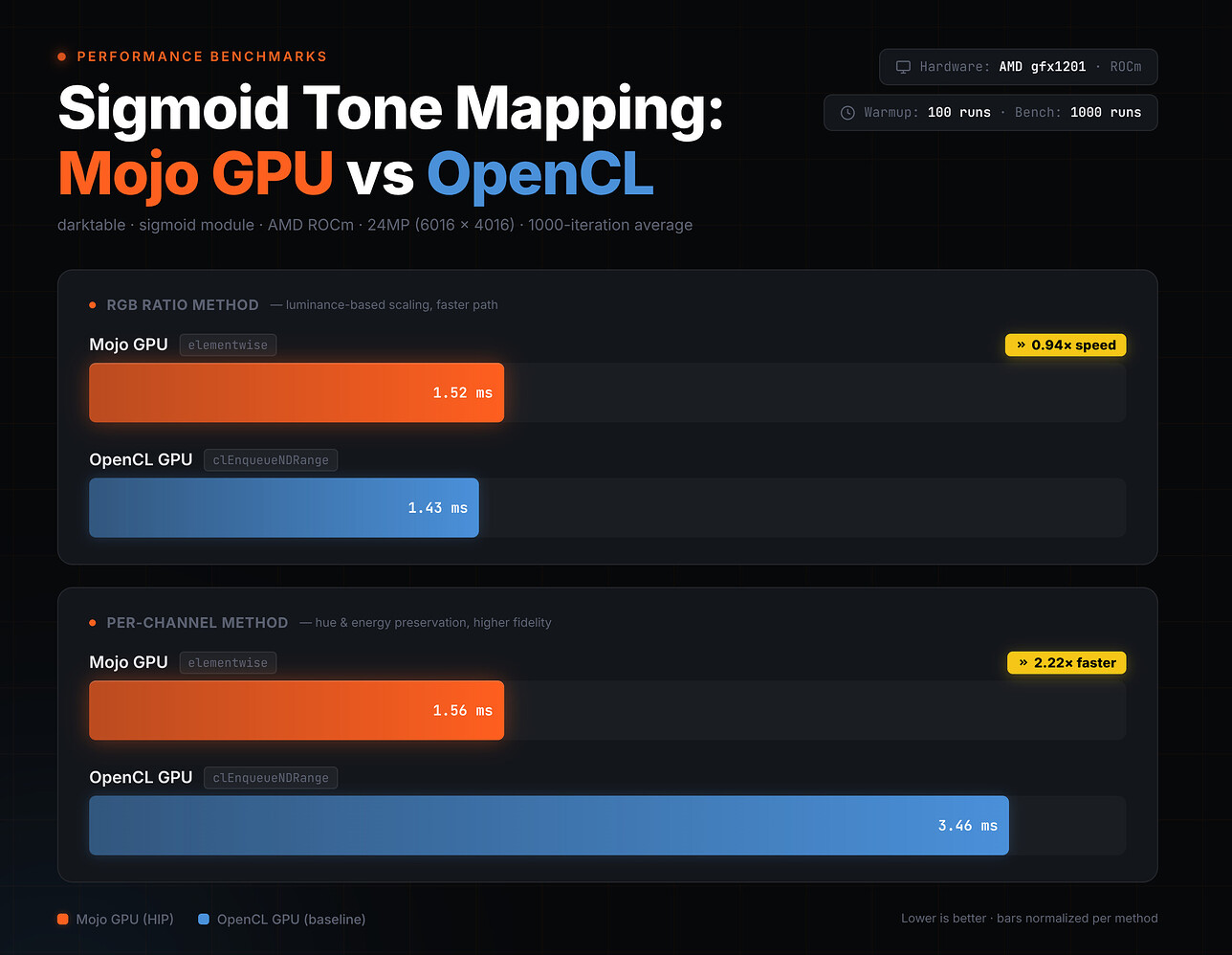
  • Mojo GPU Kernels in Digital Photo Editing: Max Chistokletov explored replacing Darktable's OpenCL image processing kernels with Mojo GPU kernels. For the more compute-intensive per-channel sigmoid tonemapping operation, his Mojo implementation ran 2.2x faster than OpenCL on a Radeon RX 9070 (RDNA4), a compelling look at where Mojo can shine outside of AI inference.
  • MojoR: A "Numba" for R: Statistics PhD Seyoon Ko is building a JIT compiler that transpiles standard R code into Mojo kernels for CPU/GPU execution, without leaving the R session. Early benchmarks on a bivariate Gibbs Sampler show ~117x speedup over GNU R (0.16s vs. 19.28s).
  • Mist: ANSI-Friendly Terminal Toolkit: Mikhail Tavarez refactored mist into a comprehensive terminal manipulation library for Mojo, covering text styling, ANSI-aware transformations, terminal control (alternate screen buffer, mouse capture, cursor manipulation), and event parsing. New TUI examples including a snake game are available via the companion banjo repo.
  • Floki: Requests-like HTTP Client: Also from Mikhail Tavarez, Floki is an HTTP client for Mojo with an API modeled after Python's requests package, powered by libcurl.
  • Decimo v0.8.0 (formerly DeciMojo): Yuhao Zhu shipped a major milestone release focused on performance. Highlights include a brand-new base-2^32 BigInt type with Karatsuba multiplication and Burnikel-Ziegler division, Toom-Cook 3-way multiplication for BigUInt, and significantly improved sqrt, ln, and exp implementations for BigDecimal. Install via pixi add decimo.
  • NuMojo v0.8.0: Photon's NumPy-like library for Mojo got a big update: Python-style complex number literals (1j), initial matrix views, explicit copy semantics aligned with Mojo's ownership model, improved NumPy-compatible slicing with full negative indexing, and a Pixi-based build backend. A major step toward v1.0.
  • Mojo-GTK: Autogenerated GTK Bindings: Hammad Ali wrote Python scripts that autogenerate GTK bindings for Mojo, covering most of GTK's widgets and functionality. Tested on macOS and Ubuntu, with an OpenGL demo included.
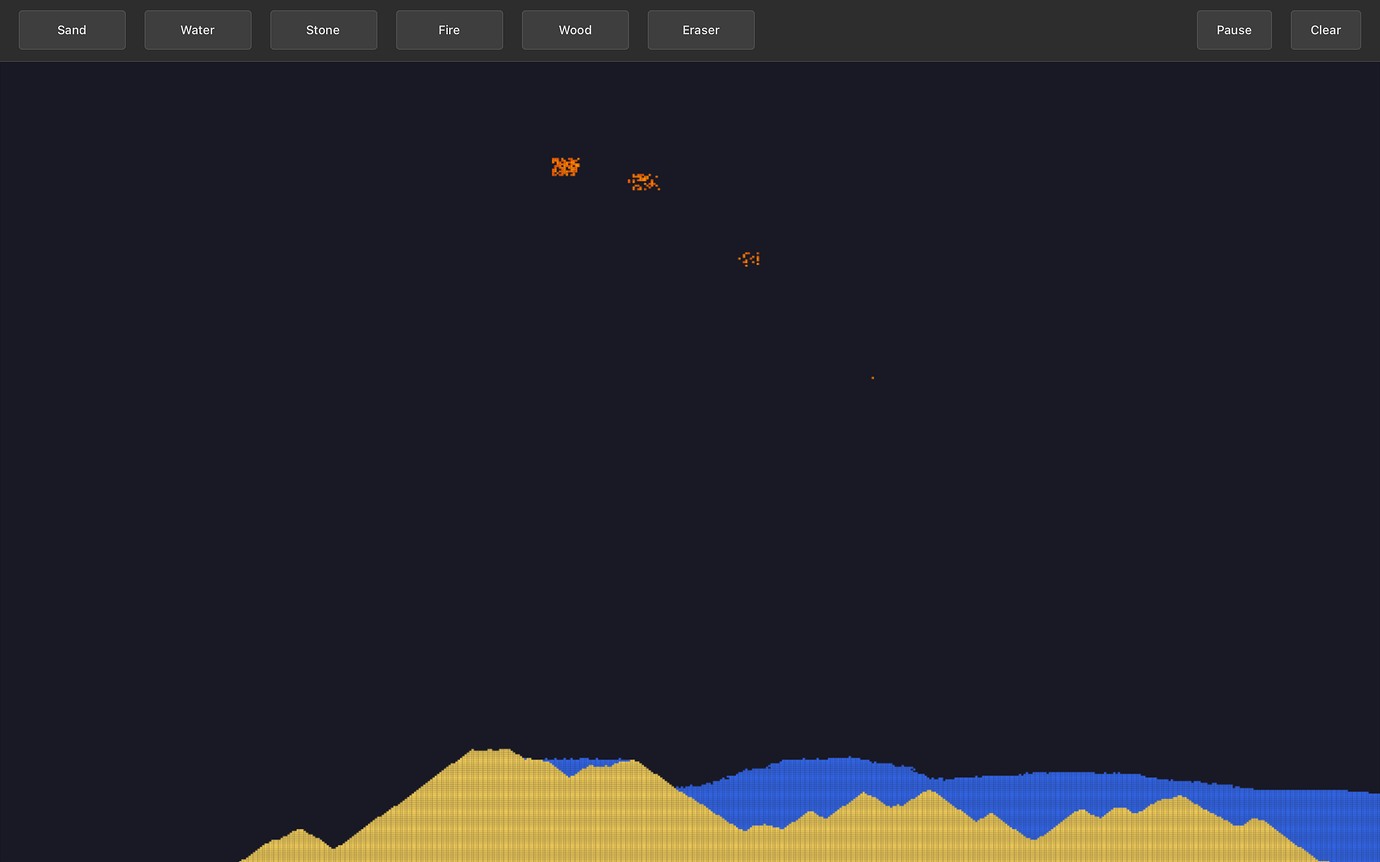
  • Powder Simulation: To put those GTK bindings through their paces, Hammad also built a falling-sand-style powder simulation in Mojo using cairo and GTK, featuring sand, water, fire, stone, and wood. A fun demo of what's possible with Mojo GUI development.
  • mojo-marimo: Run Mojo in Marimo Notebooks: Michael Booth released a library offering three patterns for running Mojo inside interactive Python notebooks via marimo: a decorator-based API, a dynamic string executor, and compiled .so extension modules for near-zero call overhead. Now available on PyPI as py-run-mojo.

💡 We love seeing what you create! Share your MAX or Mojo projects in the forum under the Community Showcase category so we can highlight them in the next edition.

Modular Making Waves

Modular continues to make an impact across the AI and developer space. Here's a roundup of what's been happening:

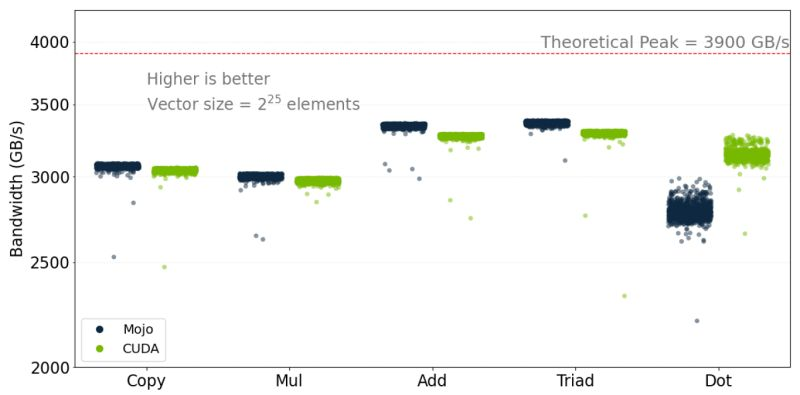
  • Researchers from Oak Ridge National Laboratory (ORNL) and the University of Tennessee, Knoxville published a peer-reviewed paper at SC '25 evaluating Mojo for performance-portable scientific computing on GPUs. Their results show Mojo is competitive with CUDA and HIP for memory-bound science kernels across NVIDIA H100 and AMD MI300A GPUs, and the paper took Best Paper at the WACCPD 2025 workshop. Read the paper. She also presented this at a recent community meeting and broke down what the results mean for Mojo. Watch the recording.
  • Community contributor Maxim Zaks wrote a great post on When "Magic" Becomes Explicit, exploring how Mojo's compile-time reflection and default trait method implementations let any library author build the kind of automatic conformance synthesis that Swift keeps locked behind compiler magic. He also presented at CODAI 2026, proposing Mojo as the answer to the multi-platform AI compute problem, walking through compile-time generics, cross-GPU dispatch, and where MAX fits in. Watch the talk.
  • QWERKY AI published a detailed technical deep-dive on how their team built first-class state space model (SSM/Mamba) support into the MAX framework in two weeks, including what may be the first-ever CPU-only Selective Scan and causal conv1d kernels and a new SSM cache layer. A great read on what it's like extending MAX to support a fundamentally different model architecture.
  • Mojo in Jupyter is now a thing. fast.ai co-founder Jeremy Howard released mojokernel, a Jupyter kernel that lets you run Mojo directly in notebooks with full variable persistence across cells. Works on macOS, supports recent Linux versions, and installs via pip or uv. Give it a try!
  • TensorWave published a blog post on running real AI workloads (inference, training, and scaling) on AMD GPUs, featuring the Modular platform as part of their stack.
  • Business Insider covered how Modular is making it possible to run AI across any chip without rewriting code, and what that means for the future of AI infrastructure. Check it out here.
  • Chris Lattner joined Scott Hanselman on the Hanselminutes podcast to talk about Mojo and why today's AI infrastructure demands new abstractions. They cover the full arc from LLVM and Swift to Mojo, digging into heterogeneous compute, memory ownership, and what it means to give developers precise control over how AI workloads hit silicon.

Open Source Contributions

If you've recently had your first PR merged, message Inaara Walji in the forum to claim your Modular swag! Check out the recently merged contributions from our amazing community members:

Modular News & Events: Stay Connected

  • Modular is heading to NVIDIA GTC 2026! Find us at Booth #3004, March 16-19 in San Jose. Get a first look at Modular Cloud, now in early access, with DeepSeek V3.1 serving live. Plus live Mojo 🔥 GPU programming on NVIDIA Blackwell, the latest AI models in MAX, and AI-assisted kernel development. All powered by Mojo 🔥 and MAX, a simpler way to hit SOTA performance across heterogeneous hardware. Come see the demos, meet the team, and grab some swag 🙌 Follow along for updates: https://luma.com/gtc-modular
  • Join us for our next community meeting on March 23rd at 10am PT via Zoom, featuring exciting community projects, a deep dive into Variadic Metaprogramming in Mojo, and an overview of our latest release 👀
  • Missed our February community meeting? Hammad Ali showed off his auto-generated GTK bindings for Mojo, Tatiana Melnichenko from Oak Ridge National Laboratory shared her award-winning GPU performance research, and Brad Larson walked through the 26.1 release highlights including new Mojo language features and Apple Silicon GPU support. Catch the recap here.
  • Person with blonde hair using a laptop with an Apple logo.

    Sign up today

    Signup to our Cloud Platform today to get started easily.

    Sign Up

  • Magnifying glass emoji with black handle and round clear lens.

    Browse open models

    Browse our model catalog, or deploy your own custom model

    Browse models

Sign up for our newsletter

Get all our latest news, announcements and updates delivered directly to your inbox. Unsubscribe at anytime.

Thanks for signing up to our newsletter! 🚀

Thank you,

Modular Sales Team

Oops! Something went wrong while submitting the form.