惯性聚合 高效追踪和阅读你感兴趣的博客、新闻、科技资讯
阅读原文 在惯性聚合中打开

推荐订阅源

酷 壳 – CoolShell
酷 壳 – CoolShell
P
Privacy & Cybersecurity Law Blog
G
GRAHAM CLULEY
T
The Exploit Database - CXSecurity.com
www.infosecurity-magazine.com
Threat Intelligence Blog | Flashpoint
Project Zero
Project Zero
S
Security @ Cisco Blogs
TaoSecurity Blog
TaoSecurity Blog
A
Arctic Wolf
Webroot Blog
Webroot Blog
Hacker News - Newest:
Hacker News - Newest: "LLM"
Security Latest
Security Latest
H
Heimdal Security Blog
N
News and Events Feed by Topic
N
News | PayPal Newsroom
T
Tor Project blog
OSCHINA 社区最新新闻
OSCHINA 社区最新新闻
GbyAI
GbyAI
The Last Watchdog
The Last Watchdog
Y
Y Combinator Blog
宝玉的分享
宝玉的分享
Scott Helme
Scott Helme
A
About on SuperTechFans
M
MIT News - Artificial intelligence
V
V2EX
V
Visual Studio Blog
Recorded Future
Recorded Future
博客园 - 叶小钗
F
Fortinet All Blogs
L
Lohrmann on Cybersecurity
The GitHub Blog
The GitHub Blog
博客园 - Franky
P
Proofpoint News Feed
MyScale Blog
MyScale Blog
D
Darknet – Hacking Tools, Hacker News & Cyber Security
S
Secure Thoughts
D
DataBreaches.Net
Cyber Security Advisories - MS-ISAC
博客园 - 三生石上(FineUI控件)
I
InfoQ
SecWiki News
SecWiki News
Blog — PlanetScale
Blog — PlanetScale
Engineering at Meta
Engineering at Meta
J
Java Code Geeks
B
Blog RSS Feed
AWS News Blog
AWS News Blog
Know Your Adversary
Know Your Adversary
V
Vulnerabilities – Threatpost
H
Help Net Security

Modular Blog

Qualcomm to Acquire Modular ModCon 2026: Modular’s Developer Conference Day Zero: MiniMax M3 Open Weights on Modular Cloud Modverse #55: Mojo 1.0 Beta, Community Mojo Libraries, and Real-Time Patient Conversations Powered by MAX What about OpenCL and CUDA C++ alternatives? (Democratizing AI Compute, Part 5) Why LLM Inference Needs a New Kind of Router - Part 3 Three trends from MLSys 2026 Why LLM Inference Needs a New Kind of Router - Part 2 How I built a pure Mojo app (and 10 libraries) with AI agents Hippocratic AI partners with Modular to power flexible, high-quality inference for real-time patient conversations Translating to Mojo via AI Agents Inkwell: Why Your Inference Platform Matters As Much As Your Model Why LLM Inference Needs a New Kind of Router - Part 1 Modular 26.3: Mojo 1.0 Beta, MAX Video Gen, and more Modverse #54: AMD AI DevDay, New Modular Offices, and a Community That Keeps Shipping How Frontier Coding Agents Built a Video Diffusion Pipeline on MAX TileTensor Part 1 - Safer, More Efficient GPU Kernels Modular Opens Edinburgh & San Francisco Offices Structured Mojo Kernels Part 4 - Portability and the Road Ahead Day Zero Launch: Fastest Performance for Gemma 4 on NVIDIA and AMD Modverse #54: From GTC to Edinburgh, a Community Building Momentum Software Pipelining for GPU Kernels: Part 1 - The Pipeline Problem Structured Mojo Kernels Part 3 - Composition in Practice Modular 26.2: State-of-the-Art Image Generation and Upgraded AI Coding with Mojo Modular at NVIDIA GTC 2026: MAX on Blackwell, Mojo Kernel Porting, and DeepSeek V3 on B200 Structured Mojo Kernels Part 2 - The Three Pillars Modverse #53: Community Builds, Research Milestones, and a Growing Ecosystem Structured Mojo Kernels Part 1 - Peak Performance, Half the Code The Claude C Compiler: What It Reveals About the Future of Software BentoML Joins Modular The Five Eras of KVCache Modular 26.1: A Big Step Towards More Programmable and Portable AI Infrastructure How to Beat Unsloth's CUDA Kernel Using Mojo—With Zero GPU Experience 🔥 Modular 2025 Year in Review The path to Mojo 1.0 Modverse #52: Advancing AI Together — Community Projects & Platform Milestones Modular 25.7: Faster Inference, Safer GPU Programming, and a More Unified Developer Experience "TTS 1 Max" (powered by Modular Platform) Ranked #1 Speech Model on Artificial Analysis PyTorch and LLVM in 2025 — Keeping up With AI Innovation Achieving State-of-the-Art Performance on AMD MI355 — in Just 14 Days Modular Raises $250M to scale AI's Unified Compute Layer Modular 25.6: Unifying the latest GPUs from NVIDIA, AMD, and Apple Matrix Multiplication on Blackwell: Part 4 - Breaking SOTA Modverse #51: Modular x Inworld x Oracle, Modular Meetup Recap and Community Projects Matrix Multiplication on Blackwell: Part 3 - The Optimizations Behind 85% of SOTA Performance Matrix Multiplication on Blackwell: Part 2 - Using Hardware Features to Optimize Matmul Matrix Multiplication on Blackwell: Part 1 - Introduction Modverse #50: Modular Platform 25.5, Community Meetups, and Mojo's Debut in the Stack Overflow Developer Survey Modular Platform 25.5: Introducing Large Scale Batch Inference SF Compute and Modular Partner to Revolutionize AI Inference Economics AI Agents for AWS Marketplace Modverse #49: Modular Platform 25.4, Modular 🤝 AMD, and Modular Hack Weekend Inside Modular Hack Weekend: Top Projects and Community Highlights How is Modular Democratizing AI Compute? (Democratizing AI Compute, Part 11) Modular 25.4: One Container, AMD and NVIDIA GPUs, No Lock-In Introducing Mammoth: Enterprise-Scale GenAI Deployments Made Simple Modular + AMD: Unleashing AI performance on AMD GPUs Modverse #48: Modular Platform 25.3, MAX AI Kernels, and the Modular GPU Kernel Hackathon Exploring Metaprogramming in Mojo Modular GPU Kernel Hackathon Highlights: Innovation, Community, & Mojo🔥 Modular’s bet to break out of the Matrix (Democratizing AI Compute, Part 10) Modular Platform 25.3: 450K+ Lines of Open Source Code and pip Packaging A New, Simpler License for MAX and Mojo Why do HW companies struggle to build AI software? (Democratizing AI Compute, Part 9) Modverse #47: MAX 25.2 and an evening of GPU programming at Modular HQ What about the MLIR compiler infrastructure? (Democratizing AI Compute, Part 8) What about Triton and Python eDSLs? (Democratizing AI Compute, Part 7) MAX 25.2: Unleash the power of your H200's–without CUDA! What about TVM, XLA, and AI compilers? (Democratizing AI Compute, Part 6) Modverse #46: MAX 25.1, MAX Builds, and Democratizing AI Compute CUDA is the incumbent, but is it any good? (Democratizing AI Compute, Part 4) MAX 25.1 - Introducing MAX Builds How did CUDA succeed? (Democratizing AI Compute, Part 3) Paged Attention & Prefix Caching Now Available in MAX Serve What exactly is “CUDA”? (Democratizing AI Compute, Part 2) Modular DeepSeek's Impact on AI (Democratizing AI Compute, Part 1) Modular Hands-on with Mojo 24.6 Evaluating Llama Guard with MAX 24.6 and Hugging Face Modular Introducing MAX 24.6: A GPU Native Generative AI Platform MAX GPU: State of the Art Throughput on a New GenAI platform Understanding SIMD: Infinite Complexity of Trivial Problems Community Spotlight: Writing Mojo with Cursor Hands-on with Mojo 24.5 MAX 24.5 - With SOTA CPU Performance for Llama 3.1 Announcing stack-pr: an open source tool for managing stacked PRs on GitHub Debugging in Mojo🔥 Write hardware-agnostic custom ops for PyTorch | Modular Take control of your AI Develop locally, deploy globally A brief guide to the Mojo n-body example What's new in MAX 24.4? MAX on macOS, fast local Llama3, native quantization and GGUF support What’s new in Mojo 24.4? Improved collections, new traits, os module features and core language enhancements MAX 24.4 - Introducing quantization APIs and MAX on macOS Deep dive into ownership in Mojo What ownership is really about: a mental model approach Fast⚡k-means clustering in Mojo🔥: a guide to porting Python to Mojo🔥 for accelerated k-means clustering
Modular 26.4: SOTA MoE Serving, Model Bringup via Agent Skills, Mojo 1.0 Beta 2 and More
No items found. · 2026-06-18 · via Modular Blog

June 18, 2026

Modular Team

Modular 26.4 brings state-of-the-art mixture-of-experts (MoE) serving to Modular Cloud, expands MAX support for the newest open-weight models, and takes another step toward Mojo 1.0.

Modular Cloud is expanding and now supports the latest frontier models such as MiniMax M3, GLM 5.2, and Kimi 2.7. Modular Cloud is built on top of the 26.4 release which adds support for new model architectures, enhances quantization and speculative decoding capabilities, improves OpenAI API compatibility, extends Apple silicon GPU support, and makes MAX more accessible via modular/skills for agentic model bring-up.

💡

We’ll share much more about what’s coming for Mojo, MAX and Modular Cloud at our ModCon conference: join us August 18th in San Francisco.

Serve SOTA MoEs on Modular Cloud

All frontier models today are MoE based. The MoE architecture means that while the model is large (in the hundreds of billions or trillions of parameters), only a few of those parameters are active at any time. This sparse activation is further extended by relying on sparse activations of KVCache blocks. The large size and sparsity makes these models more difficult to serve, since it requires cross stack optimizations from the cloud to the kernels. In Modular Cloud we've carefully tuned modules such as Gemma 4, Deepseek, GLM, MiniMax, and Kimi to ensure peak performance of these models.

New MoE models available through Modular Cloud include:
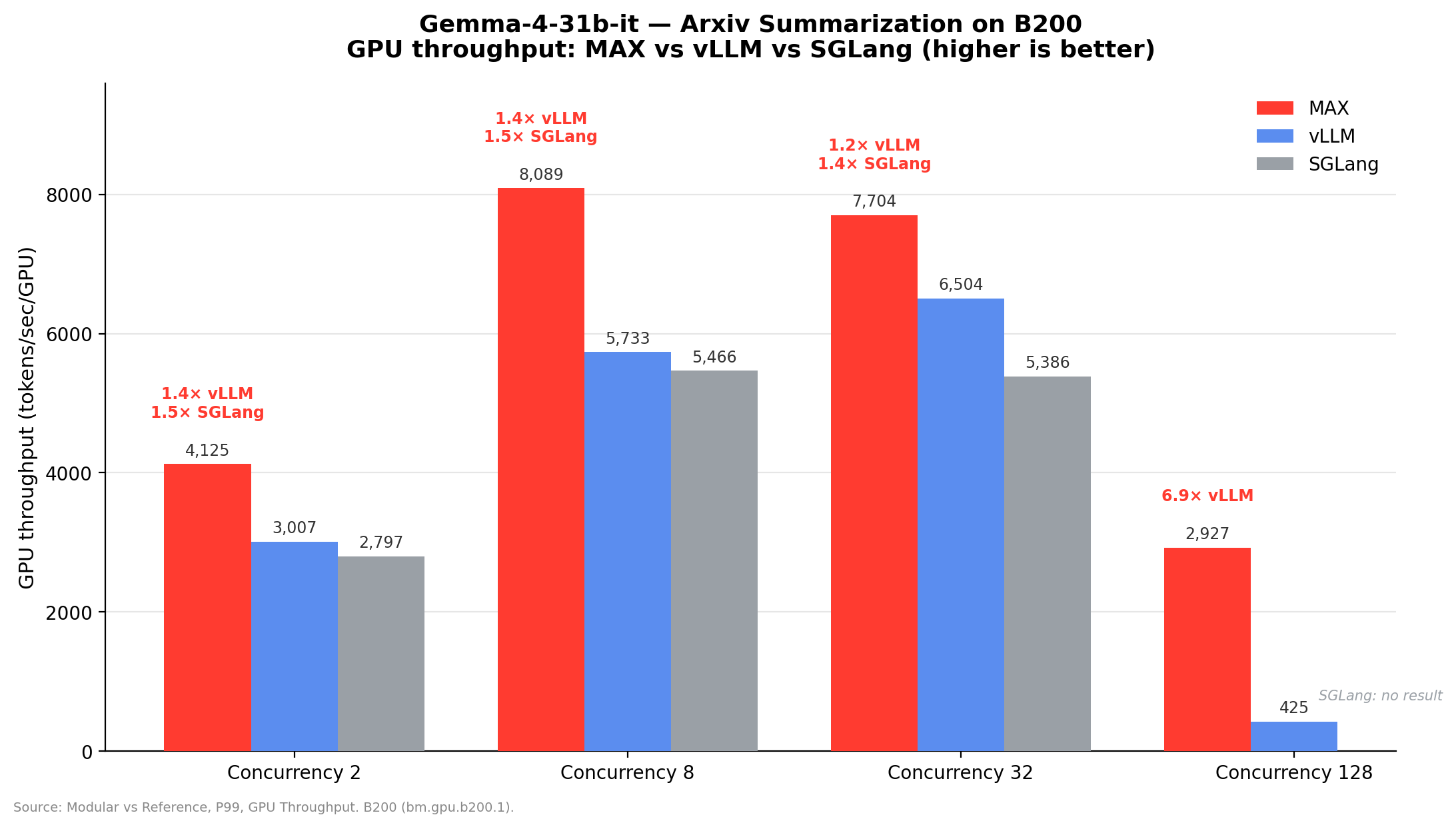
Modular Cloud gives you access to 500+ model architectures for different use cases from agentic coding, multi-turn chat, to vision and video generation. Request access to Modular Cloud today.

MAX: New models, more capabilities, faster bring-up

In the prior 26.3 release, we introduced distributed-aware tensors and initial pieces of Modular native agentic tooling. In MAX 26.4, we continued our investments to expand the capabilities of the MAX framework and improve development experience.

MAX underpins the capabilities of Modular Cloud and with MAX 26.4, we've added additional model coverage and serving machinery. This includes:

  • New model architectures such as GlmMoeDsaForCausalLM, LFM2ForCausalLM and HYV3ForCausalLM are now supported in MAX.
  • KimiK25ForConditionalGeneration extends to support both Kimi 2.6 and 2.7 as well as support for different speculative decoders such as Eagle3 and DFlash.
  • Improve OpenAI API compatibility: MAX 26.4 adds support for the developer role, aligns reasoning output with the Responses API, improves structured-output handling, and adds compatibility flags so real-world requests is less likely to fail on minor request differences.
  • Wider quantization coverage: Models such as Gemma4 and FLUX.2-Klein can now run using eitherboth FP8 or FP4 weights.
  • Apple silicon GPU: MAX now supports many common model architectures, including Qwen 3.6 and Gemma 4, on M3 and newer Apple silicon GPUs. We’re continuing to improve Apple silicon support across Mojo and MAX, so check out the nightlies for the latest capabilities and best performance.
  • Cleaner MAX APIs and migration notes: 26.4 moves MAX modules into clearer homes and removes older legacy types. Most changes include deprecation shims, so existing code should keep working while you migrate.

See the MAX changelog for the full list.

Agentic model bring-up with modular/skills

Developers often ask us how they can bring their own models into MAX to enjoy these features. In 26.4, we’ve released the import-model and debug-model skills, which enable importing your models into MAX with agents. The skill can be installed via:

mojo

npx skills add modular/skills

These skills guide an AI coding agent through a repeatable model bring-up workflow:

  1. Decide and plan by inspecting the Hugging Face config and modeling code.
  2. Implement the model by scaffolding from the closest existing MAX architecture.
  3. Verify its outputs by running a layer-by-layer logit-divergence hunt against the reference implementation until outputs match.

The result is a fast and practical path from a Hugging Face model ID to a working MAX architecture that’s ready to deploy. To demonstrate this, we've brought up Tencent’s Hunyuan Hy3-preview model into MAX using these agent skills. The model uses 192 routed experts with sigmoid plus correction-bias routing, and runs in MAX with multi-GPU tensor-parallel attention and expert-parallel MoE.

Read more about model bring-up with our agentic skills in the new guide.

Mojo 1.0 beta 2: stabilizing on path to release

As another step in our path to Mojo 1.0, this release includes Mojo 1.0 beta 2. This update focuses on refinement and stabilization You’ll soon start to see markers in the nightlies for the Mojo standard library stating which interfaces are stable, and we’ll be expanding that surface as we draw closer to the 1.0 release.

There are also several language improvements since beta 1:

  • Many common collection types like List[T] no longer require their contents to be Copyable . This makes collections more generic containers across a broader set of element types..
  • We've removed the redundant function argument forenqueue_function. This makes accelerator programming more succinct by only requiring the kernel to be specified once.
  • We are continuing to invest in the Python -> Mojo interop and part of that is reducing the overhead when Python is calling into Mojo for many common use cases.
  • Mojo’s reflections are now more ergonomic and more tightly integrated with the standard library.

Get started with 26.4

Modular 26.4 is available now, with new model support, new agent skills, SOTA MoE in MAX, Mojo 1.0 Beta 2, and more.

Install or upgrade to get started in minutes:

mojo

uv pip install --pre --upgrade modular

We only touched on the highlights in this release, for a deeper look at all the changes please check out our changelog:

If you’re building with Modular, join us on:

Share your feedback on the Mojo 1.0 beta:

We’re excited to hear about what you build with 26.4, and with the Mojo beta - and join us at ModCon on August 18th for much more.

  • Person with blonde hair using a laptop with an Apple logo.

    Sign up today

    Signup to our Cloud Platform today to get started easily.

    Sign Up

  • Magnifying glass emoji with black handle and round clear lens.

    Browse open models

    Browse our model catalog, or deploy your own custom model

    Browse models

Sign up for our newsletter

Get all our latest news, announcements and updates delivered directly to your inbox. Unsubscribe at anytime.

Thanks for signing up to our newsletter! 🚀

Thank you,

Modular Sales Team

Oops! Something went wrong while submitting the form.