惯性聚合 高效追踪和阅读你感兴趣的博客、新闻、科技资讯
阅读原文 在惯性聚合中打开

推荐订阅源

GbyAI
GbyAI
酷 壳 – CoolShell
酷 壳 – CoolShell
宝玉的分享
宝玉的分享
IT之家
IT之家
Recent Announcements
T
The Blog of Author Tim Ferriss
雷峰网
雷峰网
阮一峰的网络日志
阮一峰的网络日志
CTFtime.org: upcoming CTF events
M
MIT News - Artificial intelligence
D
Docker
C
CERT Recently Published Vulnerability Notes
月光博客
月光博客
奇客Solidot–传递最新科技情报
奇客Solidot–传递最新科技情报
Recorded Future
Recorded Future
博客园 - 司徒正美
D
DataBreaches.Net
Last Week in AI
Last Week in AI
U
Unit 42
人人都是产品经理
人人都是产品经理
博客园_首页
Blog — PlanetScale
Blog — PlanetScale
量子位
大猫的无限游戏
大猫的无限游戏
博客园 - Franky
T
Tailwind CSS Blog
小众软件
小众软件
Y
Y Combinator Blog
WordPress大学
WordPress大学
B
Blog RSS Feed
C
Check Point Blog
H
Help Net Security
The Last Watchdog
The Last Watchdog
F
Full Disclosure
腾讯CDC
V
Visual Studio Blog
Google Online Security Blog
钛媒体:引领未来商业与生活新知
钛媒体:引领未来商业与生活新知
T
Troy Hunt's Blog
N
News and Events Feed by Topic
F
Fortinet All Blogs
B
Blog
cs.CV updates on arXiv.org
J
Java Code Geeks
K
KPMG report finds enterprise disconnect between AI and its ROI | CIO
有赞技术团队
有赞技术团队
博客园 - 三生石上(FineUI控件)
TaoSecurity Blog
TaoSecurity Blog
I
InfoQ
V
Vulnerabilities – Threatpost

Modular Blog

Qualcomm to Acquire Modular Modular 26.4: SOTA MoE Serving, Model Bringup via Agent Skills, Mojo 1.0 Beta 2 and More ModCon 2026: Modular’s Developer Conference Modverse #55: Mojo 1.0 Beta, Community Mojo Libraries, and Real-Time Patient Conversations Powered by MAX What about OpenCL and CUDA C++ alternatives? (Democratizing AI Compute, Part 5) Why LLM Inference Needs a New Kind of Router - Part 3 Three trends from MLSys 2026 Why LLM Inference Needs a New Kind of Router - Part 2 How I built a pure Mojo app (and 10 libraries) with AI agents Hippocratic AI partners with Modular to power flexible, high-quality inference for real-time patient conversations Translating to Mojo via AI Agents Inkwell: Why Your Inference Platform Matters As Much As Your Model Why LLM Inference Needs a New Kind of Router - Part 1 Modular 26.3: Mojo 1.0 Beta, MAX Video Gen, and more Modverse #54: AMD AI DevDay, New Modular Offices, and a Community That Keeps Shipping How Frontier Coding Agents Built a Video Diffusion Pipeline on MAX TileTensor Part 1 - Safer, More Efficient GPU Kernels Modular Opens Edinburgh & San Francisco Offices Structured Mojo Kernels Part 4 - Portability and the Road Ahead Day Zero Launch: Fastest Performance for Gemma 4 on NVIDIA and AMD Modverse #54: From GTC to Edinburgh, a Community Building Momentum Software Pipelining for GPU Kernels: Part 1 - The Pipeline Problem Structured Mojo Kernels Part 3 - Composition in Practice Modular 26.2: State-of-the-Art Image Generation and Upgraded AI Coding with Mojo Modular at NVIDIA GTC 2026: MAX on Blackwell, Mojo Kernel Porting, and DeepSeek V3 on B200 Structured Mojo Kernels Part 2 - The Three Pillars Modverse #53: Community Builds, Research Milestones, and a Growing Ecosystem Structured Mojo Kernels Part 1 - Peak Performance, Half the Code The Claude C Compiler: What It Reveals About the Future of Software BentoML Joins Modular The Five Eras of KVCache Modular 26.1: A Big Step Towards More Programmable and Portable AI Infrastructure How to Beat Unsloth's CUDA Kernel Using Mojo—With Zero GPU Experience 🔥 Modular 2025 Year in Review The path to Mojo 1.0 Modverse #52: Advancing AI Together — Community Projects & Platform Milestones Modular 25.7: Faster Inference, Safer GPU Programming, and a More Unified Developer Experience "TTS 1 Max" (powered by Modular Platform) Ranked #1 Speech Model on Artificial Analysis PyTorch and LLVM in 2025 — Keeping up With AI Innovation Achieving State-of-the-Art Performance on AMD MI355 — in Just 14 Days Modular Raises $250M to scale AI's Unified Compute Layer Modular 25.6: Unifying the latest GPUs from NVIDIA, AMD, and Apple Matrix Multiplication on Blackwell: Part 4 - Breaking SOTA Modverse #51: Modular x Inworld x Oracle, Modular Meetup Recap and Community Projects Matrix Multiplication on Blackwell: Part 3 - The Optimizations Behind 85% of SOTA Performance Matrix Multiplication on Blackwell: Part 2 - Using Hardware Features to Optimize Matmul Matrix Multiplication on Blackwell: Part 1 - Introduction Modverse #50: Modular Platform 25.5, Community Meetups, and Mojo's Debut in the Stack Overflow Developer Survey Modular Platform 25.5: Introducing Large Scale Batch Inference SF Compute and Modular Partner to Revolutionize AI Inference Economics AI Agents for AWS Marketplace Modverse #49: Modular Platform 25.4, Modular 🤝 AMD, and Modular Hack Weekend Inside Modular Hack Weekend: Top Projects and Community Highlights How is Modular Democratizing AI Compute? (Democratizing AI Compute, Part 11) Modular 25.4: One Container, AMD and NVIDIA GPUs, No Lock-In Introducing Mammoth: Enterprise-Scale GenAI Deployments Made Simple Modular + AMD: Unleashing AI performance on AMD GPUs Modverse #48: Modular Platform 25.3, MAX AI Kernels, and the Modular GPU Kernel Hackathon Exploring Metaprogramming in Mojo Modular GPU Kernel Hackathon Highlights: Innovation, Community, & Mojo🔥 Modular’s bet to break out of the Matrix (Democratizing AI Compute, Part 10) Modular Platform 25.3: 450K+ Lines of Open Source Code and pip Packaging A New, Simpler License for MAX and Mojo Why do HW companies struggle to build AI software? (Democratizing AI Compute, Part 9) Modverse #47: MAX 25.2 and an evening of GPU programming at Modular HQ What about the MLIR compiler infrastructure? (Democratizing AI Compute, Part 8) What about Triton and Python eDSLs? (Democratizing AI Compute, Part 7) MAX 25.2: Unleash the power of your H200's–without CUDA! What about TVM, XLA, and AI compilers? (Democratizing AI Compute, Part 6) Modverse #46: MAX 25.1, MAX Builds, and Democratizing AI Compute CUDA is the incumbent, but is it any good? (Democratizing AI Compute, Part 4) MAX 25.1 - Introducing MAX Builds How did CUDA succeed? (Democratizing AI Compute, Part 3) Paged Attention & Prefix Caching Now Available in MAX Serve What exactly is “CUDA”? (Democratizing AI Compute, Part 2) Modular DeepSeek's Impact on AI (Democratizing AI Compute, Part 1) Modular Hands-on with Mojo 24.6 Evaluating Llama Guard with MAX 24.6 and Hugging Face Modular Introducing MAX 24.6: A GPU Native Generative AI Platform MAX GPU: State of the Art Throughput on a New GenAI platform Understanding SIMD: Infinite Complexity of Trivial Problems Community Spotlight: Writing Mojo with Cursor Hands-on with Mojo 24.5 MAX 24.5 - With SOTA CPU Performance for Llama 3.1 Announcing stack-pr: an open source tool for managing stacked PRs on GitHub Debugging in Mojo🔥 Write hardware-agnostic custom ops for PyTorch | Modular Take control of your AI Develop locally, deploy globally A brief guide to the Mojo n-body example What's new in MAX 24.4? MAX on macOS, fast local Llama3, native quantization and GGUF support What’s new in Mojo 24.4? Improved collections, new traits, os module features and core language enhancements MAX 24.4 - Introducing quantization APIs and MAX on macOS Deep dive into ownership in Mojo What ownership is really about: a mental model approach Fast⚡k-means clustering in Mojo🔥: a guide to porting Python to Mojo🔥 for accelerated k-means clustering
Day Zero: MiniMax M3 Open Weights on Modular Cloud
No items found. · 2026-06-11 · via Modular Blog

June 11, 2026

Modular Team

💡

Today, MiniMax released the MiniMax M3 model as open weights. Modular is proud to be a Day Zero launch partner.

MiniMax M3 is the newest open-weights model that has been optimized for coding, agentic work, and native multimodality for MiniMax. A few things that make this a frontier model are:
  • A 1M-token context window (with a guaranteed minimum of 512K), built for long-running agent tasks, large coding workloads, and long-video understanding.
  • Native multimodality. M3 is trained on both text and images, so it is multi-modal by design.
  • MiniMax Sparse Attention (MSA). This is the key that keeps attention efficient as context grows.
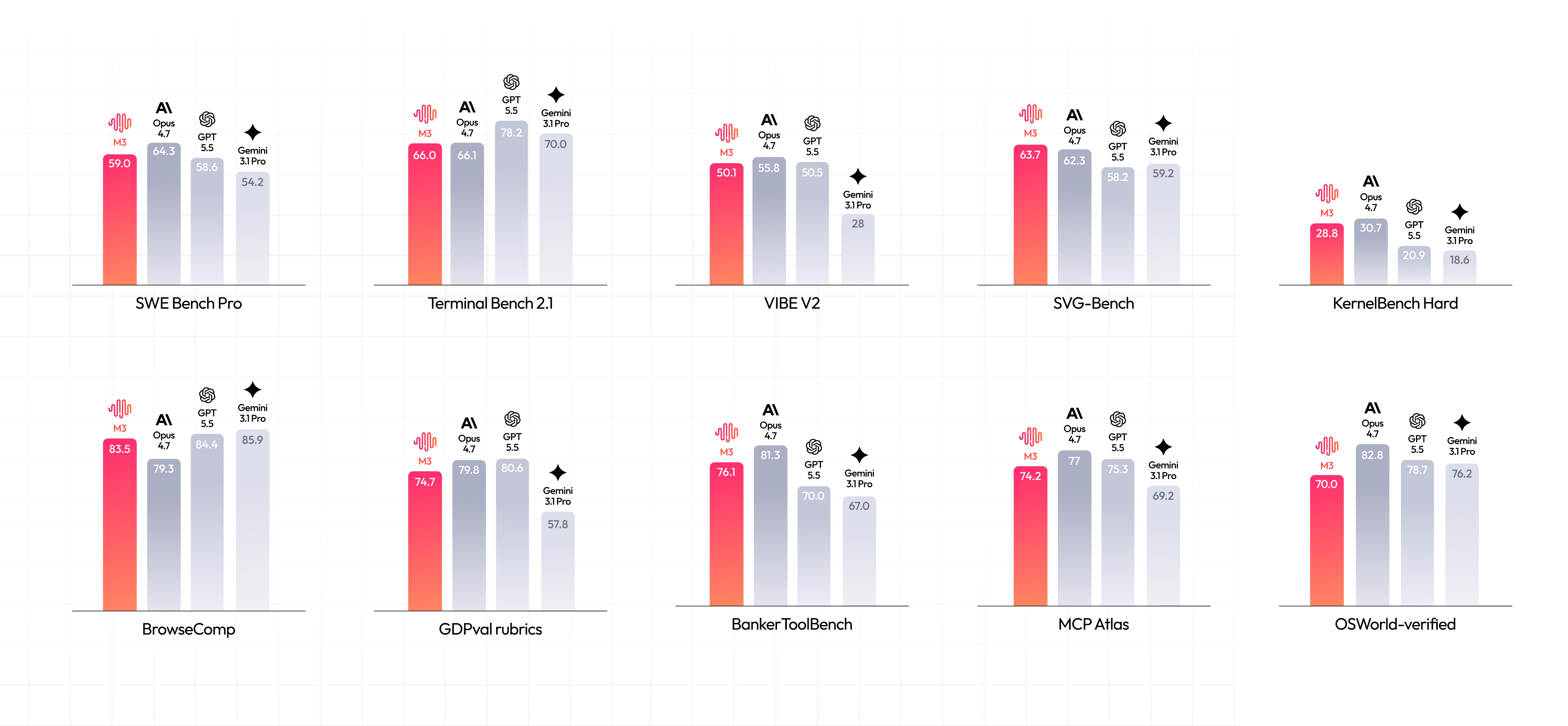
MiniMax M3 accuracy benchmarks across evaluation dataset.

A look into MiniMax’s Sparse Attention

Behind M3 is a new MiniMax Sparse Attention (MSA) operation. MSA is what enables a 1M context to be served, and a big part of what makes M3 demanding to run well. But, if optimized, MSA’s design allows it to cut the per-token attention compute to roughly 1/20th of its full-attention predecessor. This results in around 9.7× speedup on prefill and 15.6× speedup on decode, while matching full attention across the vast majority of workloads.
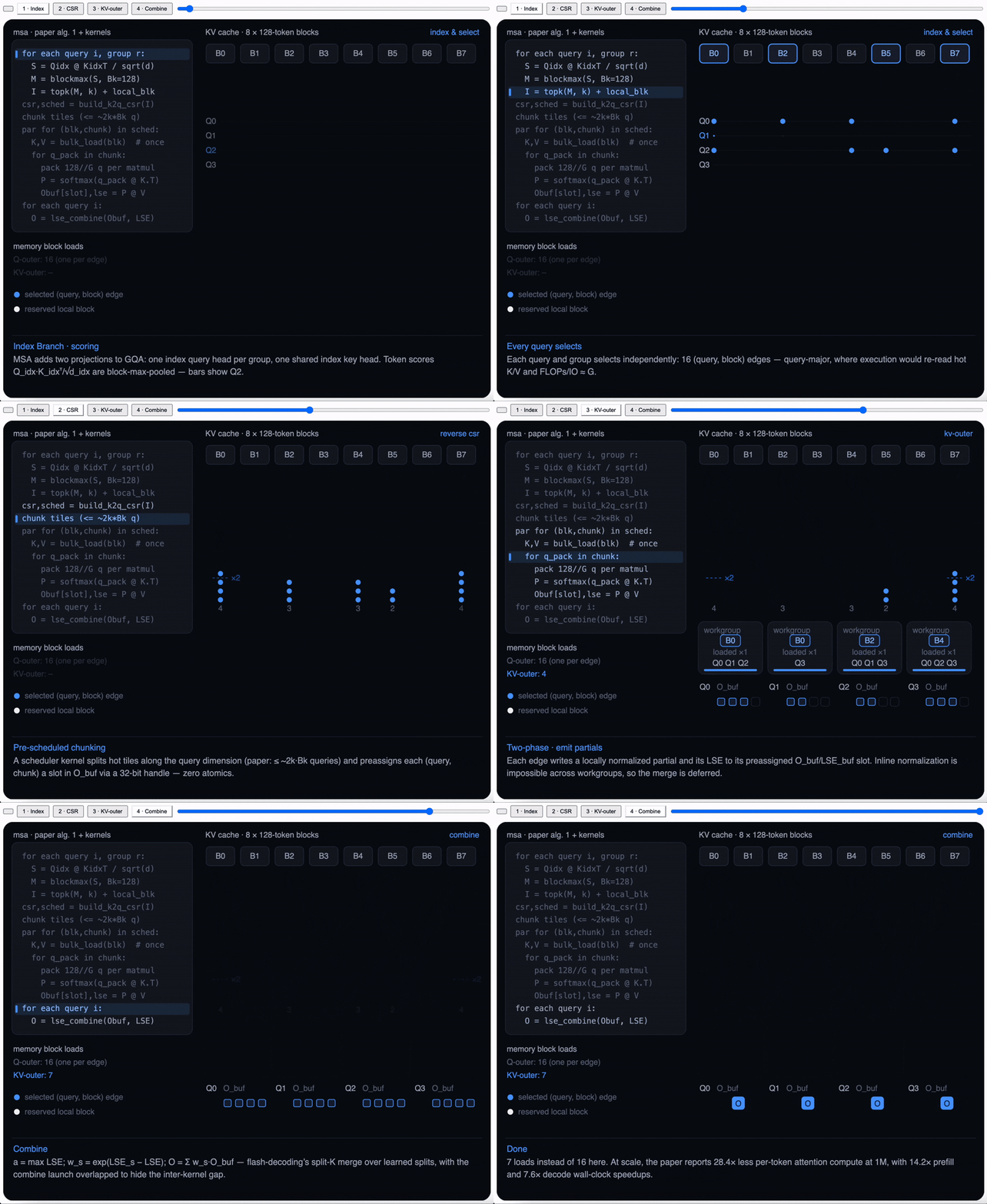
MSA splits every attention layer into two parts: which KV to look at, and how to attend to it. The first is solved by introducing an indexing layer. For each query, the indexer scores candidate KV blocks and chooses the top-k blocks. The indexer also maintains a cache of index keys with a single shared head and a small head dimension. By focusing only on top scoring KV cache blocks, MSA only computes the attention of the relevant 128 tokens in the KV caches rather than the full block.

mojo

# One MSA layer, conceptually
s = (Q_idx @ K_idx.T) * idx_scale      # single shared index head, tiny d_idx -- nearly free
S = block_max_pool(s, B=128)           # token scores -> 128-token block scores
S[:, :init_blocks]  = INF             # force-select the attention-sink blocks
S[:, local_window:] = INF - eps       # force-select the recent window
I = topk_per_kv_group(S, k)            # ONE selection, shared by every head in the GQA group
O = softmax_attention(Q, K[I], V[I])   # ordinary GQA over the REAL K/V of the selected blocks

The model produces selection in query-major form: for each query, a list of top-k block IDs. The natural kernel follows that shape — loop over queries, gather their selected KV blocks, and then attend. Executing in query-major order would mean each query independently gathers its selected blocks, the same KV block may be fetched from HBM many times (which is not very efficient).

mojo

# Query-major: the natural schedule
for q_tile in queries:                    # parallel across threadblocks
    for blk in I[q_tile]:                 # this tile's top-k blocks
        K_blk, V_blk = load_block(blk)    # hot blocks re-fetched by EVERY threadblock that picked them
        online_softmax_update(q_tile, K_blk, V_blk)

To avoid the repeated loads, MSA inverts the mapping by grouping the queries by the KV block they selected; i.e. executing in key-block-major form and what MiniMax calls “KV outer gather Q”. As a result, we can improve the arithmetic intensity since the blocks are loaded once, before computing partial attention for all of those queries, and then merging the partial results.

mojo

# Once per step: transpose the selection (a sparse-matrix transpose into CSR)
k2q  = invert(I)                  # row = (seq, kv_block); entries = queries that selected it
work = chunk_rows(k2q, q_budget)  # split hot rows for load balance (more below)

# Block-major forward: one threadblock per work item -- each KV byte leaves HBM once
blk, q_list = work[work_id]
K_blk, V_blk = bulk_load(blk)              # ONE contiguous load; resident for the threadblock's lifetime
for q_tile in tiles(q_list, BM):           # stream the selecting queries through it
    Q_t = gather_rows(Q, q_tile)           # gather the queries (scattered rows)
    O_p, lse = attend_one_block(Q_t, K_blk, V_blk)   # single-tile softmax -- next section
    O_partial[q_tile, slot(q_tile, blk)]   = O_p     # per-(query, block) partials,
    LSE_partial[q_tile, slot(q_tile, blk)] = lse     # merged by a separate combine pass

This structure has an added benefit of simplifying the online softmax computation. Remember that in query-major attention one needs to perform online softmax. But in the block-major format, a thread block only ever sees one KV block per query group.  Thus the softmax can be performed on a single tile without the need for an online correction. This is very much similar to the split-kv reduction step in flash decoding.

Minimax M3 available today on Modular Cloud

The MiniMax M3 model bring novel innovations that require whole stack optimizations - from kernels to cloud. This is only possible in the Modular platform. MiniMax M3 is available on Modular Cloud today for enterprise customers. Talk to our AI engineers to request access today.

Discover what Modular can do for you

Request a demo

  • Person with blonde hair using a laptop with an Apple logo.

    Sign up today

    Signup to our Cloud Platform today to get started easily.

    Sign Up

  • Magnifying glass emoji with black handle and round clear lens.

    Browse open models

    Browse our model catalog, or deploy your own custom model

    Browse models

Sign up for our newsletter

Get all our latest news, announcements and updates delivered directly to your inbox. Unsubscribe at anytime.

Thanks for signing up to our newsletter! 🚀

Thank you,

Modular Sales Team

Oops! Something went wrong while submitting the form.