





惯性聚合 高效追踪和阅读你感兴趣的博客、新闻、科技资讯
阅读原文 在惯性聚合中打开

推荐订阅源

T
Threatpost
aimingoo的专栏
aimingoo的专栏
OSCHINA 社区最新新闻
OSCHINA 社区最新新闻
T
Tailwind CSS Blog
J
Java Code Geeks
博客园_首页
Google Online Security Blog
Hugging Face - Blog
Hugging Face - Blog
C
CXSECURITY Database RSS Feed - CXSecurity.com
I
Intezer
P
Palo Alto Networks Blog
V
Vulnerabilities – Threatpost
雷峰网
雷峰网
O
OpenAI News
SecWiki News
SecWiki News
小众软件
小众软件
酷 壳 – CoolShell
酷 壳 – CoolShell
美团技术团队
N
News | PayPal Newsroom
Project Zero
Project Zero
Forbes - Security
Forbes - Security
IT之家
IT之家
A
Arctic Wolf
WordPress大学
WordPress大学
Jina AI
Jina AI
T
Tor Project blog
博客园 - 三生石上(FineUI控件)
S
Secure Thoughts
Google DeepMind News
Attack and Defense Labs
博客园 - 聂微东
Exploit-DB.com RSS Feed
P
Privacy International News Feed
Cloudbric
Cloudbric
G
GRAHAM CLULEY
博客园 - 叶小钗
H
Hacker News: Front Page
腾讯CDC
量子位
Help Net Security
Help Net Security
人人都是产品经理
人人都是产品经理
C
Cyber Attacks, Cyber Crime and Cyber Security
月光博客
月光博客
奇客Solidot–传递最新科技情报
奇客Solidot–传递最新科技情报
宝玉的分享
宝玉的分享
爱范儿
爱范儿
L
Lohrmann on Cybersecurity
Hacker News - Newest:
Hacker News - Newest: "LLM"
Recorded Future
Recorded Future
C
CERT Recently Published Vulnerability Notes

Analytics Vidhya

Handling Imbalanced Classification: What Works Better Than SMOTE GPT-5.6 Is Here: Sol, Terra, and Luna Loop Engineering for AI Agents: How /loop is Changing AI Workflows DeepSeek DSpark: The Speculative Decoding Trick Behind 400% Faster LLM OKF: Redefining Knowledge Bases for AI Agents Modern VLMs Explained: How GPT-4o, Gemini, Claude Vision, and Qwen-VL Work YOLO26 Tutorial: Object Detection, Pose Estimation & More Large Action Models (LAMs) vs Agentic LLMs: What's the Real Difference? Claude Sonnet 5: The Fable 5 at Home The Best $20 AI Plan: ChatGPT Plus vs Claude Pro vs Gemini Pro GraphRAG vs Vector RAG: Which Retrieval Method is Best? Using AI When You Don’t Trust AI The Self-Improving Loop in AI Agents: Architecture, Benefits, and How it Outperforms Traditional Agent Workflows Harness-1: The 20B Retrieval Subagent That Beats GPT-5.4 at Search Sakana Fugu: Multi-Agent System as a Model Claude's Hidden Art Skill: Making Illustrations With Code System Design for ML Interviews: 10 Real Problems Walked Through Most People Use ChatGPT Wrong: 10 Features and Tips That Changed How I Work OpenAI Just Launched 3 Free AI Courses with Certificates Autoregressive Models: Predicting the Future Using the Past Gemini Omni: AI Video Generation Inside Gemini DiffusionGemma: Google’s Diffusion-Based Open Model for Faster Text Generation Top 10 AI Engineering Tools Everyone is Using in 2026 I Tested Claude Fable 5: Can Anthropic’s Newest AI Deliver on the Hype? Prophet vs NeuralProphet vs TimeGPT vs Chronos: A Practical Comparison Build an Emergency Helpline Voice Agent with LangChain Choosing the Right Vector Database for RAG and AI Applications Google Gemma 4 12B: Architecture, Benchmarks, Access, and Hands-on Guide for Developers How to Choose the Right AI Model for Your Needs Agent Observability with LangSmith, Langfuse, and Arize: A Hands-On Comparison How to Use Claude Managed Agents? Google AI Studio vs Gemini App: What’s the Difference? AI Workflows for Sales Teams: Prospect Research, Lead Qualification, and CRM Updates on Autopilot Using LangGraph 25 Most Influential AI Pioneers to Meet at DataHack Summit 2026 Claude Opus 4.8: A Smarter Model in the Right Direction PySpark Optimization: 12 Proven Techniques to Speed Up Your Spark Jobs 10 Everyday Tasks You Can Automate with AI Today (With n8n Templates) Google Antigravity 2.0: The Full Developer Guide (I/O 2026) Build a Claude Cowork-Like Browser Agent Using Playwright MCP and Claude Desktop Pandas vs Polars vs DuckDB: Which Library Should You Choose? Qwen3.7-Max: Alibaba’s New Agent-First LLM for Coding, Reasoning, and Long-Horizon AI Workflows The Biggest Announcements from Google I/O 2026 Top 9 AI Events and Conferences in 2026 that you Must Attend Gemini 3.5 Flash: Frontier Intelligence with Speed Kimi WebBridge: Hands-on Guide to Kimi’s Browser Extension for AI Agents 40 Advanced SQL Window Functions Every Data Scientist Must Know(with examples) Top 10 AI Research Papers of 2025 6 Steps to Crack GenAI Case Study Interviews (With Real Examples) OpenAI Omni Moderation: How to Filter Text & Images for Free DataHack Summit 2026: You Just Cannot Skip This AI Event of the Year OpenAI’s New API Voice Models Will Change the Way You Use AI Hermes Agent Guide: What is it and How to Use it? Top 10 LLM Research Papers of 2026 Agent Memory Patterns in Cognitive Science and AI Systems 10 AI Agents Every AI Engineer Must Build (with GitHub Samples) 23 Tips for Smart Claude Code Token Saving and Workflow Optimization Feature Engineering with LLMs: Techniques & Python Examples ChatGPT is Now Inside Excel and Google Sheets: Here is How to Use it Gemini API File Search: The Easy Way to Build RAG Top 10 Open-Source Libraries to Fine-Tune LLMs Locally ML Intern in Practice: From Prompt to a Shipped Hugging Face Model 15+ Solved Agentic AI Projects with Github Links How People are Figuring Out Life With Claude MemPalace Explained: Building Long-Term Memory for AI Agents Beyond RAG Compressing LSTM Models for Retail Edge Deployment: A Practical Comparison MCP vs Agent Skills: Different Altogether GPT 5.5 vs Opus 4.7: Which is the Best AI Model Today? What is Agentic AI? Claude Code vs Codex: A Detailed Terminal Agent Comparison Google Deep Research Max: Build Autonomous AI Research Agents in Minutes Meta Muse Spark Review: Is It Worth the Hype? ChatGPT Images 2.0 vs Nano Banana 2: Which is Better? Cursor V3 Explained: The AI Coding Agent That’s Replacing Traditional IDEs in 2026 DeepSeek-V4: The Most Powerful Open-Source Model Ever Is GPT Image 2 the Best Image Generation Model? Token Economics: Why AI is Getting “Cheaper” From Idea to Output: Claude Does the Design Work Opus 4.7 vs Opus 4.6: Should You Switch? Build Human-Like AI Voice App with Gemini 3.1 Flash TTS How to Structure a Claude Code Project that Thinks Like an Engineer Gemma 4 Tool Calling Explained: Build AI Agents with Function Calling (Step-by-Step Guide) Anthropic Launches Claude Opus 4.7 For “Most Difficult Tasks” Top 28 Claude Shortcuts that will 10X your Speed GPT-5.4-Cyber: Why OpenAI is Keeping its Most Powerful Model Under Lock and Key Google AI Studio Guide: Every Feature Explained Mastering Deep Agents: Context Engineering that Actually Works 21 Computer Vision Projects from Beginner to Advanced (2026 Guide) Excel 101: Excel Agent Mode Explained MiniMax M2.7 Goes Open-Weight to Let You Run Agents Locally Top 10 Gemma 4 Projects That Will Blow Your Mind GLM-5.1: Architecture, Benchmarks, Capabilities & How to Use It Understanding BERTopic: From Raw Text to Interpretable Topics From Karpathy’s LLM Wiki to Graphify: AI Memory Layers are Here 10 Most Important AI Concepts Explained Simply Project Glasswing is World’s Most Powerful AI in Action How to Run Gemma 4 on Your Phone Without Internet: A Hands-On Guide Running Claude Code for Free with Gemma 4 and Ollama LLM Wiki Revolution: How Andrej Karpathy’s Idea is Changing AI Rethinking Enterprise Search: How Cortex Search Turns Data into Business Impact Google’s Gemma 4: Is it the Best Open-Source Model of 2026?
Grok Voice Think Fast 1.0: Build Voice AI Agents That Actually Think
Riya Bansal · 2026-05-01 · via Analytics Vidhya

Voice assistants that engage in back-and-forth communication are something you’ve likely experienced. But a voice assistant that provides rational, uninterrupted exchanges via spoken dialogue? That’s what xAI delivered with their Grok Voice Think Fast 1.0 in April 2026 and instantly, it became the top model on the τ-voice Bench leaderboard

This is not simply another TTS interface but a voice agent to address real world sound intensity issues. For those building voice-based agents or developing agentic workflows using such agents, this functionality opens doors not previously possible and, in this guide, we’re going to explore exactly that. 

What is Grok Voice Think Fast 1.0?

Most voice AI systems operate in a stepwise manner: speech gets converted into text, which is then processed through a language model, and the response is converted back into speech. Each of the steps contributes to lag before generating an entire conversation that feels unnatural. 

However, Grok‘s Voice Think Fast 1.0 model combines recognition, reasoning, and response into one feedback loop. It performs the tasks of receiving speech and producing audio simultaneously, true full-duplex communication. xAI defines this as background reasoning. The model can navigate through complex queries at the same time as producing audio.
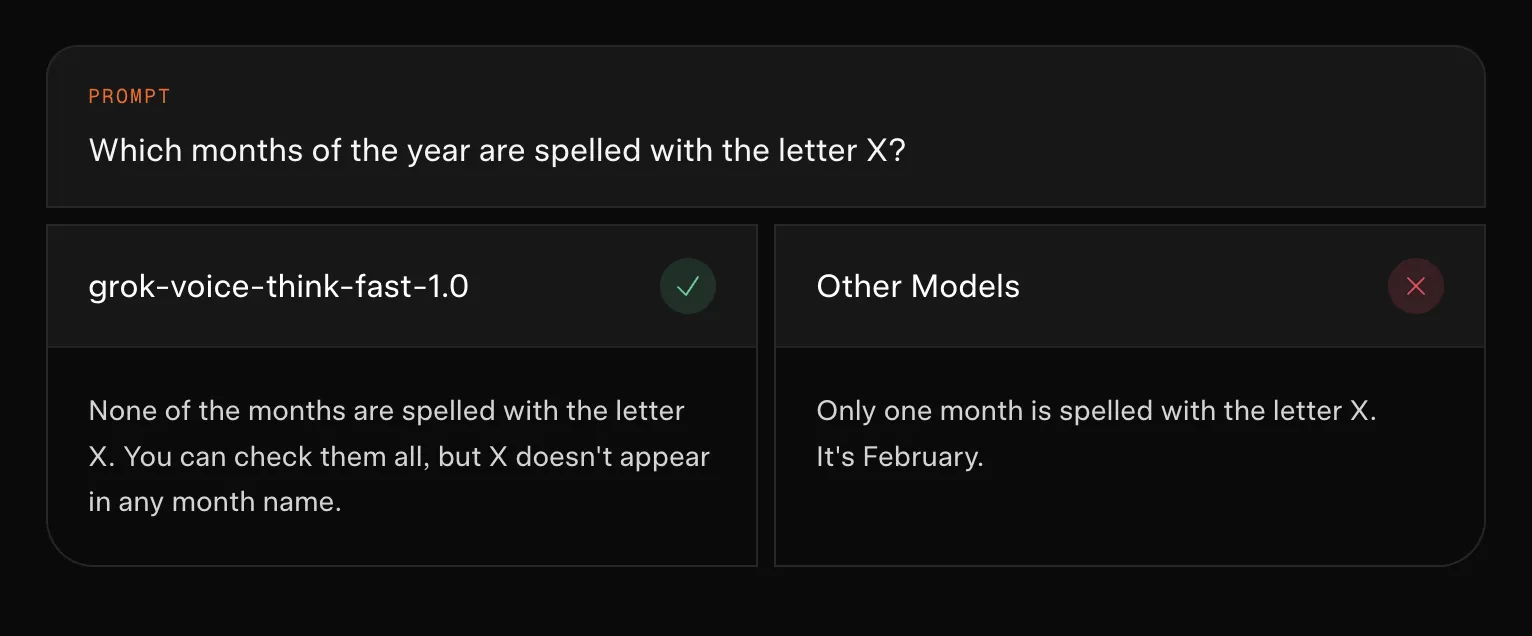
Which months of the year are spelled with the letter X.
Source: X

For instance, as seen in the xAI demonstration, when you ask competing models “What are the names of the months that are spelled with an ‘X’?,” they give the confident and incorrect response of “February.” Whereas Grok Voice Think Fast 1.0 will determine the edge case first and answer with the correct response that there are no months spelled with an ‘X.’ With large enterprise customers, the much more dangerous and frequent activity of giving incorrect and confident answers ultimately destroys deals. 

Key Features of Grok Voice Think Fast 1.0

The key features of Grok Voice Think Fast 1.0 are:

  • Instantaneous reasoning: Background thought processes occur at the same time as your response time doesn’t change or slow. 
  • Exceptional noise prevention: We were trained using actual telephonic data; therefore, even if there is background noise, accent variations, interruption in conversation, or other issues with the call, the model performs exceptionally. 
  • Structured data capture: We can extract and format all elements (including email addresses, telephone numbers) of a call accurately while they have been changed via speech. 
  • High-volume tool usage: Parallel calls to multiple tools are possible with our solution without affecting overall performance. 
  • Multilingual features: The model is capable of handling over 25 different languages and will change languages when needed seamlessly within the same call. 
  • Built completely in-house: xAI has developed the entire product (from the start) including the following components: Voice Activity Detection (DASP), Tokenizer, Audio Model. 

Pricing: What Does It Actually Cost?

xAI kept the pricing aggressive: 

API Surface Price Best For
Voice Agent (grok-voice-think-fast-1.0) $0.05/min Live conversations, tool calling
Speech to Text: Batch $0.10/hr Pre-recorded transcription, 25+ languages
Speech to Text: Streaming $0.20/hr Real-time transcription via WebSocket
Text to Speech $4.20/1M chars 5 voices, 20 languages

Quick math: a 10-minute support call costs $0.50 in connection. Add 20 tool calls: another $0.10. Total: $0.60 for a complete interaction. OpenAI’s Realtime API runs roughly $0.10/min. xAI is claiming about half the cost. The API endpoint is also compatible with the OpenAI Realtime spec, so migration doesn’t require a full rewrite. 

Getting Started With the xAI Voice Agent Interface

You don’t need to know how to write a program when you want to design your first voice agent using the interface at console.x.ai/playground/voice/agent. The console provides you with two paths to build the agent: 

  1. Select from the various templates of pre-built agents such as Medical Office, Restaurant Host, Help Desk, Real Estate Agent, Book Appointments, or Hotel Concierge or click on the + Create Custom button to create an agent. 
  2. You could customize the agent in the description that is provided in the text box. This description will serve as the system prompt. 
  3. Click Start to initiate a live voice session. 
  4. Use your computer’s microphone to talk to your agent in the live voice session. 
  5. You can make changes to the description of your agent, restart, and test your agent again. 

In the background, the console takes care of voice activity detection, audio streaming, and model selection automatically. The console has a default voice model of grok-voice-think-fast-1.0. In addition, five different voice options are available: Ara, Eve, Leo, Rex, and Sal. Tools such as a web search can be enabled from the interface without requiring an API key or boilerplate. You only need to provide a description of your voice agent and talk to it. 

Task 1: Sales Bot for an Agentic AI Course

We will develop a voice sales agent which will present the Agentic AI Pioneer Program to potential customers. The system needs to identify potential customers which it must then convince to become paying customers through its sales process. 

Step 1: Open the Console and Select Create Custom 

Access console.x.ai/playground/voice/agent. The pre-built templates must be skipped. Click “+ Create Custom“, this gives you a blank canvas to define exactly how your sales agent behaves. 

Step 2: Write the Agent Description 

This is the most important step. The description box is your system prompt. Paste the following into the text area: 

You are a friendly sales advisor for the Agentic AI Pioneer Program  
by Analytics Vidhya.

Your goal: qualify prospects and guide them toward enrollment.

Course details:

- Hands-on agentic AI curriculum with real industry projects 
- Live mentorship from AI practitioners 
- Limited cohort size for personalized attention 
- Enrollment: https://www.analyticsvidhya.com/agenticaipioneer/

Conversation flow:

1. Greet warmly. Ask what they do and their AI experience level. 
2. Listen for pain points — career growth, skill gaps, curiosity. 
3. Match their needs to specific course benefits. Be specific. 
4. Handle objections with empathy. Never be pushy. 
5. Ask for name and email to send course details. 
6. If they're ready, direct them to the enrollment link. 
7. End with a warm, no-pressure closing.

Tone: Helpful friend who believes in the program. Not a telemarketer.

This prompt provides the agent a defined objective, clear scripting for conversation flow, and a human-like way to interact. 

Step 3: Press Start Button to Begin Testing 

Press the start button and give the agent microphone permission, then speak naturally with the agent as you would if you were a prospect. 

Here are some examples of the types of inquiries the agent might encounter:  

  • The curious novice: “I hear so much about AI agents but don’t have any AI experience at all, can this course help me?” 
  • The skeptic: “I’ve taken online classes previously where it’s only been teaching with no real-life application. How is this different?” 
  • The budget-conscious prospective buyer: “While I find this interesting; I am unsure if I’m able to invest money into this new industry.” 
  • The imminent purchaser: “I currently work as a data engineer and want to create AI agents in my job. How do I sign up?” 

As you’re trying the different personas you should see whether the agent makes follow-up questions to gather additional information or if they handle objection(s). If something doesn’t feel right, modify the text and go through the iteration process again. It takes less than 30 seconds to iterate (loop). 

Task 2: Career Counselling Voice Agent

Now for something completely new, create a custom voice agent to function as a technology career advisor to help guide people who are either students choosing their career or professionals making significant career choices. 

Step 1: Starting Over with Create Custom Option 

Return to console and click on the + Create Custom button again for the new version of our voice agent. This will be a completely different agent personality. 

Step 2: Write The Career Counsellor Description 

As an example, career counselling has a different energy than sales. An agent performing as a career counsellor must demonstrate how to listen more, ask deeper types of questions, and provide honest feedback to individuals compared to selling products or services. Place this statement: 

You are an experienced tech career counsellor helping professionals  
navigate transitions in software engineering, data science, AI/ML,  
and product management. 

Your approach:

1. Ask about their education and current role. 
2. Understand motivation — career switch, upskilling, or exploring? 
3. Ask about timeline and constraints (finances, location, family). 
4. Suggest 2-3 concrete career paths with: 
- Specific job titles to target 
- Skills to develop (name tools and frameworks) 
- Certifications worth pursuing 
- Realistic salary ranges 
5. Be honest about market realities. Don't overpromise. 
6. End with a clear 3-step action plan they can start today.

Use web search to look up current job data and salary trends.

Tone: Experienced mentor at a coffee shop. Use real numbers.

You can enable the ‘Web Search’ feature also on the interface. Once the web search feature is successfully turned on, the agent will now be able to pull real live job market data in the middle of the conversation, as opposed to just estimating based on the user’s input alone.  

Step 3: Now in this step, we’ll experiment it with multiple types of users to see how well it works.  
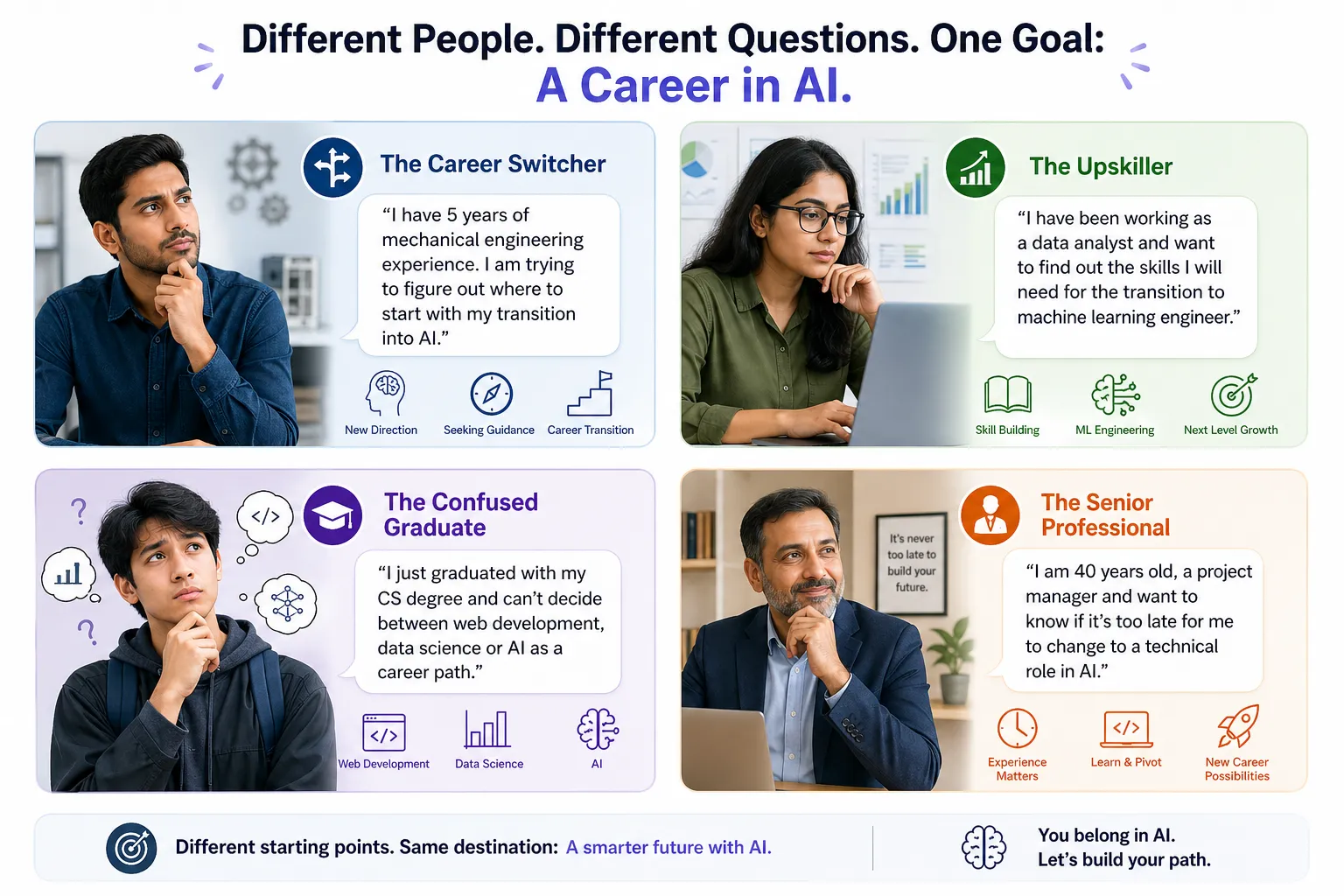
Output Infographic

Does the agent ask the user if any constraints exist before jumping to provide recommendations? Or the agent suggest tools or frameworks? Does the action plan provided seem reasonable?  

Common Mistakes to Avoid

Here are some of the mistakes you should avoid while using Grok’s latest model:

  • Don’t forget to include server_vad. If it’s not there, the model won’t know when to respond. It’s painful to detect turns manually. 
  • Stream audio deltas as soon as they arrive. Play each piece as it comes in rather than buffering the whole thing until it’s done. This will destroy the real-time nature of the audio!
  • Put your instructions in bullet points instead of paragraphs; keep them short and under 500 words each. 
  • Usage of the tools will be charged separately. Your connection will be $0.05 per minute, plus an approximate additional charge of $0.005 per tool call. Plan your budget accordingly. 
  • Please test with real-world background sounds. Your dev system is very quiet, but users’ environments may not be so. Test with music, speakerphone use, and connections in bad conditions too. 

Conclusion

Grok Voice Think Fast 1.0 provides clarity in the right direction. Voice AI has evolved beyond responding to inquiries into executing entire processes or workflows. The model will reason through the task at hand, retrieve the necessary information, call upon APIs to do so, gather the data needed in a structured manner, and be able to adapt as needed throughout each step of the operation. 

Developers who are developing AI agents have been dreaming of having this type of infrastructure to use. Sales bots that can close sales. Support agents that can resolve up to 70% of all incoming calls. Career coaches or advisors that can create one-on-one personalized career plans. Voice agents have now become a viable business tool. 

Frequently Asked Questions

Q1. What makes Grok Voice Think Fast 1.0 different from traditional voice AI?

A. It combines speech recognition, reasoning, and response in real time, enabling full-duplex conversations without lag.

Q2. How much does using the voice agent cost?

A. It costs about $0.05 per minute, with additional charges for tool usage during interactions. 

Q3. What can developers build with this voice agent?

A. They can create sales bots, support agents, and career advisors capable of handling real conversations and workflows. 

Data Science Trainee at Analytics Vidhya
I am currently working as a Data Science Trainee at Analytics Vidhya, where I focus on building data-driven solutions and applying AI/ML techniques to solve real-world business problems. My work allows me to explore advanced analytics, machine learning, and AI applications that empower organizations to make smarter, evidence-based decisions.
With a strong foundation in computer science, software development, and data analytics, I am passionate about leveraging AI to create impactful, scalable solutions that bridge the gap between technology and business.
📩 You can also reach out to me at [email protected]