惯性聚合 高效追踪和阅读你感兴趣的博客、新闻、科技资讯
阅读原文 在惯性聚合中打开

推荐订阅源

Stack Overflow Blog
Stack Overflow Blog
N
News | PayPal Newsroom
阮一峰的网络日志
阮一峰的网络日志
月光博客
月光博客
T
Tailwind CSS Blog
博客园 - 叶小钗
博客园 - 【当耐特】
Apple Machine Learning Research
B
Blog RSS Feed
Know Your Adversary
Know Your Adversary
P
Privacy International News Feed
cs.CL updates on arXiv.org
Project Zero
Project Zero
美团技术团队
雷峰网
雷峰网
Martin Fowler
Martin Fowler
P
Privacy & Cybersecurity Law Blog
T
The Blog of Author Tim Ferriss
S
Schneier on Security
V
V2EX
Cisco Talos Blog
Cisco Talos Blog
Blog — PlanetScale
Blog — PlanetScale
G
GRAHAM CLULEY
J
Java Code Geeks
V
Visual Studio Blog
N
Netflix TechBlog - Medium
Threat Intelligence Blog | Flashpoint
Cyberwarzone
Cyberwarzone
Recent Announcements
C
CXSECURITY Database RSS Feed - CXSecurity.com
让小产品的独立变现更简单 - ezindie.com
N
News and Events Feed by Topic
Forbes - Security
Forbes - Security
GbyAI
GbyAI
奇客Solidot–传递最新科技情报
奇客Solidot–传递最新科技情报
The Hacker News
The Hacker News
Application and Cybersecurity Blog
The Cloudflare Blog
腾讯CDC
爱范儿
爱范儿
Exploit-DB.com RSS Feed
OSCHINA 社区最新新闻
OSCHINA 社区最新新闻
罗磊的独立博客
T
Threatpost
大猫的无限游戏
大猫的无限游戏
NISL@THU
NISL@THU
Cloudbric
Cloudbric
C
CERT Recently Published Vulnerability Notes
C
Check Point Blog
Microsoft Azure Blog

Analytics Vidhya

Handling Imbalanced Classification: What Works Better Than SMOTE GPT-5.6 Is Here: Sol, Terra, and Luna Loop Engineering for AI Agents: How /loop is Changing AI Workflows DeepSeek DSpark: The Speculative Decoding Trick Behind 400% Faster LLM OKF: Redefining Knowledge Bases for AI Agents Modern VLMs Explained: How GPT-4o, Gemini, Claude Vision, and Qwen-VL Work YOLO26 Tutorial: Object Detection, Pose Estimation & More Large Action Models (LAMs) vs Agentic LLMs: What's the Real Difference? Claude Sonnet 5: The Fable 5 at Home GraphRAG vs Vector RAG: Which Retrieval Method is Best? Using AI When You Don’t Trust AI The Self-Improving Loop in AI Agents: Architecture, Benefits, and How it Outperforms Traditional Agent Workflows Harness-1: The 20B Retrieval Subagent That Beats GPT-5.4 at Search Sakana Fugu: Multi-Agent System as a Model Claude's Hidden Art Skill: Making Illustrations With Code System Design for ML Interviews: 10 Real Problems Walked Through Most People Use ChatGPT Wrong: 10 Features and Tips That Changed How I Work OpenAI Just Launched 3 Free AI Courses with Certificates Autoregressive Models: Predicting the Future Using the Past Gemini Omni: AI Video Generation Inside Gemini DiffusionGemma: Google’s Diffusion-Based Open Model for Faster Text Generation Top 10 AI Engineering Tools Everyone is Using in 2026 I Tested Claude Fable 5: Can Anthropic’s Newest AI Deliver on the Hype? Prophet vs NeuralProphet vs TimeGPT vs Chronos: A Practical Comparison Build an Emergency Helpline Voice Agent with LangChain Choosing the Right Vector Database for RAG and AI Applications Google Gemma 4 12B: Architecture, Benchmarks, Access, and Hands-on Guide for Developers How to Choose the Right AI Model for Your Needs Agent Observability with LangSmith, Langfuse, and Arize: A Hands-On Comparison How to Use Claude Managed Agents? Google AI Studio vs Gemini App: What’s the Difference? AI Workflows for Sales Teams: Prospect Research, Lead Qualification, and CRM Updates on Autopilot Using LangGraph 25 Most Influential AI Pioneers to Meet at DataHack Summit 2026 Claude Opus 4.8: A Smarter Model in the Right Direction PySpark Optimization: 12 Proven Techniques to Speed Up Your Spark Jobs 10 Everyday Tasks You Can Automate with AI Today (With n8n Templates) Google Antigravity 2.0: The Full Developer Guide (I/O 2026) Build a Claude Cowork-Like Browser Agent Using Playwright MCP and Claude Desktop Pandas vs Polars vs DuckDB: Which Library Should You Choose? Qwen3.7-Max: Alibaba’s New Agent-First LLM for Coding, Reasoning, and Long-Horizon AI Workflows The Biggest Announcements from Google I/O 2026 Top 9 AI Events and Conferences in 2026 that you Must Attend Gemini 3.5 Flash: Frontier Intelligence with Speed Kimi WebBridge: Hands-on Guide to Kimi’s Browser Extension for AI Agents 40 Advanced SQL Window Functions Every Data Scientist Must Know(with examples) Top 10 AI Research Papers of 2025 6 Steps to Crack GenAI Case Study Interviews (With Real Examples) OpenAI Omni Moderation: How to Filter Text & Images for Free DataHack Summit 2026: You Just Cannot Skip This AI Event of the Year OpenAI’s New API Voice Models Will Change the Way You Use AI Hermes Agent Guide: What is it and How to Use it? Top 10 LLM Research Papers of 2026 Agent Memory Patterns in Cognitive Science and AI Systems 10 AI Agents Every AI Engineer Must Build (with GitHub Samples) 23 Tips for Smart Claude Code Token Saving and Workflow Optimization Feature Engineering with LLMs: Techniques & Python Examples ChatGPT is Now Inside Excel and Google Sheets: Here is How to Use it Gemini API File Search: The Easy Way to Build RAG Top 10 Open-Source Libraries to Fine-Tune LLMs Locally ML Intern in Practice: From Prompt to a Shipped Hugging Face Model 15+ Solved Agentic AI Projects with Github Links How People are Figuring Out Life With Claude MemPalace Explained: Building Long-Term Memory for AI Agents Beyond RAG Grok Voice Think Fast 1.0: Build Voice AI Agents That Actually Think Compressing LSTM Models for Retail Edge Deployment: A Practical Comparison MCP vs Agent Skills: Different Altogether GPT 5.5 vs Opus 4.7: Which is the Best AI Model Today? What is Agentic AI? Claude Code vs Codex: A Detailed Terminal Agent Comparison Google Deep Research Max: Build Autonomous AI Research Agents in Minutes Meta Muse Spark Review: Is It Worth the Hype? ChatGPT Images 2.0 vs Nano Banana 2: Which is Better? Cursor V3 Explained: The AI Coding Agent That’s Replacing Traditional IDEs in 2026 DeepSeek-V4: The Most Powerful Open-Source Model Ever Is GPT Image 2 the Best Image Generation Model? Token Economics: Why AI is Getting “Cheaper” From Idea to Output: Claude Does the Design Work Opus 4.7 vs Opus 4.6: Should You Switch? Build Human-Like AI Voice App with Gemini 3.1 Flash TTS How to Structure a Claude Code Project that Thinks Like an Engineer Gemma 4 Tool Calling Explained: Build AI Agents with Function Calling (Step-by-Step Guide) Anthropic Launches Claude Opus 4.7 For “Most Difficult Tasks” Top 28 Claude Shortcuts that will 10X your Speed GPT-5.4-Cyber: Why OpenAI is Keeping its Most Powerful Model Under Lock and Key Google AI Studio Guide: Every Feature Explained Mastering Deep Agents: Context Engineering that Actually Works 21 Computer Vision Projects from Beginner to Advanced (2026 Guide) Excel 101: Excel Agent Mode Explained MiniMax M2.7 Goes Open-Weight to Let You Run Agents Locally Top 10 Gemma 4 Projects That Will Blow Your Mind GLM-5.1: Architecture, Benchmarks, Capabilities & How to Use It Understanding BERTopic: From Raw Text to Interpretable Topics From Karpathy’s LLM Wiki to Graphify: AI Memory Layers are Here 10 Most Important AI Concepts Explained Simply Project Glasswing is World’s Most Powerful AI in Action How to Run Gemma 4 on Your Phone Without Internet: A Hands-On Guide Running Claude Code for Free with Gemma 4 and Ollama LLM Wiki Revolution: How Andrej Karpathy’s Idea is Changing AI Rethinking Enterprise Search: How Cortex Search Turns Data into Business Impact Google’s Gemma 4: Is it the Best Open-Source Model of 2026?
The Best $20 AI Plan: ChatGPT Plus vs Claude Pro vs Gemini Pro
Vasu Deo Sankrityayan · 2026-06-30 · via Analytics Vidhya

Reading list

Vasu Deo Sankrityayan

6 min read

Three chatbots. Same price of $20 for their subscriptions. The convergence is almost funny considering how different the offerings are.

The same price does not mean the same product. I paid for all three and ran the same work through each. They are not interchangeable as you’ll soon find out.

Pick wrong and you’ll spend months wondering why everyone else seems to be getting more out of this. Pick right and the 20 dollars pays for itself by Tuesday. So here’s what actually separates them.

Table of contents

  • The whole picture, at a glance
  • Rule two out first
  • The fight over words
  • The fight over code
  • The fight over research
  • What it remembers
  • What each plugs into
  • The overlooked feature
  • Google is a bundle
  • The Ceiling
  • Which $20 AI Plan Should You Buy?

The whole picture, at a glance

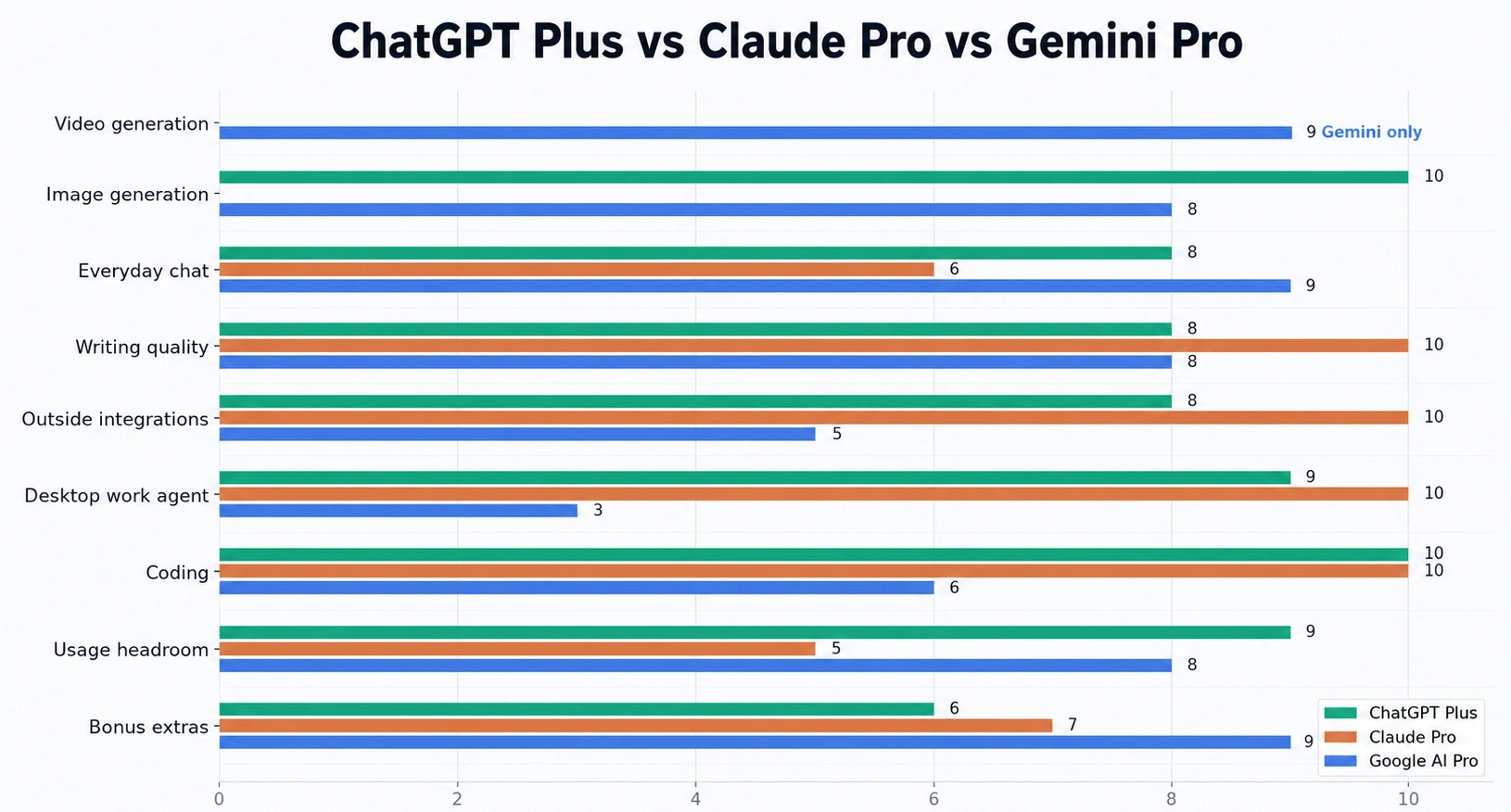
My scores after months of use:

ChatGPT Plus vs Claude Pro vs Gemini Pro
Claude can generate vector graphics by rendering SVG to PNG, but cannot produce full image generation

Rule two out first

Do not ask which is best. Ask what you cannot live without. A few need to settle it instantly:

  • Need video? Only Google does it, and does it well. Claude and ChatGPT do not. Decision made.
  • Need images? Claude is out entirely. ChatGPT makes the best ones; Google is a close second.
Two needs

knock out two plans before the real contest begins.

The fight over words

For most people, the daily job is writing. If that’s your work, the choice isn’t close. Claude writes best of the three models, by a mile. Here are its standout features:
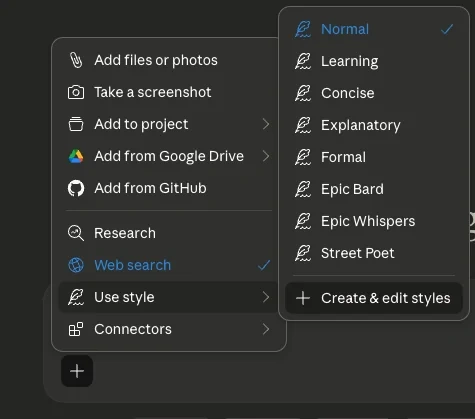
  • Sounds human, not assembled: The others read templates. Claude has a voice. Its default mode of economical word usage and precise intent delivery puts it in a league of its own.
  • Learns your voice: Feed it your old writing samples and watch it create every draft that comes back sounding like you. This is exclusive to Claude.
Writing Style in Claude
As of June, 2026, this has been moved to Skills
  • Holds tone across long pieces: Consistent from first line to last, due to having long contexts in the chat interface.

Caveat: Best writer, not best editor. You can’t hand-edit its drafts, only ask for changes.

If the words are the product, choose Claude.

The fight over code

Closest race of the bunch. Two real winners here, not one.

Claude and ChatGPT are both legit. Either ships code you can actually use, tracks what’s happening across files, and holds up when you let it run loose.

Gemini’s the odd one out: it gets shaky on big, messy, unfamiliar codebases. The huge context window (1M+) is handy for reading a whole repo, but doesn’t save it when the problem’s actually hard. Fine for a script, not for the gnarly stuff.

Between the two that matter:

  • Cleaner code: Claude. Thinks before it types, giving a tighter structure. The one most people reach for when it’s serious.
  • Better workflow: ChatGPT. Codex lives inside your setup, so code lands where you already work. Claude Code is close, but ChatGPT edges it here. Gemini CLI is just a placeholder compared to these two.

Catch with Claude: usage limits dry up fast on long sessions. Plan around it.

Read more: 23 tips to save Claude Code tokens

The fight over research

Every model says it can research. They don’t mean the same thing by it. Ask all three the same question and the split shows up right away.
  • Gemini casts the widest net. Google’s search DNA is doing the work, so it reaches further and comes back with the freshest stuff. If you need what happened this week, it’s the one that actually knows.
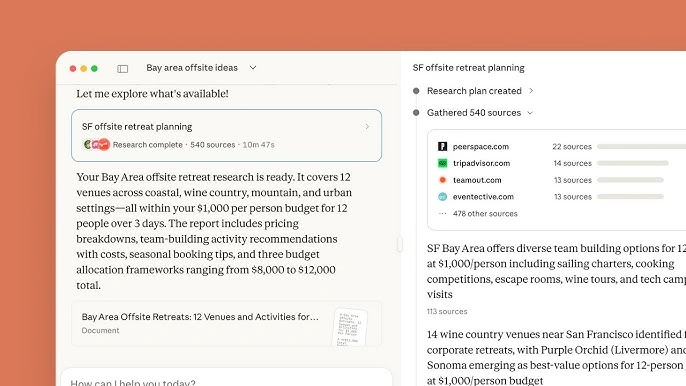
  • Claude is the one that makes the pile make sense. It doesn’t just hand you a stack of links. It reasons over them, connects them, and tells you what they add up to. Linguistically the outputs are above all else.
Claude research
  • ChatGPT is the steady all-rounder. Good citations, thorough, web access that works. It’s rarely the sharpest at either finding or reasoning, but it doesn’t faceplant either. One catch though: when it’s wrong, it’s wrong with total confidence, the same calm voice it uses for facts. Verify it

The bigger catch: casting a wide net and knowing what’s in it aren’t the same skill. Gemini finds the most. It doesn’t always know what matters.

What it remembers

A model that forgets you every session makes you do the same setup forever. Memory is the difference between a tool and an assistant.

  • Most mature: ChatGPT. Builds a real profile over time, carries it across chats, and you feel it.
  • Most personal: Claude. Memory plus the voice-learning skill means it doesn’t just remember facts, it remembers how you sound.
  • Most contextual: Gemini. Less standalone memory, but it leans on everything Google already knows about you.

Caveat: the same memory that helps can drift. All three occasionally remember the wrong thing confidently.

What each plugs into

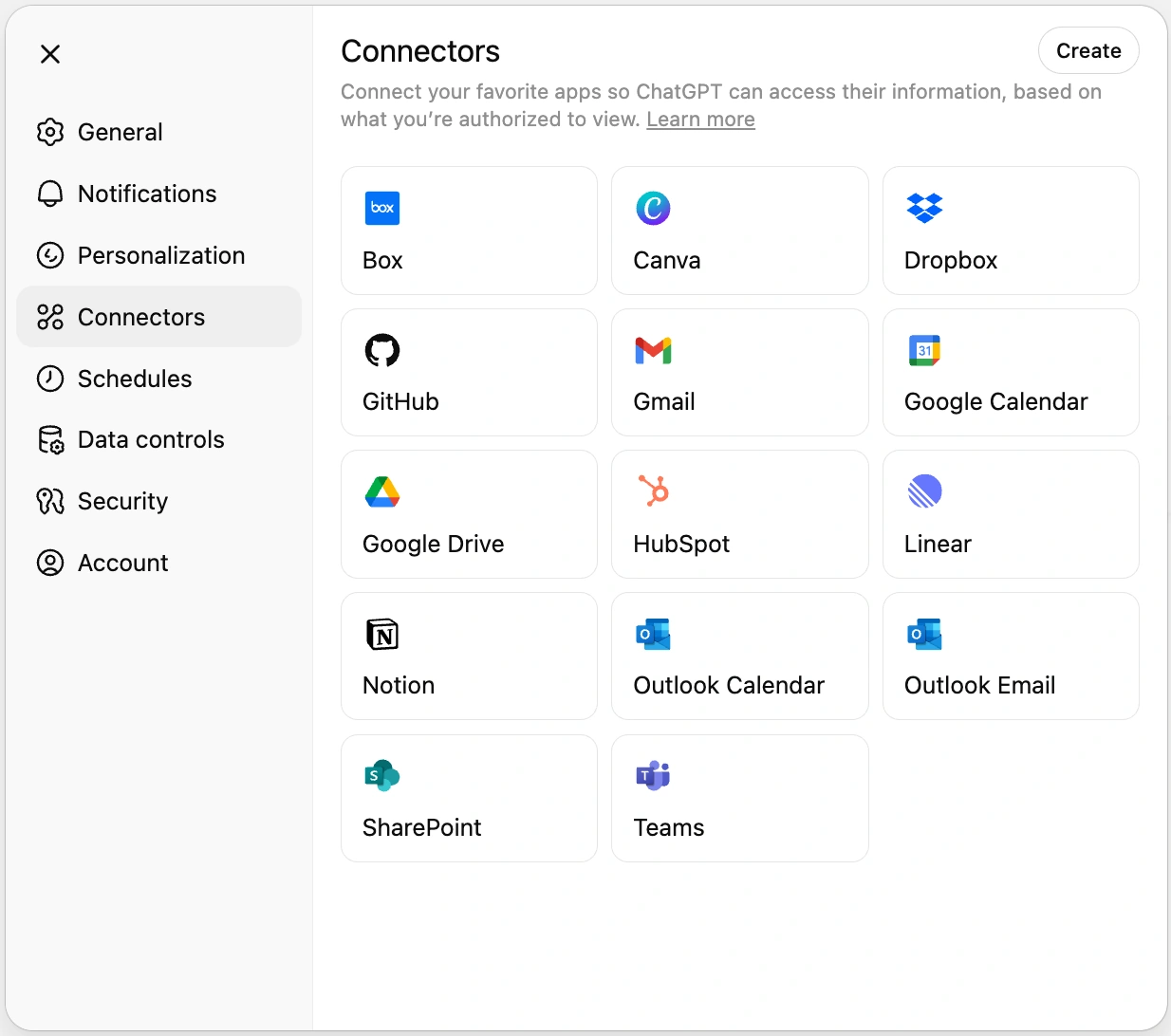
Connections allow these models to further enhance their capabilities. While some of the models offer limited (albeit robust) integration, the others are a lot more liberal when it comes to connections:
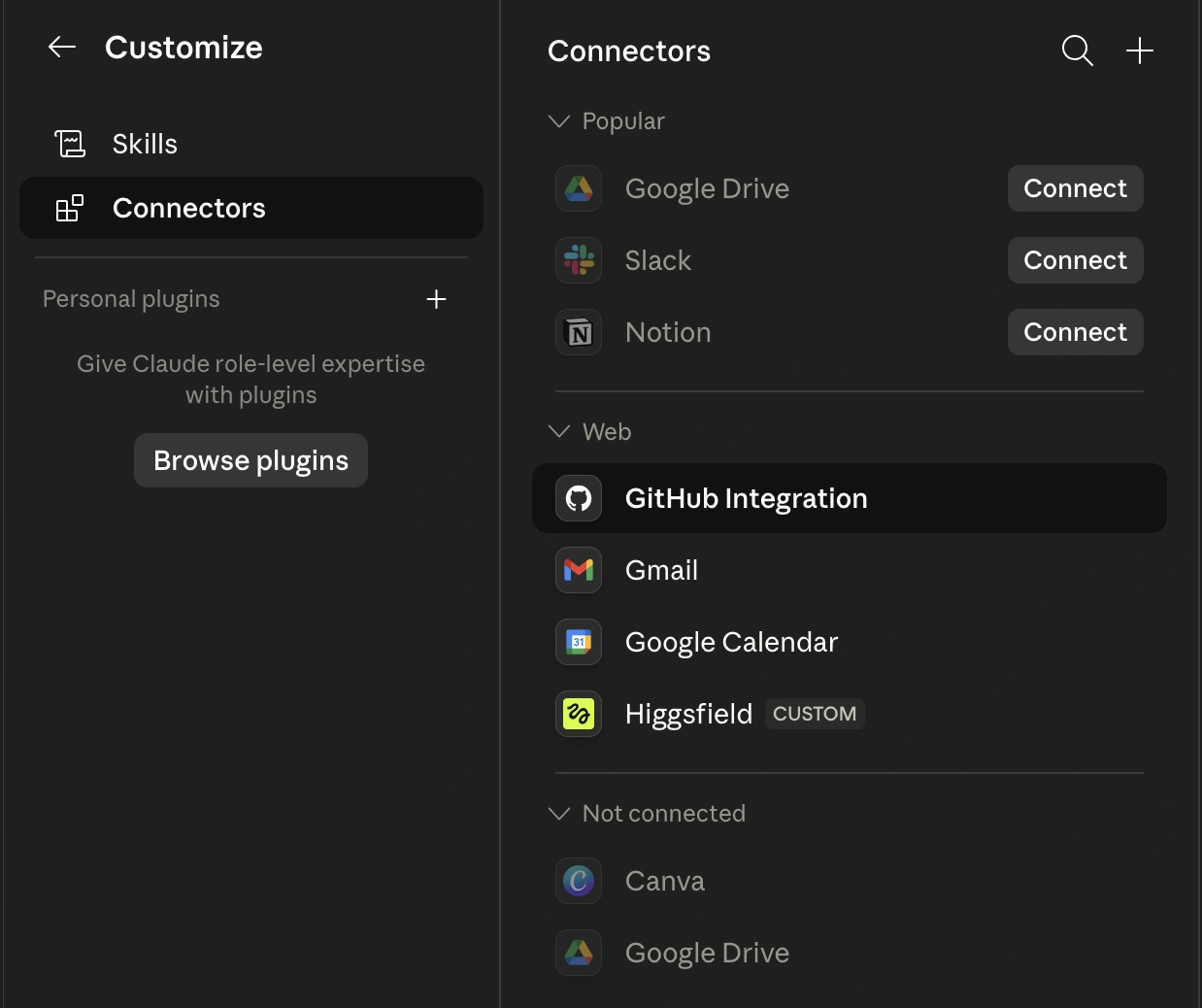
  • Claude: connects to almost everything, because it includes Zapier.
Claude Connectors
  • ChatGPT: supports several types of integrations barring Zapier.
ChatGPT connectors
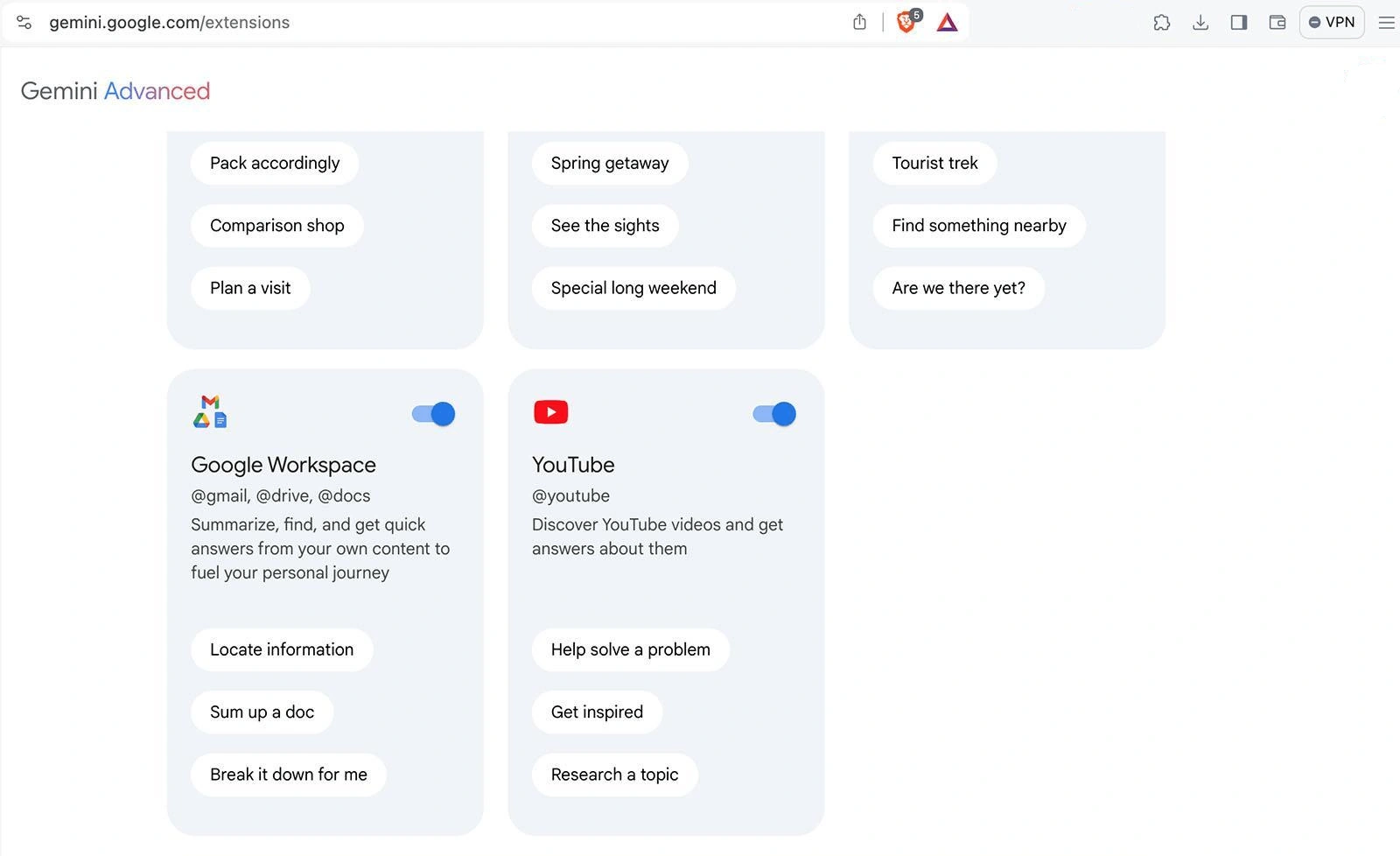
  • Gemini: The entire Google Ecosystem. Gmail, Drive, YouTube and any other service/product that falls under the Google umbrella can be connected with Gemini.
Google AI Ecosystem

The overlooked feature

Two plans hand you a desktop agent that works on your real files. This changes everything.
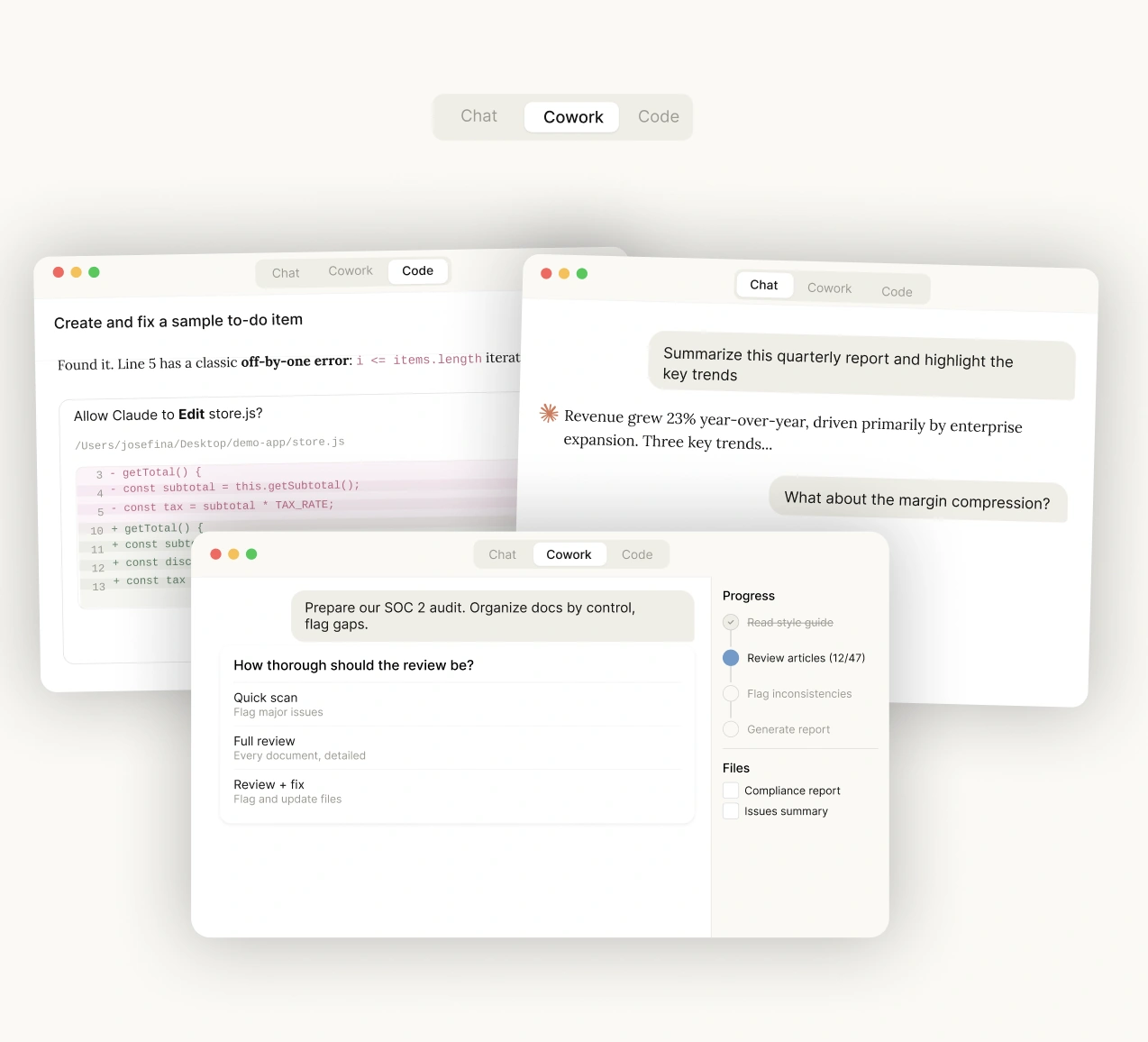
  • Claude Cowork points at a folder and reads, edits, and builds files. Best-in-class for knowledge work.
  • ChatGPT Codex is just as capable, a touch less tidy. Either makes you happy.
  • Gemini Spark is cloud-only and locked to higher tiers. Not in this plan yet.
Claude Cowork

Google is a bundle

Google AI Pro is more like Pandora’s box than an LLM subscription: video tools (Veo3 & Omni), music, NotebookLM, YouTube Premium, a health coach, cloud credits, 5TB Google Drive storage and much more.

Several are $10 products alone. The standalone value clears the price, if you use the pieces.
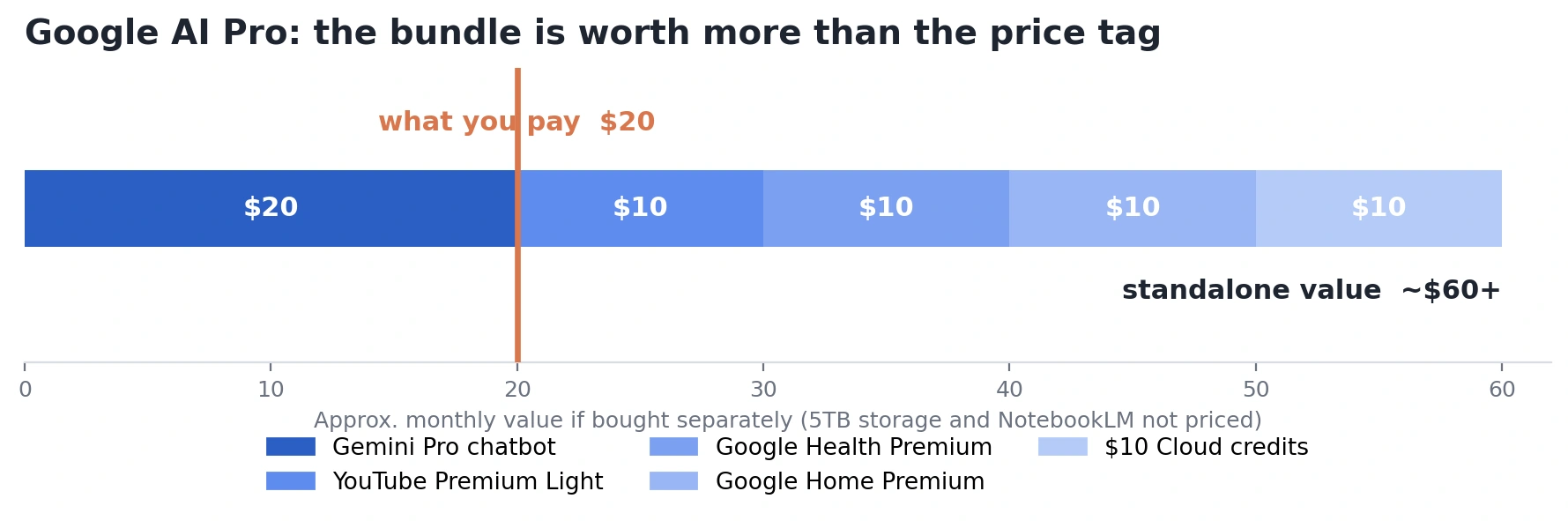
The bundle offered by Google in the Google AI Plus subscription

But in terms of the value it offers as an LLM, it is pretty lacklustre.

The Ceiling

Features mean nothing if you hit a wall, and you will hit one. The real question is how soon, and that single fact can decide your whole subscription.

The biggest divide is what happens when you hit it:

  • ChatGPT and Gemini quietly downgrade you to a weaker model and let you keep going.
  • Claude just stops. No fallback, no downgrade, you wait for the reset.

The takeaway: If you work in long, intense bursts, Claude’s wall arrives first and hits hardest. ChatGPT is the most predictable, while Gemini is the most forgiving.

Here’s how the limits actually work:

  ChatGPT Plus Claude Pro Gemini Pro
Limit type Fixed, published Variable Variable
Main cap 160 msgs / 3 hrs (top model) Flexes by model, tools, length Flexes by model & usage
Reset window Every 3 hours Every 5 hours (+ weekly cap) Rolling
At the limit Downgrades, keeps going Stops until reset Downgrades, keeps going
Runs out… Least often Fastest Rarely (I could never hit limit)

The table now carries the per-plan detail, and the prose just makes the one point that matters.
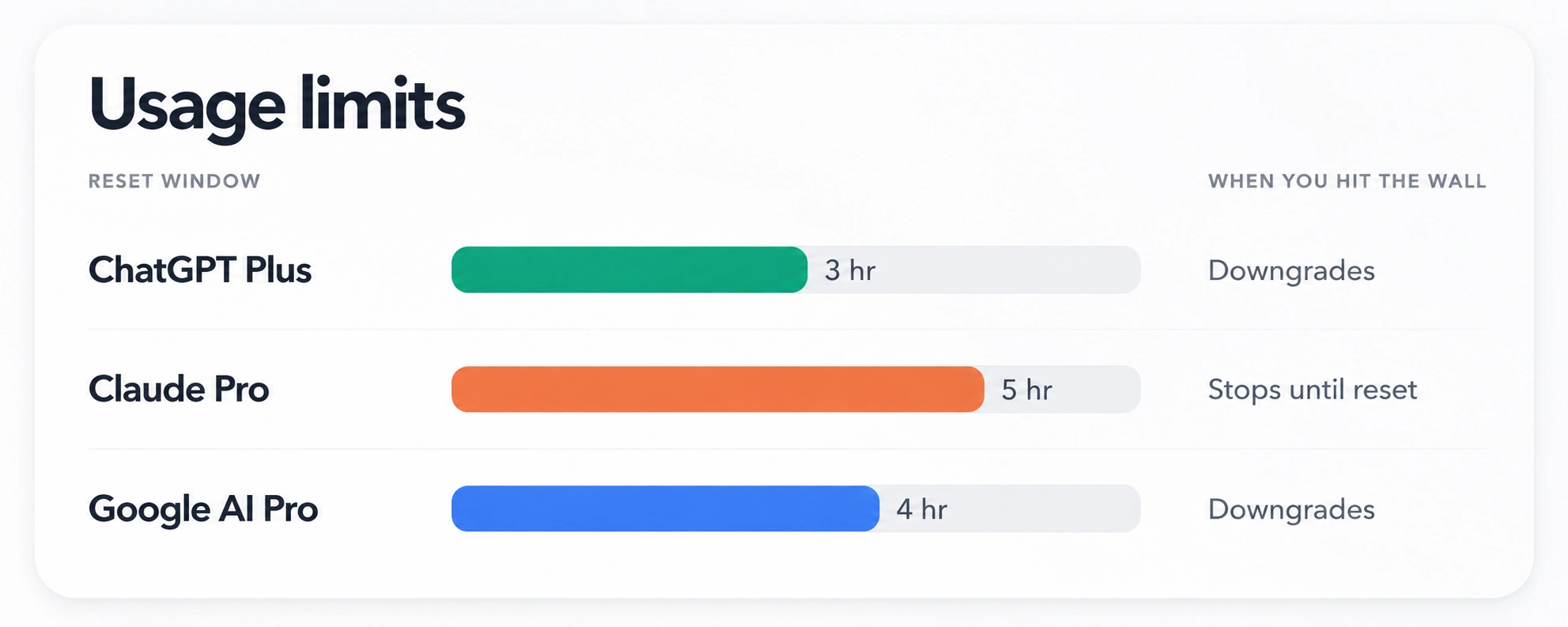
Usage limits of ChatGPT, Claude, Gemini
Use this graphic as a reference

Which $20 AI Plan Should You Buy?

Match the plan to how you work.

  • Claude: best writing, the Cowork agent, near-universal integrations. It runs out first.
  • ChatGPT: best images, steadiest limits, the safe all-rounder.
  • Google: video, a real editor, the deepest bundle, if you already live in Google.

Here’s the full comprehensive comparison between the subscriptions:

Feature ChatGPT Plus Claude Pro Gemini Pro
Price $20 / month $20 / month $20 / month
Best for The safe all-rounder Writing & knowledge work Media & Google power users
Everyday chat Reliable, tunable Dense replies Most structured
Writing quality Strong Best, most human Strong
Document editing Inline, editable View only, no hand edits Full word-processor canvas
Image generation Best in class None Very good
Video generation None None Yes, and good
Coding Excellent via Codex Excellent Capable
Desktop work agent Codex, local files Cowork, local files Spark, cloud, higher tiers
Integrations Long list, no Zapier Most, includes Zapier Mostly Google products
Usage limits Clear numbers, most room Flexes, runs out first Flexes, extras don’t count
At the limit Downgrades, keeps going Stops until reset Downgrades, keeps going
Bundled extras Few Few Many: video, music, 5TB, etc.
Standout strength Predictability + images Writing + integrations Sheer value of the bundle
Main weakness Fewer extras Hits limits, no doc editing Weak outside Google

I specialize in reviewing and refining AI-driven research, technical documentation, and content related to emerging AI technologies. My experience spans AI model training, data analysis, and information retrieval, allowing me to craft content that is both technically accurate and accessible.


Login to continue reading and enjoy expert-curated content.

Free Courses