

惯性聚合 高效追踪和阅读你感兴趣的博客、新闻、科技资讯
阅读原文 在惯性聚合中打开

推荐订阅源

J
Java Code Geeks
GbyAI
GbyAI
阮一峰的网络日志
阮一峰的网络日志
Cloudbric
Cloudbric
奇客Solidot–传递最新科技情报
奇客Solidot–传递最新科技情报
宝玉的分享
宝玉的分享
I
Intezer
Simon Willison's Weblog
博客园_首页
The Cloudflare Blog
C
Cisco Blogs
AWS News Blog
AWS News Blog
IT之家
IT之家
Cyberwarzone
Cyberwarzone
罗磊的独立博客
美团技术团队
V
V2EX
Project Zero
Project Zero
A
Arctic Wolf
C
Cyber Attacks, Cyber Crime and Cyber Security
大猫的无限游戏
大猫的无限游戏
博客园 - 叶小钗
月光博客
月光博客
freeCodeCamp Programming Tutorials: Python, JavaScript, Git & More
酷 壳 – CoolShell
酷 壳 – CoolShell
博客园 - 聂微东
有赞技术团队
有赞技术团队
钛媒体:引领未来商业与生活新知
钛媒体:引领未来商业与生活新知
雷峰网
雷峰网
S
Schneier on Security
P
Privacy International News Feed
V
Visual Studio Blog
量子位
T
Tor Project blog
S
Securelist
腾讯CDC
A
About on SuperTechFans
T
Threat Research - Cisco Blogs
G
GRAHAM CLULEY
B
Blog RSS Feed
D
DataBreaches.Net
博客园 - 三生石上(FineUI控件)
B
Blog
NISL@THU
NISL@THU
L
Lohrmann on Cybersecurity
V
Vulnerabilities – Threatpost
人人都是产品经理
人人都是产品经理
博客园 - 【当耐特】
L
LINUX DO - 热门话题
Recorded Future
Recorded Future

Analytics Vidhya

Handling Imbalanced Classification: What Works Better Than SMOTE GPT-5.6 Is Here: Sol, Terra, and Luna Loop Engineering for AI Agents: How /loop is Changing AI Workflows DeepSeek DSpark: The Speculative Decoding Trick Behind 400% Faster LLM OKF: Redefining Knowledge Bases for AI Agents Modern VLMs Explained: How GPT-4o, Gemini, Claude Vision, and Qwen-VL Work YOLO26 Tutorial: Object Detection, Pose Estimation & More Large Action Models (LAMs) vs Agentic LLMs: What's the Real Difference? Claude Sonnet 5: The Fable 5 at Home The Best $20 AI Plan: ChatGPT Plus vs Claude Pro vs Gemini Pro GraphRAG vs Vector RAG: Which Retrieval Method is Best? Using AI When You Don’t Trust AI The Self-Improving Loop in AI Agents: Architecture, Benefits, and How it Outperforms Traditional Agent Workflows Harness-1: The 20B Retrieval Subagent That Beats GPT-5.4 at Search Sakana Fugu: Multi-Agent System as a Model Claude's Hidden Art Skill: Making Illustrations With Code System Design for ML Interviews: 10 Real Problems Walked Through Most People Use ChatGPT Wrong: 10 Features and Tips That Changed How I Work OpenAI Just Launched 3 Free AI Courses with Certificates Autoregressive Models: Predicting the Future Using the Past Gemini Omni: AI Video Generation Inside Gemini DiffusionGemma: Google’s Diffusion-Based Open Model for Faster Text Generation Top 10 AI Engineering Tools Everyone is Using in 2026 I Tested Claude Fable 5: Can Anthropic’s Newest AI Deliver on the Hype? Prophet vs NeuralProphet vs TimeGPT vs Chronos: A Practical Comparison Build an Emergency Helpline Voice Agent with LangChain Choosing the Right Vector Database for RAG and AI Applications Google Gemma 4 12B: Architecture, Benchmarks, Access, and Hands-on Guide for Developers How to Choose the Right AI Model for Your Needs Agent Observability with LangSmith, Langfuse, and Arize: A Hands-On Comparison How to Use Claude Managed Agents? Google AI Studio vs Gemini App: What’s the Difference? AI Workflows for Sales Teams: Prospect Research, Lead Qualification, and CRM Updates on Autopilot Using LangGraph 25 Most Influential AI Pioneers to Meet at DataHack Summit 2026 Claude Opus 4.8: A Smarter Model in the Right Direction PySpark Optimization: 12 Proven Techniques to Speed Up Your Spark Jobs 10 Everyday Tasks You Can Automate with AI Today (With n8n Templates) Google Antigravity 2.0: The Full Developer Guide (I/O 2026) Build a Claude Cowork-Like Browser Agent Using Playwright MCP and Claude Desktop Pandas vs Polars vs DuckDB: Which Library Should You Choose? Qwen3.7-Max: Alibaba’s New Agent-First LLM for Coding, Reasoning, and Long-Horizon AI Workflows The Biggest Announcements from Google I/O 2026 Top 9 AI Events and Conferences in 2026 that you Must Attend Gemini 3.5 Flash: Frontier Intelligence with Speed Kimi WebBridge: Hands-on Guide to Kimi’s Browser Extension for AI Agents 40 Advanced SQL Window Functions Every Data Scientist Must Know(with examples) Top 10 AI Research Papers of 2025 6 Steps to Crack GenAI Case Study Interviews (With Real Examples) OpenAI Omni Moderation: How to Filter Text & Images for Free DataHack Summit 2026: You Just Cannot Skip This AI Event of the Year OpenAI’s New API Voice Models Will Change the Way You Use AI Hermes Agent Guide: What is it and How to Use it? Top 10 LLM Research Papers of 2026 Agent Memory Patterns in Cognitive Science and AI Systems 10 AI Agents Every AI Engineer Must Build (with GitHub Samples) 23 Tips for Smart Claude Code Token Saving and Workflow Optimization Feature Engineering with LLMs: Techniques & Python Examples ChatGPT is Now Inside Excel and Google Sheets: Here is How to Use it Gemini API File Search: The Easy Way to Build RAG Top 10 Open-Source Libraries to Fine-Tune LLMs Locally ML Intern in Practice: From Prompt to a Shipped Hugging Face Model 15+ Solved Agentic AI Projects with Github Links MemPalace Explained: Building Long-Term Memory for AI Agents Beyond RAG Grok Voice Think Fast 1.0: Build Voice AI Agents That Actually Think Compressing LSTM Models for Retail Edge Deployment: A Practical Comparison MCP vs Agent Skills: Different Altogether GPT 5.5 vs Opus 4.7: Which is the Best AI Model Today? What is Agentic AI? Claude Code vs Codex: A Detailed Terminal Agent Comparison Google Deep Research Max: Build Autonomous AI Research Agents in Minutes Meta Muse Spark Review: Is It Worth the Hype? ChatGPT Images 2.0 vs Nano Banana 2: Which is Better? Cursor V3 Explained: The AI Coding Agent That’s Replacing Traditional IDEs in 2026 DeepSeek-V4: The Most Powerful Open-Source Model Ever Is GPT Image 2 the Best Image Generation Model? Token Economics: Why AI is Getting “Cheaper” From Idea to Output: Claude Does the Design Work Opus 4.7 vs Opus 4.6: Should You Switch? Build Human-Like AI Voice App with Gemini 3.1 Flash TTS How to Structure a Claude Code Project that Thinks Like an Engineer Gemma 4 Tool Calling Explained: Build AI Agents with Function Calling (Step-by-Step Guide) Anthropic Launches Claude Opus 4.7 For “Most Difficult Tasks” Top 28 Claude Shortcuts that will 10X your Speed GPT-5.4-Cyber: Why OpenAI is Keeping its Most Powerful Model Under Lock and Key Google AI Studio Guide: Every Feature Explained Mastering Deep Agents: Context Engineering that Actually Works 21 Computer Vision Projects from Beginner to Advanced (2026 Guide) Excel 101: Excel Agent Mode Explained MiniMax M2.7 Goes Open-Weight to Let You Run Agents Locally Top 10 Gemma 4 Projects That Will Blow Your Mind GLM-5.1: Architecture, Benchmarks, Capabilities & How to Use It Understanding BERTopic: From Raw Text to Interpretable Topics From Karpathy’s LLM Wiki to Graphify: AI Memory Layers are Here 10 Most Important AI Concepts Explained Simply Project Glasswing is World’s Most Powerful AI in Action How to Run Gemma 4 on Your Phone Without Internet: A Hands-On Guide Running Claude Code for Free with Gemma 4 and Ollama LLM Wiki Revolution: How Andrej Karpathy’s Idea is Changing AI Rethinking Enterprise Search: How Cortex Search Turns Data into Business Impact Google’s Gemma 4: Is it the Best Open-Source Model of 2026?
How People are Figuring Out Life With Claude
Sarthak Dogr · 2026-05-02 · via Analytics Vidhya

AI chatbots are the new norm. What earlier was “ask Google” has now largely become “ask Claude”. And that is not just a change of platforms. The new form of conversational guidance goes a whole lot deeper than trying to find the best car for you or looking for an upskilling course. It now spills into just about every aspect of human life, and a new study by Anthropic confirms this, highlighting Claude’s extensive use for personal guidance by users across the world.

At the surface, the study by Anthropic shines light on how exactly people are using Claude for personal guidance. Yet, it manages to go a whole lot deeper, tackling a major issue that plagues just about every LLM like Claude and ChatGPT today. And one which can potentially lead to you receiving bad advice from Claude, even if it does not mean to.

So, what is this issue? And more importantly, what is this study all about?

Let us explore that in detail here.

What is the new Anthropic Study?

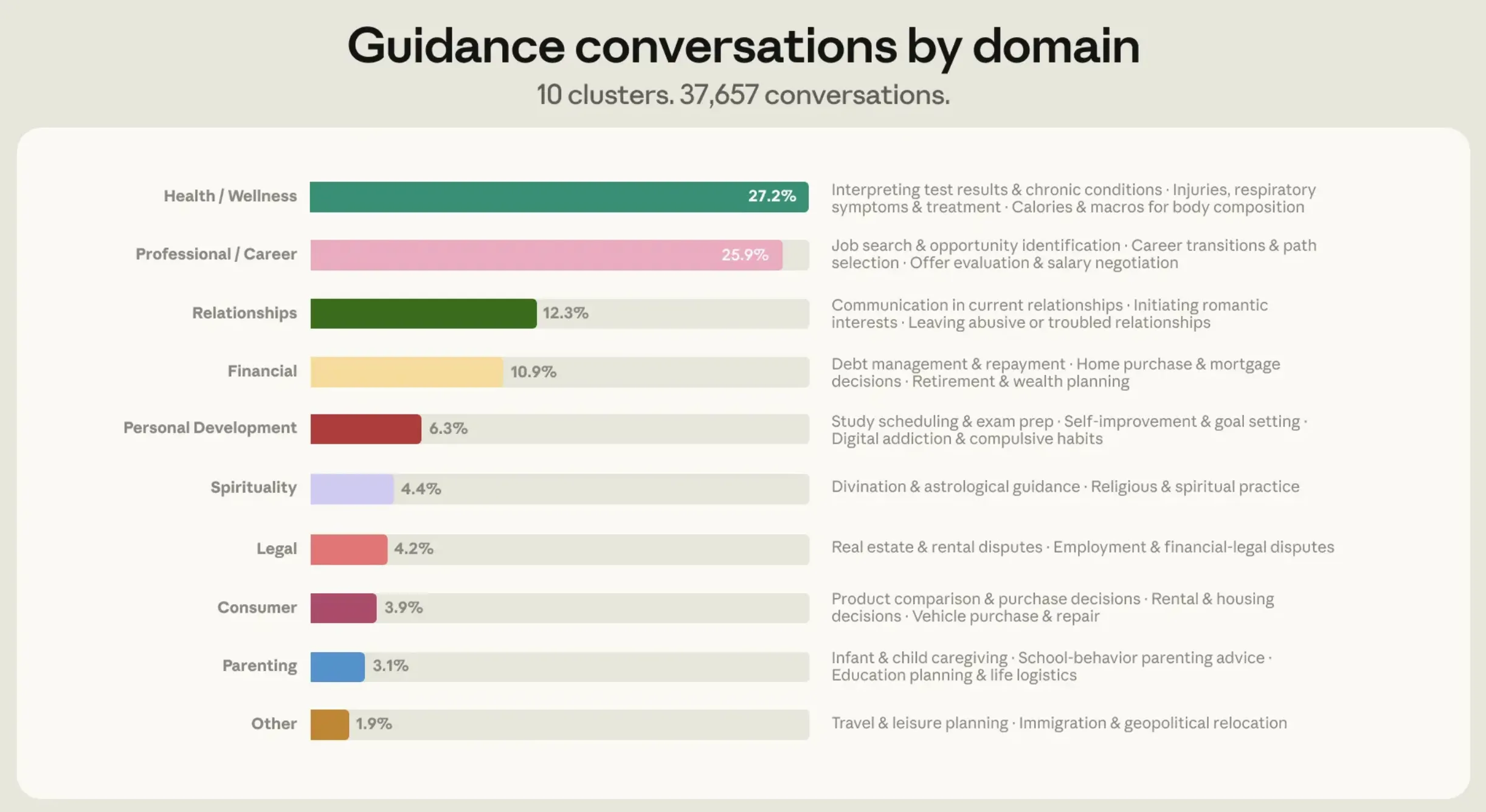
On Thursday, Anthropic came out with a new study on the societal impacts of Claude. The findings are listed under a blog titled “How people ask Claude for personal guidance”. That title tells us a lot about the very intention of the study – to find how people are using Claude for personal guidance. This type of guidance covers several verticals. The report lists them as:
  • Health/ Wellness
  • Professional/ Career
  • Relationships
  • Financial
  • Personal Development
  • Spirituality
  • Legal
  • Consumer
  • Parenting
  • Other
Claude use by guidance domain
Source: Anthropic

The findings were based on 1 million Claude conversations from March to April 2026. For unique users, this number came down to “roughly 639,000 conversations”. From these, Anthropic further used classifiers like “Should I…?” and “What do I do about…?” for a very specific set of conversations that purely revolved around personal guidance. The final number, around 38,000 conversations, was then divided into the nine domains as listed above. These covered 98% of conversations, while the rest 2% were listed under ‘Others’.

Interestingly, over 75% of these conversations could be summed up within 4 verticals. And this is exactly where exciting patterns began to emerge from the enormous data.

Also read: Claude Code: Master it in 20 Minutes for 10X Faster Coding

Anthropic Study: Findings

Based on the conversations that Anthropic researched, two main takeaways emerged:

  1. Over 75% of such conversations with Claude were concentrated in just four domains: health and wellness (27%), professional and career (26%), relationships (12%), and personal finance (11%).
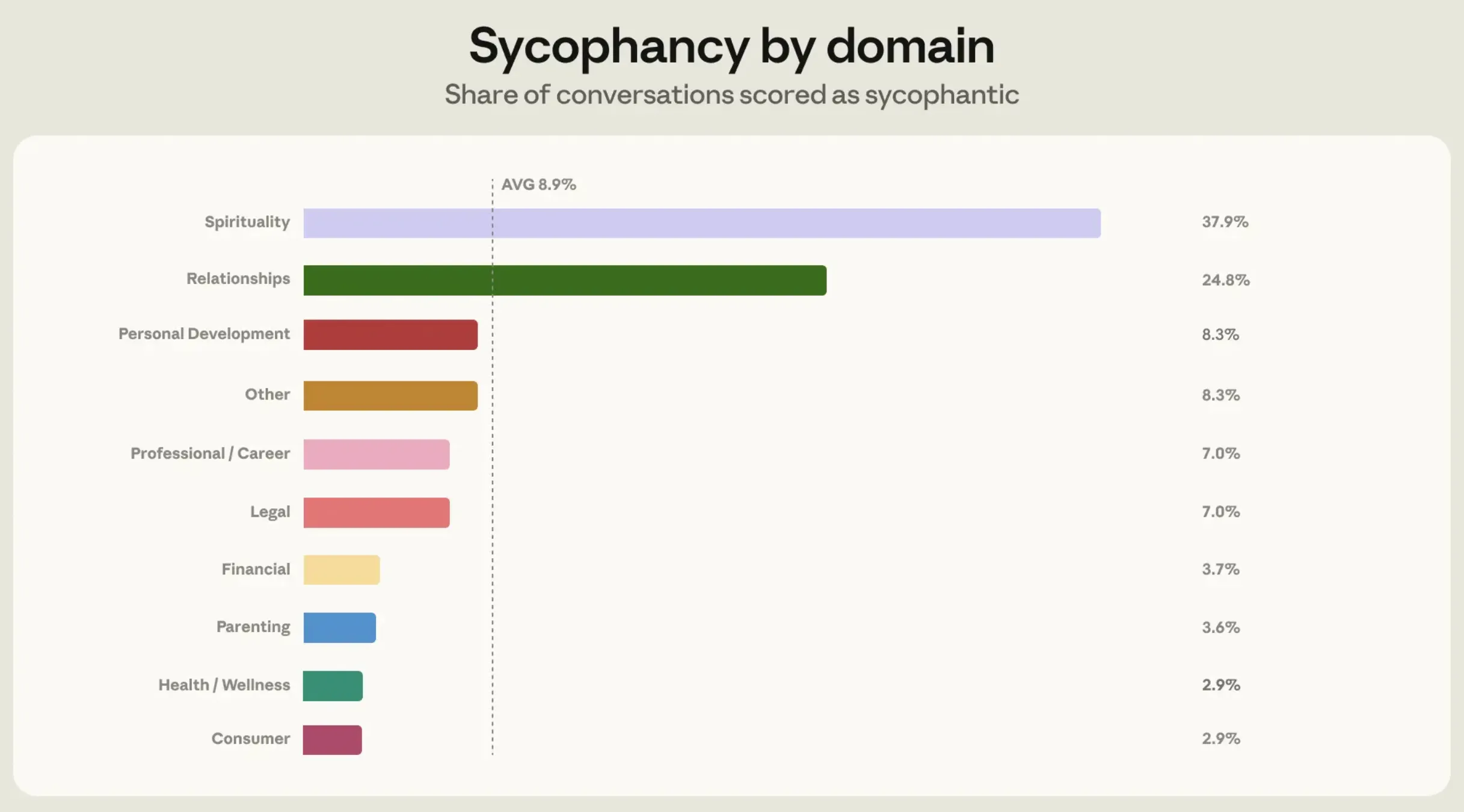
  2. Claude’s sycophantic behaviour rose dramatically in very specific domains out of these, and that is an issue that AI makers like Anthropic are particularly worried about.

Which brings us to the core issue of the study:

Sycophancy: What is it?

The typical meaning of Sycophancy is an insincere act or excessive flattery toward an influential person to gain an advantage. In terms of LLMs, we often see this in their responses to our queries. Have you ever observed ChatGPT or Claude agreeing to everything you say, calling it a “fantastic idea” or praising you with confident phrases like “you are leagues above others”? I am sorry to burst your bubble but you are not alone. And in the world of AI, this is a very common problem.

You see, as an AI chatbot, LLMs are often trained to be “helpful”. In most cases, this means building on the user’s idea and helping them further down the road to their success. However, in a social context, this often skips a super important aspect of human conversations – a different perspective.

After all, agreeing to someone’s each and every point may bring them momentary comfort, but it can never be beneficial in the long run.

And that is where AI models are falling short. Through this study, Anthropic has managed to find exactly the areas where Claude’s sycophantic behaviour shoots way over average.

Also read:

How Claude Showed Sycophancy

In its study, Anthropic used an “automatic classifier” to judge Claude’s sycophancy. It worked on four main principles:
  • Whether Claude pushed back
  • Whether it maintained its position when challenged
  • If its praises were proportional to the idea’s merit
  • And if it spoke frankly, regardless of what the person wanted to hear
Claude Sycophancy by domain
Source: Anthropic

The results of this showed that Claude displayed higher sycophancy in a very specific domain – relationship guidance. The domain showed 25% sycophantic responses, as compared to 9% across other verticals.

Here is an excerpt from the study highlighting the same –

“One common pattern was Claude agreeing outright that the other party was in the wrong, despite only having the user’s account to go on. Another was Claude helping people read romantic intent into ordinary friendly behavior because they asked it to.”

Upon a deep dive into such conversations, Anthropic figured out the reason for this. It quotes in its report that Claude showed higher sycophancy in relationship guidance because this is the area where people push back more than any other domain. They tend to believe their own side of the story more than anything else, and argue the same with the AI during conversations.

Couple this to the fact that Claude tends to be more sycophantic under pressure from pushback, primarily because of its ‘always empathetic’ stance towards users, and you know the reason for this higher-than-average people pleasing.

How Anthropic Tackled Claude’s Sycophancy

Now that the problem was obvious, Anthropic dove even deeper into it to tackle the issue right from its roots. It first identified how exactly its users were pushing back within their conversations with Claude, especially the ways that triggered sycophantic responses. Some of the examples that emerged were “when people criticize Claude’s initial assessment, or supply a flood of one-sided detail.”

Accordingly, Anthropic designed artificial scenarios for training Claude on relationship guidance. Within this training, Claude was asked to sample two different responses for each scenario. Another Claude instance then grades the above responses based on their adherence to the ideal behaviour outlined by Anthropic.

The team then employed stress-testing to measure the level of improvement in each case. For this, it fed existing sycophantic responses that Claude had given out earlier, to new models – Opus 4.7 and Mythos. The technique used for this is called prefilling. This made it difficult for the model to steer an already sycophantic conversation towards a regular conversation. Hence, the “stress” in stress-testing. This helped measure Claude’s behavior under “deliberately adverse conditions.”

Anthropic notes that both Opus 4.7 and Mythos were “more skilled” at looking at the larger context of a conversation. This allowed them to be way less sycophantic in future responses, regardless of the user pushback. In one instance where Sonnet 4.6 was all praises, Mythos Preview simply declined to comment, citing insufficient information for the right judgment.

Conclusion

As soon as AI enters the social aspects of human lives, several new issues arise that may have nothing to do with the technical performance of the model. Even if the model is giving out seemingly accurate answers, it may have to be tweaked to produce outputs that are more relevant in the context of helping the user in the long term.

In short, people pleasing is now plaguing AI, and Anthropic has just found a way out of it.

Technical content strategist and communicator with a decade of experience in content creation and distribution across national media, Government of India, and private platforms