








The Sun is experiencing “striking” long-term shifts in its behavior that have gone undiscovered for more than a decade, according to a study published in the Monthly Notices of the Royal Astronomical Society on Wednesday.
The Sun passes through a cycle of high and low activity that lasts roughly 11 years and is caused by variations in the star’s magnetic activity. This activity peaks at a solar maximum, producing more frequent sunspots and higher radio flux, which are known as surface “proxies” of intense magnetism, as well as dramatic eruptions like solar flares and coronal mass ejections. At solar minimum, when magnetic activity winds down, the Sun enters a quieter phase. Throughout the cycle, sound waves known as p-modes oscillate near the surface of the Sun, providing clues about its internal structure.
All of the above is well known, but using new tools, astronomers have just discovered a weird mismatch in surface and p-mode signals that emerged more than a decade ago and has become especially pronounced in the current epoch, Cycle 25, which began in 2019.
“Essentially, we can use the p-modes as a proxy and a probe of activity underneath the surface of the Sun, because the frequencies change in response to the changing magnetic field,” said Bill Chaplin, a professor of astrophysics at the University of Birmingham who led the study, in a call with 404 Media.
“The sunspot number and the radio flux are basically proxies of the total amount of magnetic flux,” he continued. “What we're doing with the p-modes is saying: What is actually happening beneath the visible surface?”
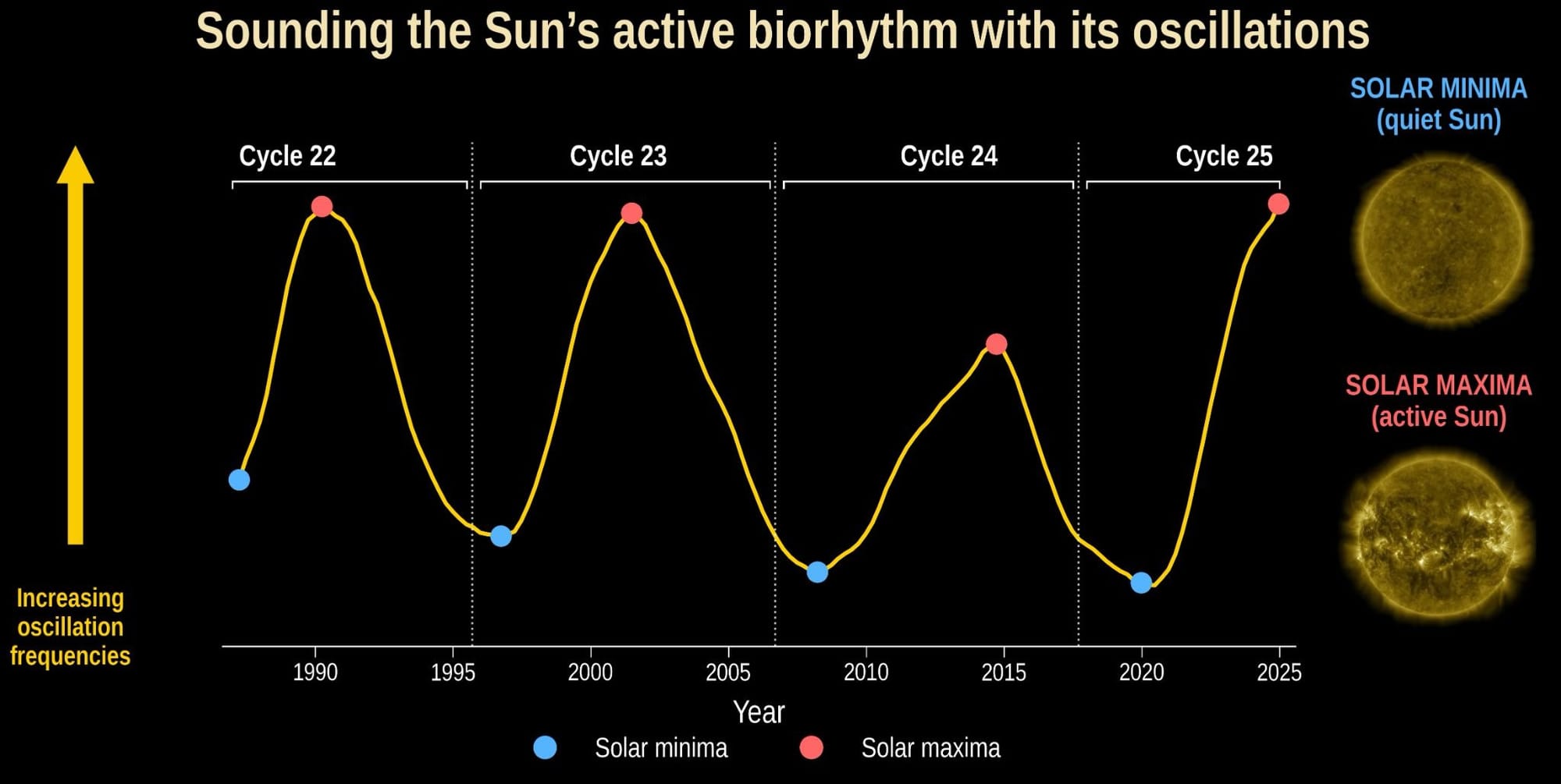
To answer that question, Chaplin and his colleagues examined four decades of observations from the Birmingham Solar Oscillations Network (BiSON), a collection of six remote solar observatories located around the world that have tracked the Sun’s oscillations since 1976.
While astronomers have monitored sunspots for centuries, BiSON has enabled researchers to monitor long-term shifts in “helioseismology,” which measures the seismic activity inside the Sun, a dataset that has led to the recent discovery of so-called "glitches" and other previously undetectable solar phenomena.
“There's a tendency to think that because we've only had data on a few cycles, that all cycles look like that, and that they copy and repeat,” Chaplin said. “I think what's becoming clear is that that isn't the case. No cycle is the same as another.”
The new study revealed that Cycle 25 shows stronger high-frequency p-mode activity just below the surface compared to recent cycles, but that it also appears weaker in terms of surface proxies, meaning it is showing comparatively fewer sunspots and reduced radio flux. This discrepancy hints that magnetic activity has become increasingly confined to a region of several hundred miles under the surface with each successive cycle, though the underlying reason for this change is unclear.
“We saw this really clear signal in the high frequency modes,” said Chaplin. “You can see in the high frequency modes that the current cycle is as strong as Cycles 22 and 23 and that the picture looks very different in the proxies.”
The results suggest that surface proxies, while valuable as rough estimates of magnetic activity, don’t provide the full picture of the roiling dynamics playing out under the solar surface. Chaplin and his colleagues note that several other studies have presented evidence for long-term changes in near-surface solar phenomena, though it will take more research to understand what is driving these trends.
To that end, the team plans to continue observing Cycle 25, which just passed its maximum and is expected to close out with a minimum toward the end of the 2020s. The researchers speculated that the structural changes may be linked either to the longer Hale cycle, which is a period covering two solar cycles—roughly 22 years. Since the Sun’s magnetic poles flip after each solar cycle, the Hale cycle measures the time it takes for the Sun to return to its original magnetic state.
These long-term observations are slowly peeling back the enigmatic inner workings of the Sun, especially the solar dynamo—the process that generates its magnetic field—which remains poorly understood. These efforts could help refine forecasts of hazardous space weather near Earth, while also shedding light on the behavior of other stars.
“Getting more robust space weather predictions is important, but also, from the science point of view, there is [a need] for a better understanding of the dynamo, and how the dynamo changes on long timescales,” Chaplin said.
“Helioseismology is important because it enables you to see inside the Sun, which is something that you can't do by any other means,” he concluded.