A software developer made a Chrome and Firefox extension called Knockoff that automatically hides, grays out, or filters products from sketchy brands on Amazon, which highlights just how many shady brands are on the platform and how commonly they show up on searches for basic items.
In just a few minutes of using the extension, Knockoff dimmed product listings for screwdrivers made by “SUNHZMCKP,” spoons made by “SACATR,” and a lamp made by “ROTTOGOON.” In a tweet announcing the extension, developer Josh Pigford wrote “Sorry to brands like WNPETHOME, EHEYCIGA, YXYL, LU&MN, JOYIN, TOMY, GODONLIF, YOOJEE, LINGTENG, LANEIGE, VISCOO, BIODANCE, COOFANDY, BALENNZ, TOSY, and LUENX.” The extension can also hide all sponsored product listings. The extension quickly went viral as a much-needed filter for people who still use Amazon and, for those who don’t use Amazon because of its horrendous labor practices and other concerns, it is evidence of what an incredible wasteland the platform has become.
0:00
/0:09
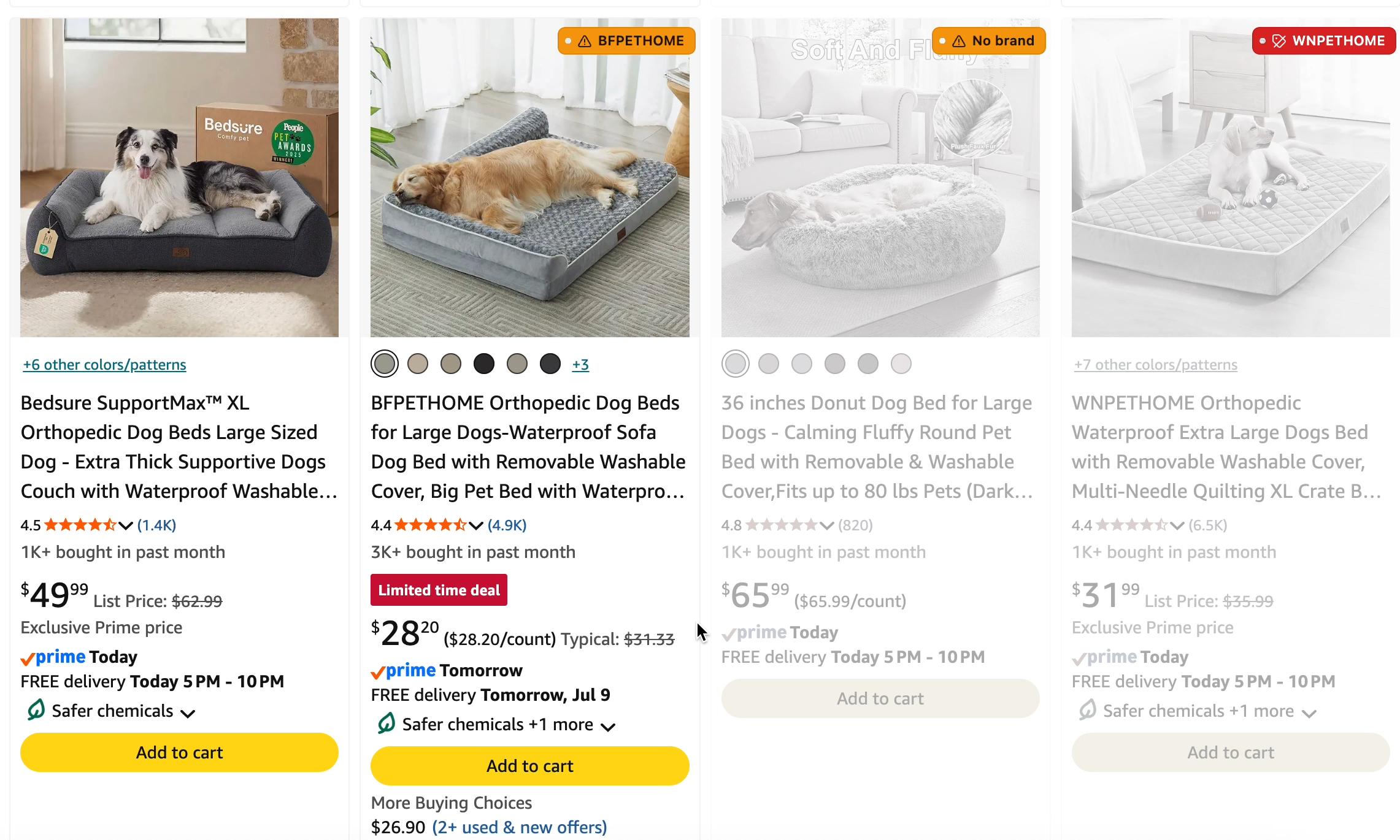
In a video call, Pigford told me that he had been thinking about making Knockoff for a while but that he finally decided to do it last weekend. “I was cutting the grass and about to get my trimmer out to do some weed eating, and it wouldn’t crank. So I decided to get some specific tools, and I searched for them and was like ‘What are these brands? Am I going insane?’ I just wanted something from a common brand or something I was familiar with,” he said. “I was like ‘man, I’ve gotta build something.’”
Pigford said that Knockoff is essentially building a list of brands to allow or not allow, and that it uses several different criteria to do this, including looking at the names of the brands: “Basically number of consonants, number of vowels, how they are grouped together, whether they’re in all caps or not,” he said. This means that brands like “EHEYCIGA” will be automatically added to the filter list. But the list of blocked brands is intended to be determined by its community of users, and any user can ask the extension to allow or block any specific brand for themselves. The project builds on previous similar attempts to highlight sketchy brands on Amazon, including one called AmazonBrandFilter and The Markup’s Amazon Brand Detector. The extension also allows anyone who has downloaded it to report potentially sketchy brands and to report brands that have been accidentally flagged as knockoffs.
The extension runs locally and doesn’t require an account to use, and doesn’t send data back to any server. It is free. “I stand to benefit nothing directly economically, it’s a nice little tool I wanted to make,” Pigford said.
Knockoff is pretty useful whether you use Amazon or not. For those who don’t use Amazon, it highlights a problem repeatedly shown by Joe Biden’s Federal Trade Commission in an antitrust lawsuit against the company, which is that much of Amazon is pay-to-play, with brands needing to buy ads or placement boosts in order to be featured at the top of search results. The platform has also become an algorithmic and financial race to the bottom, with companies stealing others’ designs, jamming their product pages with keywords that will perform well in search, and creating fly-by-night brands to try to end up at the top of search results.
“There was somebody who sent me a screenshot from using the extension and the first 20 items or something were all grayed out. Like there were all these knockoff brands before they could find a legitimate item,” Pigford said. “It’s like, OK, that about sums it up.”
“I think people want control over what it is that they're seeing on the internet,” he added. “This sort of gives some control back to just getting everything shoved in your face. It’s like fighting back against the algorithm to some extent.”
About the author
Jason is a cofounder of 404 Media. He was previously the editor-in-chief of Motherboard. He loves the Freedom of Information Act and surfing.