惯性聚合 高效追踪和阅读你感兴趣的博客、新闻、科技资讯
阅读原文 在惯性聚合中打开

推荐订阅源

freeCodeCamp Programming Tutorials: Python, JavaScript, Git & More
S
SegmentFault 最新的问题
N
Netflix TechBlog - Medium
Vercel News
Vercel News
F
Fortinet All Blogs
量子位
博客园 - Franky
酷 壳 – CoolShell
酷 壳 – CoolShell
Cyber Security Advisories - MS-ISAC
MongoDB | Blog
MongoDB | Blog
Y
Y Combinator Blog
GbyAI
GbyAI
博客园 - 三生石上(FineUI控件)
Apple Machine Learning Research
爱范儿
爱范儿
月光博客
月光博客
Recent Announcements
人人都是产品经理
人人都是产品经理
Hugging Face - Blog
Hugging Face - Blog
D
DataBreaches.Net
H
Help Net Security
阮一峰的网络日志
阮一峰的网络日志
D
Docker
WordPress大学
WordPress大学

ByteByteGo Newsletter

Why An LLM’s Memory Gets Expensive and How to Fix It LLM Security Basics: The Full Threat Model Hiring: Part Time Instructor, Write Production Grade Code with AI A Detailed Guide to Idempotency, Delivery Semantics, and Deduplication How ChatGPT Optimizes its Agent Loop: Harness, API, and Inference Why DoorDash, Instacart, and Uber Eats Integrated LLMs Into Search Three Different Ways How NVIDIA Builds Open Models for the Age of AI A Beginner’s Guide to Clocks, Causality, and Ordering in Distributed Systems Best Practices for Building AI Agents That Work in Production Inside Roblox’s Bet on World Models MCP vs A2A vs ACP: How AI Agents Actually Talk to Each Other A Guide to Multi-Tenancy: Benefits and Challenges AI Customer Support at Scale: The Travel Industry’s $Billion Bet How LLMs Learn to Be Helpful (RLHF vs DPO) How Microsoft Ships AI Agents at Enterprise Scale EP221: How Docker Works Under the Hood LAST CALL FOR ENROLLMENT: Become an AI Engineer - Cohort 7 Streaming vs Batch: Two Philosophies of Data Processing The Agent Loop: How AI Goes From Answering Questions to Doing Things ChatGPT vs Gemini vs Claude: How They Differ LAST CALL FOR ENROLLMENT: Become an AI Engineer - Cohort 7 Proof of Human: How to Verify a Person Is Real and Unique Multi-Region Architecture: Going Global Without Going Broke How OpenAI Delivers Low-Latency Voice AI for 900M Users Inside Thinking Machines’ Interaction Models How AI Agents Manage Memory and Avoid Forgetfulness EP220: RAG vs Graph RAG vs Agentic RAG Top Anti-Patterns to Avoid in Service Architecture Large Language Models vs Small Language Models An Ex-Meta L8’s Agentic Engineering Setup
The Path of a Request: A Tour of Modern Web Architecture
ByteByteGo · 2026-06-04 · via ByteByteGo Newsletter

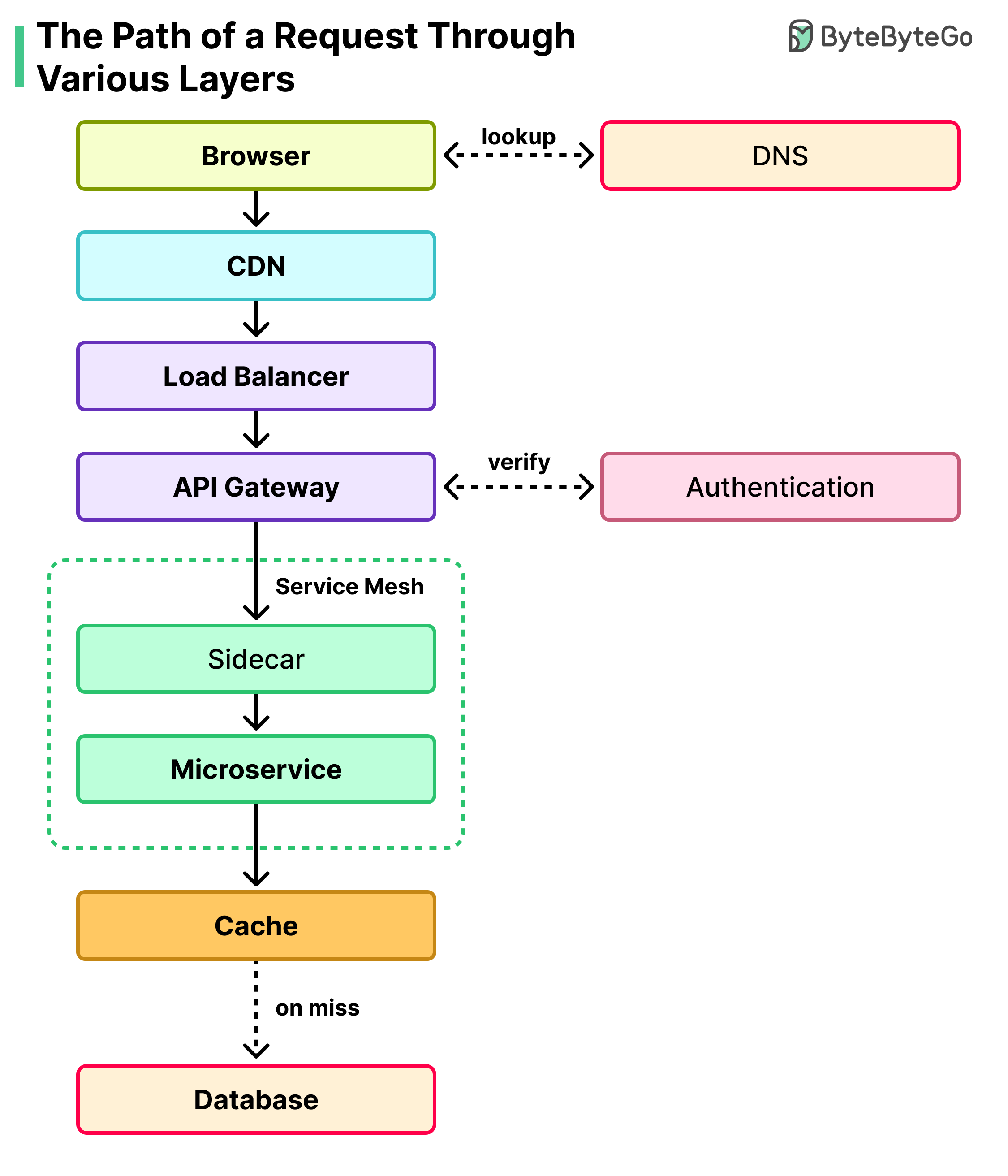
A web page loads in under a second. In that second, a single user request may have passed through roughly ten distinct systems on its way to and from the database. The page feels fast because of how those systems are arranged. Each layer absorbs as much traffic as it can before passing the rest along. Taken together, the layers form a funnel, with most traffic handled long before it reaches the bottom.

Understanding what each layer does to narrow that funnel can lead to a better grasp of each component of a modern web stack.

In this article, we follow the journey of a web request one hop at a time. At each stop, we ask two questions. What is this layer doing, and what trade-off is it making? The journey starts before the request has fully left the browser, and latency is spent at every hop.