惯性聚合 高效追踪和阅读你感兴趣的博客、新闻、科技资讯
阅读原文 在惯性聚合中打开

推荐订阅源

钛媒体:引领未来商业与生活新知
钛媒体:引领未来商业与生活新知
Apple Machine Learning Research
Last Week in AI
Last Week in AI
Blog — PlanetScale
Blog — PlanetScale
V
Visual Studio Blog
月光博客
月光博客
博客园 - 三生石上(FineUI控件)
博客园 - Franky
IT之家
IT之家
博客园 - 叶小钗
Engineering at Meta
Engineering at Meta
The GitHub Blog
The GitHub Blog
雷峰网
雷峰网
腾讯CDC
博客园 - 聂微东
OSCHINA 社区最新新闻
OSCHINA 社区最新新闻
V
V2EX
人人都是产品经理
人人都是产品经理
MongoDB | Blog
MongoDB | Blog
大猫的无限游戏
大猫的无限游戏
Martin Fowler
Martin Fowler
宝玉的分享
宝玉的分享
博客园_首页
G
Google Developers Blog

ByteByteGo Newsletter

Why An LLM’s Memory Gets Expensive and How to Fix It LLM Security Basics: The Full Threat Model Hiring: Part Time Instructor, Write Production Grade Code with AI How ChatGPT Optimizes its Agent Loop: Harness, API, and Inference Why DoorDash, Instacart, and Uber Eats Integrated LLMs Into Search Three Different Ways How NVIDIA Builds Open Models for the Age of AI A Beginner’s Guide to Clocks, Causality, and Ordering in Distributed Systems Best Practices for Building AI Agents That Work in Production Inside Roblox’s Bet on World Models MCP vs A2A vs ACP: How AI Agents Actually Talk to Each Other A Guide to Multi-Tenancy: Benefits and Challenges AI Customer Support at Scale: The Travel Industry’s $Billion Bet How LLMs Learn to Be Helpful (RLHF vs DPO) How Microsoft Ships AI Agents at Enterprise Scale EP221: How Docker Works Under the Hood LAST CALL FOR ENROLLMENT: Become an AI Engineer - Cohort 7 Streaming vs Batch: Two Philosophies of Data Processing The Agent Loop: How AI Goes From Answering Questions to Doing Things ChatGPT vs Gemini vs Claude: How They Differ LAST CALL FOR ENROLLMENT: Become an AI Engineer - Cohort 7 Proof of Human: How to Verify a Person Is Real and Unique Multi-Region Architecture: Going Global Without Going Broke How OpenAI Delivers Low-Latency Voice AI for 900M Users Inside Thinking Machines’ Interaction Models How AI Agents Manage Memory and Avoid Forgetfulness EP220: RAG vs Graph RAG vs Agentic RAG Top Anti-Patterns to Avoid in Service Architecture Large Language Models vs Small Language Models An Ex-Meta L8’s Agentic Engineering Setup AI-Native Leaders: The Organizational Playbook for Engineering Transformation at Scale
A Detailed Guide to Idempotency, Delivery Semantics, and ...
ByteByteGo · 2026-07-30 · via ByteByteGo Newsletter

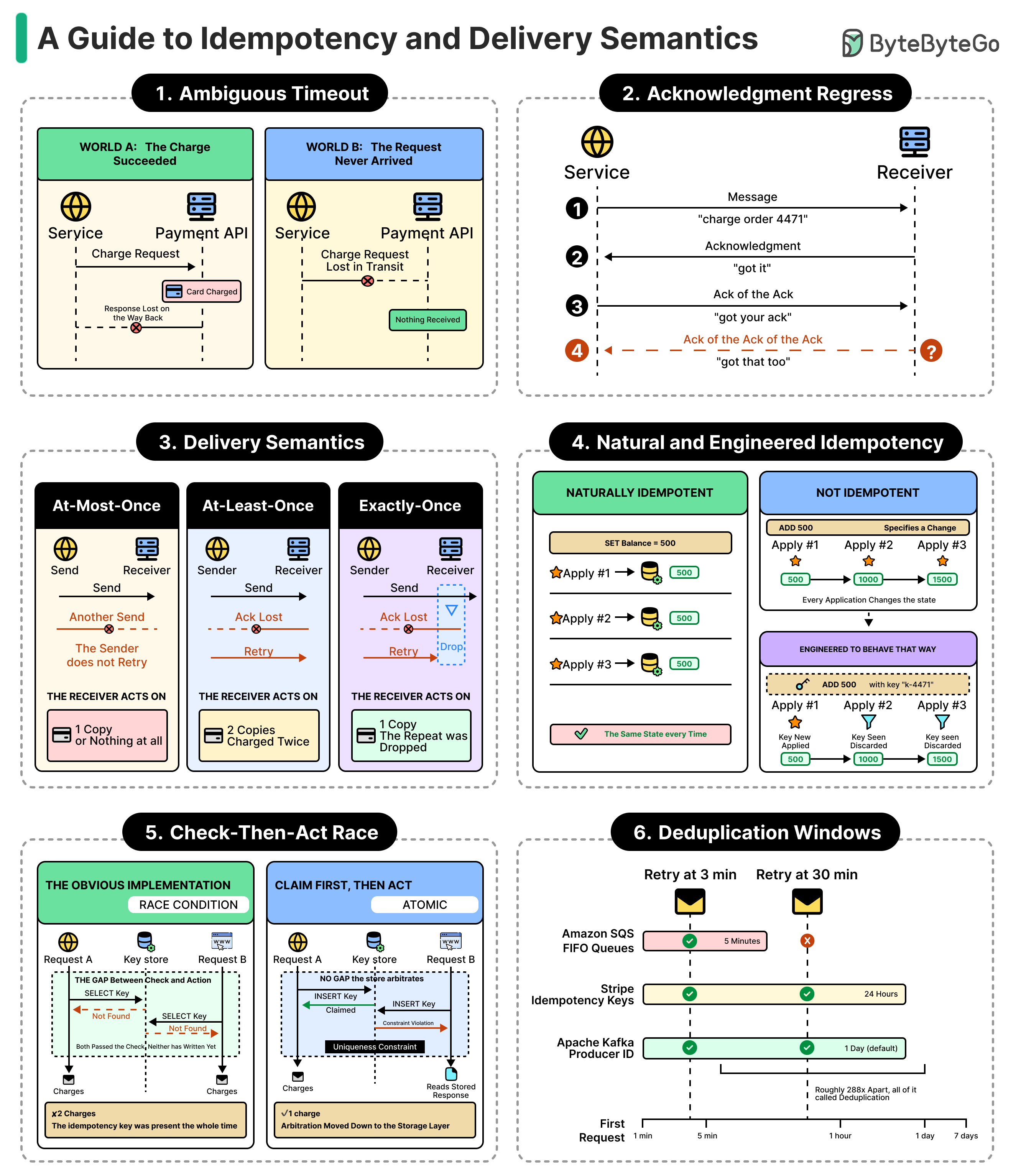
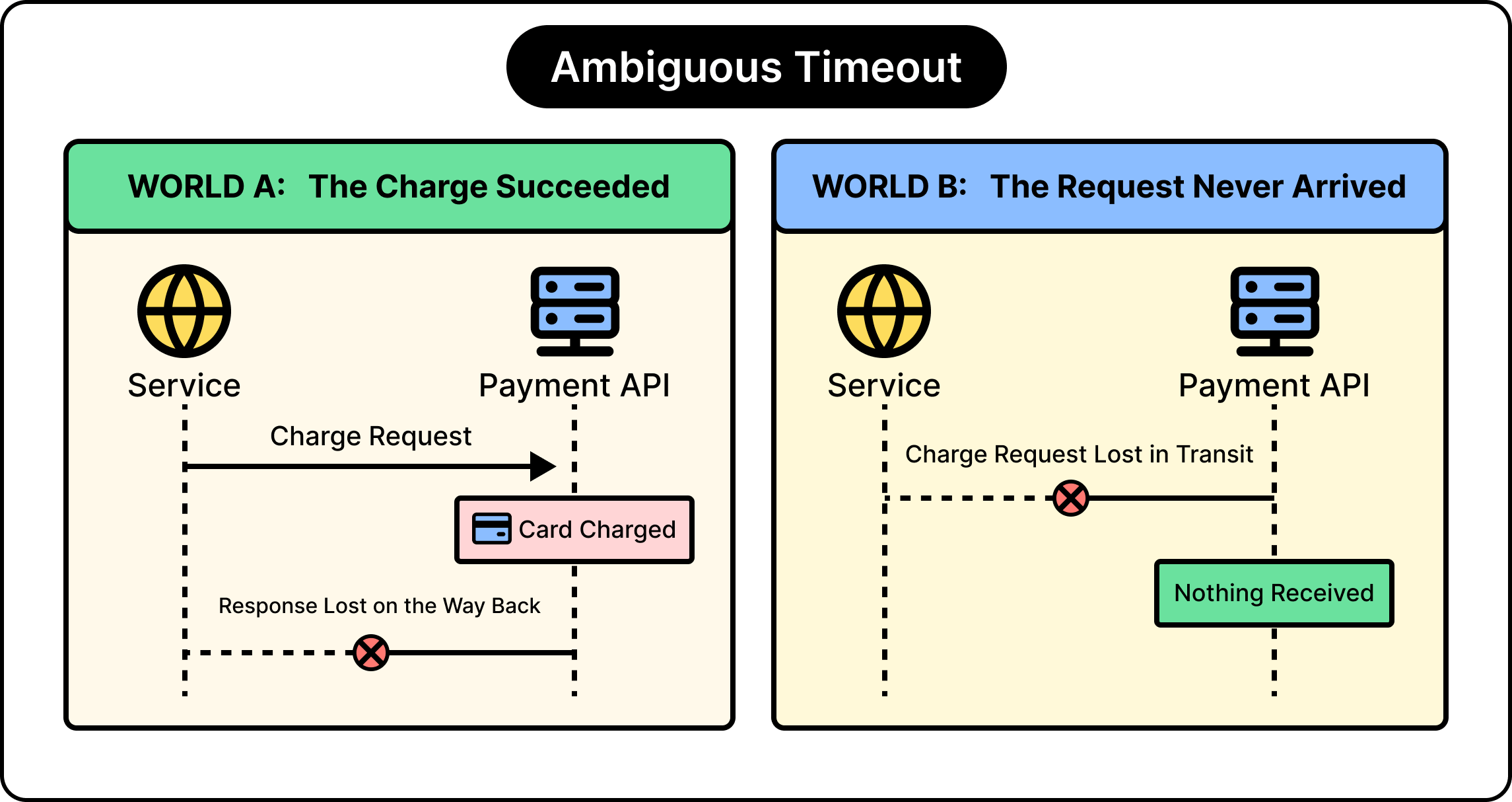
What happens when a service sends a request to charge a customer, but the request times out with no response? The burning question is whether the charge went through. Or should it be retried?

Two different things could have happened. The charge succeeded, and the confirmation was lost on the way back, or the request never reached the payment service at all. Both possibilities produce identical outputs, which makes it difficult to figure out what happened and the next action to be taken. Retrying risks charging the customer twice. On the other hand, declining to retry risks never charging them at all.

Idempotency is the property that makes the retry safe. An operation is idempotent when applying it more than once produces the same state as applying it once. For example, setting an account balance to 500 is idempotent, because even the tenth time to execute this operation, the outcome will be the same. In contrast, adding 500 to a balance is not idempotent, since every time it is executed, the balance amount changes. Most operations that matter in a business system resemble the second one.
In this article, we will look at the following topics in detail:

  • The three different delivery semantics available for developers.

  • The three points where duplicates enter a producer, broker, and consumer path, and why a fix at one point does nothing for the other two

  • The difference between an operation that is idempotent by nature and an endpoint engineered to behave that way

  • What does an idempotency key need to work, and how can it fail?

  • Why every deduplication scheme has a time limit, and what the guarantee is worth once that limit passes

  • What “exactly-once” means in real-world systems, and where each guarantee ends?