惯性聚合 高效追踪和阅读你感兴趣的博客、新闻、科技资讯
阅读原文 在惯性聚合中打开

推荐订阅源

J
Java Code Geeks
量子位
MongoDB | Blog
MongoDB | Blog
N
Netflix TechBlog - Medium
奇客Solidot–传递最新科技情报
奇客Solidot–传递最新科技情报
B
Blog
A
About on SuperTechFans
腾讯CDC
The GitHub Blog
The GitHub Blog
云风的 BLOG
云风的 BLOG
雷峰网
雷峰网
Last Week in AI
Last Week in AI
H
Help Net Security
WordPress大学
WordPress大学
博客园 - 司徒正美
钛媒体:引领未来商业与生活新知
钛媒体:引领未来商业与生活新知
H
Hackread – Cybersecurity News, Data Breaches, AI and More
T
Tailwind CSS Blog
博客园 - 【当耐特】
S
SegmentFault 最新的问题
美团技术团队
M
MIT News - Artificial intelligence
L
LangChain Blog
博客园 - 聂微东

ByteByteGo Newsletter

Why An LLM’s Memory Gets Expensive and How to Fix It LLM Security Basics: The Full Threat Model Hiring: Part Time Instructor, Write Production Grade Code with AI A Detailed Guide to Idempotency, Delivery Semantics, and Deduplication How ChatGPT Optimizes its Agent Loop: Harness, API, and Inference Why DoorDash, Instacart, and Uber Eats Integrated LLMs Into Search Three Different Ways How NVIDIA Builds Open Models for the Age of AI A Beginner’s Guide to Clocks, Causality, and Ordering in Distributed Systems Best Practices for Building AI Agents That Work in Production Inside Roblox’s Bet on World Models MCP vs A2A vs ACP: How AI Agents Actually Talk to Each Other A Guide to Multi-Tenancy: Benefits and Challenges AI Customer Support at Scale: The Travel Industry’s $Billion Bet How LLMs Learn to Be Helpful (RLHF vs DPO) How Microsoft Ships AI Agents at Enterprise Scale EP221: How Docker Works Under the Hood LAST CALL FOR ENROLLMENT: Become an AI Engineer - Cohort 7 Streaming vs Batch: Two Philosophies of Data Processing The Agent Loop: How AI Goes From Answering Questions to Doing Things ChatGPT vs Gemini vs Claude: How They Differ LAST CALL FOR ENROLLMENT: Become an AI Engineer - Cohort 7 Proof of Human: How to Verify a Person Is Real and Unique Multi-Region Architecture: Going Global Without Going Broke How OpenAI Delivers Low-Latency Voice AI for 900M Users Inside Thinking Machines’ Interaction Models How AI Agents Manage Memory and Avoid Forgetfulness EP220: RAG vs Graph RAG vs Agentic RAG Large Language Models vs Small Language Models An Ex-Meta L8’s Agentic Engineering Setup AI-Native Leaders: The Organizational Playbook for Engineering Transformation at Scale
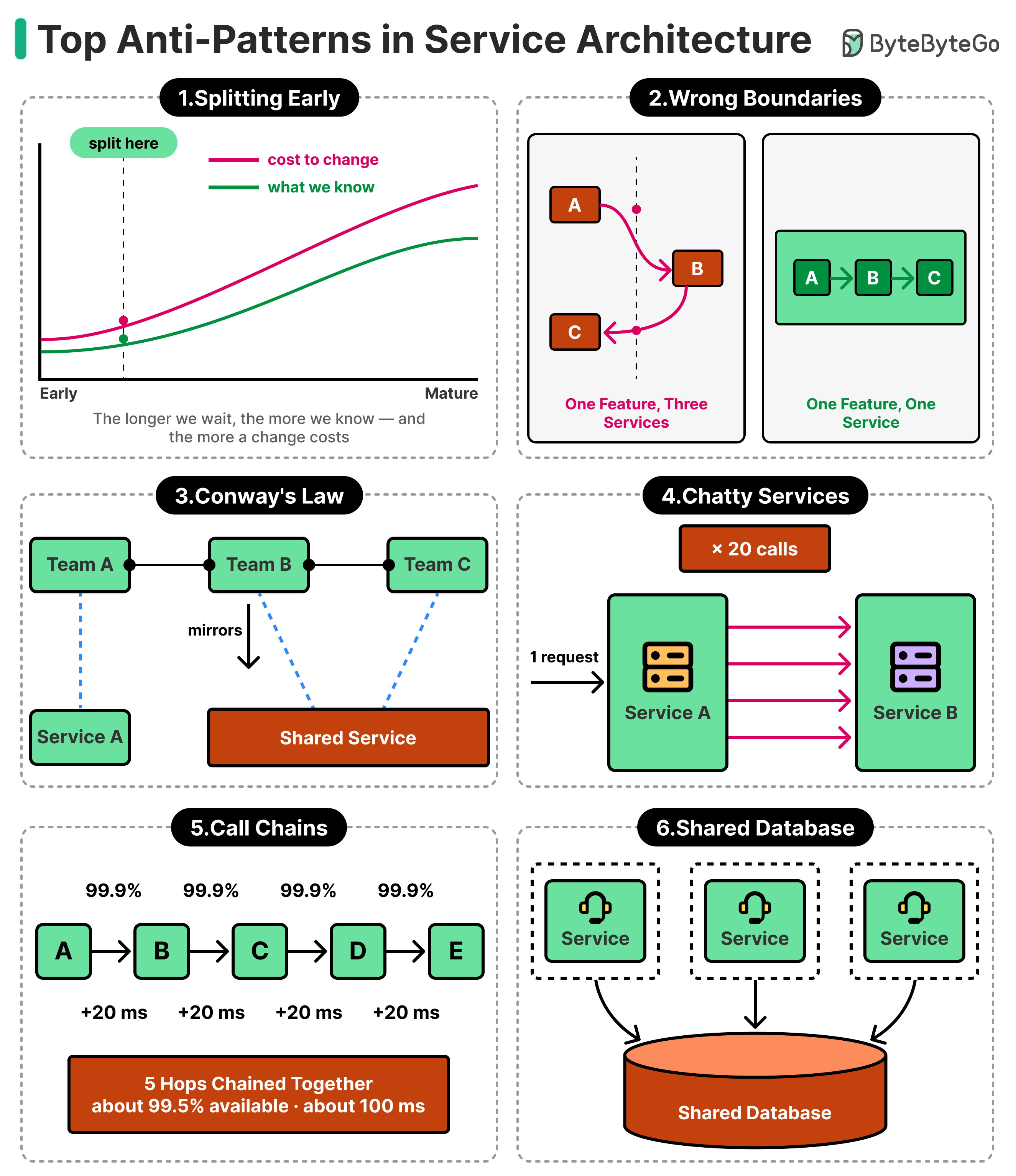
Top Anti-Patterns to Avoid in Service Architecture
ByteByteGo · 2026-06-25 · via ByteByteGo Newsletter

A service architecture can end up slower to change, harder to operate, and less reliable than the single large system it replaced, and it can cost more to run while doing it. This is rarely the work of a careless team.

How many decisions does it take to reach that point?

It rarely takes a single bad one. The path to such a situation is built from individually sound choices, a clean separation here, an independent deployment there, a new service each time a part of the system felt distinct enough to stand on its own. Those reasonable steps accumulate into an arrangement no one would have chosen on purpose, and the problems that emerge look like a catalog of separate mistakes even though nearly all of them trace back to one early decision about how to break a system.

At a basic level, a service is a part of a system that can be deployed on its own and controls its own data. This means it does not reach into any other service’s database to do its work. It also talks to other services over a network. Inside a single program, one function calling another takes a few nanoseconds and either returns an answer or raises an error. The same call across a service boundary can take a few milliseconds, and it can also time out or succeed halfway and leave things in an odd state. Almost every anti-pattern below emerges from this one problem.

In this article, we will look at some of the most important anti-patterns in service architecture, how they happen, and how they can be avoided.