惯性聚合 高效追踪和阅读你感兴趣的博客、新闻、科技资讯
阅读原文 在惯性聚合中打开

推荐订阅源

GbyAI
GbyAI
The GitHub Blog
The GitHub Blog
小众软件
小众软件
美团技术团队
博客园 - 司徒正美
G
Google Developers Blog
Blog — PlanetScale
Blog — PlanetScale
Hugging Face - Blog
Hugging Face - Blog
博客园_首页
大猫的无限游戏
大猫的无限游戏
罗磊的独立博客
Recent Announcements
酷 壳 – CoolShell
酷 壳 – CoolShell
D
Docker
J
Java Code Geeks
Last Week in AI
Last Week in AI
V
Visual Studio Blog
Microsoft Azure Blog
钛媒体:引领未来商业与生活新知
钛媒体:引领未来商业与生活新知
P
Proofpoint News Feed
V
V2EX
C
Check Point Blog
OSCHINA 社区最新新闻
OSCHINA 社区最新新闻
MyScale Blog
MyScale Blog

ByteByteGo Newsletter

Why An LLM’s Memory Gets Expensive and How to Fix It LLM Security Basics: The Full Threat Model Hiring: Part Time Instructor, Write Production Grade Code with AI A Detailed Guide to Idempotency, Delivery Semantics, and Deduplication How ChatGPT Optimizes its Agent Loop: Harness, API, and Inference Why DoorDash, Instacart, and Uber Eats Integrated LLMs Into Search Three Different Ways How NVIDIA Builds Open Models for the Age of AI A Beginner’s Guide to Clocks, Causality, and Ordering in Distributed Systems Best Practices for Building AI Agents That Work in Production Inside Roblox’s Bet on World Models MCP vs A2A vs ACP: How AI Agents Actually Talk to Each Other A Guide to Multi-Tenancy: Benefits and Challenges AI Customer Support at Scale: The Travel Industry’s $Billion Bet How LLMs Learn to Be Helpful (RLHF vs DPO) How Microsoft Ships AI Agents at Enterprise Scale EP221: How Docker Works Under the Hood LAST CALL FOR ENROLLMENT: Become an AI Engineer - Cohort 7 Streaming vs Batch: Two Philosophies of Data Processing The Agent Loop: How AI Goes From Answering Questions to Doing Things ChatGPT vs Gemini vs Claude: How They Differ LAST CALL FOR ENROLLMENT: Become an AI Engineer - Cohort 7 Proof of Human: How to Verify a Person Is Real and Unique Multi-Region Architecture: Going Global Without Going Broke How OpenAI Delivers Low-Latency Voice AI for 900M Users Inside Thinking Machines’ Interaction Models How AI Agents Manage Memory and Avoid Forgetfulness EP220: RAG vs Graph RAG vs Agentic RAG Top Anti-Patterns to Avoid in Service Architecture Large Language Models vs Small Language Models An Ex-Meta L8’s Agentic Engineering Setup
Database Performance Strategies and Their Hidden Costs
2026-04-02 · via ByteByteGo Newsletter

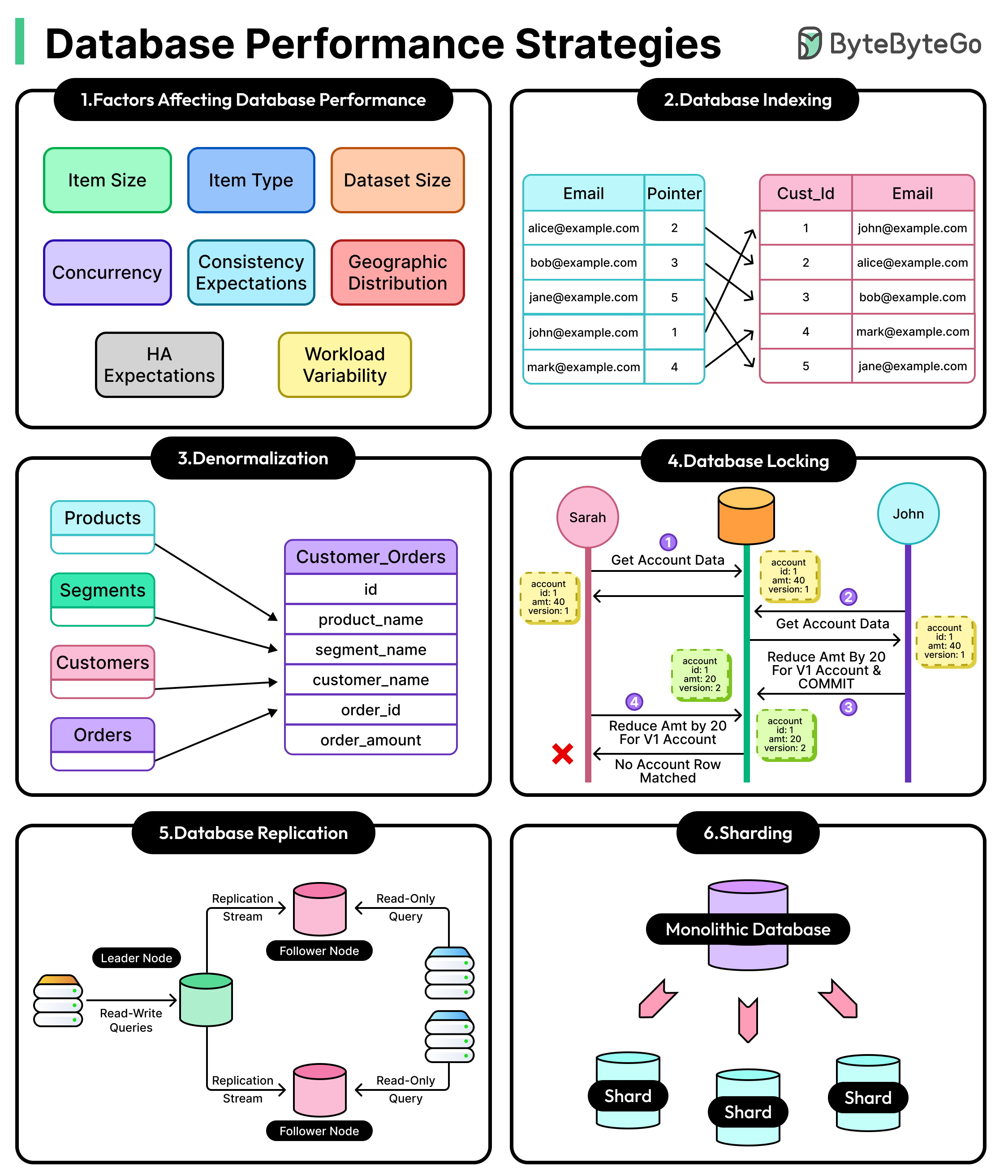
A feature is deployed, and the database queries run well. The team is happy with the results. However, six months later, the main table has grown from 50,000 rows to 5 million, and the same query now takes eight seconds.

Then, someone adds an index, and read latency drops to milliseconds, which seems like a clear win. But a week later, the nightly data import is running 40% slower than before. Fixing one problem created another.

This is the central challenge of database performance.

Every optimization helps one thing and can potentially hurt something else. Indexes speed up reads but slow down writes. Caching reduces database load but introduces stale data. Denormalization makes queries faster but complicates updates.

The real challenge isn’t knowing the strategies, but understanding what each strategy costs and deciding which tradeoffs a given application can afford. In this article, we’ll go through the major strategies for improving database performance along with their benefits and trade-offs.