










Afternoon all,
What could have been, eh? With GDP rising at 0.5% in February, unemployment falling in January and borrowing coming in below forecast, the economic backdrop to Spring could have been so different. But trouble over the water continues to derail this Government in more ways than one….and it was fascinating to hear Jeremy Hunt’s honest reflections on dealing with an energy price shock at our event on Monday. If you missed it, you can also try out the podcast version.
We’ve been thinking a lot at Resolution Foundation about young people, especially what can be done about those not in education or employment. Some of the solutions lie in the education system, and chart of the week digs into school absence data – showing huge variation across the country. Read on for a new depressing effect of war, the ethical purchases of the rich and more.
Have a good weekend,
Ruth
The lost innovation. The downsides of war hardly need prosecuting but one under-discussed impact is the effect on innovation. While resulting labour shortages might incentivise the development of new technologies, this new working paper finds that when shocks disproportionately remove highly educated or technically trained individuals, the consequences for innovation are net bad. When Britain called for volunteers at the outset of WW1, vast numbers of educated young men answered the call, and mortality rates among this group were particularly high. The authors examine the impact of this ‘lost generation’ on innovation trajectories. Those communities that lost more soldiers in WW1 experienced persistent declines in invention, and even the productivity of surviving inventors, plus the next generation, in those communities declined. Who knows what wonders we might have lost?
Mo money, mo problems. Go vegan? Get thrifty? Boycott bad brands? Making ethical and sustainable choices as a consumer can be challenging. The authors of this paper (non-paywalled version here) explore whether richer consumers buy more “responsible” products — the kind that reduce harm to others or the environment but often come with a bigger price tag. The good news: higher incomes led people to buy more of the responsible stuff, and its share of the total shopping basket nudged up too. The less encouraging finding? Because wealthier consumers also just buy more of everything, the total damage can actually go up, even when the purchases themselves are more responsible.
Permanent Perks. Workplace training is a classic chicken-and-egg problem: firms won’t invest in workers they don’t expect to keep, and workers can’t progress without the training they’re not being offered. This conundrum gets a useful empirical test in a new piece from Indeed’s Hiring Lab. Across eight rich countries, workers consistently rate skill development as a higher personal priority than their bosses do (an 18-point gap in the UK), and graduates are far more likely to receive training than non-graduates (78 per cent vs 60 per cent). The authors use a neat natural experiment looking at Spain’s 2022 reform that sharply restricted temporary contracts, and find that this led to a spike in training offers for occupations previously offering these contracts. So Britain’s flexible labour market may be connected to our skills problem?
Adopt, adapt, improve. What can we learn from how other countries are using AI? This fascinating new paper looks at gaps in AI adoption at work between the US and six European countries. Perhaps unsurprisingly, America is leading the charge, with 43 per cent of stateside workers using AI compared to 32 per cent in Europe though British workers are doing better than the average with 36 per cent using it at work. While about half the gap in different adoption rates is down to workforce composition, management practices also play an outsized role. We’ve previously highlighted the importance of tech usage in explaining the UK-US productivity gap, and the introduction of AI risks exacerbating this. How do we fix it? Ask management…
Something for the weekend | War inflation primer
On Monday we had our first of two events on the fallout from the war in the Middle East, which zeroed in on the potential cost of living squeeze on the horizon (watch out for part two on Wednesday looking at the wider economy). The IMF’s latest forecast puts UK inflation for 2026 at 3.2 per cent, the joint highest in the G7. At the same time, wholesale energy prices have fallen this week, leaving oil and gas prices well below their March peaks. So in advance of the first CPI numbers since the war began coming next week, here’s a quick look at what we know so far about the impact on prices:
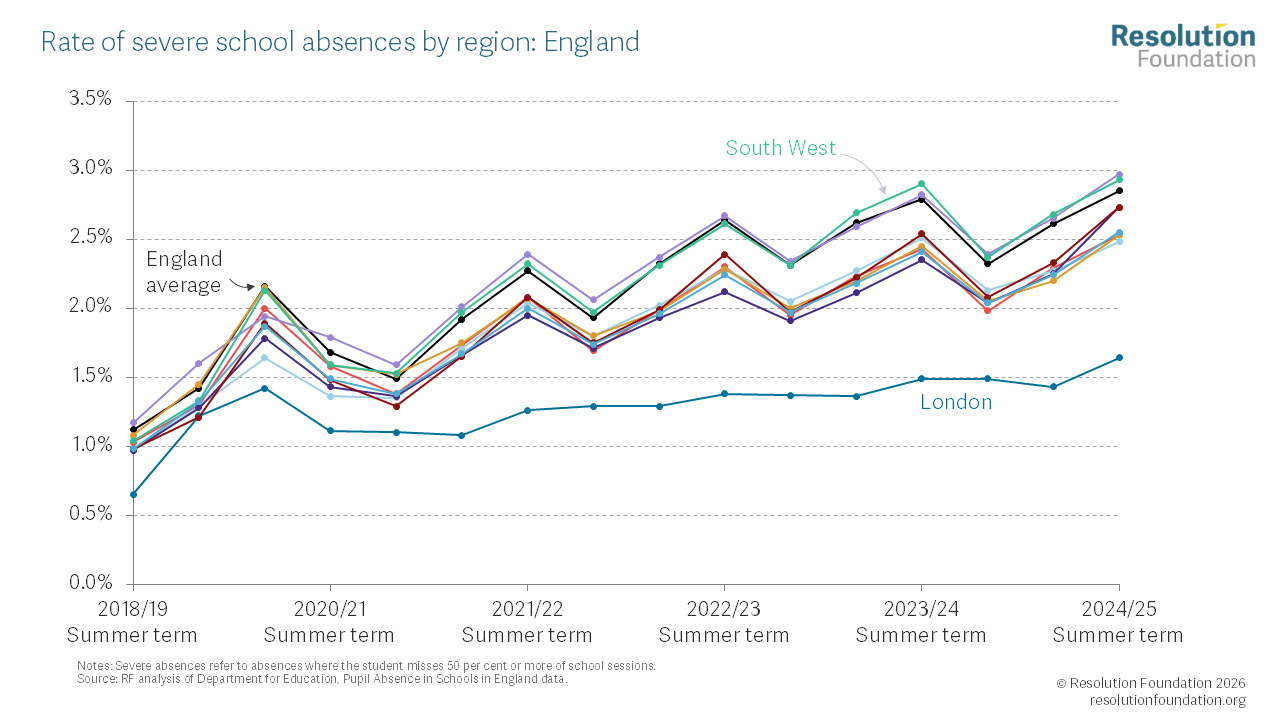
School’s out everywhere except London it seems. The latest data from the Department for Education breaks down pupil absence rates in England and it’s a bit of a mixed bag. The headline finding isn’t too bad: the overall absence rate for 2024-25 sits at 6.78 per cent, down slightly from 7.15 in 2023-24. But this is still way above the pre-pandemic level, and what’s more, the rate of severe absences – that is, absences where the pupil misses 50 per cent or more of school sessions – is only rising. The chart below breaks it down by region and shows that London is doing far and away better than the rest of the country, with a severe absence rate of only 1.64 per cent, vs the England average of 2.55. Our analysis suggests that if the whole country had a similar rate to London, around 56,000 fewer pupils would be severely absent each term. The better performance of London schools on results is well documented but the growing gap in the most severe absence rates needs more attention. London boroughs also have some of the lowest NEET rates in the country for 16–17-year-olds. 176,000 thousand kids (and rising) missing more than half of their schooling each term can hardly bode well for the future.
此内容由惯性聚合(RSS阅读器)自动聚合整理,仅供阅读参考。 原文来自 — 版权归原作者所有。