





Morning all,
With hearts broken and hopes crushed all across England, I can promise you a mercifully football-free edition of Top of the Charts this week.
Parliament may be in recess but Westminster remains restless. The incoming PM is confirmed, but there is nothing but (virtual) column-inches of media speculation about the makeup of his cabinet. Whoever Andy Burnham picks for No. 11, they will step into an economic malaise and fiscal morass. But, as I cover in Chart of the Week, we have some ideas about what it might take for them to climb out of the fiscal hole they will find themselves in.
There are reshuffles afoot at RF towers as well. As I step back to a part-time position to bring more ‘life’ into my ‘work-life balance’, Ruth is seeking a new partner in crime to help run the place. Can confirm that it’s a very good job.
Keep scrolling to learn how inequality affects children, why resurrecting ghost towns might have its drawbacks, and whether we really are experiencing a mental health crisis.
Have a great weekend,
Mike
Deputy Chief Executive
Resolution Foundation
A melting pot? British Muslim Trust and British Future have teamed up to bring us this insightful paper on anti-Muslim hostility. Sadly, the survey results are very much consistent with the record-breaking levels of hate crime cases we saw in 2025: over half (56 per cent) of Muslims reported experiencing religious prejudice in the past year. The Unite the Kingdom protests have stoked further fear in the community: 61 per cent say they felt more worried about personal safety since the September demonstration. It is not hard to see why. More than a third (37 per cent) of the British public agree that “the growth in the Muslim population poses a foundational threat to UK culture”. The report sets out to understand what is driving this hostility and how to build mutual respect in its place, from narrowing generational divides to examining the role of institutions. Stay tuned because the authors promise more on what organisations can do later this year.
Learning to share. We know how divisive wealth gaps can be, but are we aware of just how much this impacts children growing up in an unequal society? The Fairness Foundation sought an answer in their recent study, combining insights from 1,790 participants across 7 different countries reported in 21 research papers. Turns out that the experience of inequality can reduce children’s willingness to share. This seems to fade among older children, but the sense of unfairness persists. Older children tend to perceive inequalities as more unfair than younger children, and thus believe in the need for equitable redistribution of resources. The authors offer many ways to deepen this picture in future research, including through more cross-cultural analysis.
How’s everyone feeling? Ben Baumberg Geiger (BBG) – a friend of this newsletter – recently published some excellent analysis exploring the differing trends between “psychological distress, mental illness and activity limitations”. It got picked up by John Burn-Murdoch (JBM) in the FT (paywalled), and BBG has also offered a further clarifying write up. The puzzle at the heart of the analysis is why incidences of mental ill-health and psychological distress are going up, even as significant limitations arising from poor mental health remain flat. BBG suggests the answer may partly lie in pressures towards medicalisation. This could be welfare and employment systems that require people to identify as ‘sick’ to get sorely needed help, or a cultural shift towards viewing mental distress as a long-term condition. As JBM observes, these changes may be explained by the fact that “different groups of people label the same behaviour or symptoms very differently” – particularly along generational lines, with young people much more likely to identify psychological distress as being a symptom of a long-term condition. Both BBG and JBM agree that the rise in distress is real, but BBG warns that “sigh – more research is needed” before we can be definitive about the cause. Maybe it’s their sturdy acronyms, but I think they know what they’re talking about.
Ghost towns. New research examining the frontrunner country on population ageing – Japan – shows how ageing and depopulation are inherently spatial processes. Japan’s elderly (65+) population is projected to reach 37 per cent by 2050, but there are rural municipalities which already have shares of nearly 50 per cent, while big cities stay younger and denser. Younger people are moving to Tokyo to have their kids, rather than in the rural places they came from. The authors find that income transfers can slow the hollowing out of rural areas (a 5 per cent income transfer in the oldest prefectures would nearly double their population by 2065). But these transfers would lower the labour income per capita by more than 1 per cent and raise fiscal spending per capita by about 0.5 per cent. Now, Japan has many more geographical and demographic challenges than the UK, but this is a reminder that ‘raising growth in every postcode’ may have costs, as well as benefits.
Herr apparent. Digging into more than four decades of German data, has found that women are losing out on inheritance and gifts more than men. Men receive larger gifts and higher overall transfers (about €12,000 more). Zooming into West Germany, younger women receive €22,000 less in inheritances and €31,000 less in gifts than their male counterparts. The authors attribute this to gendered family norms persisting in West Germany (such as sons being viewed as custodians of familial wealth). Closer to home, we’ve shown that high-income young people receive larger gifts earlier than low-income young people. Given that the authors find that inheritances and gifts contribute 7 per cent to the gender wealth gap, addressing gender inequality as well as income inequality, will be key to rebalancing intergenerational unfairness for all, especially due to the increasing role of inheritance and gifts in wealth accumulation.
Chart of the week
This week Ruth has used her break from TOTC to pen some words of advice to the incoming Chancellor (has she forgotten she’s no longer a Treasury civil servant?), saying that it’s time to face up to our fiscal reality and make some tough choices. Part of this is understanding that, whatever the new Cabinet ministers desperate to make voter-friendly announcements will say, the problem with our fiscal framework is not that it has been too tight, but too loose. Our Chart of the Week illustrates this point: for 23 of the 31 fiscal events since its founding, the OBR has projected the Government’s current budget (i.e. spending on day-to-day public services, welfare and debt interest less all tax revenue) to be in balance by the end of each five-year forecast period (and, if you exclude the pandemic and the post-financial crisis period, a budget deficit has been forecast only once). But reality has almost never lived up to these austere expectations, as we have found ourselves repeatedly spending more than we tax, and managing a surplus just a single time, in 2018-19. With debt and borrowing costs piling higher and higher, whoever’s running the Treasury next week needs to live in the real world. (Funding higher investment, though, is a different story, and one we will cover next week in a report on the UK’s public financial institutions).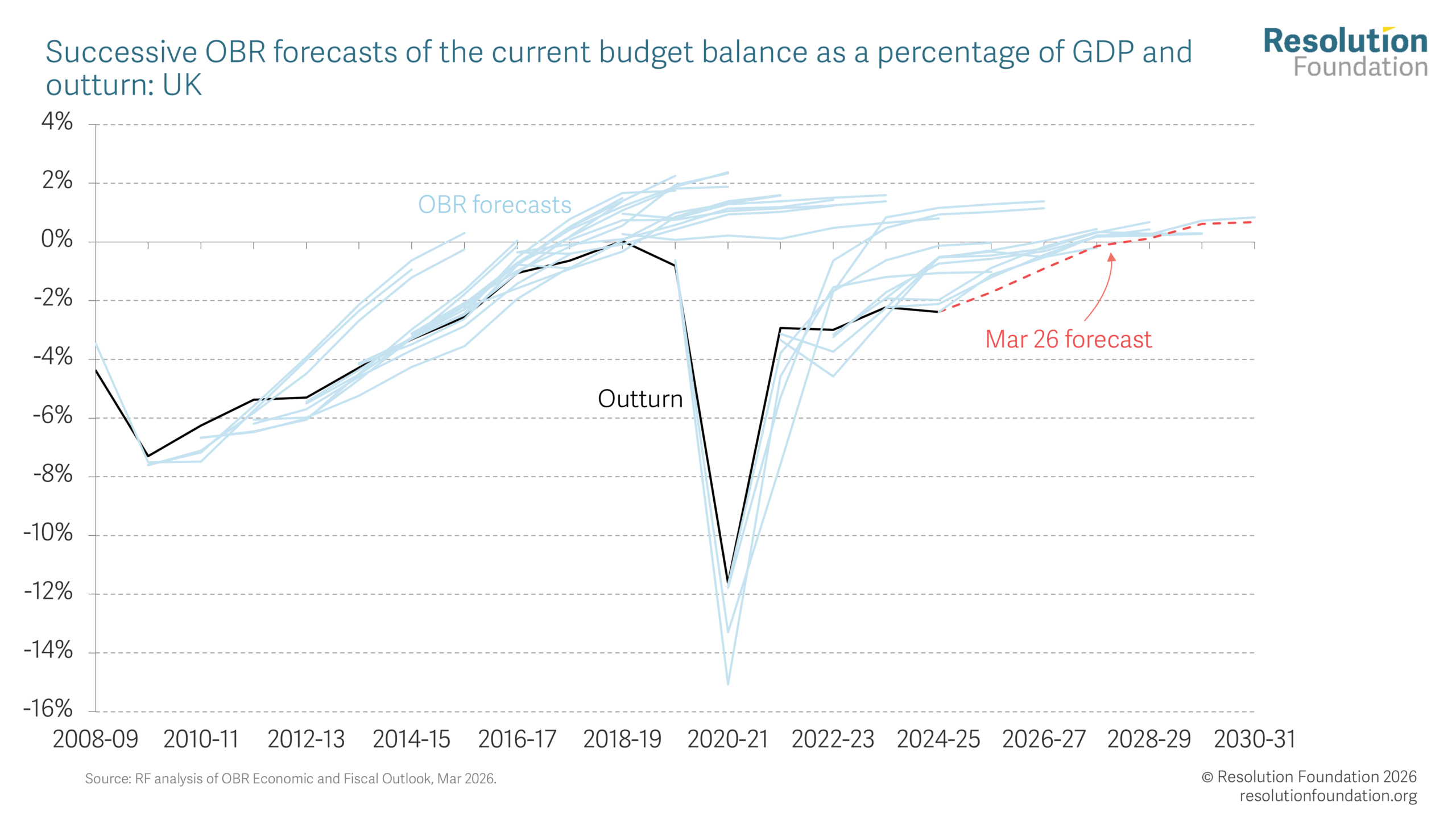
此内容由惯性聚合(RSS阅读器)自动聚合整理,仅供阅读参考。 原文来自 — 版权归原作者所有。