





Afternoon all,
We’ve had plenty of numbers to crunch this week, with new insights on (slowing) pay growth, (accelerating) inflation and a worrying cost of living outlook from the Bank of England – more on all that in our Chart of the week and Something for the weekend. Certainly not an easy context in which to deliver a Budget. I wrote this week about why cost of living support can be self-defeating, and do come along next week to hear about how to reform housing taxes.
Plus, we found out that about half the UK’s productivity puzzle is now thought to evaporate, as the hours everyone was working were being overestimated. Of course, total output, living standards and government revenues remain the same – so we aren’t any better off as a result. But in our post-financial crisis economic history, fewer hours per job looks to be a more important, and declining output per hour less important than we previously thought.
As if that weren’t enough to keep us busy, I decided to spice up my Tuesday by describing the triple lock as “crazy” on the Today programme (listen at 1 hour 10 if you’re interested) thereby clogging our phone line with people who felt somewhat differently.
Please do find us at Labour party conference, if you’re there next weekend.
Have a great weekend,
Chief Executive
Resolution Foundation
Heir today. The wealthiest are not one tribe but several, and a new study of 26 years of Norwegian tax data pulls them apart. Split today’s top 0.1 per cent by those who were already rich in their 20s and those less so and differences emerge. Old Money were already worth 26 times average household wealth in their 20s. Inheritance (42 per cent) and saving (31 per cent) did most of the work to accumulate additional wealth by middle age, despite unremarkable investment returns (+8.5 per cent annually). New Money began with minus 0.1 times average wealth, but rocketed up on high savings returns (+18 per cent annually), and their labour income contributed 22 times more than Old Money’s. So, the self-made rich are out-investing, and out-working, the aristocrats.
Artificial intelligence? It was a pleasure to speak at LSE’s fascinating Global AI and Social Sciences Forum this week. Alongside it, LSE published reports on how AI has impacted the quantity and quality of work, focusing on 74 studies of its impact on employment or wages. The headline finding? You can find a study to support whichever story you want to tell, so be wary anyone claiming to know the answer. Much of the huge divergence comes from studies focused on exposure. 70 per cent of the literature uses “potential” evidence (such as the tasks AI could affect) rather than the jobs AI has affected. The actual story could either be reassuring or terrifying, but given data challenges and the evolving nature of AI that remains to be seen. (Sorry.)
Rung out to dry. The Social Market Foundation has surveyed 3,000 UK adults and interviewed 200 more on their career paths. The authors map five distinct trajectories and find the gaps compound. The best pathway brings faster pay growth and substantially higher earnings by 35 (almost £30k higher than the worst). Family background explains much of the gap, but so do employers. Young workers whose first job boosted their confidence and readiness for senior roles earned 24 per cent more later on, while those who’d interned were more than twice as likely to land a job on the best pathway. The authors advocate for a “Good First Job Guarantee” but that relies on employers training first time hires rather than seeing them as a cost burden.
Burning (out) the candle at both ends. Ever wish your working week was a smidge shorter? So do over a third of European workers, according to this blog exploring the impact of working more than you want to. Drawing on a survey tracking more than 43,000 German workers over 35 years, it finds that working at least two hours longer per week than desired hits wellbeing by roughly half as much as unemployment, and lingers just as long. That holds even after excluding extreme hours and turbulent years. Normally we adapt to big life changes, good or bad, and our wellbeing drifts back to where it started, but overwork breaks that rule — perhaps because the daily grind of it is simply impossible to ignore. So maybe don’t reply to that 9pm email, unless of course you want to.
Something for the weekend
The data deluge this week confirmed that the cost of living crisis is about to get worse. Inflation climbed to 3.1 per cent in August following a 12p-a-litre jump at the pumps, and the worst is still ahead. The Bank of England forecasts inflation of 4 per cent this winter, with the energy price cap tipped to rise by a quarter in January.
The Bank offered some glimmers of hope, holding bank rate at 3.75 per cent and changing the way it unwinds QE, taking some heat off the cost of government borrowing (gilt yields dropped roughly 10bps on announcement, worth about £900 million).
Not such great news for workers though, with real regular pay growth hovering at 0.6 per cent and set to weaken as inflation climbs. Unemployment has held at 4.9 per for most of the year, even as the number of payrolled employees and vacancies continue to drift downwards.
With prices up, bills rising, and pay soon to fall, the squeeze will continue. As the new PM and Chancellor eye their first Budget, they may be starkly aware that winter is coming.
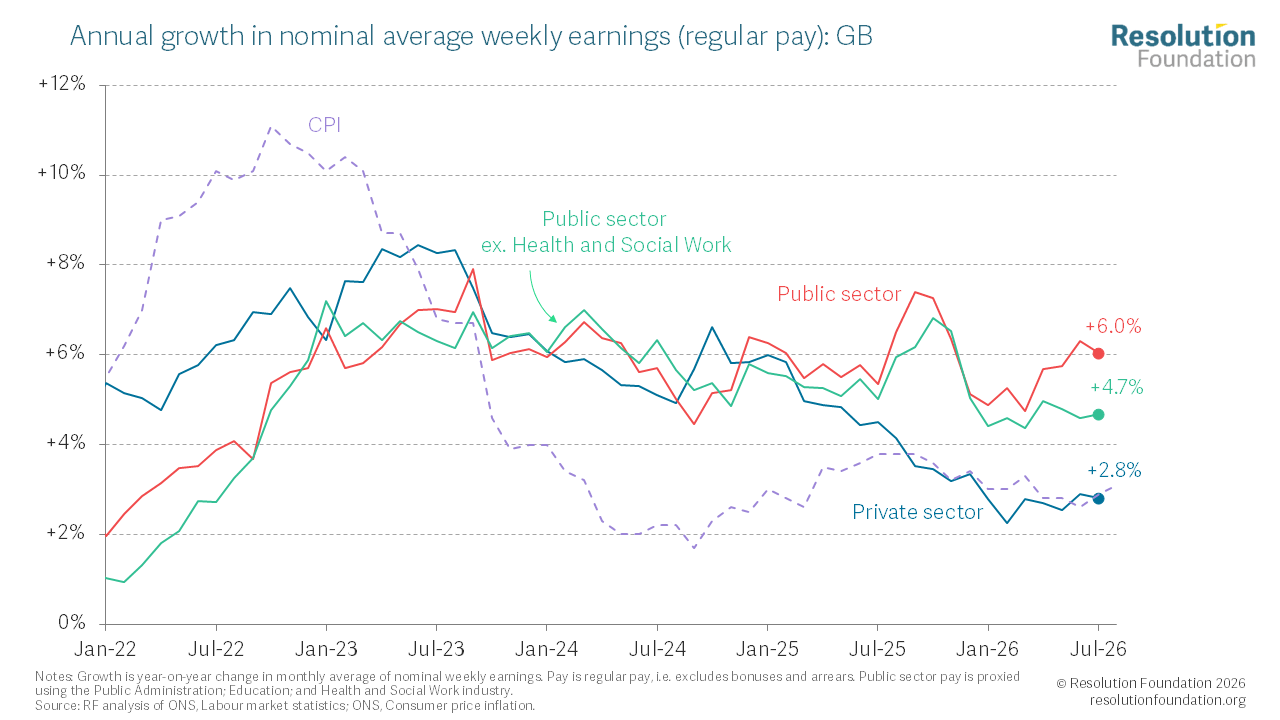
All eyes were on this week’s wage data, which put the state pension up 3.9 per cent in April. But beneath that headline lies a widening gap between public and private sector pay. Private sector pay growth (using the single month average of weekly earnings) fell to 2.8 per cent in July. For these workers the real wage squeeze has already begun – their typical weekly pay is worth £2 less than last October – and will worsen over the autumn. In contrast, public sector pay growth is racing ahead at 6.0 per cent. This bumper figure partly reflects NHS pay settlements landing earlier this year than last. But what about public sector workers outside health and social care? The green line shows their pay too outstripped the private sector last year. With inflation set to hover above 3 cent for now, whether you’re sinking or swimming may depend on where you work, or whether you’ve retired. Strong public sector wage growth also presents a challenge for the Spending Review next year. The biggest unfunded policy bequeathed by Rachel Reeves was a £1.8bn teachers’ pay settlement (now set for a £500m top up). So, who will take the strain? Teachers and nurses through greater pay restraint, public services if they’re funded through the existing spending envelope, or taxpayers if they’re funded via more taxation? Another tricky trade-off…
此内容由惯性聚合(RSS阅读器)自动聚合整理,仅供阅读参考。 原文来自 — 版权归原作者所有。