





Afternoon all,
Roll up, roll up, we’ve got a policy announcement bonanza for you. The first week of Burnham’s premiership certainly wasn’t short of news. But where does it leave us?
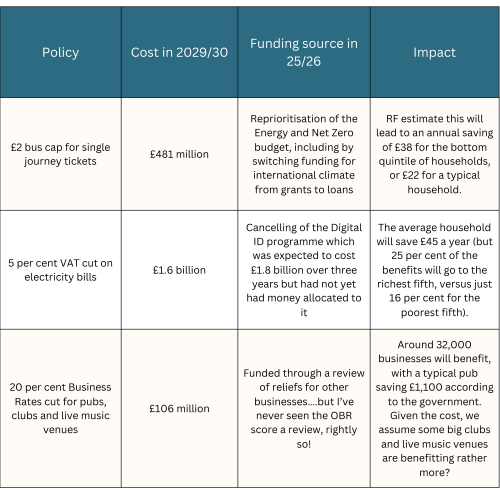
The biggest by far was the 5% VAT cut on energy bills, with a £2 bus fare cap also aimed at providing ‘breathing room’ on the cost of living. Over £67 of support a year for a typical family is not life-changing but it’s not to be sniffed at either. Alongside the business rate cuts for pubs, that means a total cost in 2029-30 of over £2 billion from announcements this week alone (taking our latest headroom estimate to around £8 billion).
The funding debate has focused on both the flimsy detail of where the money is coming from, and the ambiguity about whether the measures are permanent. The upshot is that either John Healey needs to find more money in the Budget, or he needs to put up energy bills back up by 5%. Stepping back, what’s most interesting to me is whether the signals about funding this week suggest a broader approach – a willingness to cut departmental spending to put money back in people’s pockets – or just the opening skirmishes of a government yet to face the big trade-offs.
Here’s our attempt to keep track of what’s going on from buses to pubs…
On our latest podcast episode Luke Tryl was optimistic about the tactic of showing you are trying even if global events may ultimately determine outcomes. Listen to find out why he also made me stressed about which ice cream flavour to choose this summer.
Read on for how prospects for love might affect your enthusiasm for work, and how the 1900s were fuelled by local authority borrowing. Chart of the week is from our Housing Outlook out today on what a step change in council house building might mean.
Have a great weekend,
Ruth
Chief Executive
Resolution Foundation
The Royal Economic Society conference in Newcastle two weeks ago was good hunting ground for TOTC papers, so we start with two I saw presented there.
Deutsche downtime. This paper looks at the German short-time work scheme which allows flexible reduction in hours for employees and partial wage subsidies for hours not worked. The permanent scheme, loosened through the pandemic, cost £45 billion between 2020-21. The paper finds that firms taking up the scheme during Covid were disproportionately weaker performers on productivity and quality measures, but this did not hold in the financial crisis; so the nature of the shock really matters. The same firms saw employment run 3-4 per cent higher than non-scheme users. Alas, the effect evaporated fast once firms left the scheme. Reality was postponed, not avoided.
Working for weddings. Marriage and providing for a family incentivise hard work for many people. But what happens when marriage prospects are dim? This paper constructs a ‘competition index’ from the marriage patterns of 18-45-year-olds and local population data to examine how marriage market tightness shapes labour supply by gender and education. College-educated men face greater local competition, work longer hours and earn more perhaps seeking to make themselves a more attractive marriage prospect. Men without degrees work fewer hours but this may just be compositional, as they become less likely to work at all. Among non-college educated women, however, greater competition for love increases the likelihood of dropping out of the official labour force entirely. Unromantic as it sounds, the dating market and labour market remain tightly intertwined.
Bond, devolved Bond. Here’s one for Andy Burnham: how did local authorities in 19th century England pay for services and infrastructure? A new paper digs into loan records and finds that, by 1900, municipal debt was almost as large as the corporate bond market and around half the size of the national debt. Faced with the burgeoning costs of providing sewage infrastructure (sound familiar?) London started issuing municipal debt and it grew from there to fund streets, trams, schools and more. Almost all of it came from private lenders rather than Whitehall, and not a single local authority went bust. Something radical fiscal devolutionists will want to reflect on, though we mustn’t forget all borrowing has to be repaid by someone in the end (whether it’s a war bond or a local bond).
Manmaxxing. How big an impact does masculinity play in politics? To find out, this research looked at leaders’ facial width-to-height ratios as a biological marker for testosterone-driven behaviour i.e. they measured people’s faces. Mapping the faces of over 2,000 world leaders across 184 countries and over 150 years, the authors find that masculinity has increased over the past 70 years – with spikes during geopolitical turbulence like the Cold War. The authors also found masculine leaders were much more likely to preside over institutional decline and engage in militarised conflict. Could Burnham buck the trend with his record-breaking majority-female cabinet? Hard to tell – eyelash length wasn’t covered.
Chart of the week
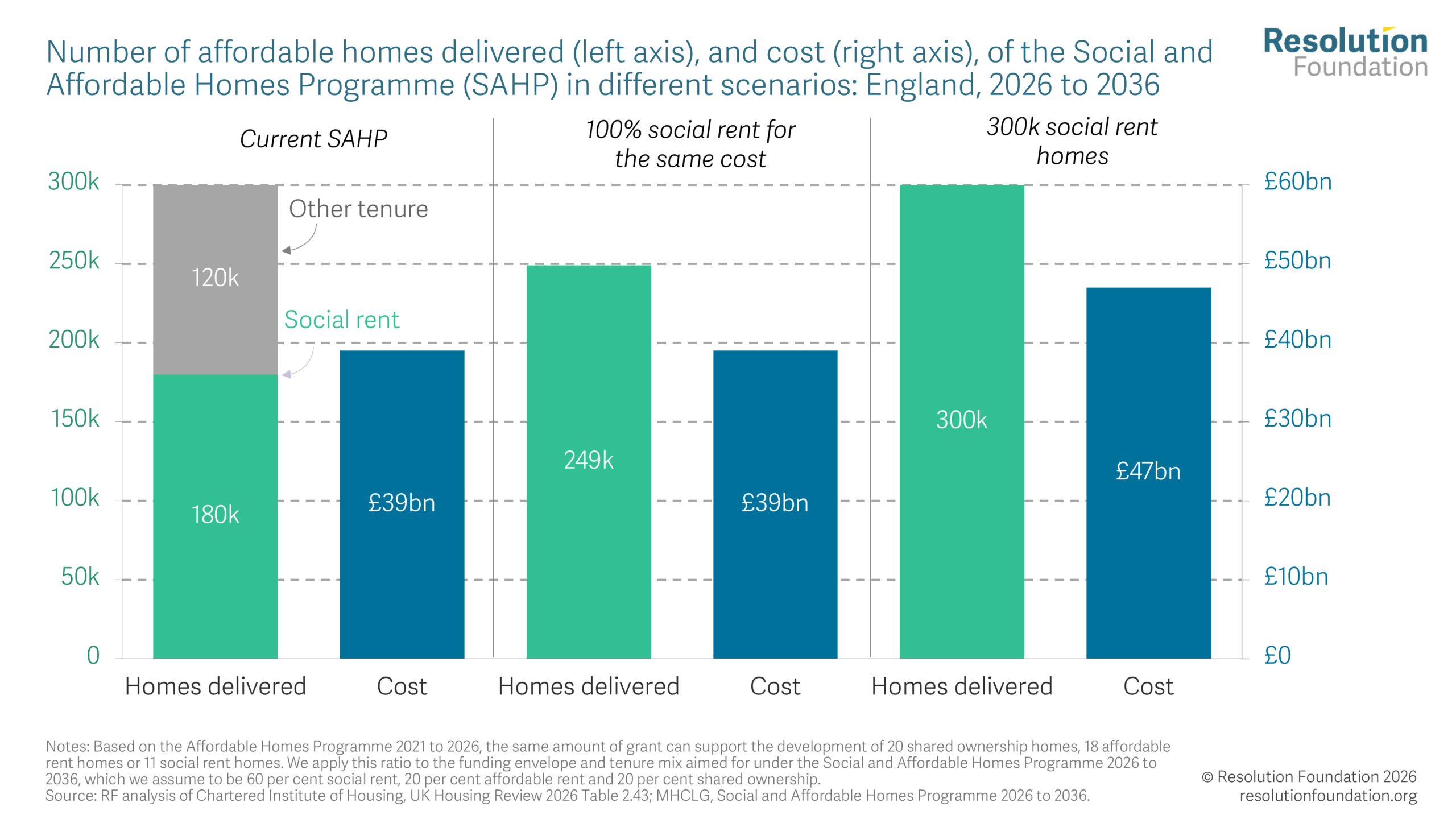
Andy Burnham wants to deliver the biggest programme of council housebuilding since the post-war era. A mighty ambition, but tricky. Our new Housing Outlook looks at what it might take to deliver more homes let at a social rent, commonly known as council houses. On paper, the new Social and Affordable Homes programme looks like the vehicle to deliver this: a £39 billion envelope targeting 300,000 affordable homes with a full 60 per cent earmarked for social rent. So why not go the full hog and ring-fence every last pound for social rent? Because bricks don’t care about tenure, but the Treasury does. A home costs the same to build whoever ends up renting it, but social rent brings in less rental income over its lifetime than other affordable products, so it needs a bigger dollop of grant up front to stack up for a housing association. Hold the money fixed and chase 100 per cent social rent, and you build 50,000 fewer homes overall; hold the homes fixed, and you’re reaching for £8 billion more in grant.
此内容由惯性聚合(RSS阅读器)自动聚合整理,仅供阅读参考。 原文来自 — 版权归原作者所有。