




Afternoon all,
Is there such a thing as an UN-lucky DIP? The long-delayed Defence Investment Plan landed this week, creating a headache for our PM-in-waiting: Andy says he will stick with the fiscal rule that the current budget will be balanced in 29-30, and the DIP is a £2 billion hit against that rule. That, and the small matter of the effects of the Iran war, will need to be addressed at the Budget before we get to shiny new things. (The widely-discussed £5bn is money added up over different years, and none of the capital savings help the current budget rule).
Even so, we’re still £25 billion a year shy of hitting the NATO target of 3.5 per cent by 2035 – that’s more than would be raised by 3p on income tax, or by freezing the state pension in cash terms for the rest of the Parliament. So yes, there’s £2 billion for the next Chancellor to find in the coming months, but there’s a bigger discussion to be had for all of us over the coming years.
If these kinds of impossible problems are what get you leaping out of bed in the morning, then please do consider applying to become our next Director – I’m after a partner in crime to run this fantastic organisation.
I’ll be headed north next week (long planned not bandwagon jumping I promise) to talk about shared growth at an event with Atom bank and talk fiscal rules with a great panel at the annual RES conference, please come along if you’re near Newcastle.
Keep scrolling to learn how many people believe lizards rule us and why you shouldn’t hand off your emotional labour to Claude. Plus, Chart of the week puts the DIP in context.
Have a great weekend,
Ruth
Chief Executive
Resolution Foundation
Risky business. We’re all about living standards here at RF. But one problem with using disposable income or GDP per capita to measure them is that they can’t handle new goods, quality improvements or anything not sold in a market. This paper argues for a different way of capturing change in living standards: the value of a statistical life. In their telling, people’s willingness to trade consumption against mortality risk (e.g., the pay premium for dangerous work) reveals what they think their remaining life is worth. On this metric, lifetime utility in the US has grown fivefold since 1940 – more than double what consumption measures would suggest. Caveats incoming: these calculations are massively sensitive to what discount rate you pick and the data itself is a bit shaky. We’ll be sticking with our own numbers for now.
A conspiracy of dunces. We’ve all seen the worrying headlines – for example that 12 million Americans believe we’re ruled by alien lizards. Well, this paper attempts to challenge such misconceptions, positing survey respondents are not being totally honest about their beliefs. The authors tested this by constructing a survey which included a question on whether people believed Canada was “secretly developing an elite army of genetically engineered, super intelligent, giant raccoons”. In case you couldn’t tell, they made that one up. And still, 10 per cent of the 1,000 Australian respondents claimed to think it was true. The people who ticked yes to super racoons, were more likely to endorse the other pre-existing conspiracy theories on the list – including both that Covid was spread by 5G, and that Covid didn’t exist. The kicker? Fully 13 per cent of respondents admitted to answering “randomly or insincerely”. A useful reminder that ticking “yes” on a survey does not require devoted belief.
The kids robots are alright. Shrinking and ageing populations whip up productivity and economic growth fears among academics and policymakers, but a new paper finds the opposite. The authors find that, across countries, since 1950, lower birth rates are linked to higher GDP per working-age adult over a 50-year period. The authors explain this counterintuitive finding by arguing a scarcity of young workers pushes firms to invent and adopt labour-saving technologies. Using WWII casualty data as a natural experiment, the authors cross-check the productivity boosts from falling birth rates and find they are driven by the loss of younger workers, from military deaths, rather than overall population loss. Could human capital investment be a hopeful story for Britain’s baby bust?
Floor plan. Cheery reading from the Joseph Rowntree Foundation this week: the price shock from the war in the Middle East threatens to make this the worst parliament on record for living standards, with the poorest bearing the brunt. We don’t quite agree, mainly because it depends a lot how you define the start of the parliament and because they’ve used a more pessimistic inflation forecast. But we do agree things aren’t great. In response, they propose a whole host of interventions, including re-linking Local Housing Allowance to rents, an energy price discount, and a minimum floor for UC that covers bare essentials. The price tag is pretty hefty at £18bn, which they say can be funded by equalising Capital Gains Tax with income tax (+£11bn) and higher National Insurance on investment income (+£8bn). By their count, these changes would lift living standards by 7 percentage point by the end of the decade. Not bad if you can get it.
Claude is not your confidant. Before asking ChatGPT for relationship advice, maybe read this research. Born out of a PhD student’s shocking discovery that undergrads used AI to draft breakup texts, this study finds that chatbots are agreeable to the point of sycophancy. The authors queried 11 language models on interpersonal dilemmas, finding models endorsed users 49 per cent more than humans, and endorsed harmful or illegal behaviour 47 per cent of the time. They then tested over 2,400 participants’ attitudes toward sycophantic versus non-sycophantic AI. Users rated both as equally objective, returning readily to the flattering model – unconvinced of any wrongdoing. The authors call for models to be more critical and better regulated. As AI seeps into every corner of our lives, we should hold onto that friend who lets us know we’re in the wrong.
Chart of the week
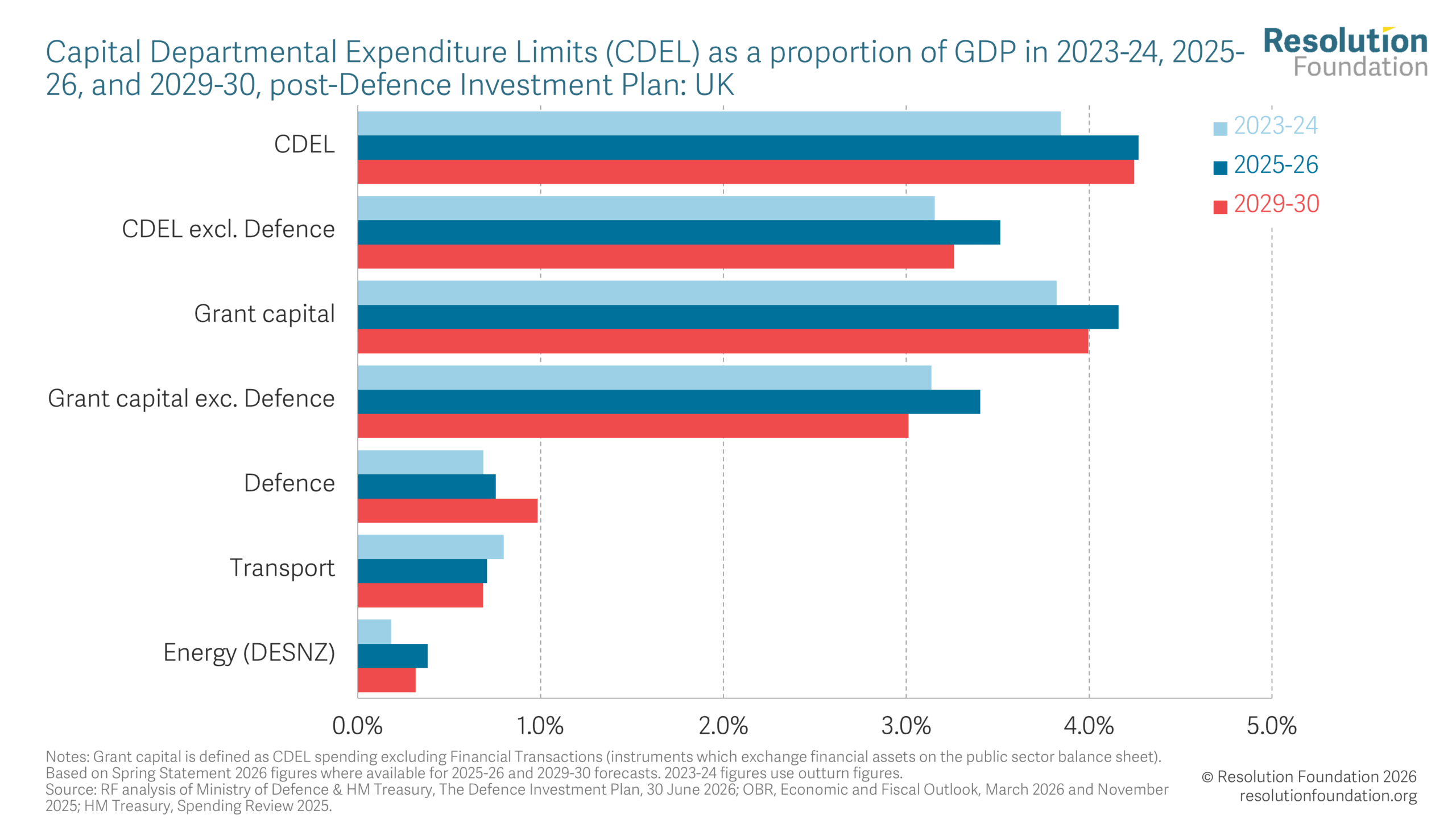
The news this week has been all about Starmer’s gift to Burnham, who will stroll into No10 to find some unpaid bills on the doormat. But what’s the impact of the cuts we were told about? A further shift of capital spending towards defence may well be necessary, but it is less conducive to economic growth than other departments’ spending (such as transport and energy). At the start of her stint as Chancellor, Rachel Reeves reversed planned cuts to capital spending and moved to sustain public investment at 2.6 per cent of GDP, the highest average rate in any five-year period since 1980. Since then, the demands on defence have grown. The DIP continues that trend. Grant capital spending (excluding financial transactions) outside of defence will now be £6.4 billion lower (in real terms) in 29-30 than in 25-26, although £3 billion higher than the last year of the previous Parliament. £1.77 in every £10 of capital spending (excluding financial transactions) went on defence in 23-24, by 29-30 it will be £2.46. Had the proportion stayed the same there would be £9 billion more, in real terms, for other infrastructure. Paying for national defence is of the highest importance, but let’s not pretend there is no growth cost to this reallocation.
此内容由惯性聚合(RSS阅读器)自动聚合整理,仅供阅读参考。 原文来自 — 版权归原作者所有。