


惯性聚合 高效追踪和阅读你感兴趣的博客、新闻、科技资讯
阅读原文 在惯性聚合中打开

推荐订阅源

H
Heimdal Security Blog
A
Arctic Wolf
K
Kaspersky official blog
V
Vulnerabilities – Threatpost
Threat Intelligence Blog | Flashpoint
Simon Willison's Weblog
L
LINUX DO - 热门话题
MongoDB | Blog
MongoDB | Blog
T
Threat Research - Cisco Blogs
D
Docker
爱范儿
爱范儿
T
Tenable Blog
C
Check Point Blog
B
Blog
C
Cisco Blogs
Vercel News
Vercel News
The Cloudflare Blog
T
Threatpost
NISL@THU
NISL@THU
T
Tor Project blog
V2EX - 技术
V2EX - 技术
P
Palo Alto Networks Blog
Application and Cybersecurity Blog
T
Tailwind CSS Blog
G
GRAHAM CLULEY
P
Privacy & Cybersecurity Law Blog
SecWiki News
SecWiki News
博客园 - 司徒正美
S
Security @ Cisco Blogs
GbyAI
GbyAI
S
Secure Thoughts
Microsoft Security Blog
The Register - Security
Recorded Future
Recorded Future
Cloudbric
Cloudbric
Webroot Blog
Webroot Blog
N
News and Events Feed by Topic
Y
Y Combinator Blog
博客园_首页
T
Troy Hunt's Blog
The Hacker News
The Hacker News
雷峰网
雷峰网
Google DeepMind News
U
Unit 42
AWS News Blog
AWS News Blog
PCI Perspectives
PCI Perspectives
V
Visual Studio Blog
博客园 - 聂微东
有赞技术团队
有赞技术团队
酷 壳 – CoolShell
酷 壳 – CoolShell

AWS for Industries

Dynamic Inbound Routing for BYOIP Workloads Using Amazon VPC Route Server | Amazon Web Services How Autel Transformed Charging Station Management with AI Agents on AWS | Amazon Web Services How Danone Simplified Kubernetes at Scale with Amazon EKS Auto Mode | Amazon Web Services Build a Multi-Agent Assessment Workbench with Amazon Bedrock AgentCore | Amazon Web Services Sovereign by design: How AWS helps Nigeria’s financial services industry protect data and drive innovation | Amazon Web Services Scaling ML in production: how BBVA accelerated delivery with MLOps | Amazon Web Services Inside BBVA’s MLOps transformation: from data platform to scalable ML on AWS | Amazon Web Services Blazing a Trail: How Peloton Rebuilt the SDLC for the Agentic Era with Amazon Bedrock | Amazon Web Services Accelerate RISC-V Software Development Before Silicon: Virtual Prototyping with MachineWare’s SIM-V on AWS | Amazon Web Services How retailers deliver hyper-personalization in-store with Personalisation Hub, UST, and AWS | Amazon Web Services Deploy diagnostic-quality imaging globally with MedDream and AWS HealthImaging | Amazon Web Services Coins in Motion: Building agentic blockchain payments for in-vehicle experiences | Amazon Web Services Reduce P&ID analysis time by 80% with hybrid AI maintenance planning | Amazon Web Services Deploying industrial AI on AWS: Building the autonomous factory | Amazon Web Services How Atlantic Health cut legal document search time by 42% with Amazon Bedrock metadata filtering | Amazon Web Services Edge-to-Cloud Architecture for Real-Time Surgical Intelligence with AWS and NVIDIA | Amazon Web Services Reimagining B-Pillar DFMEA: Why Ontology-Grounded AI Is the Future of Automotive Engineering | Amazon Web Services Transforming energy trading by managing complexity and driving growth with Cloud ETRM | Amazon Web Services How Multi-Agent AI Turns Supply Chain Data into Decisions and Actions | Amazon Web Services ​​​Deploy Agentic Bidding Without Sacrificing Speed: ARTF Containers with NVIDIA GPU Acceleration on AWS​​ | Amazon Web Services Next-generation programmatic advertising: How AWS RTB Fabric redefines the game | Amazon Web Services Flexible Telecom AI Workload Deployment Across AWS Hybrid Cloud | Amazon Web Services Building a HIPAA-ready generative AI architecture for healthcare on AWS | Amazon Web Services Highlights from the 2026 AWS Life Sciences Symposium: MedTech Track | Amazon Web Services Multi-Agent Systems for Financial Services on Amazon EKS and AgentCore | Amazon Web Services How AI can help developers migrate embedded codebases between Arm SoCs | Amazon Web Services From Connected to Resilient: Cloud-Native Payment Connectivity on AWS | Amazon Web Services Ultra-low-latency cross-Region crypto trading with Avelacom and AWS | Amazon Web Services Build an AI-powered 5G Signaling Trace Analyzer Using Amazon Bedrock | Amazon Web Services Medical Legal Regulatory Review Orchestration with AI Agents on AWS | Amazon Web Services AWS showcases the agentic AI future of advertising and entertainment at Cannes Lions 2026 | Amazon Web Services The Road to 180M GRefs/s: Sizing Epic on AWS with R8ib and Enhanced EBS | Amazon Web Services Rethink Everything: Highlights from the 2026 AWS Financial Services Symposium | Amazon Web Services Improving Defect Analysis and Quality Control with AI Diagnostics | Amazon Web Services Building a cloud-based EV charging monitoring platform with real-time AI analytics | Amazon Web Services Introducing the AWS guide to the ECB Guide on outsourcing cloud services to cloud service providers | Amazon Web Services How a Luxury Retailer Accelerates Customer Experience with Amazon CloudFront | Amazon Web Services The Art of the Possible: Building an Intelligent Wealth Management Platform – Part 1 | Amazon Web Services How We Built Healthcare AI You Can Trust: The Science Behind Amazon Connect Health | Amazon Web Services How Everllence Scaled P&ID Intelligence to Improve Plant Operations | Amazon Web Services Rivian accelerates production with second-generation AWS Outposts: Improving resiliency and reducing costs | Amazon Web Services AI-Driven Development Lifecycle for Financial Services | Amazon Web Services How Agentic AI and Digital Twins on AWS Drive Operational Excellence | Amazon Web Services Modernizing Core Banking Systems: A Strategic Guide for Financial Leaders | Amazon Web Services Highlights from the 2026 AWS Life Sciences Symposium: Research and Drug Discovery | Amazon Web Services Discount Tire Uses Cloud WAN and Buffer VPC to Create a Scalable Enterprise Network Centralized third-party connectivity in AWS: Architecture patterns for highly regulated environments | Amazon Web Services FHIR-powered Care Continuum on AWS HealthLake From code to chemistry: using Kiro to tackle ADME-Tox, a key drug discovery challenge | Amazon Web Services How Toyota securely deployed HiveMQ with mTLS on AWS to power Smart Manufacturing | Amazon Web Services From record to intelligence: How EMR systems on AWS become the foundation for generative AI in healthcare | Amazon Web Services How to Connect AWS HealthOmics to Public and Private Network Sources at Runtime | Amazon Web Services Accelerating Android Builds on AWS: From 3 Hours to Under 5 Minutes with SourceFS | Amazon Web Services Closing the Loop with Amazon Bio Discovery’s Integrated Lab Partners | Amazon Web Services Massive Parallel Processing of Financial Transactions with Amazon EKS and Amazon MSK | Amazon Web Services Submit up to 100,000 Bioinformatics Workflow Runs with a Single API Call in AWS HealthOmics | Amazon Web Services Energy HPC Orchestrator powers collaborative, scalable energy computing | Amazon Web Services Automate Investment Research Using Strands Agents on Bedrock AgentCore | Amazon Web Services How OCC Built a Governed Cloud Foundation and Then Stress-Tested It Executive Insights from the 2026 AWS Life Sciences Symposium How Carlsberg’s Traitomic business leveraged AWS HealthOmics to power genetic trait development | Amazon Web Services CME Group MDP multicast data access on AWS using Transit Gateway | Amazon Web Services How retailers solve the customer identity puzzle with Amperity and AWS | Amazon Web Services Exact Sciences Transforms Bioinformatics Infrastructure with AWS HealthOmics | Amazon Web Services Building a Serverless Supply Chain Management Solution for Automotive Customers with AWS AppSync and Amazon Aurora Serverless | Amazon Web Services Accelerating physical AI with AWS and NVIDIA: building production-ready applications with simulation and real-world learning | Amazon Web Services Modernizing life-saving workloads with AWS serverless | Amazon Web Services Transforming Industrial Operations: How AVEVA and AWS drive Cloud Innovation | Amazon Web Services Introducing Amazon Bio Discovery | Amazon Web Services Accelerate Project Delivery with AI-Native Execution System on Amazon Quick | Amazon Web Services Reinvent Telecom Mediation Systems with Amazon Bedrock AgentCore, Strands Agents, and the Model Context Protocol | Amazon Web Services AWS Cloud Connectivity Patterns for Financial Market Infrastructures | Amazon Web Services Event-Driven Digital Pathology: Governed Whole Slide Image Ingestion to Scalable Inference with Amazon SageMaker | Amazon Web Services How Telefonica Germany achieved a centralized tracing solution with VPC Traffic Mirroring | Amazon Web Services AWS Teams Up with Wingstop to Deliver Wings to Millions During March Hoops Tournament | Amazon Web Services How Amazon Connect Health brings agentic AI to the point of care | Amazon Web Services How Liftoff improved conversion performance and reduced infrastructure costs with Cortex using AWS Graviton | Amazon Web Services From Prompt to Pipeline: AI-Powered Bioinformatics Workflow Development with Kiro and AWS HealthOmics | Amazon Web Services Driving Intelligent Quality in the Software-Defined Vehicle Era | Amazon Web Services How Amazon Devices Eliminated Credential Risk to Scale AI across Engineering Tools | Amazon Web Services The Evolution of BMW Group’s 3D Streaming Experience | Amazon Web Services Build ChatGPT Apps with MCP Servers and AWS Infrastructure | Amazon Web Services
BridgeWise builds responsible AI in FSI with Amazon Bedrock | Amazon Web Services
Emir Ayar · 2026-06-10 · via AWS for Industries

AWS for Industries

Why responsible AI matters to BridgeWise

When it comes to the wealth and finance space, recommendations take on additional weight. Investors decide about their capital based on the guidance provided by financial services institutions (FSIs), meaning that accuracy and data quality are paramount. If investors encounter errors or hallucinations when interacting with AI in the wealth space, their trust erodes quickly. With such a high bar, FSIs need to know the tools they make available to their customers will uphold that trust.

In this post, we show how BridgeWise was able to overcome these challenges when developing their wealth AI platform with responsible AI in mind. BridgeWise is a global leader in AI for wealth. Its proprietary technology includes a finance-specific Micro Language Model (MLM). BridgeWise provides financial institutions and trading platforms with a core AI layer that delivers analysis for over 70,000 global assets via engaging, investor-friendly solutions. It brings AI chat for investments, social and news sentiment analysis, market alerts, and more. BridgeWise’s AI is also purpose-built for wealth, ensuring accuracy and compliance across the board.

The challenges BridgeWise faced

To ensure the model uses the right language and adheres with financial regulations, BridgeWise trained a custom model. This proved a cost-effective way to handle millions of calls daily. However, every model training iteration could potentially result in the loss of some past training (a.k.a. catastrophic forgetting). BridgeWise had to assess the model periodically against a diverse set of questions. Each answer from the custom model was assessed against multiple parameters, including accuracy, language used, and factuality.

This task is cumbersome, requiring a team of subject matter experts (SMEs) for days at a time. It also created a responsible AI dilemma, choosing between:

  • Evaluate frequently — fast detection of regressions with a high impact on the SME team
  • Evaluate infrequently — lower impact on SMEs, but risk having regressions grow over multiple training iterations.

To maintain its position as a trusted industry leader, BridgeWise set an ambitious goal: to automate the evaluation of the model’s response. They chose an LLM-as-a-Judge approach. This automated evaluation cycle happens after each training
cycle.

It also reduced human effort, as human evaluation is now only there to prevent evaluation-drift over time. Another way to think about it is that this will do to model training what DevOps did for software developers. It allows them to move fast as they can rely on automated testing to find regressions.

Solution Overview

Let’s explore how BridgeWise and AWS collaborated to build an automated model evaluation system using Amazon Bedrock as the backbone for LLM-as-a-Judge. To run after each training cycle, the solution had to return the results quickly. It also had to have a minimal impact on the SME team. Previously, the SME team spent days reviewing thousands of question-response pairs. Now, the evaluation runs automatically. The diagram illustrates the full architecture of the evaluation system:
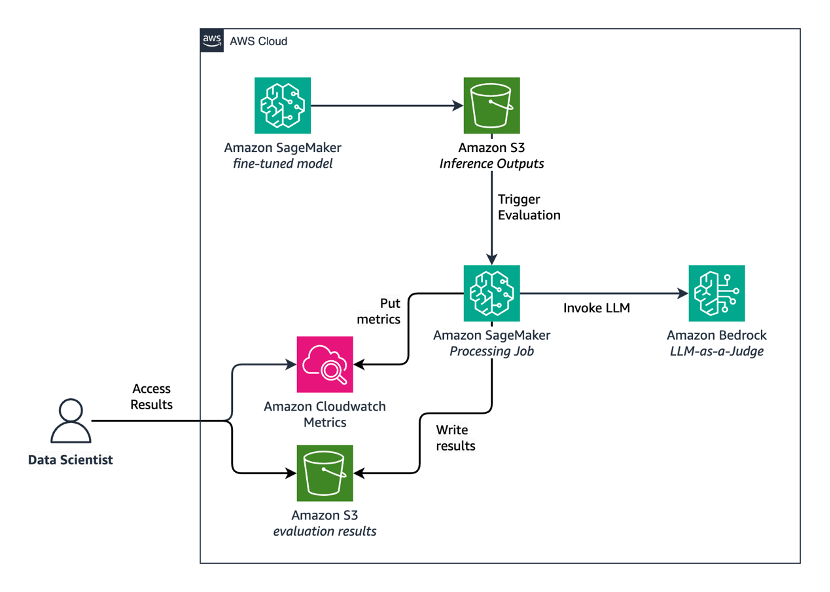
Figure 1. Solution architecture for the BridgeWise LLM evaluation system on AWS

Figure 1. Solution architecture for the BridgeWise LLM evaluation system on AWS

At a high level, the workflow operates as follows:

  1. After a fine-tuning cycle, data scientists define evaluation criteria files and upload them to an Amazon S3 bucket.
  2. When new model outputs are available for evaluation, the system automatically triggers a job in Amazon SageMaker Processing.
  3. The processing job reads the evaluation files and model outputs from Amazon S3. It then invokes foundation models on Amazon Bedrock to evaluate each response against ground truth data.
  4. The tool stores evaluation results, including scores, explanations, and token usage metrics, in Amazon S3. It also sends operational metrics to Amazon CloudWatch.
  5. Data scientists access the results through an analysis notebook and can analyze performance across responsible AI dimensions or model versions.

This architecture provides BridgeWise with a repeatable, managed evaluation pipeline that decouples the evaluation process from individual machines and scales with its growing language coverage.

Technical Implementation

The AWS PACE (Prototyping, AI & Cloud Engineering) team worked with the BridgeWise data science team over 3-weeks to build this solution. Let’s walk through the key components of the implementation.

Evaluation Logic

The evaluation process begins with input from multiple sources:

  • Inference outputs from different model versions
  • Ground truth data curated by the product team
  • Evaluation configuration provided by a data scientist

The evaluation tool is a containerized application with custom application logic. It retrieves this data from Amazon S3 and processes it.

For each question-response pair, the tool constructs a structured JSON prompt containing the evaluation criteria, the expected answer, and the model’s response. It then invokes a Foundation Model (FM) on Amazon Bedrock — such as Anthropic Claude — which acts as the judge. The model returns a structured evaluation output including a score (qualitative decision) and an explanation of its reasoning (qualitative). This structured approach makes the analysis consistent and quantifiable across metrics such as faithfulness, factual accuracy, and regulatory language compliance.

Serverless Execution with Amazon SageMaker

Running evaluations on individual laptops occasionally failed because of missing dependencies or inconsistent environments. The team designed the tool to run using Amazon SageMaker Processing jobs. Each evaluation run is an immutable, atomic job that uses a predefined container image. This prevents inconsistency and improves reproducibility.

Data scientists configure evaluation parameters through an interactive notebook, providing the inputs. Multiple evaluation jobs can run concurrently, each operating independently and storing results separately. This also helps process multiple versions of the model without interference.

Built-in Operational Excellence

Beyond the core evaluation capability, the team implemented several best practices during the engagement:

  • Resilience: The tool uses type validators to detect and correct malformed JSON responses from the LLM. When the judge model returns improperly formatted output, a feedback loop prompts the model to correct its response, preventing pipeline failures.
  • Reliability: BridgeWise’s usage pattern is spiky. Thousands of evaluations in one hour, then nothing for days. The team implemented proactive rate limiting and adaptive retry with exponential backoff through the AWS SDKs, preventing throttling failures under burst workloads.
  • Monitoring: The tool sends custom metrics to Amazon CloudWatch, tracking input and output token counts, execution time, and success rates. This helps BridgeWise build dashboards for cost attribution across model versions and set alarms for anomalous behavior.

Results Analysis

To help data scientists interpret evaluation results at scale, the team built two analysis mechanisms powered by Amazon Bedrock:

  1. Overall explanation: A notebook that takes a completed evaluation run. It filters results below a configurable quality threshold. It then uses Amazon Bedrock to identify common patterns of failure, key missing points, and areas for improvement. For each finding, it surfaces three representative questions from the evaluation dataset.
  2. Overall comparison: A notebook that summarizes and compares evaluation results across multiple model versions, explaining which model performed better and why. This helps data scientists make informed decisions about which training iteration to promote.

BridgeWise also applies a human-in-the-loop pattern. Subject matter experts review a sample of evaluation results to validate the automated scores and detect potential drift in the LLM judge over time.

Conclusion

You’ve now seen how BridgeWise used LLM-as-a-Judge to put responsible AI into practice. Instead of improving the training itself, the focus is on reducing the overhead of evaluating the training’s results. They used the vast dataset of past reviews to facilitate an effective, automated evaluation. The result is faster detection of regressions in the model training (for example, catastrophic forgetting). This leads to a higher level of trust in the model. It’s also a more scalable approach, allowing BridgeWise to add questions and corner cases to continue evolving their coverage. This reduced the evaluation time from 4 human days to 3 hours.

The automated evaluation pipeline positions BridgeWise to scale its quality assurance process across multiple languages. It decouples the effort of evaluation from human labor. The serverless architecture built on Amazon SageMaker and Amazon Bedrock means evaluation capacity scales on demand. The operational instrumentation through Amazon CloudWatch provides the visibility needed to manage costs and performance proactively.

To get started with building your own responsible AI evaluation systems, explore Amazon Bedrock and Amazon SageMaker. The AI landscape evolves quickly, and AWS continues to expand its managed offerings in this space. You can also start by learning about GenAI evaluations using the managed evaluation service in Amazon Bedrock. This offers another path for teams looking to add automated evaluation to their workflows. For fine-tuning, Amazon Nova Forge delivers a managed experience from data preparation through training, with techniques like data mixing to help prevent catastrophic forgetting.