


Can your physical store be as intelligent as your website?
What if each physical store you own knows who just walked in the door? What if the store could present the right offer on the right shelf, at the right moment—not based on guesswork, but on real-time intent? What if the in-store experience adapted and became as fluid as your website?
The data exists, and the technology has evolved. Gone are the days when the average customer is a stranger the moment they step through the door.
Here, we explore the next wave of personalization and what it takes to close that gap—not with more screens, but with a fundamentally different operating model for physical retail. New technology brings one-to-one personalization from ecommerce into the physical store. And you can deploy it today.
Why in-store personalization is hard to scale
The digital-physical personalization divide has been a challenge since ecommerce emerged. And that’s more likely due to ecommerce being, at the time, a bit of an experiment. Some thought it was a fad. Others never saw the convergence of the two. It was a clean miss for both schools of thought.
Today’s shoppers expect retailers to deliver connected and personalized experiences online as well as in store. In large retailers, maintaining integrations across legacy platforms often results in a patchwork marketing stack that—at its best—consistently misses the mark.
From an in-store personalization perspective, customers are typically identified only at the point of checkout. That means upsell and cross-sell opportunities are often missed when the opportunity matters the most. You can think of them, because you’ve been in the same situations. Standing in front of a display trying to figure out what to buy. Looking at a sandwich menu board just wishing you could remember what you got the last time (and really liked it). Or maybe you were browsing through a store looking for the perfect gift for a friend? The examples are endless, as have become the aisles with ecommerce. If only the store could talk to you? Well, it can.
Enter Personalisation Hub and UST
AWS Partner, Personalisation Hub (an Australian-based company) has spent over seven years solving this problem, specifically for brick-and-mortar retailers. Its platform is available through AWS Marketplace. It is deployed inside the retailer’s own Amazon Virtual Private Cloud (Amazon VPC), running on the retailer’s domain, data, agents, models, and security controls.
For deployment, Personalisation Hub works with another AWS Partner, UST. With the help of UST, which brings enterprise transformation expertise, systems integration, and boots on the ground, Personalisation Hub’s technology can be scaled across a large footprint.
Together, with AWS as the cloud foundation, the three organizations form an integrated capability stack that takes retailers from fragmented, channel-specific experiments to a unified, AI-driven personalization operation. Personalisation Hub identifies the customer (GDPR-compliant), integrates the customer profile, product information and tertiary elements such as weather, while UST provides planogram insights, AI-powered product content, shelf-edge offer presentation, and virtual try-on.
How does it work?
There are four challenges to overcome, the first being simply identifying customers on arrival. That’s the key to the second challenge, which is accessing customer data quickly and at the store’s location. The third challenge involves creating custom content for each customer—quickly. And the last challenge is less of a mechanical one, but more of a change in thinking about how to do business when you, as the retailer, can command hyper-personalization at scale.
Challenge 1: Identify customers on arrival in-store
For most retailers, customers remain anonymous until they reach the checkout—meaning the entire in-store journey is a missed personalization opportunity.
Personalisation Hub solves this by identifying customers at the moment they arrive, creating a continuous, personalized experience from entry to exit—and beyond purchase. As such, there are multiple frictionless check-in methods to suit different store formats and customer preferences.
To expand on that notion, see the following graphic.
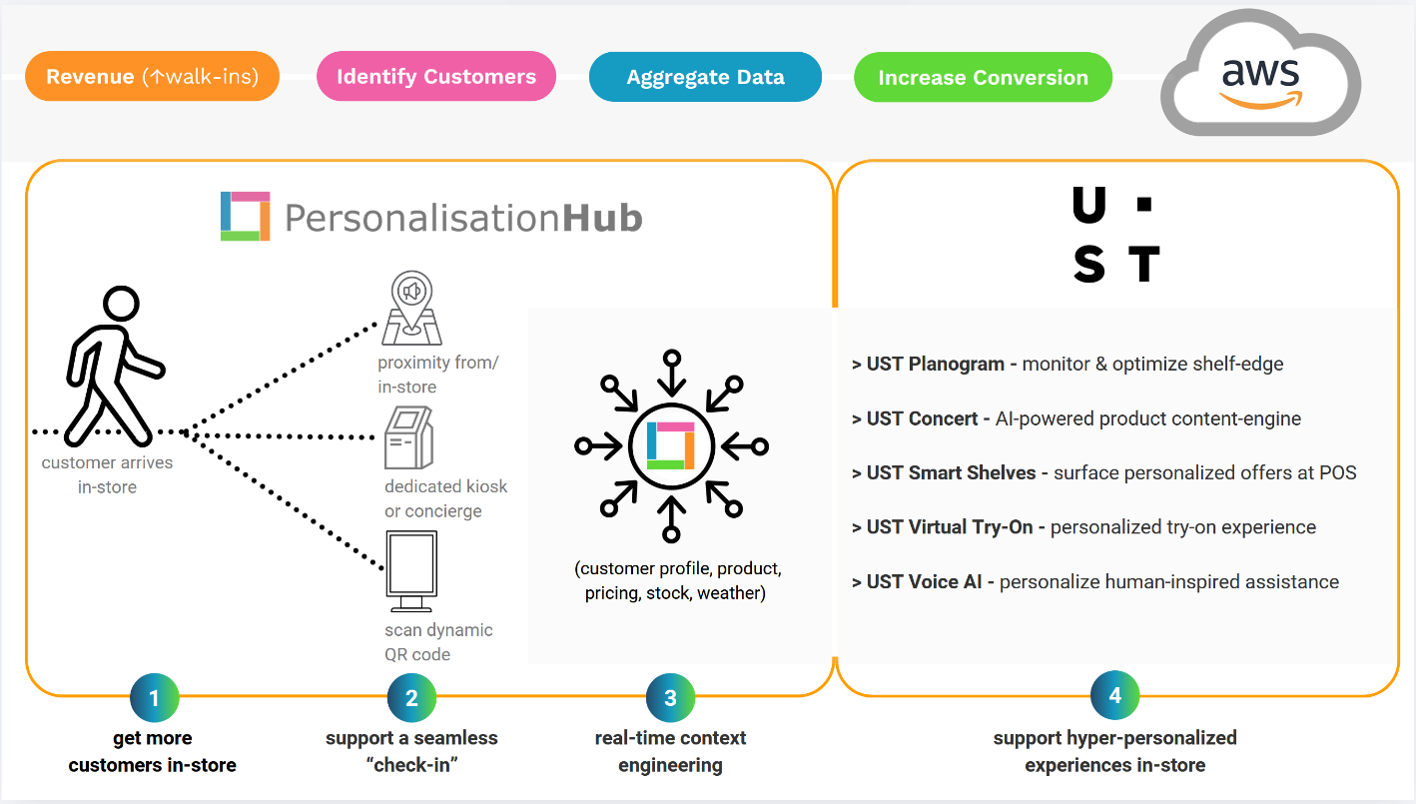
Figure 1: Connecting and personalizing a customer’s experience on arrival in-store
Figure 1 illustrates how this arrival identification layer connects to the broader personalization journey. The key capabilities it unlocks include:
- Drive foot traffic and in-store engagement: Using UST’s computer vision platform with geo-targeting and Wi-Fi analytics capabilities and Personalisation Hub’s campaign management (with a digital signage CMS), retailers can reach shoppers before they arrive and re-engage them once they are in-store. Personalized offers, store-specific promotions, and real-time content are then served across digital displays.
- Identify customers on arrival: Personalisation Hub supports multiple frictionless check-in methods like:
- Scanning a dynamic QR code on signage
- Store app detection
- Kiosk sign-in
- Proximity sensing with MIST/HPE that uses Wi-Fi and patented Virtual Bluetooth Low Energy (vBLE) to detect the exact location of users or assets, triggering mobile notifications or tracking movements.
The moment a customer is identified, their profile is activated: purchase history, preferences, loyalty tier and real-time context all become available to personalize what they see and experience next.
- Activate real-time data at the shelf edge: UST’s Smart Shelf and UST Planogram intelligence connects directly with Personalisation Hub’s real-time experience engine. Dwell-time data—how long a shopper lingers at a display or shelf bay—is captured with UST’s computer vision and fed into UST’s recommendation engine to surface the right offer in the right place. For CPGs, this closes a historical blind spot: understanding which products attract attention, and which convert. All data processing is permission-based and runs within the retailer’s own secure cloud environment.
- Close the loop on conversion and attribution: A customer who engages with a product display but does not purchase in-store is not a lost sale; it is the beginning of a remarketing journey. Personalisation Hub tracks that intent signal and can re-engage the shopper online, completing the attribution cycle across physical and digital touchpoints. This cross-channel view gives retailers and CPGs a true picture of campaign ROI.
Challenge 2: Leverage customer data (in real-time) in-store
Retailers don’t lack customer insights—they lack the ability to activate these insights in-store, at shelf edge, and in the moment of purchase decision.
Once a customer checks in, Personalisation Hub enables real-time context engineering, securely aggregating live data (customer, product, stock, and externals like weather or even events taking place in the store’s area) to surface the right offer, in the right place, at the right time.
Personalisation Hub also supports Model Context Protocol (MCP), so as clients extend MCP adoption across their organization, this data can be used to personalize experiences.
Because the platform runs on the retailer’s own domain, it can also connect an arriving, non-authenticated shopper journey using a first-party cookie, enabling personalized experiences, including virtual try-on, without requiring prior login.
Challenge 3: Scaling creative content for personalization
Historically, the cost of creating personalized content can be prohibitive for many retailers.
Using Personalisation Hub’s integration with Amazon Bedrock and combining decades of experience consulting in the enterprise personalization space, the team redesigned the personalization workflow. Now, they automate the creative workflow—from the campaign brief to generating the variations needed for every touchpoint. As retailers expand their personalization programs globally, Personalisation Hub scales with them—delivering localized creative across every market and language, without adding complexity or cost to the creative process.
The platform also uses edge-based computer vision to measure passerby engagement with digital signage while protecting customer privacy. These engagement signals feed back into the creative optimization loop, meaning campaigns improve automatically over time, based on what actually works in each store environment.
Challenge 4: Building a new AI operating model for retail
What Personalisation Hub and UST represent together is not simply a technology integration. It is a new operating model for retail personalization, one designed to replace the siloed approach that has defined the industry for the past decade.
Historically, ecommerce teams owned digital personalization. Store operations owned the physical experience. The two rarely shared data, infrastructure, or strategy. The result was disconnected customer journeys and an inability to measure true cross-channel impact.
UST and Personalisation Hub change that model by bringing strategy, systems integration, and an AI-native platform together under a single coordinated engagement. UST evaluates a retailer’s existing data estate, identifies integration points across core systems, including ERP and loyalty platforms, and designs the architecture required for Personalisation Hub to scale within the retailer’s AWS environment. This includes connecting Smart Shelf sensors and Planogram optimization tools to Personalisation Hub’s real-time context engine, so the platform knows not just who the customer is, but also where they are, what is near them, and which promotions are active in that section of the store.
For retailers transitioning to an AI-first operating model, UST also delivers organizational change management and on-the-ground deployment support that standalone technology vendors typically do not. UST supports rollouts across large store networks by configuring, training, and optimizing the platform at the regional and local levels.
Personalisation Hub provides the centralized intelligence layer. UST ensures it is activated consistently and effectively at every touchpoint.
Associated business benefits
These four capabilities combine to deliver measurable commercial outcomes across the entire retail operation:
- Increase foot traffic in-store: Leverage geo-targeting, computer vision, and local store data to optimize campaign targeting—driving measurable increases in daily walk-ins per store.
- Maximize basket size and revenue: Activate in-store personalization on signage and smart shelves to influence purchase behavior at the shelf edge—lifting in-store conversion rates and average basket value.
- Reduce campaign creative costs: Automate personalized campaign creative workflows—significantly reducing the time and cost of producing campaign variations at scale.
- Continually optimize campaigns: Personalisation Hub captures every dimension of each campaign—creative assets, copy variations, weather conditions, local events, shopper transactions, and passerby engagement. This accumulated campaign history enables the AI to make smarter decisions with each new campaign, matching creatives, timing, and messaging to what has proven to work before. The result is a personalization program that gets measurably more effective over time, without additional effort from the marketing team.
Conclusion
We opened with a simple question: What if your physical store were as intelligent as your website? That’s no longer a hypothetical. The operating model exists. The infrastructure exists. The question has shifted from can we do this to how quickly can we operationalize it—and what happens to the retailers who don’t.
Today, the gap between digital and physical personalization is closing, and the retailers closing it fastest are those who have built the infrastructure to identify, activate, and learn from every customer interaction, regardless of channel. The combination of Personalisation Hub, UST, and AWS is how that infrastructure comes together—available, deployable, and scalable—for enterprise retailers everywhere.
AWS Partner Spotlight
About Personalisation Hub
Personalisation Hub is a self-hosted platform designed to bridge the gap between digital and physical commerce by delivering AI-driven personalization across all channels. For customers: ensure retailers can seamlessly connect and personalize customer experiences when they arrive in-store. For retailers: a single platform that allows retailers to seamlessly activate personalized experiences across all touchpoints. For advertisers: show the right message at the right time (at point of sale) and continually optimize campaign performance over time.
Personalisation Hub in AWS Marketplace >
About UST
Since 1999, UST has worked side by side with some of the world’s top companies to make a powerful impact through transformation. Powered by technology, driven by AI, inspired by people, and led by its purpose, UST partners with its clients from design to operation. UST’s AI-driven digital solutions, proprietary platforms, engineering, R&D, products, and innovation ecosystem turn core challenges into impactful solutions. Together, with over 30,000 employees in over 30 countries, UST builds for boundless impact—touching billions of lives in the process.