
惯性聚合 高效追踪和阅读你感兴趣的博客、新闻、科技资讯
阅读原文 在惯性聚合中打开

推荐订阅源

T
Tenable Blog
K
Kaspersky official blog
cs.AI updates on arXiv.org
T
The Exploit Database - CXSecurity.com
Cisco Talos Blog
Cisco Talos Blog
P
Palo Alto Networks Blog
Latest news
Latest news
cs.CL updates on arXiv.org
C
CXSECURITY Database RSS Feed - CXSecurity.com
P
Privacy International News Feed
The Hacker News
The Hacker News
T
Tor Project blog
www.infosecurity-magazine.com
C
Cisco Blogs
阮一峰的网络日志
阮一峰的网络日志
Recent Commits to openclaw:main
博客园_首页
N
News and Events Feed by Topic
W
WeLiveSecurity
罗磊的独立博客
GbyAI
GbyAI
T
Troy Hunt's Blog
Y
Y Combinator Blog
Recorded Future
Recorded Future
The Cloudflare Blog
TaoSecurity Blog
TaoSecurity Blog
爱范儿
爱范儿
美团技术团队
Attack and Defense Labs
C
Check Point Blog
Engineering at Meta
Engineering at Meta
Cyberwarzone
Cyberwarzone
Cyber Security Advisories - MS-ISAC
F
Fortinet All Blogs
The GitHub Blog
The GitHub Blog
奇客Solidot–传递最新科技情报
奇客Solidot–传递最新科技情报
Apple Machine Learning Research
Know Your Adversary
Know Your Adversary
AWS News Blog
AWS News Blog
D
DataBreaches.Net
Recent Announcements
K
KPMG report finds enterprise disconnect between AI and its ROI | CIO
M
MIT News - Artificial intelligence
Webroot Blog
Webroot Blog
Security Latest
Security Latest
T
Tailwind CSS Blog
V2EX - 技术
V2EX - 技术
aimingoo的专栏
aimingoo的专栏
S
Security @ Cisco Blogs
Exploit-DB.com RSS Feed

AWS for Industries

GreenBridge.AI redefines renewable energy operations with agentic AI on AWS | Amazon Web Services Build a voice-enabled Automotive and Manufacturing assistant using Amazon Nova Sonic and Amazon Bedrock AgentCore | Amazon Web Services Managing AI agent sprawl across business units | Amazon Web Services Dynamic Inbound Routing for BYOIP Workloads Using Amazon VPC Route Server | Amazon Web Services How Autel Transformed Charging Station Management with AI Agents on AWS | Amazon Web Services How Danone Simplified Kubernetes at Scale with Amazon EKS Auto Mode | Amazon Web Services Build a Multi-Agent Assessment Workbench with Amazon Bedrock AgentCore | Amazon Web Services Sovereign by design: How AWS helps Nigeria’s financial services industry protect data and drive innovation | Amazon Web Services Scaling ML in production: how BBVA accelerated delivery with MLOps | Amazon Web Services Inside BBVA’s MLOps transformation: from data platform to scalable ML on AWS | Amazon Web Services Blazing a Trail: How Peloton Rebuilt the SDLC for the Agentic Era with Amazon Bedrock | Amazon Web Services Accelerate RISC-V Software Development Before Silicon: Virtual Prototyping with MachineWare’s SIM-V on AWS | Amazon Web Services How retailers deliver hyper-personalization in-store with Personalisation Hub, UST, and AWS | Amazon Web Services Deploy diagnostic-quality imaging globally with MedDream and AWS HealthImaging | Amazon Web Services Coins in Motion: Building agentic blockchain payments for in-vehicle experiences | Amazon Web Services Reduce P&ID analysis time by 80% with hybrid AI maintenance planning | Amazon Web Services Deploying industrial AI on AWS: Building the autonomous factory | Amazon Web Services How Atlantic Health cut legal document search time by 42% with Amazon Bedrock metadata filtering | Amazon Web Services Edge-to-Cloud Architecture for Real-Time Surgical Intelligence with AWS and NVIDIA | Amazon Web Services Reimagining B-Pillar DFMEA: Why Ontology-Grounded AI Is the Future of Automotive Engineering | Amazon Web Services Transforming energy trading by managing complexity and driving growth with Cloud ETRM | Amazon Web Services How Multi-Agent AI Turns Supply Chain Data into Decisions and Actions | Amazon Web Services ​​​Deploy Agentic Bidding Without Sacrificing Speed: ARTF Containers with NVIDIA GPU Acceleration on AWS​​ | Amazon Web Services Next-generation programmatic advertising: How AWS RTB Fabric redefines the game | Amazon Web Services Flexible Telecom AI Workload Deployment Across AWS Hybrid Cloud | Amazon Web Services Building a HIPAA-ready generative AI architecture for healthcare on AWS | Amazon Web Services Highlights from the 2026 AWS Life Sciences Symposium: MedTech Track | Amazon Web Services Multi-Agent Systems for Financial Services on Amazon EKS and AgentCore | Amazon Web Services How AI can help developers migrate embedded codebases between Arm SoCs | Amazon Web Services From Connected to Resilient: Cloud-Native Payment Connectivity on AWS | Amazon Web Services Ultra-low-latency cross-Region crypto trading with Avelacom and AWS | Amazon Web Services Build an AI-powered 5G Signaling Trace Analyzer Using Amazon Bedrock | Amazon Web Services Medical Legal Regulatory Review Orchestration with AI Agents on AWS | Amazon Web Services AWS showcases the agentic AI future of advertising and entertainment at Cannes Lions 2026 | Amazon Web Services The Road to 180M GRefs/s: Sizing Epic on AWS with R8ib and Enhanced EBS | Amazon Web Services BridgeWise builds responsible AI in FSI with Amazon Bedrock | Amazon Web Services Rethink Everything: Highlights from the 2026 AWS Financial Services Symposium | Amazon Web Services Improving Defect Analysis and Quality Control with AI Diagnostics | Amazon Web Services Building a cloud-based EV charging monitoring platform with real-time AI analytics | Amazon Web Services Introducing the AWS guide to the ECB Guide on outsourcing cloud services to cloud service providers | Amazon Web Services How a Luxury Retailer Accelerates Customer Experience with Amazon CloudFront | Amazon Web Services The Art of the Possible: Building an Intelligent Wealth Management Platform – Part 1 | Amazon Web Services How We Built Healthcare AI You Can Trust: The Science Behind Amazon Connect Health | Amazon Web Services How Everllence Scaled P&ID Intelligence to Improve Plant Operations | Amazon Web Services Rivian accelerates production with second-generation AWS Outposts: Improving resiliency and reducing costs | Amazon Web Services AI-Driven Development Lifecycle for Financial Services | Amazon Web Services How Agentic AI and Digital Twins on AWS Drive Operational Excellence | Amazon Web Services Modernizing Core Banking Systems: A Strategic Guide for Financial Leaders | Amazon Web Services Highlights from the 2026 AWS Life Sciences Symposium: Research and Drug Discovery | Amazon Web Services Discount Tire Uses Cloud WAN and Buffer VPC to Create a Scalable Enterprise Network Centralized third-party connectivity in AWS: Architecture patterns for highly regulated environments | Amazon Web Services FHIR-powered Care Continuum on AWS HealthLake From code to chemistry: using Kiro to tackle ADME-Tox, a key drug discovery challenge | Amazon Web Services How Toyota securely deployed HiveMQ with mTLS on AWS to power Smart Manufacturing | Amazon Web Services From record to intelligence: How EMR systems on AWS become the foundation for generative AI in healthcare | Amazon Web Services How to Connect AWS HealthOmics to Public and Private Network Sources at Runtime | Amazon Web Services Accelerating Android Builds on AWS: From 3 Hours to Under 5 Minutes with SourceFS | Amazon Web Services Closing the Loop with Amazon Bio Discovery’s Integrated Lab Partners | Amazon Web Services Massive Parallel Processing of Financial Transactions with Amazon EKS and Amazon MSK | Amazon Web Services Submit up to 100,000 Bioinformatics Workflow Runs with a Single API Call in AWS HealthOmics | Amazon Web Services Energy HPC Orchestrator powers collaborative, scalable energy computing | Amazon Web Services Automate Investment Research Using Strands Agents on Bedrock AgentCore | Amazon Web Services How OCC Built a Governed Cloud Foundation and Then Stress-Tested It Executive Insights from the 2026 AWS Life Sciences Symposium How Carlsberg’s Traitomic business leveraged AWS HealthOmics to power genetic trait development | Amazon Web Services CME Group MDP multicast data access on AWS using Transit Gateway | Amazon Web Services How retailers solve the customer identity puzzle with Amperity and AWS | Amazon Web Services Exact Sciences Transforms Bioinformatics Infrastructure with AWS HealthOmics | Amazon Web Services Building a Serverless Supply Chain Management Solution for Automotive Customers with AWS AppSync and Amazon Aurora Serverless | Amazon Web Services Accelerating physical AI with AWS and NVIDIA: building production-ready applications with simulation and real-world learning | Amazon Web Services Modernizing life-saving workloads with AWS serverless | Amazon Web Services Transforming Industrial Operations: How AVEVA and AWS drive Cloud Innovation | Amazon Web Services Introducing Amazon Bio Discovery | Amazon Web Services Accelerate Project Delivery with AI-Native Execution System on Amazon Quick | Amazon Web Services Reinvent Telecom Mediation Systems with Amazon Bedrock AgentCore, Strands Agents, and the Model Context Protocol | Amazon Web Services AWS Cloud Connectivity Patterns for Financial Market Infrastructures | Amazon Web Services Event-Driven Digital Pathology: Governed Whole Slide Image Ingestion to Scalable Inference with Amazon SageMaker | Amazon Web Services How Telefonica Germany achieved a centralized tracing solution with VPC Traffic Mirroring | Amazon Web Services AWS Teams Up with Wingstop to Deliver Wings to Millions During March Hoops Tournament | Amazon Web Services How Amazon Connect Health brings agentic AI to the point of care | Amazon Web Services How Liftoff improved conversion performance and reduced infrastructure costs with Cortex using AWS Graviton | Amazon Web Services From Prompt to Pipeline: AI-Powered Bioinformatics Workflow Development with Kiro and AWS HealthOmics | Amazon Web Services Driving Intelligent Quality in the Software-Defined Vehicle Era | Amazon Web Services How Amazon Devices Eliminated Credential Risk to Scale AI across Engineering Tools | Amazon Web Services Build ChatGPT Apps with MCP Servers and AWS Infrastructure | Amazon Web Services
The Evolution of BMW Group’s 3D Streaming Experience | Amazon Web Services
2026-03-27 · via AWS for Industries

Transforming the Online Car Configuration Experience

BMW Group’s Emotional Virtual Experience (EVE) began as an innovative dealership tool that enables immersive 3D real-time streaming consultations in dealers’ showrooms. This solution allowed them to showcase vehicles in every possible configuration as stunning 3D rendering, helping customers envision their future BMW vehicle with unprecedented fidelity.
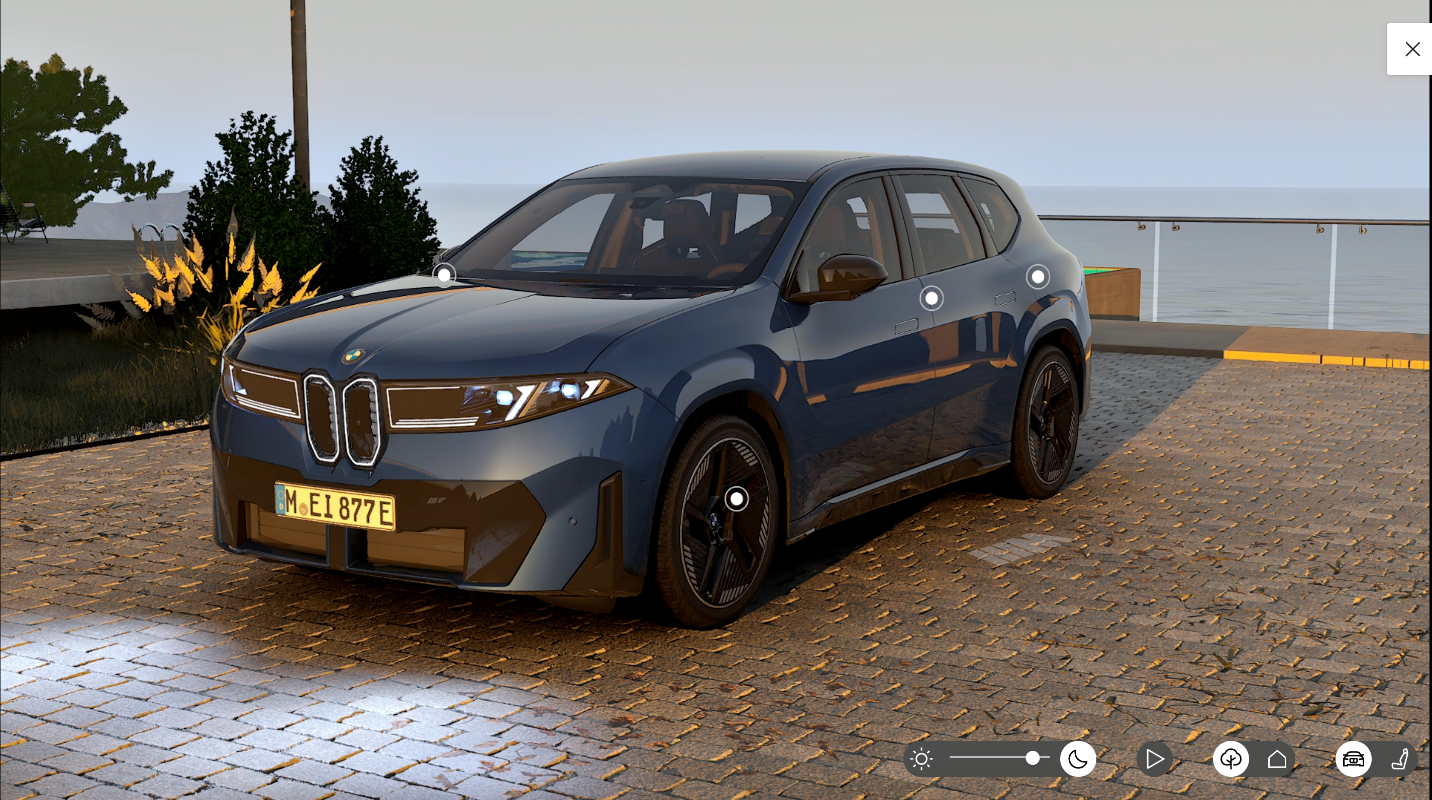
photo of a BMW suv

However, the automotive industry’s digital transformation demanded more from BMW Group. With the highly anticipated launch of the Neue Klasse on September 5, 2025, BMW Group faced a pivotal challenge: how to transform this dealership-exclusive technology into a global, internet-scale digital experience that could serve thousands of users simultaneously.

The stakes were enormous. BMW Group needed to deliver one of the automotive industry’s most advanced 3D streaming experiences directly through its online configurator, accessible from any device, anywhere in the world. The original EVE solution, while successful in controlled dealership environments, relied on expensive on-premises Windows GPU servers and was not built to be hosted on cost-efficient Linux instances on AWS.

This challenge pushed BMW Group beyond incremental improvements toward a fundamental reimagination of its 3D streaming architecture. The goal was ambitious yet clear: deliver seamless, real-time 3D vehicle visualization, embedded into BMW Group’s online car configurator. It had to feel natural, responsive, and visually accurate to customers exploring their dream vehicle from their living room, office, or anywhere they choose to configure.

The Neue Klasse launch represented more than just a new vehicle line—it was an opportunity to set a new standard for digital customer engagement in the automotive industry, transforming how customers worldwide discover, explore, and connect with BMW vehicles before ever setting foot in a showroom.

In this blog post, we’ll explain why BMW Group chose Amazon Web Services, Inc. (“AWS”) as its cloud provider to deliver this user experience and dive deep into how the team solved the technical challenges along the way.

Why AWS for Global 3D Streaming?

When BMW Group evaluated deployment options for the 3D streaming platform transformation, several factors made AWS the clear choice.

Global Reach: The Neue Klasse launch demanded worldwide availability from day one. AWS’s global footprint, with regions strategically positioned across continents, provided the foundation for low-latency 3D streaming regardless of customer location.

GPU Infrastructure at Scale: AWS offers a diverse portfolio of GPU-optimized EC2 instances. The g4dn.2xlarge provided the optimal balance of price and performance for the Unreal Engine workload, and AWS’s scale gave BMW Group confidence that demand spikes during launch events could be handled.

Cost-Effective Linux Migration: Moving from Windows-based on-premises infrastructure to Linux instances in the cloud represented significant cost savings through reduced licensing costs and improved resource efficiency.

Collaborative Engineering: AWS teams worked closely with BMW Group’s engineers throughout the architecture design process, helping navigate the complexities of transforming a dealership tool into a globally distributed, customer-facing service.

Technical Challenges to Solve

As BMW Group designed the global architecture, three critical technical requirements emerged that would define their implementation approach:

Capacity Management: Unlike traditional web applications that can run on standard compute instances, Unreal Engine streaming applications require GPUs. Therefore, they had to ensure sufficient availability of optimal GPU instances. They ran benchmarks to identify g4dn.2xlarge as the EC2 instance with the best price-performance and wanted to ensure that they’d always have enough instances of that type for the day of the launch of the “Neue Klasse”, for which they expected substantial demand.

Latency Optimization: Real-time 3D streaming is unforgiving when it comes to network latency. Intelligent routing to map each user to the geographically closest AWS region while maintaining consistent performance standards across the US and EU is necessary.

Resource Isolation: Perhaps most challenging was the fundamental constraint of BMW’s Group’s existing Unreal Engine based streaming architecture: each GPU instance can support only one concurrent user session. This is a common challenge with real-time 3D streaming applications: the GPU continuously renders a personalized, interactive scene for each user, maintaining session state and responding to user inputs in real-time. Unlike traditional web applications where a single server handles thousands of stateless requests, 3D streaming requires dedicated GPU resource per active session and at most a few concurrent users are supported. For BMW’s application, only one user per instance was supported. This meant they had to implement a sophisticated 1-to-1 mapping between users and EC2 instances in the instance pool.

These challenges required BMW Group to leverage AWS services in innovative ways, to create a truly scalable global streaming platform.

Architecture: Building a Global 3D Streaming Platform

3D Streaming platform’s architecture follows a pattern common in AWS services: separating control plane from data plane. This allows optimizing each component for its specific responsibilities while maintaining clear boundaries between configuration and execution.

Instance Management Middleware (IMM): The control plane handles orchestration – mapping user requests to GPU instances, tracking instance states (available, assigned, provisioning) across all regions, determining optimal regions via IP geolocation, and implementing regional fallback when capacity is constrained. IMM coordinates resources globally but doesn’t execute streaming workloads.

Regional Stacks: The data plane operates as independent stacks deployed across multiple AWS regions. GPU-optimized EC2 instances run Unreal Engine to render photorealistic 3D vehicle visualizations, delivered to browsers via WebRTC. CoTurn servers manage connection establishment, while pre-warmed instance pools ensure rapid session startup.

Deployment Strategy: Centralized Control, Distributed Execution

The data plane spans multiple AWS regions across North America and Europe, with two regions per geography for availability and resilience. The control plane (IMM) runs in a single region: eu-central-1 (Frankfurt).
This centralization is deliberate. IMM must atomically assign GPU instances and mark them unavailable to prevent double-booking. Distributing IMM across regions would introduce consistency challenges – network partitions or replication lag could allow two IMM instances to assign the same GPU to different users. A single region eliminates this entirely, providing one source of truth. The latency cost (under 100ms globally) is negligible compared to multi-minute streaming sessions.
The data plane must be distributed because streaming latency directly impacts user experience – a customer in New York experiences noticeably lower latency from a US-region instance than from Frankfurt. When a customer clicks to view their configured vehicle in 3D, IMM assigns an optimal GPU instance based on location, and the regional data plane streams the rendered visualization via WebRTC.
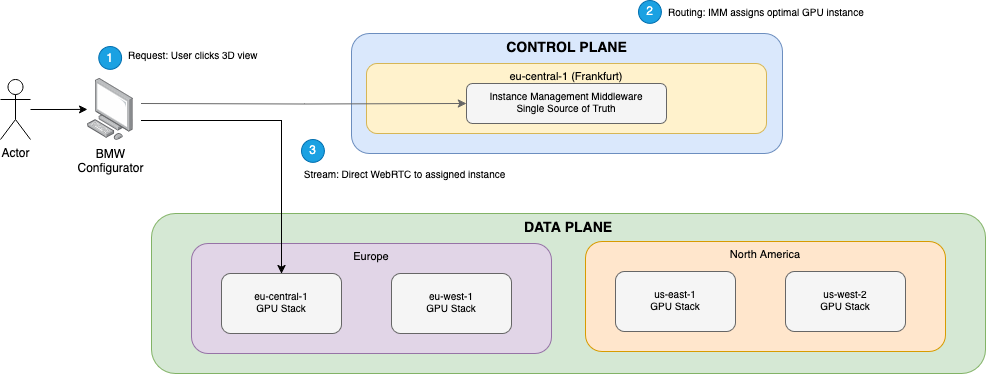
architecture of control and data planes

Data Plane Deep Dive: Regional Stack Architecture

A core security requirement was keeping GPU instances running Unreal Engine off the public internet. The BMW Group deployed them in private subnets within AWS VPCs, routing all access through an AWS Application Load Balancer (ALB) integrated with AWS Shield and AWS WAF in a public subnet. However, this did not solve their most critical technical challenge: the strict 1-to-1 mapping between users and GPU instances.

Their solution for the 1-to-1 mapping problem was an auto-scaled fleet of NGINX servers on EC2 instances in the private subnet, positioned between the ALB and the GPU fleet. They customized NGINX’s routing logic with a Lua script that extracts the private IP address of the user’s assigned GPU instance from the request URL. After validating the IP address, NGINX forwards the request directly to that specific instance, maintaining the 1-to-1 user-to-instance mapping while preserving the security architecture.
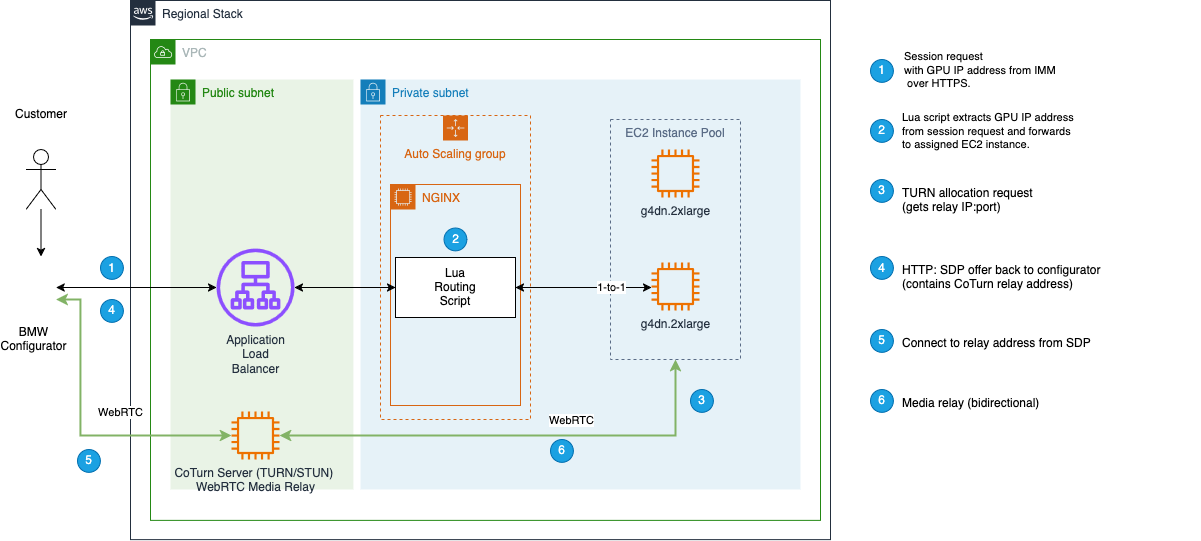
architecture of regional stack

Outcomes: Launch Day Success

On September 5, 2025, BMW Group achieved their most significant milestone with the world premiere of the all-new BMW Group’s iX3. During the launch day online car configurator served up to 500 parallel 3D real-time configuration sessions to customers.

For the first time, BMW enthusiasts worldwide could experience their dream car configuration with unprecedented interactivity – opening the frunk, exploring practical features, and walking around the vehicle to appreciate design elements from every angle. The interior experience allowed customers to view the BMW Panoramic Vision, gauge trunk space, and explore cabin layout and upholstery details in immersive depth.

Conclusions and Future Outlook

BMW Group’s 3D streaming platform demonstrates how cloud-native architecture can transform traditionally on-premises sales experiences into globally accessible digital services. By separating the control plane and data plane, centralizing orchestration for consistency while distributing execution for performance, they successfully scaled a dealership tool into a worldwide 3D streaming platform capable of handling the Neue Klasse launch.

Looking ahead, BMW Group is exploring dynamic scaling for the instance warm pool, which would minimize the number of instances necessary in the pool and reduce cost.

BMW Group will be extending the streaming experience to additional BMW models soon. This is just the beginning of 3D streaming platform’s evolution.