




惯性聚合 高效追踪和阅读你感兴趣的博客、新闻、科技资讯
阅读原文 在惯性聚合中打开

推荐订阅源

月光博客
月光博客
钛媒体:引领未来商业与生活新知
钛媒体:引领未来商业与生活新知
人人都是产品经理
人人都是产品经理
IT之家
IT之家
Cyberwarzone
Cyberwarzone
T
Troy Hunt's Blog
有赞技术团队
有赞技术团队
阮一峰的网络日志
阮一峰的网络日志
T
Threat Research - Cisco Blogs
S
SegmentFault 最新的问题
Apple Machine Learning Research
G
GRAHAM CLULEY
cs.CL updates on arXiv.org
博客园 - 叶小钗
Last Week in AI
Last Week in AI
C
CERT Recently Published Vulnerability Notes
The Hacker News
The Hacker News
Jina AI
Jina AI
T
Tor Project blog
V
Vulnerabilities – Threatpost
酷 壳 – CoolShell
酷 壳 – CoolShell
Spread Privacy
Spread Privacy
博客园_首页
C
Cybersecurity and Infrastructure Security Agency CISA
Threat Intelligence Blog | Flashpoint
freeCodeCamp Programming Tutorials: Python, JavaScript, Git & More
Simon Willison's Weblog
Security Latest
Security Latest
cs.CV updates on arXiv.org
cs.AI updates on arXiv.org
博客园 - 司徒正美
V2EX - 技术
V2EX - 技术
I
Intezer
The Cloudflare Blog
Cisco Talos Blog
Cisco Talos Blog
SecWiki News
SecWiki News
博客园 - 【当耐特】
奇客Solidot–传递最新科技情报
奇客Solidot–传递最新科技情报
L
Lohrmann on Cybersecurity
Scott Helme
Scott Helme
Google Online Security Blog
量子位
The Last Watchdog
The Last Watchdog
AI
AI
Application and Cybersecurity Blog
S
Security Affairs
P
Palo Alto Networks Blog
S
Secure Thoughts
OSCHINA 社区最新新闻
OSCHINA 社区最新新闻
Attack and Defense Labs

AWS for Industries

Build a voice-enabled Automotive and Manufacturing assistant using Amazon Nova Sonic and Amazon Bedrock AgentCore | Amazon Web Services Managing AI agent sprawl across business units | Amazon Web Services Dynamic Inbound Routing for BYOIP Workloads Using Amazon VPC Route Server | Amazon Web Services How Autel Transformed Charging Station Management with AI Agents on AWS | Amazon Web Services How Danone Simplified Kubernetes at Scale with Amazon EKS Auto Mode | Amazon Web Services Build a Multi-Agent Assessment Workbench with Amazon Bedrock AgentCore | Amazon Web Services Sovereign by design: How AWS helps Nigeria’s financial services industry protect data and drive innovation | Amazon Web Services Scaling ML in production: how BBVA accelerated delivery with MLOps | Amazon Web Services Inside BBVA’s MLOps transformation: from data platform to scalable ML on AWS | Amazon Web Services Blazing a Trail: How Peloton Rebuilt the SDLC for the Agentic Era with Amazon Bedrock | Amazon Web Services Accelerate RISC-V Software Development Before Silicon: Virtual Prototyping with MachineWare’s SIM-V on AWS | Amazon Web Services How retailers deliver hyper-personalization in-store with Personalisation Hub, UST, and AWS | Amazon Web Services Deploy diagnostic-quality imaging globally with MedDream and AWS HealthImaging | Amazon Web Services Coins in Motion: Building agentic blockchain payments for in-vehicle experiences | Amazon Web Services Reduce P&ID analysis time by 80% with hybrid AI maintenance planning | Amazon Web Services Deploying industrial AI on AWS: Building the autonomous factory | Amazon Web Services How Atlantic Health cut legal document search time by 42% with Amazon Bedrock metadata filtering | Amazon Web Services Edge-to-Cloud Architecture for Real-Time Surgical Intelligence with AWS and NVIDIA | Amazon Web Services Reimagining B-Pillar DFMEA: Why Ontology-Grounded AI Is the Future of Automotive Engineering | Amazon Web Services Transforming energy trading by managing complexity and driving growth with Cloud ETRM | Amazon Web Services How Multi-Agent AI Turns Supply Chain Data into Decisions and Actions | Amazon Web Services ​​​Deploy Agentic Bidding Without Sacrificing Speed: ARTF Containers with NVIDIA GPU Acceleration on AWS​​ | Amazon Web Services Next-generation programmatic advertising: How AWS RTB Fabric redefines the game | Amazon Web Services Flexible Telecom AI Workload Deployment Across AWS Hybrid Cloud | Amazon Web Services Building a HIPAA-ready generative AI architecture for healthcare on AWS | Amazon Web Services Highlights from the 2026 AWS Life Sciences Symposium: MedTech Track | Amazon Web Services Multi-Agent Systems for Financial Services on Amazon EKS and AgentCore | Amazon Web Services How AI can help developers migrate embedded codebases between Arm SoCs | Amazon Web Services From Connected to Resilient: Cloud-Native Payment Connectivity on AWS | Amazon Web Services Ultra-low-latency cross-Region crypto trading with Avelacom and AWS | Amazon Web Services Build an AI-powered 5G Signaling Trace Analyzer Using Amazon Bedrock | Amazon Web Services Medical Legal Regulatory Review Orchestration with AI Agents on AWS | Amazon Web Services AWS showcases the agentic AI future of advertising and entertainment at Cannes Lions 2026 | Amazon Web Services The Road to 180M GRefs/s: Sizing Epic on AWS with R8ib and Enhanced EBS | Amazon Web Services BridgeWise builds responsible AI in FSI with Amazon Bedrock | Amazon Web Services Rethink Everything: Highlights from the 2026 AWS Financial Services Symposium | Amazon Web Services Improving Defect Analysis and Quality Control with AI Diagnostics | Amazon Web Services Building a cloud-based EV charging monitoring platform with real-time AI analytics | Amazon Web Services Introducing the AWS guide to the ECB Guide on outsourcing cloud services to cloud service providers | Amazon Web Services How a Luxury Retailer Accelerates Customer Experience with Amazon CloudFront | Amazon Web Services The Art of the Possible: Building an Intelligent Wealth Management Platform – Part 1 | Amazon Web Services How We Built Healthcare AI You Can Trust: The Science Behind Amazon Connect Health | Amazon Web Services How Everllence Scaled P&ID Intelligence to Improve Plant Operations | Amazon Web Services Rivian accelerates production with second-generation AWS Outposts: Improving resiliency and reducing costs | Amazon Web Services AI-Driven Development Lifecycle for Financial Services | Amazon Web Services How Agentic AI and Digital Twins on AWS Drive Operational Excellence | Amazon Web Services Modernizing Core Banking Systems: A Strategic Guide for Financial Leaders | Amazon Web Services Highlights from the 2026 AWS Life Sciences Symposium: Research and Drug Discovery | Amazon Web Services Discount Tire Uses Cloud WAN and Buffer VPC to Create a Scalable Enterprise Network Centralized third-party connectivity in AWS: Architecture patterns for highly regulated environments | Amazon Web Services FHIR-powered Care Continuum on AWS HealthLake From code to chemistry: using Kiro to tackle ADME-Tox, a key drug discovery challenge | Amazon Web Services How Toyota securely deployed HiveMQ with mTLS on AWS to power Smart Manufacturing | Amazon Web Services From record to intelligence: How EMR systems on AWS become the foundation for generative AI in healthcare | Amazon Web Services How to Connect AWS HealthOmics to Public and Private Network Sources at Runtime | Amazon Web Services Accelerating Android Builds on AWS: From 3 Hours to Under 5 Minutes with SourceFS | Amazon Web Services Closing the Loop with Amazon Bio Discovery’s Integrated Lab Partners | Amazon Web Services Massive Parallel Processing of Financial Transactions with Amazon EKS and Amazon MSK | Amazon Web Services Submit up to 100,000 Bioinformatics Workflow Runs with a Single API Call in AWS HealthOmics | Amazon Web Services Automate Investment Research Using Strands Agents on Bedrock AgentCore | Amazon Web Services How OCC Built a Governed Cloud Foundation and Then Stress-Tested It Executive Insights from the 2026 AWS Life Sciences Symposium How Carlsberg’s Traitomic business leveraged AWS HealthOmics to power genetic trait development | Amazon Web Services CME Group MDP multicast data access on AWS using Transit Gateway | Amazon Web Services How retailers solve the customer identity puzzle with Amperity and AWS | Amazon Web Services Exact Sciences Transforms Bioinformatics Infrastructure with AWS HealthOmics | Amazon Web Services Building a Serverless Supply Chain Management Solution for Automotive Customers with AWS AppSync and Amazon Aurora Serverless | Amazon Web Services Accelerating physical AI with AWS and NVIDIA: building production-ready applications with simulation and real-world learning | Amazon Web Services Modernizing life-saving workloads with AWS serverless | Amazon Web Services Transforming Industrial Operations: How AVEVA and AWS drive Cloud Innovation | Amazon Web Services Introducing Amazon Bio Discovery | Amazon Web Services Accelerate Project Delivery with AI-Native Execution System on Amazon Quick | Amazon Web Services Reinvent Telecom Mediation Systems with Amazon Bedrock AgentCore, Strands Agents, and the Model Context Protocol | Amazon Web Services AWS Cloud Connectivity Patterns for Financial Market Infrastructures | Amazon Web Services Event-Driven Digital Pathology: Governed Whole Slide Image Ingestion to Scalable Inference with Amazon SageMaker | Amazon Web Services How Telefonica Germany achieved a centralized tracing solution with VPC Traffic Mirroring | Amazon Web Services AWS Teams Up with Wingstop to Deliver Wings to Millions During March Hoops Tournament | Amazon Web Services How Amazon Connect Health brings agentic AI to the point of care | Amazon Web Services How Liftoff improved conversion performance and reduced infrastructure costs with Cortex using AWS Graviton | Amazon Web Services From Prompt to Pipeline: AI-Powered Bioinformatics Workflow Development with Kiro and AWS HealthOmics | Amazon Web Services Driving Intelligent Quality in the Software-Defined Vehicle Era | Amazon Web Services How Amazon Devices Eliminated Credential Risk to Scale AI across Engineering Tools | Amazon Web Services The Evolution of BMW Group’s 3D Streaming Experience | Amazon Web Services Build ChatGPT Apps with MCP Servers and AWS Infrastructure | Amazon Web Services
Energy HPC Orchestrator powers collaborative, scalable energy computing | Amazon Web Services
Yuriy Gubano · 2026-05-04 · via AWS for Industries

AWS for Industries

High-performance computing (HPC) is the backbone of modern seismic data processing. As seismic data volumes expand and geophysical workflows become increasingly compute-intensive, the industry is transitioning from traditional on-premises infrastructure toward flexible, cloud-based HPC solutions. Today’s seismic imaging and processing demands—driven by denser sensor arrays, higher resolution surveys, and more sophisticated algorithms—require unprecedented computational power. Energy companies must balance performance and cost while managing access, provisioning specialized workstations on demand, and maintaining stringent data security. Without proper orchestration tools, these environments can rapidly become fragmented, expensive, and unable to keep pace with growing seismic data volumes.

For decades, seismic data processing has remained largely vendor-specific, handled by a few processing companies using proprietary infrastructure and algorithms. This concentration created persistent bottlenecks: projects frequently experienced delays due to processor resource constraints, and the single-vendor nature prevented companies from achieving better results by combining superior solutions from multiple providers. Meanwhile, proprietary research often remained underutilized, and smaller technology providers struggled to bring innovative solutions to market due to limited workflow coverage.

Energy HPC Orchestrator on AWS

The Energy HPC Orchestrator (EHO) on AWS represents a new paradigm, built on components that work together to create a flexible, scalable processing environment. Rather than treating seismic processing as a monolithic workflow, the system deconstructs complex algorithms into specialized, decoupled services. The EHO’s Reverse Time Migration (RTM) template, shown in the following figure, demonstrates this approach.

The EHO workflow begins when the core component receives workflow requests and publishes events to the Amazon Simple Queue Service (Amazon SQS) event bus. The deployment step provisions the necessary infrastructure and routes job specifications to dedicated SQS queues for each processing pipeline. Each pipeline independently pulls messages, scales Amazon Elastic Compute Cloud (Amazon EC2) resources using Auto Scaling Groups, and executes containerized workloads. Throughout this process, the monitoring workflow tracks job execution across the pipelines, providing comprehensive observability and health monitoring. This architecture supports parallel processing of multiple workload types while maintaining separation between stable permanent infrastructure (deployment, execute, and monitoring workflows) and dynamic, on-demand job infrastructure that scales automatically.

RTM jobs infrastructure consists of the following services:

  • Analysis service – Fragments work into independent processing units
  • Migration service – Performs computationally intensive wave equation solving on GPU-accelerated instances
  • Reduction service – Progressively stacks images
  • Converter service – Handles output formatting

Because these services communicate through queue-based systems, each component scales independently based on workload demands, providing resilience and reducing processing bottlenecks.

Perhaps most transformative is the platform’s open marketplace ecosystem, which replaces single-vendor lock-in with true interoperability. Energy companies can now integrate commercial algorithms from multiple technology providers alongside proprietary internal research. The platform supports NVIDIA Energy Samples—reference implementations of key algorithms like RTM, Kirchhoff, and full waveform inversion (FWI) optimized for GPUs—helping organizations rapidly deploy GPU-accelerated seismic processing. Standardized data formats support seamless interoperability, helping geoscientists compose optimal workflows using the best algorithm for each processing step.
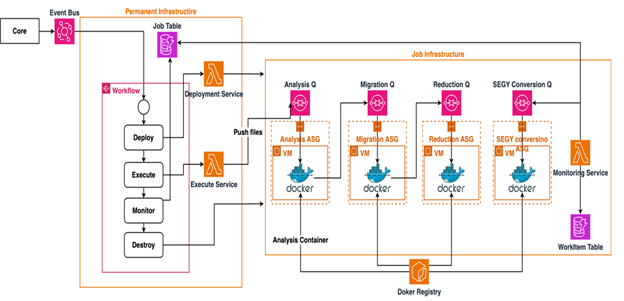
architecture illustration of the EHO’s Reverse Time Migration (RTM) template

Intelligent resource management employs sophisticated automatic scaling that dynamically adjusts compute resources based on queued workload. Different processing tasks use appropriately optimized EC2 instance types: general-purpose instances for analysis, HPC-optimized instances for compute-intensive migration, and GPU-accelerated instances (G4dn, G5, G6, P4d, P5). The platform uses AWS Spot Instances for significant cost optimization while maintaining fault tolerance.

AWS Partners and the Energy HPC Orchestrator

AWS Partners power the Energy HPC Orchestrator (EHO) by contributing specialized seismic processing modules to an open, interoperable ecosystem—replacing single-vendor lock-in with operator choice at every stage of the workflow. EPAM Systems, an AWS Premier Tier Services Partner, co-developed the cloud-based EHO platform alongside AWS, contributing solution architecture and integration services. Processing companies such as S-Cube (with their XWI algorithm), Seiswave RTM, and Seimax RTM participate as algorithm providers in the open marketplace ecosystem, offering specialized seismic processing capabilities that can be seamlessly integrated into workflows. This partnership model establishes an open marketplace where multiple technology providers can contribute specialized algorithms, innovators can bring solutions to market, and energy companies can integrate best-of-breed capabilities from various vendors—mitigating traditional single-vendor constraints that previously limited innovation and delayed projects due to resource bottlenecks.

Academic-industry collaboration: University of Texas and Occidental

International energy company Occidental integrated the University of Texas (UT) Madagascar—an open source seismic processing framework developed at UT—into production workflows running on AWS. The EHO solution made it possible to combine Madagascar’s GPL-licensed algorithms with Occidental’s proprietary code and commercial tools in the same processing pipeline.

“The Energy HPC Orchestrator lets us run Madagascar’s open-source algorithms alongside our internal research and commercial solutions on AWS. This cut our development time and gave us the flexibility to swap in new technologies as needed,” says Klaas Koster, VP Subsurface Innovation, Occidental.

The key technical benefit is that organizations can build seismic workflows using whatever components work best—open source, commercial, or internal—while maintaining full vendor and framework independence. The platform handles the infrastructure, security, and scaling on AWS.

Future steps: EHO evolution with MCP server integration

The addition of a Model Context Protocol (MCP) server to the EHO makes building and scaling seismic workflows simple. By exposing the platform’s capabilities through standardized MCP interfaces, the orchestrator becomes accessible to AI assistants and large language models (LLMs), democratizing seismic workflow development. With MCP server integration, geoscientists can describe their processing objectives in natural language rather than navigating traditional interfaces. An AI assistant connected to the MCP server can interpret requests like:

“I’d like to build a seismic data processing workflow on the EHO platform. Create a sequential processing chain using the NMO and STACK applications. Use the XYZ gathers and ABC velocity volume as inputs. Execute the workflow.”

The MCP server translates this into the JSON parameters, service configurations, and resource specifications the orchestrator requires — no manual navigation needed. This makes the powerful multi-vendor ecosystem accessible to a broader audience and accelerates the journey from concept to production.

Conclusion

The Energy HPC Orchestrator introduces a new model for how the energy industry delivers seismic processing at scale — moving from restrictive single-vendor solutions to an open, collaborative ecosystem that provides geoscientists with unprecedented flexibility and control. With the integration of MCP servers, the platform further democratizes access to advanced HPC capabilities, helping teams use natural language interfaces for workflow creation and accelerating the path from concept to production.

Ready to transform your seismic processing workflows? Contact your AWS account team or visit the AWS Energy & Utilities page to learn how Energy HPC Orchestrator gives your organization the freedom to choose best-of-breed tools across vendors, accelerate time-to-insight, and unlock better outcomes with cloud-native processing at scale. EPAM Systems is ready to support your implementation with solution architecture and integration services—reach out today to start your journey toward more flexible, scalable, and cost-efficient seismic processing on AWS.