
惯性聚合 高效追踪和阅读你感兴趣的博客、新闻、科技资讯
阅读原文 在惯性聚合中打开

推荐订阅源

Cyberwarzone
Cyberwarzone
Google DeepMind News
宝玉的分享
宝玉的分享
博客园_首页
量子位
博客园 - 司徒正美
罗磊的独立博客
腾讯CDC
IT之家
IT之家
S
Schneier on Security
Hugging Face - Blog
Hugging Face - Blog
L
Lohrmann on Cybersecurity
H
Hacker News: Front Page
钛媒体:引领未来商业与生活新知
钛媒体:引领未来商业与生活新知
J
Java Code Geeks
Know Your Adversary
Know Your Adversary
人人都是产品经理
人人都是产品经理
有赞技术团队
有赞技术团队
大猫的无限游戏
大猫的无限游戏
D
Darknet – Hacking Tools, Hacker News & Cyber Security
AWS News Blog
AWS News Blog
Spread Privacy
Spread Privacy
I
InfoQ
T
Threatpost
Simon Willison's Weblog
云风的 BLOG
云风的 BLOG
L
LINUX DO - 热门话题
A
About on SuperTechFans
Blog — PlanetScale
Blog — PlanetScale
Latest news
Latest news
Forbes - Security
Forbes - Security
Security Latest
Security Latest
NISL@THU
NISL@THU
The GitHub Blog
The GitHub Blog
P
Proofpoint News Feed
The Hacker News
The Hacker News
M
MIT News - Artificial intelligence
S
SegmentFault 最新的问题
cs.AI updates on arXiv.org
B
Blog
A
Arctic Wolf
C
Check Point Blog
G
Google Developers Blog
S
Security @ Cisco Blogs
Google DeepMind News
The Cloudflare Blog
L
LINUX DO - 最新话题
奇客Solidot–传递最新科技情报
奇客Solidot–传递最新科技情报
P
Privacy International News Feed
小众软件
小众软件

AWS for Industries

How AWS helps Hong Kong banks deliver on HKMA DART Framework | Amazon Web Services GreenBridge.AI redefines renewable energy operations with agentic AI on AWS | Amazon Web Services Build a voice-enabled Automotive and Manufacturing assistant using Amazon Nova Sonic and Amazon Bedrock AgentCore | Amazon Web Services Managing AI agent sprawl across business units | Amazon Web Services Dynamic Inbound Routing for BYOIP Workloads Using Amazon VPC Route Server | Amazon Web Services How Autel Transformed Charging Station Management with AI Agents on AWS | Amazon Web Services How Danone Simplified Kubernetes at Scale with Amazon EKS Auto Mode | Amazon Web Services Build a Multi-Agent Assessment Workbench with Amazon Bedrock AgentCore | Amazon Web Services Sovereign by design: How AWS helps Nigeria’s financial services industry protect data and drive innovation | Amazon Web Services Scaling ML in production: how BBVA accelerated delivery with MLOps | Amazon Web Services Inside BBVA’s MLOps transformation: from data platform to scalable ML on AWS | Amazon Web Services Blazing a Trail: How Peloton Rebuilt the SDLC for the Agentic Era with Amazon Bedrock | Amazon Web Services Accelerate RISC-V Software Development Before Silicon: Virtual Prototyping with MachineWare’s SIM-V on AWS | Amazon Web Services How retailers deliver hyper-personalization in-store with Personalisation Hub, UST, and AWS | Amazon Web Services Deploy diagnostic-quality imaging globally with MedDream and AWS HealthImaging | Amazon Web Services Coins in Motion: Building agentic blockchain payments for in-vehicle experiences | Amazon Web Services Reduce P&ID analysis time by 80% with hybrid AI maintenance planning | Amazon Web Services Deploying industrial AI on AWS: Building the autonomous factory | Amazon Web Services How Atlantic Health cut legal document search time by 42% with Amazon Bedrock metadata filtering | Amazon Web Services Edge-to-Cloud Architecture for Real-Time Surgical Intelligence with AWS and NVIDIA | Amazon Web Services Reimagining B-Pillar DFMEA: Why Ontology-Grounded AI Is the Future of Automotive Engineering | Amazon Web Services Transforming energy trading by managing complexity and driving growth with Cloud ETRM | Amazon Web Services ​​​Deploy Agentic Bidding Without Sacrificing Speed: ARTF Containers with NVIDIA GPU Acceleration on AWS​​ | Amazon Web Services Next-generation programmatic advertising: How AWS RTB Fabric redefines the game | Amazon Web Services Flexible Telecom AI Workload Deployment Across AWS Hybrid Cloud | Amazon Web Services Building a HIPAA-ready generative AI architecture for healthcare on AWS | Amazon Web Services Highlights from the 2026 AWS Life Sciences Symposium: MedTech Track | Amazon Web Services Multi-Agent Systems for Financial Services on Amazon EKS and AgentCore | Amazon Web Services How AI can help developers migrate embedded codebases between Arm SoCs | Amazon Web Services From Connected to Resilient: Cloud-Native Payment Connectivity on AWS | Amazon Web Services Ultra-low-latency cross-Region crypto trading with Avelacom and AWS | Amazon Web Services Build an AI-powered 5G Signaling Trace Analyzer Using Amazon Bedrock | Amazon Web Services Medical Legal Regulatory Review Orchestration with AI Agents on AWS | Amazon Web Services AWS showcases the agentic AI future of advertising and entertainment at Cannes Lions 2026 | Amazon Web Services The Road to 180M GRefs/s: Sizing Epic on AWS with R8ib and Enhanced EBS | Amazon Web Services BridgeWise builds responsible AI in FSI with Amazon Bedrock | Amazon Web Services Rethink Everything: Highlights from the 2026 AWS Financial Services Symposium | Amazon Web Services Improving Defect Analysis and Quality Control with AI Diagnostics | Amazon Web Services Building a cloud-based EV charging monitoring platform with real-time AI analytics | Amazon Web Services Introducing the AWS guide to the ECB Guide on outsourcing cloud services to cloud service providers | Amazon Web Services How a Luxury Retailer Accelerates Customer Experience with Amazon CloudFront | Amazon Web Services The Art of the Possible: Building an Intelligent Wealth Management Platform – Part 1 | Amazon Web Services How We Built Healthcare AI You Can Trust: The Science Behind Amazon Connect Health | Amazon Web Services How Everllence Scaled P&ID Intelligence to Improve Plant Operations | Amazon Web Services Rivian accelerates production with second-generation AWS Outposts: Improving resiliency and reducing costs | Amazon Web Services AI-Driven Development Lifecycle for Financial Services | Amazon Web Services How Agentic AI and Digital Twins on AWS Drive Operational Excellence | Amazon Web Services Modernizing Core Banking Systems: A Strategic Guide for Financial Leaders | Amazon Web Services Highlights from the 2026 AWS Life Sciences Symposium: Research and Drug Discovery | Amazon Web Services Discount Tire Uses Cloud WAN and Buffer VPC to Create a Scalable Enterprise Network Centralized third-party connectivity in AWS: Architecture patterns for highly regulated environments | Amazon Web Services FHIR-powered Care Continuum on AWS HealthLake From code to chemistry: using Kiro to tackle ADME-Tox, a key drug discovery challenge | Amazon Web Services How Toyota securely deployed HiveMQ with mTLS on AWS to power Smart Manufacturing | Amazon Web Services From record to intelligence: How EMR systems on AWS become the foundation for generative AI in healthcare | Amazon Web Services How to Connect AWS HealthOmics to Public and Private Network Sources at Runtime | Amazon Web Services Accelerating Android Builds on AWS: From 3 Hours to Under 5 Minutes with SourceFS | Amazon Web Services Closing the Loop with Amazon Bio Discovery’s Integrated Lab Partners | Amazon Web Services Massive Parallel Processing of Financial Transactions with Amazon EKS and Amazon MSK | Amazon Web Services Submit up to 100,000 Bioinformatics Workflow Runs with a Single API Call in AWS HealthOmics | Amazon Web Services Energy HPC Orchestrator powers collaborative, scalable energy computing | Amazon Web Services Automate Investment Research Using Strands Agents on Bedrock AgentCore | Amazon Web Services How OCC Built a Governed Cloud Foundation and Then Stress-Tested It Executive Insights from the 2026 AWS Life Sciences Symposium How Carlsberg’s Traitomic business leveraged AWS HealthOmics to power genetic trait development | Amazon Web Services CME Group MDP multicast data access on AWS using Transit Gateway | Amazon Web Services How retailers solve the customer identity puzzle with Amperity and AWS | Amazon Web Services Exact Sciences Transforms Bioinformatics Infrastructure with AWS HealthOmics | Amazon Web Services Building a Serverless Supply Chain Management Solution for Automotive Customers with AWS AppSync and Amazon Aurora Serverless | Amazon Web Services Accelerating physical AI with AWS and NVIDIA: building production-ready applications with simulation and real-world learning | Amazon Web Services Modernizing life-saving workloads with AWS serverless | Amazon Web Services Transforming Industrial Operations: How AVEVA and AWS drive Cloud Innovation | Amazon Web Services Introducing Amazon Bio Discovery | Amazon Web Services Accelerate Project Delivery with AI-Native Execution System on Amazon Quick | Amazon Web Services Reinvent Telecom Mediation Systems with Amazon Bedrock AgentCore, Strands Agents, and the Model Context Protocol | Amazon Web Services AWS Cloud Connectivity Patterns for Financial Market Infrastructures | Amazon Web Services Event-Driven Digital Pathology: Governed Whole Slide Image Ingestion to Scalable Inference with Amazon SageMaker | Amazon Web Services How Telefonica Germany achieved a centralized tracing solution with VPC Traffic Mirroring | Amazon Web Services AWS Teams Up with Wingstop to Deliver Wings to Millions During March Hoops Tournament | Amazon Web Services How Amazon Connect Health brings agentic AI to the point of care | Amazon Web Services How Liftoff improved conversion performance and reduced infrastructure costs with Cortex using AWS Graviton | Amazon Web Services From Prompt to Pipeline: AI-Powered Bioinformatics Workflow Development with Kiro and AWS HealthOmics | Amazon Web Services Driving Intelligent Quality in the Software-Defined Vehicle Era | Amazon Web Services How Amazon Devices Eliminated Credential Risk to Scale AI across Engineering Tools | Amazon Web Services The Evolution of BMW Group’s 3D Streaming Experience | Amazon Web Services Build ChatGPT Apps with MCP Servers and AWS Infrastructure | Amazon Web Services
How Multi-Agent AI Turns Supply Chain Data into Decisions and Actions | Amazon Web Services
Jun Xia · 2026-06-22 · via AWS for Industries

AWS for Industries

How Multi-Agent AI Turns Supply Chain Data into Decisions and Actions

Supply chain is one of the most critical competitive differentiators for retail companies—and one of the most operationally complex. Every decision carries quantifiable cost consequences that may seem minimal at the time: shaving a single day off inventory turnover, reducing stockout rates by one percentage point, catching a logistics anomaly an hour sooner. However, at the scale of millions of SKUs and billions in revenue, these gains compound into meaningful impact on cost, customer experience, and speed to market. The prerequisite is decision quality: the ability to make the right call, at the right time, with the right information. That capability is now within reach. LLMs (large language models) can reliably use tools, and orchestration frameworks have matured to coordinate multiple specialized agents through complex workflows at production quality.

For retailers, becoming “data-driven” is the most frequently cited goal of supply chain transformation. After years of digital investment, most organizations have the data infrastructure in place, from ERP (Enterprise Resource Planning), WMS (Warehouse Management System), and TMS (Transportation Management System) to data lakes and dashboards. The dominant solution has been the control tower: a centralized dashboard that aggregates multi-source data and provides visualization and alerting. Control towers solved the “data visibility” problem, but they remain fundamentally data-informed—analytical capabilities are locked in at build time, they can display but not reason, and iteration cycles are measured in weeks or months. The full chain of data-driven decision-making is Collect → Query → Insight → Act. The past decade solved collection. But true data-driven decision-making also requires data to be automatically queried, analyzed, and translated into action—not sitting in a dashboard waiting for someone to look at it. For many retailers, this part of the chain still depends heavily on manual effort: operations teams query data through the data engineering team, analyze it in spreadsheets, and coordinate over email. We group these remaining bottlenecks into three layers: query barriers (SQL skill requirements, inconsistent business definitions, complex multi-table joins), insight gaps (turning raw data into business conclusions still requires manual analysis and domain experience), and action disconnect (even when insights are clear, acting on them means emails, meetings, and manual coordination with response times measured in days).

This is the gap that agentic AI can close—not by replacing the data infrastructure, but by automating the reasoning chain that sits on top of it.

From control tower to agentic AI

Agentic AI represents the next evolution of the supply chain control tower, shifting from “viewing data” to “querying data” and from “passive display” to “active reasoning.” Instead of waiting for someone to build the right dashboard or write the right query, supply chain teams can ask questions in natural language and receive not just data, but structured analysis, root cause attribution, and execution-ready action materials.

The impact is practical. The minimum unit for answering a supply chain question drops from “one analyst plus half a day” to “one sentence plus 30 seconds.” When the cost of asking drops that dramatically, more questions get asked, more anomalies get investigated, and decision coverage expands from a handful of monitored KPIs to any issue worth pursuing. Conclusions become reproducible—the same question with the same data produces a consistent analytical path that can be audited and improved—rather than dependent on individual experience.

More importantly, agentic AI can systematically address the three layers of decision bottlenecks that control towers leave unresolved:

Decision bottleneck Control tower Agentic AI
Query barriers Requires SQL skills and data engineering support Agents automatically translate natural language into SQL queries
Insight gaps Displays predefined metrics Agents perform anomaly detection, multi-dimensional drill-down, and root cause attribution
Action disconnect Insights stay in reports; action depends on manual coordination Agents generate execution-ready materials and send notifications to the right teams

Architecture: Supervisor-Workers with a semantic layer

Based on a real-world implementation with a global footwear and apparel retailer, we designed a multi-agent architecture where specialized agents each handle one step of the analytical chain. The architecture is built on Amazon Bedrock AgentCore and the open-source Strands Agents SDK.
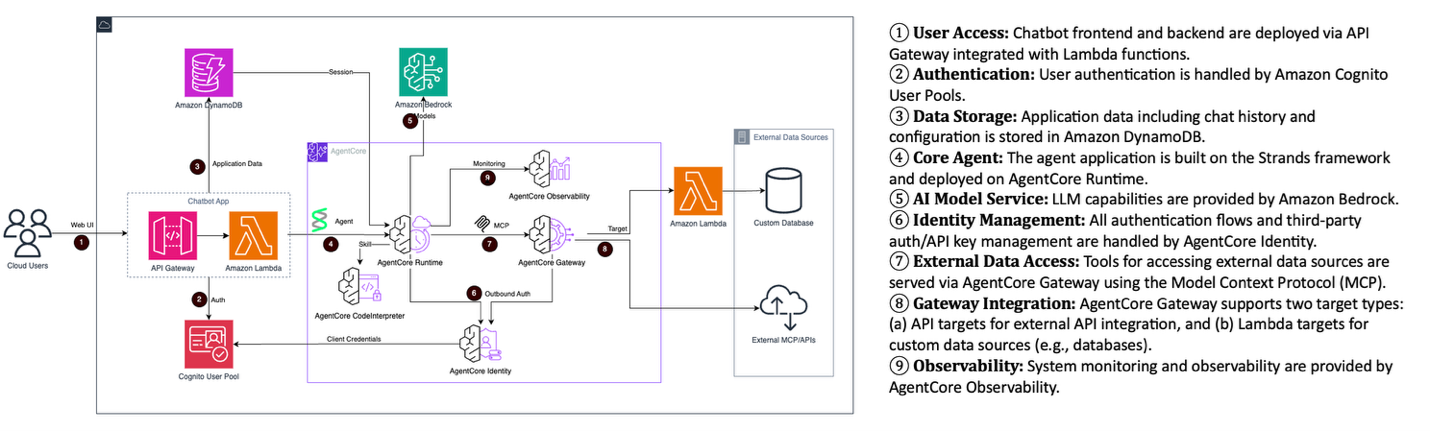
Supervisor Agent interprets user intent and orchestrates the workflow

Figure 1: Multi-agent architecture diagram showing AWS-based chatbot system with API Gateway, Lambda, DynamoDB, Bedrock, and AgentCore components

A Supervisor Agent interprets user intent and orchestrates the workflow. For simple queries, it routes directly to a summary. For complex analytical questions, it coordinates a pipeline of specialized Worker Agents:

  • Query Agent converts natural language to SQL and executes baseline queries and period-over-period comparisons
  • Detail Agent performs multi-dimensional drill-down by category, time, region, and other dimensions when anomalies are detected
  • Research Agent investigates root causes from multiple angles
  • Summary Agent organizes findings into structured business reports
  • Action Agent generates execution-ready materials—notifications, approval summaries, work orders

We found that splitting responsibilities this way was essential for accuracy. When all capabilities were packed into a single agent’s prompt, SQL generation accuracy degraded as the prompt grew. After decomposition, accuracy improved significantly, in part because of a self-correction mechanism where the agent analyzes SQL errors and retries.

Two design choices proved especially important:

A semantic layer for business terminology. The most common source of agent errors was not SQL syntax but misunderstanding business terms. “Slow-moving inventory” means different things at different companies. We injected a mapping from business terms to SQL expressions directly into the Query Agent’s prompt—for example, defining “fulfillment rate” as COUNT(status='delivered') / COUNT(*)—and required all queries to include a date filter. This semantic layer is the structured codification of enterprise business knowledge, and its quality sets the ceiling for the system’s accuracy.

Model Context Protocol (MCP) for data source decoupling. Agents access data through MCP rather than connecting to databases directly. This abstraction proved its value when the underlying query engine was migrated from one platform to another—the agent code required zero changes; only the MCP Server implementation was replaced. In supply chain, where data sources change constantly as channel partner relationships evolve, this decoupling is not optional.

Putting it to work: Channel fulfillment analysis

To illustrate how these components work together, consider a scenario based on the retailer’s actual operations (with anonymized data). During a monthly review, an operations manager asks: “How did our channel partners perform on fulfillment last month? Are there any that need attention?”

The Supervisor Agent routes this to the Query Agent, which maps “fulfillment performance” to the semantic layer’s definitions, queries data by channel, and compares with the prior month. Channel B’s fulfillment rate is flagged as anomalous—down 6.8% month-over-month. The Detail Agent drills down and identifies the footwear category as the source, with the anomaly concentrated in weeks two and three. The Research Agent investigates and finds that Channel B’s unpaid order ratio rose from 8% to 22%, triggering credit controls that froze approximately 340 orders. The Summary Agent produces a structured report with root cause attribution and recommendations. The Action Agent sends notifications to the channel account manager and credit control team and generates an order release request summary ready for the approval workflow.

The entire analysis takes about 30 seconds. What previously required half a day of spreadsheet work and email coordination becomes a single conversation, from question to insight to action.

Conclusion

The bottleneck in supply chain decision-making is no longer data visibility—it is the manual work between data and action. Control towers got us to data-informed. Agentic AI gets us to data-driven: data automatically queried, analyzed, and translated into decisions and actions.

The starting point does not have to be large. One scenario, one question, one conversation is enough to reduce the distance from data-informed to data-driven.

Ready to transform your supply chain operations with agentic AI? Start making the leap—explore Amazon Bedrock AgentCore to build multi-agent systems and the open-source Strands Agents SDK to get your first supply chain agent up and runn