










Exact Sciences, a leading provider of cancer screening and diagnostic tests, has transformed its bioinformatics infrastructure by utilizing AWS HealthOmics. This migration has delivered a significant reduction in analysis costs while maintaining the same performance and accuracy, enabling the company to focus on its mission to prevent cancer, detect it earlier, and guide personalized treatment.
As a pioneer in cancer diagnostics, Exact Sciences faces unique computational challenges in processing massive volumes of next-generation sequencing (NGS) data. Their tests generate enormous datasets—equivalent to more than 1,000 HD movies per flow cell.
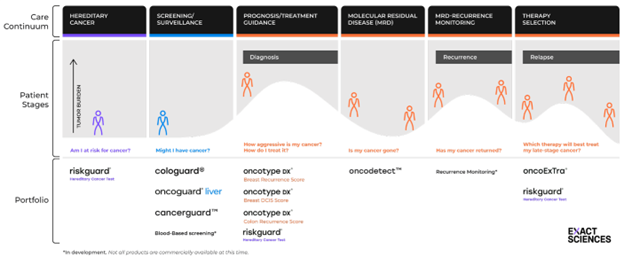
Figure: Exact Sciences’ comprehensive cancer care continuum, showing the progression from hereditary cancer risk through screening, treatment guidance, and therapy selection
“The computational requirements are equally demanding,” explains AJ Connor, Staff Bioinformatics Engineer at Exact Sciences. “Our pipelines have highly variable compute requirements, with some stages needing massive concurrency while others require minimal resources.”
This variability in resource requirements, combined with the need for GPU acceleration for certain pipeline steps, created significant infrastructure management challenges. Additionally, as a company that had grown through innovation and acquisition, Exact Sciences had accumulated a patchwork of different frameworks and technologies.
“We’d accumulated tools from companies we’ve acquired and others built in-house over different time periods using different technology stacks,” Connor notes. “This created several major operational pain points, including high maintenance costs and difficulty onboarding new team members.”
The legacy infrastructure at Exact Sciences presented several critical limitations. The company relied on fragmented systems with multiple in-house solutions for bioinformatics workflows and workflow execution tooling. Manual operations were heavily relied upon, leading to high operational costs through significant development and maintenance expenses. The slow ramp up time for new team members created onboarding challenges, while limited access to new technologies resulted in longer lead times to test and integrate emerging tools. Perhaps most critically, the company faced restricted visibility with poor observability of costs and resource usage.
These challenges led Exact Sciences to establish four critical business requirements for any infrastructure solution: repeatability for consistent and reproducible bioinformatics analysis, cost management with visibility and control over spending, efficiency at scale to ensure smooth operations as demand grows, and innovation enablement to support new product development and early evaluation.
After evaluating various options, Exact Sciences selected AWS HealthOmics, a fully managed bioinformatics service designed to accelerate scientific breakthroughs at scale.
“We deployed HealthOmics-based architecture into production alongside our existing solution,” says Connor. “The integration was seamless, with a simple flow where sequencing data hits Amazon Simple Storage Service (S3), and our LIMS system pushes sample metadata and processing parameters to our workflow orchestration layer.”
The new architecture leverages event-driven and serverless technologies, making it highly scalable and maintainable. “A lot of our components communicate with each other asynchronously via EventBridge,” Connor explains. “The fact that HealthOmics also integrates natively with Amazon EventBridge, sending events when runs have started or finished, is a huge plus point for our chosen architecture.”
Exact Sciences implemented a HealthOmics-based architecture for select pipelines that includes bioinformatics workflows using standard workflow languages, simplified workflow execution by starting pipelines with a single API call to the HealthOmics service, and automated resource management where HealthOmics automatically starts the correct compute resources and manages their lifecycle. The event-driven architecture allows components to communicate asynchronously via EventBridge, while enhanced monitoring gives the operations team access to HealthOmics via the console and Amazon CloudWatch for comprehensive tracing.
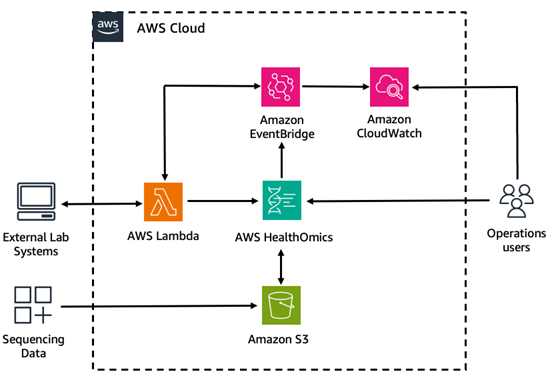
Figure: Exact Sciences HealthOmics-based architecture showing the integration of S3, LIMS system, EventBridge, and HealthOmics workflow orchestration layer.
“HealthOmics handles all of our infrastructure complexity, freeing up our team to focus on what really matters, which is getting the science right and serving our patients with tests faster,” Connor emphasizes.
With the migration to HealthOmics, Exact Sciences achieved a significant cost reduction, as Connor reports: “When we migrated our pipelines from legacy infrastructure to HealthOmics, we achieved a meaningful cost reduction while maintaining the same performance, accuracy, and throughput.”
Improved resource visibility was another key outcome. “For the very first time, we’re able to get a really good view of how our workflows are performing,” Connor notes. The team also benefited from accelerated development cycles, optimized storage management, and streamlined deployment through AWS Cloud Development Kit (CDK).
Beyond cost savings, Exact Sciences has realized several other significant benefits. Improved onboarding has been achieved through access to off-the-shelf bioinformatics workflow languages, making it easier to onboard new team members. Fine-tuned pipelines are now possible thanks to the HealthOmics Run Analyzer tool, which allows for detailed analysis of resource usage and costs for each task in the pipeline. Cross-environment workflow sharing enables production workflows to be used in other environments for development. Access to the latest technologies, particularly easy access to the latest GPUs, has reduced turnaround time on compute-intensive steps like alignment. Enhanced operational efficiency has greatly improved monitoring and troubleshooting capabilities.
Looking ahead, Exact Sciences plans to continue exploring HealthOmics capabilities to further improve operational efficiency and explore additional AWS services that complement their bioinformatics workflows.
Exact Sciences’ journey with AWS HealthOmics demonstrates how a fully managed bioinformatics service can transform operations, reduce costs, and accelerate innovation in cancer diagnostics. By achieving significant cost reductions while maintaining performance, Exact Sciences can focus more resources on its mission to prevent cancer, detect it earlier, and guide personalized treatment.
“HealthOmics handles all of our infrastructure complexity,” Connor concludes. “This frees up our team to focus on what really matters—getting the science right and serving our patients with tests faster.
To learn more about how AWS HealthOmics can accelerate your scientific breakthroughs at scale with fully managed bioinformatics workflows, contact an AWS Representative today.
此内容由惯性聚合(RSS阅读器)自动聚合整理,仅供阅读参考。 原文来自 — 版权归原作者所有。