


惯性聚合 高效追踪和阅读你感兴趣的博客、新闻、科技资讯
阅读原文 在惯性聚合中打开

推荐订阅源

V2EX - 技术
V2EX - 技术
T
Troy Hunt's Blog
The Last Watchdog
The Last Watchdog
www.infosecurity-magazine.com
S
Secure Thoughts
Hacker News - Newest:
Hacker News - Newest: "LLM"
WordPress大学
WordPress大学
freeCodeCamp Programming Tutorials: Python, JavaScript, Git & More
博客园 - 司徒正美
TaoSecurity Blog
TaoSecurity Blog
博客园 - Franky
有赞技术团队
有赞技术团队
Google Online Security Blog
罗磊的独立博客
L
LINUX DO - 最新话题
cs.CV updates on arXiv.org
NISL@THU
NISL@THU
小众软件
小众软件
OSCHINA 社区最新新闻
OSCHINA 社区最新新闻
Recent Commits to openclaw:main
K
Kaspersky official blog
奇客Solidot–传递最新科技情报
奇客Solidot–传递最新科技情报
W
WeLiveSecurity
SecWiki News
SecWiki News
Google DeepMind News
O
OpenAI News
V
V2EX
AI
AI
博客园_首页
Apple Machine Learning Research
大猫的无限游戏
大猫的无限游戏
美团技术团队
C
Cyber Attacks, Cyber Crime and Cyber Security
Threat Intelligence Blog | Flashpoint
Security Archives - TechRepublic
博客园 - 三生石上(FineUI控件)
G
GRAHAM CLULEY
月光博客
月光博客
T
Threatpost
钛媒体:引领未来商业与生活新知
钛媒体:引领未来商业与生活新知
V
Vulnerabilities – Threatpost
Last Week in AI
Last Week in AI
爱范儿
爱范儿
C
CXSECURITY Database RSS Feed - CXSecurity.com
cs.AI updates on arXiv.org
Cloudbric
Cloudbric
酷 壳 – CoolShell
酷 壳 – CoolShell
The Hacker News
The Hacker News
N
News | PayPal Newsroom
Know Your Adversary
Know Your Adversary

AWS for Industries

Build a voice-enabled Automotive and Manufacturing assistant using Amazon Nova Sonic and Amazon Bedrock AgentCore | Amazon Web Services Managing AI agent sprawl across business units | Amazon Web Services Dynamic Inbound Routing for BYOIP Workloads Using Amazon VPC Route Server | Amazon Web Services How Autel Transformed Charging Station Management with AI Agents on AWS | Amazon Web Services How Danone Simplified Kubernetes at Scale with Amazon EKS Auto Mode | Amazon Web Services Build a Multi-Agent Assessment Workbench with Amazon Bedrock AgentCore | Amazon Web Services Sovereign by design: How AWS helps Nigeria’s financial services industry protect data and drive innovation | Amazon Web Services Scaling ML in production: how BBVA accelerated delivery with MLOps | Amazon Web Services Inside BBVA’s MLOps transformation: from data platform to scalable ML on AWS | Amazon Web Services Blazing a Trail: How Peloton Rebuilt the SDLC for the Agentic Era with Amazon Bedrock | Amazon Web Services Accelerate RISC-V Software Development Before Silicon: Virtual Prototyping with MachineWare’s SIM-V on AWS | Amazon Web Services How retailers deliver hyper-personalization in-store with Personalisation Hub, UST, and AWS | Amazon Web Services Deploy diagnostic-quality imaging globally with MedDream and AWS HealthImaging | Amazon Web Services Coins in Motion: Building agentic blockchain payments for in-vehicle experiences | Amazon Web Services Reduce P&ID analysis time by 80% with hybrid AI maintenance planning | Amazon Web Services Deploying industrial AI on AWS: Building the autonomous factory | Amazon Web Services How Atlantic Health cut legal document search time by 42% with Amazon Bedrock metadata filtering | Amazon Web Services Edge-to-Cloud Architecture for Real-Time Surgical Intelligence with AWS and NVIDIA | Amazon Web Services Reimagining B-Pillar DFMEA: Why Ontology-Grounded AI Is the Future of Automotive Engineering | Amazon Web Services Transforming energy trading by managing complexity and driving growth with Cloud ETRM | Amazon Web Services How Multi-Agent AI Turns Supply Chain Data into Decisions and Actions | Amazon Web Services ​​​Deploy Agentic Bidding Without Sacrificing Speed: ARTF Containers with NVIDIA GPU Acceleration on AWS​​ | Amazon Web Services Next-generation programmatic advertising: How AWS RTB Fabric redefines the game | Amazon Web Services Flexible Telecom AI Workload Deployment Across AWS Hybrid Cloud | Amazon Web Services Building a HIPAA-ready generative AI architecture for healthcare on AWS | Amazon Web Services Highlights from the 2026 AWS Life Sciences Symposium: MedTech Track | Amazon Web Services Multi-Agent Systems for Financial Services on Amazon EKS and AgentCore | Amazon Web Services How AI can help developers migrate embedded codebases between Arm SoCs | Amazon Web Services From Connected to Resilient: Cloud-Native Payment Connectivity on AWS | Amazon Web Services Ultra-low-latency cross-Region crypto trading with Avelacom and AWS | Amazon Web Services Build an AI-powered 5G Signaling Trace Analyzer Using Amazon Bedrock | Amazon Web Services Medical Legal Regulatory Review Orchestration with AI Agents on AWS | Amazon Web Services AWS showcases the agentic AI future of advertising and entertainment at Cannes Lions 2026 | Amazon Web Services The Road to 180M GRefs/s: Sizing Epic on AWS with R8ib and Enhanced EBS | Amazon Web Services BridgeWise builds responsible AI in FSI with Amazon Bedrock | Amazon Web Services Rethink Everything: Highlights from the 2026 AWS Financial Services Symposium | Amazon Web Services Improving Defect Analysis and Quality Control with AI Diagnostics | Amazon Web Services Building a cloud-based EV charging monitoring platform with real-time AI analytics | Amazon Web Services Introducing the AWS guide to the ECB Guide on outsourcing cloud services to cloud service providers | Amazon Web Services How a Luxury Retailer Accelerates Customer Experience with Amazon CloudFront | Amazon Web Services The Art of the Possible: Building an Intelligent Wealth Management Platform – Part 1 | Amazon Web Services How We Built Healthcare AI You Can Trust: The Science Behind Amazon Connect Health | Amazon Web Services How Everllence Scaled P&ID Intelligence to Improve Plant Operations | Amazon Web Services Rivian accelerates production with second-generation AWS Outposts: Improving resiliency and reducing costs | Amazon Web Services AI-Driven Development Lifecycle for Financial Services | Amazon Web Services How Agentic AI and Digital Twins on AWS Drive Operational Excellence | Amazon Web Services Modernizing Core Banking Systems: A Strategic Guide for Financial Leaders | Amazon Web Services Highlights from the 2026 AWS Life Sciences Symposium: Research and Drug Discovery | Amazon Web Services Discount Tire Uses Cloud WAN and Buffer VPC to Create a Scalable Enterprise Network Centralized third-party connectivity in AWS: Architecture patterns for highly regulated environments | Amazon Web Services FHIR-powered Care Continuum on AWS HealthLake From code to chemistry: using Kiro to tackle ADME-Tox, a key drug discovery challenge | Amazon Web Services How Toyota securely deployed HiveMQ with mTLS on AWS to power Smart Manufacturing | Amazon Web Services From record to intelligence: How EMR systems on AWS become the foundation for generative AI in healthcare | Amazon Web Services How to Connect AWS HealthOmics to Public and Private Network Sources at Runtime | Amazon Web Services Accelerating Android Builds on AWS: From 3 Hours to Under 5 Minutes with SourceFS | Amazon Web Services Closing the Loop with Amazon Bio Discovery’s Integrated Lab Partners | Amazon Web Services Massive Parallel Processing of Financial Transactions with Amazon EKS and Amazon MSK | Amazon Web Services Submit up to 100,000 Bioinformatics Workflow Runs with a Single API Call in AWS HealthOmics | Amazon Web Services Energy HPC Orchestrator powers collaborative, scalable energy computing | Amazon Web Services Automate Investment Research Using Strands Agents on Bedrock AgentCore | Amazon Web Services How OCC Built a Governed Cloud Foundation and Then Stress-Tested It Executive Insights from the 2026 AWS Life Sciences Symposium How Carlsberg’s Traitomic business leveraged AWS HealthOmics to power genetic trait development | Amazon Web Services CME Group MDP multicast data access on AWS using Transit Gateway | Amazon Web Services How retailers solve the customer identity puzzle with Amperity and AWS | Amazon Web Services Exact Sciences Transforms Bioinformatics Infrastructure with AWS HealthOmics | Amazon Web Services Building a Serverless Supply Chain Management Solution for Automotive Customers with AWS AppSync and Amazon Aurora Serverless | Amazon Web Services Accelerating physical AI with AWS and NVIDIA: building production-ready applications with simulation and real-world learning | Amazon Web Services Modernizing life-saving workloads with AWS serverless | Amazon Web Services Transforming Industrial Operations: How AVEVA and AWS drive Cloud Innovation | Amazon Web Services Introducing Amazon Bio Discovery | Amazon Web Services Accelerate Project Delivery with AI-Native Execution System on Amazon Quick | Amazon Web Services Reinvent Telecom Mediation Systems with Amazon Bedrock AgentCore, Strands Agents, and the Model Context Protocol | Amazon Web Services AWS Cloud Connectivity Patterns for Financial Market Infrastructures | Amazon Web Services Event-Driven Digital Pathology: Governed Whole Slide Image Ingestion to Scalable Inference with Amazon SageMaker | Amazon Web Services How Telefonica Germany achieved a centralized tracing solution with VPC Traffic Mirroring | Amazon Web Services AWS Teams Up with Wingstop to Deliver Wings to Millions During March Hoops Tournament | Amazon Web Services How Amazon Connect Health brings agentic AI to the point of care | Amazon Web Services How Liftoff improved conversion performance and reduced infrastructure costs with Cortex using AWS Graviton | Amazon Web Services Driving Intelligent Quality in the Software-Defined Vehicle Era | Amazon Web Services How Amazon Devices Eliminated Credential Risk to Scale AI across Engineering Tools | Amazon Web Services The Evolution of BMW Group’s 3D Streaming Experience | Amazon Web Services Build ChatGPT Apps with MCP Servers and AWS Infrastructure | Amazon Web Services
From Prompt to Pipeline: AI-Powered Bioinformatics Workflow Development with Kiro and AWS HealthOmics | Amazon Web Services
2026-03-31 · via AWS for Industries

Introduction

Workflow development in genomics has always demanded a rare combination of domain expertise and software engineering skills. You need to understand biology and master a domain-specific language like Workflow Description Language (WDL) or Nextflow. On top of that, you have to navigate cloud infrastructure and troubleshoot failures that only surface after a run has already consumed hours of computing time. It’s a slow, frustrating loop that hasn’t changed much, even as tools like Kiro IDE and AI-powered assistants have transformed the rest of software development. The result is a development experience that lags far behind what application developers take for granted and a significant drag on the pace of genomics research and clinical pipeline development.

We built the AWS HealthOmics extension for Kiro, and its companion Kiro Power, to change that. Together, they bring the full modern IDE experience — IntelliSense, real-time diagnostics, go-to-definition, and AI assistance — directly to genomics workflow development. You can write, validate, deploy, debug, and optimize workflows without leaving your editor, and without having to explain workflow languages or the HealthOmics service to your AI assistant every time you start a new task.

AWS HealthOmics is a HIPAA-eligible service that accelerates clinical diagnostic testing, drug discovery, and agriculture research by fully managing the complex infrastructure behind your bioinformatics workflows. While HealthOmics provides a fully secured and scalable environment for running your workflows, developing and debugging workflows requires the domain expertise of the bioinformatics developer.

This blog walks through what the extension and power provide, how they work together, and how you can use these tools with Kiro to speed up your workflow development by 2x or more.

The Solution

Kiro is an agentic AI-powered IDE built by AWS that helps you go from prototype to production with spec-driven development. To improve Kiro’s bioinformatics workflow abilities, we built the AWS HealthOmics Kiro Power — a companion package that automatically configures the HealthOmics Model Context Protocol (MCP) server and provides Kiro with domain-specific steering guides.

When the power is installed, Kiro gains deep context about HealthOmics workflows. It knows how to deploy Nextflow and WDL pipelines to HealthOmics, how to set up Amazon Elastic Container Registry (ECR) pull-through caches for public containers, how to version and update existing workflows, and how to troubleshoot creation and run failures. Instead of you having to explain HealthOmics best practices in every prompt, the power teaches Kiro so it can guide you through these workflows correctly from the start.

What the extension provides

Full IDE Language Support
The AWS HealthOmics extension brings bioinformatics workflow development directly into the Kiro IDE. It provides full language support for WDL and Nextflow, — the two most widely used workflow languages in genomics — with syntax highlighting, IntelliSense, go-to-definition, find references, and real-time diagnostics. Whether you’re writing a new variant-calling pipeline or maintaining an existing RNA-seq workflow, the extension gives you the same rich editing experience you’d expect for any first-class programming language (Figure 1).
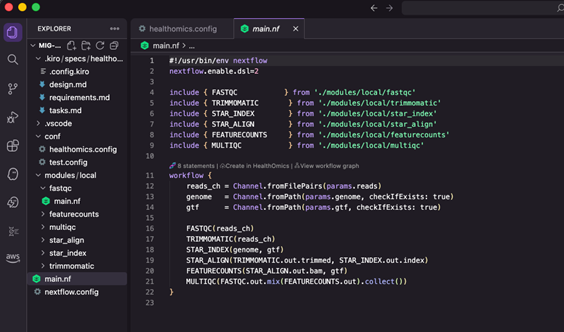
Figure 1 – A Nextflow Project in the IDE

Figure 1 – A Nextflow Project in the IDE

Integration with the Kiro Agent and HealthOmics
Beyond code editing, the extension acts as a bridge between your local development environment and AWS HealthOmics. A built-in HealthOmics Explorer lets you browse workflows and runs from your AWS account without leaving the IDE (Figure 2). You can deploy workflows directly, start and monitor runs, and when something goes wrong, use AI-assisted failure diagnosis to quickly pinpoint and even correct the issue. For completed runs, the extension offers performance analysis to help you optimize resource utilization and cost.
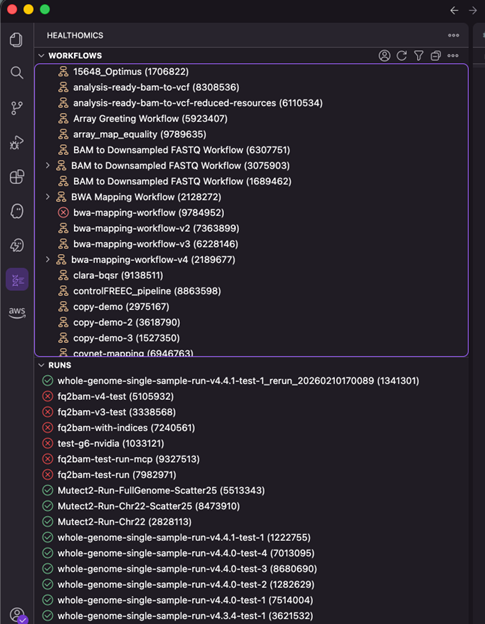
Figure 2: Viewing workflows and recent runs available in your HealthOmics account

Figure 2: Viewing workflows and recent runs available in your HealthOmics account

A built-in compatibility checker validates your workflows against HealthOmics requirements in real time, catching issues like unsupported directives or incorrect container formats before you ever attempt a deployment (Figure 3).
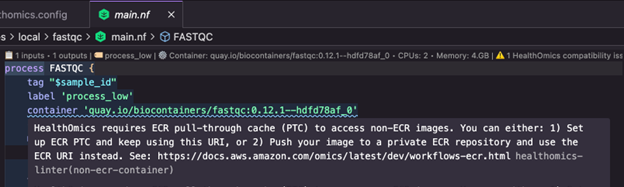
Figure 3: The IDE extension has detected a HealthOmics compatibility issue related to the use of public containers and suggests two options for remediation.

Figure 3: The IDE extension has detected a HealthOmics compatibility issue related to the use of public containers and suggests two options for remediation.

AWS HealthOmics MCP Server Integration
The extension also integrates with the AWS HealthOmics MCP Server, enabling AI-powered workflow management through natural language. You can ask Kiro to package and deploy a workflow, diagnose a failed run, or suggest optimizations — and the extension handles the underlying API calls. Customizable prompt templates make it easy to standardize common operations across your team, and workspace-level configuration keeps your IAM roles, output locations, and run parameters consistent from session to session.

Interactive Guides
To help you get started quickly, the extension also ships with a set of interactive guides covering everything from first-time setup to spec-driven workflow development and cross-platform migration (Figure 4). Each guide walks you through a real workflow with copy-pasteable prompts and direct command links, so you can learn by doing rather than reading documentation.
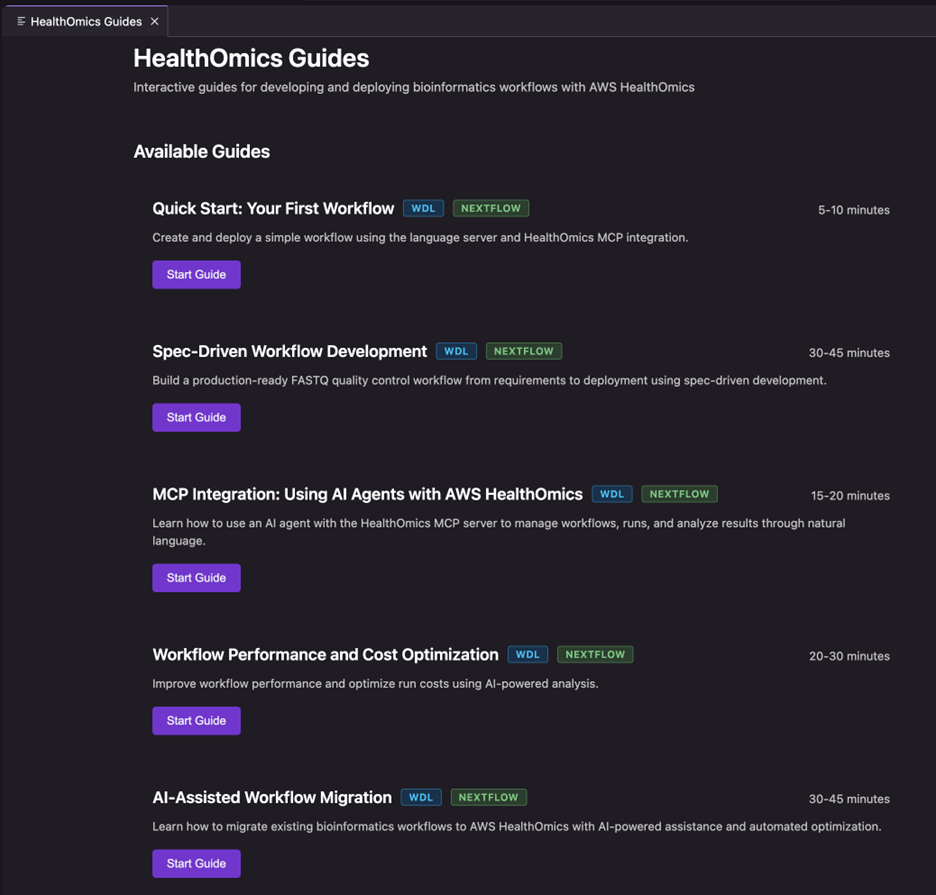
 Figure 4: The HealthOmics guides' panel

Figure 4: The HealthOmics guides’ panel

Creating Workflows Using Natural Language

You can even ask Kiro to create a totally new workflow definition from only a natural language description (Figure 5). You can either do this in Kiro’s ‘Vibe’ coding mode, or for more complex workflows you can make use of Kiro’s powerful ‘Spec’ coding mode. The Kiro Agent along with the HealthOmics extension and power can take you through the entire development life cycle from coding to deployment, testing, debugging and optimization with AI assistance at every stage – all without leaving your IDE (Figure 6).
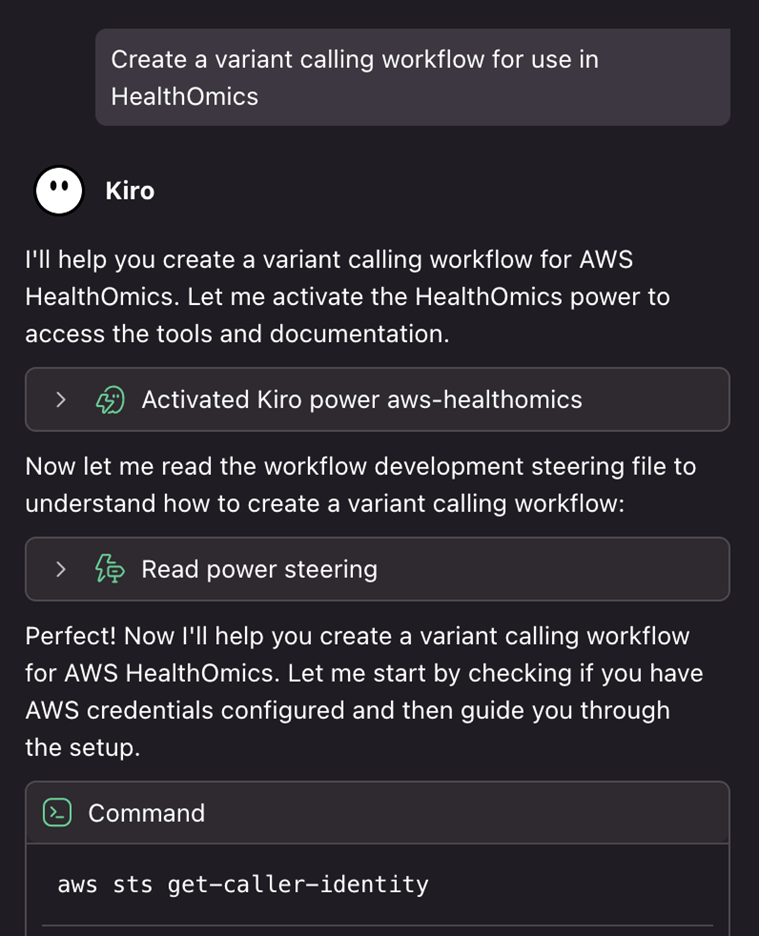
Figure 5: Initiation of a workflow creation process from a natural language prompt. Kiro recognizes that it can gain additional context on the required steps from the HealthOmics Kiro Power
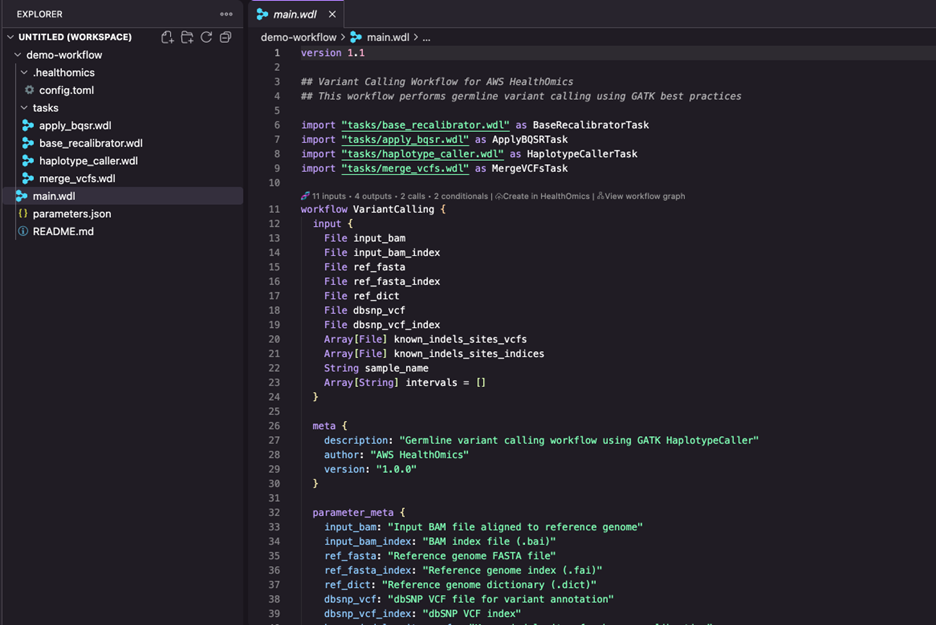
Figure 5: Initiation of a workflow creation process from a natural language prompt. Kiro recognizes that it can gain additional context on the required steps from the HealthOmics Kiro Power

Figure 6: A WDL variant calling workflow generated by Kiro following HealthOmics best practices.

Figure 6: A WDL variant calling workflow generated by Kiro following HealthOmics best practices.

Real productivity gains

In internal testing, users reported more than a 2x speedup on typical workflow creation and migration tasks when using the extension and power together. In one case, a complex multi-step migration of an RNASeq workflow that had previously taken several days, and multiple failed test runs was completed in under half a day — including a successful test run on HealthOmics. The combination of real-time compatibility validation, AI-guided migration steps, and one-click deployment removes the trial-and-error loop that makes these tasks so time-consuming.

Conclusion

The AWS HealthOmics extension for Kiro and its companion Kiro Power deliver measurable productivity gains achieving more than 2x speedup on typical workflow creation and migration tasks, with complex multi-step migrations that previously took days now completed in under half a day. The extension provides comprehensive IDE language support for WDL and Nextflow with IntelliSense, real-time diagnostics, and seamless AWS HealthOmics integration for direct deployment and monitoring. Real-time compatibility checking eliminates costly trial-and-error cycles, while MCP integration ensures Kiro has access to the latest HealthOmics features and best practices without requiring repeated explanations.
From natural language spec creation to deployment, testing, debugging, and optimization—the entire development lifecycle is now AI-assisted within a single IDE, delivering a development experience that finally matches what modern application developers expect: faster iteration, fewer errors, and more time focused on science rather than infrastructure.

Next Steps

To get started today: download Kiro; install the AWS HealthOmics extension; and add the AWS HealthOmics Power from the Powers panel. Once you’re set up, open the Quick Start guide from the command palette (HealthOmics: Show Guides) and follow along — you’ll go from an empty editor to a deployed workflow in minutes.

Resources