






Picture a technician on a factory floor, hands deep inside a malfunctioning hydraulic press, safety gloves on, noise all around. She needs the torque specification for a valve assembly—right now. Her options today: stop work, remove her gloves, walk to a workstation, sign in, and search through a 400-page equipment manual. That context switch costs minutes she doesn’t have, and it’s a scene that repeats thousands of times daily across manufacturing facilities worldwide.
The numbers tell the story. Automotive and Manufacturing facilities lose an average of 2–4 hours of daily downtime per facility because of information access delays. Workers experience 15–20% productivity loss searching through physical manuals, waiting for expert assistance, or navigating complex documentation systems. Language barriers compound the problem for multilingual workforces, while knowledge silos concentrate expertise in a few individuals, creating bottlenecks that ripple across shifts and production lines.
In this post, we show you how Amazon Nova Sonic, Amazon Bedrock AgentCore, and Strands Agents come together in VEMA (Voice-Enabled Manufacturing Assistant)—an AI-powered voice assistant that lets workers speak naturally to get instant answers, hands-free, in English or Spanish, without ever leaving their workstation.
Why speech-to-speech changes everything on the shop floor
Traditional voice assistants rely on a pipeline architecture: a separate speech-to-text (STT) service transcribes audio, a large language model (LLM) generates a text response, and a text-to-speech (TTS) service synthesizes the reply. Each hop adds latency, loses vocal nuance, and introduces potential failure points. On a noisy factory floor where every second counts, that pipeline becomes a liability.
Amazon Nova Sonic takes a fundamentally different approach. As a speech-to-speech foundation model, it handles the full conversational loop—listening, understanding, reasoning, and responding—within a single model invocation using the InvokeModelWithBidirectionalStream API. This eliminates the multi-service pipeline entirely:
- Lower latency – No serialization between the STT, LLM, and TTS stages means responses begin streaming back while the model is still generating
- Preserved context – The model processes audio directly; retaining tone, emphasis, and conversational cues that text transcription would discard
- Simplified architecture – One bidirectional WebSocket stream replaces three separate service integrations
- Native tool use – Nova Sonic can invoke tools (knowledge base lookups, agent delegation, support case creation) mid-conversation without breaking the voice stream
This makes Nova Sonic particularly well-suited for auto and manufacturing environments where workers need immediate, natural voice responses while keeping their hands on equipment.
Intelligent orchestration with AgentCore and Strands agents
A voice interface alone isn’t enough—the system needs to reason, retrieve, and act. That’s where the agentic layer comes in.
Amazon Bedrock AgentCore provides the production-grade infrastructure for deploying and scaling AI agents. It handles session isolation, persistent memory across conversations, and observability; eliminating the operational complexity of managing agent infrastructure yourself. Each agent runs in a secure, isolated environment, which means a technician can pause a troubleshooting session at lunch and pick it up in the afternoon without re-explaining the problem.
The Strands Agents SDK provides the framework for building each specialized agent. Using the declarative tool system of Strands, agents are equipped with focused capabilities and use intelligent reasoning to select and execute the appropriate tools based on the worker’s request.
Together, these technologies create a fluid experience: a worker speaks naturally, Nova Sonic processes the voice input and determines what action is needed, and Strands-based agents hosted on AgentCore perform complex reasoning and data retrieval—all within a single, uninterrupted voice conversation.
Solution overview
VEMA is a fully serverless application deployed with AWS Cloud Development Kit (AWS CDK) that provides real-time voice-based access to manufacturing knowledge. Workers interact through a mobile-responsive web interface—accessible on tablets, phones, and workstations throughout the facility—using natural voice commands in English or Spanish.
The system operates across two specialized domains:
- Maintenance mode – Equipment troubleshooting, step-by-step repair procedures, predictive maintenance insights, and root cause analysis, powered by a knowledge base of technical manuals and equipment documentation
- Safety mode – Safety protocols, emergency procedures, incident reporting, and compliance guidance with a dedicated safety knowledge base and priority routing for critical situations
The knowledge underpinning VEMA’s responses comes from equipment manuals, standard operating procedures (SOPs), and safety documentation. Through Retrieval Augmented Generation (RAG) using Amazon Bedrock Knowledge Bases, VEMA retrieves the most relevant content from these sources to deliver accurate, facility-specific answers grounded in actual operational documentation—not generic responses.
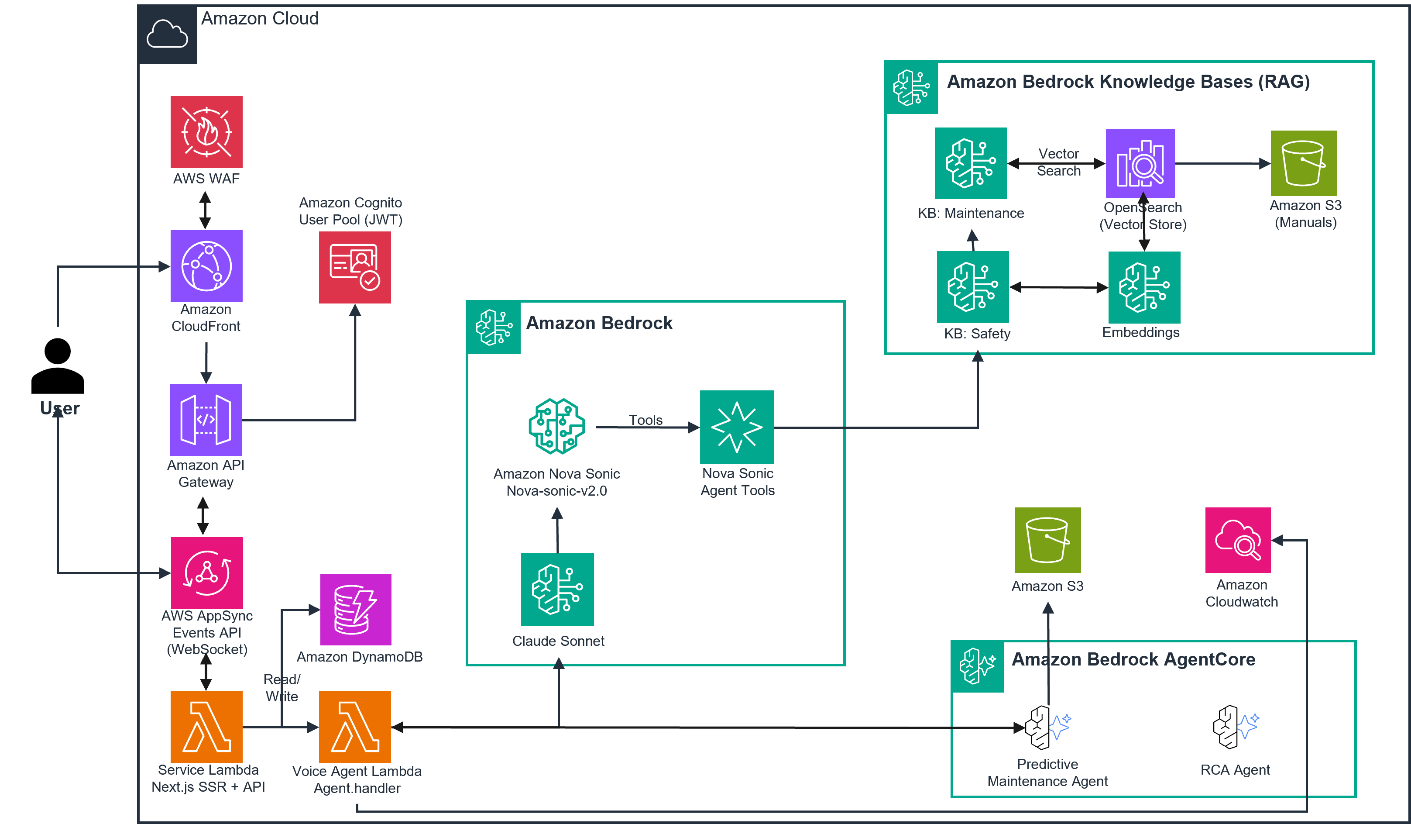 Figure 1: VEMA system architecture
Architecture deep dive
VEMA implements a fully serverless, event-driven architecture. Let’s walk through each layer.
Voice processing layer (Amazon Nova Sonic)
At the center of VEMA’s voice experience is Amazon Nova Sonic (amazon.nova-sonic-v2:0), accessed through the Bedrock Runtime InvokeModelWithBidirectionalStream API. An AWS Lambda function opens a persistent bidirectional stream with Nova Sonic and manages the full session lifecycle:
- Session initialization with a manufacturing-specific system prompt and voice configuration
- Audio input streaming from the user’s microphone using AWS AppSync Events
- Tool orchestration when Nova Sonic determines it needs external data; including delegating to AgentCore-hosted agents for complex reasoning
- Audio output streaming of Nova Sonic’s synthesized voice response back to the client in real time
The tool-use capability of Nova Sonic is what makes this architecture distinctive. The model autonomously decides when to invoke tools mid-conversation without breaking the voice stream. The worker hears a response as soon as Nova Sonic begins generating it; there’s no waiting for a full text response before synthesis begins.
Managed agent runtime (Amazon Bedrock AgentCore)
Amazon Bedrock AgentCore provides the managed infrastructure for hosting VEMA’s specialized agents:
- Persistent memory – Each agent is configured with short-term memory (STM) that tracks conversation state and diagnostic progress across sessions, enabling technicians to resume diagnostics where they left off
- Session isolation – Each technician gets an isolated session with secure execution, preventing cross-contamination of data between concurrent users
- Observability – Built-in tracing and monitoring for all agent invocations, providing visibility into tool execution, response times, and error rates
- Serverless scaling – Agents scale automatically with demand, with no capacity planning required
VEMA deploys four specialized agents to AgentCore, each built with the Strands Agents SDK:
- VEMA maintenance agent (
vema_maintenance) – The primary troubleshooting agent that guides workers through systematic, step-by-step diagnostics. Equipped with tools for knowledge base search, support case creation, and diagnostic step recording. Uses Claude 3.5 Sonnet as its reasoning model. - Root cause analysis agent (
rca_agent) – Analyzes recurring equipment issues by searching past incident history, identifying failure patterns, and recommending preventive actions. Invoked when workers mention recurring problems. - Predictive maintenance agent (
predictive_maintenance_agent) – Analyzes equipment sensor data (operating hours, temperature, vibration levels) against typical lifespan thresholds to predict failures and recommend maintenance timing. Generates visual charts for trend analysis. - Safety agent (
safety_agent) – Dedicated to safety queries with its own safety-specific knowledge base. Always searches safety documentation first before responding, helping to ensure compliance with Health, Safety, and Environment (HSE) guidelines and emergency procedures.
Each agent is invoked from the Nova Sonic tool layer using the @aws-sdk/client-bedrock-agentcore SDK using InvokeAgentRuntimeCommand, creating a seamless bridge between voice interaction and agentic reasoning.
Building agents with Strands
The Strands Agents SDK provides the intelligent orchestration framework powering each Amazon Bedrock AgentCore-hosted agent. Each agent follows a consistent pattern: define tools, wire them into an agent with a domain-specific system prompt, and expose it through the Bedrock AgentCore runtime:
from bedrock_agentcore.runtime import BedrockAgentCoreApp
from strands import Agent
from strands.tools import tool

app = BedrockAgentCoreApp()

@tool
def search_maintenance_docs(query: str) -> dict:
    """Search maintenance documentation and equipment manuals."""
    # Queries Amazon Bedrock Knowledge Base via RAG
    ...

@tool
def create_support_case(title: str, description: str, category: str, severity: str) -> dict:
    """Create a support case for maintenance or safety issues."""
    # Writes to DynamoDB with auto-assigned team routing
    ...

@tool
def record_diagnostic_step(session_id: str, step_number: int, action: str, observation: str) -> dict:
    """Record a diagnostic troubleshooting step for tracking."""
    ...

vema_agent = Agent(
    model="anthropic.claude-3-5-sonnet-20241022-v2:0",
    tools=[search_maintenance_docs, create_support_case, record_diagnostic_step],
    system_prompt="You are VEMA, an expert troubleshooting assistant..."
)

@app.entrypoint
def invoke_vema(prompt: str, session_id: str = None, mode: str = "maintenance") -> dict:
    response = vema_agent(prompt)
    return {"response": response}
This pattern—Strands agent with focused tools, deployed to Amazon Bedrock AgentCore through BedrockAgentCoreApp—is repeated for each of the four specialized agents, with domain-specific tools and system prompts tailored to their function.
Real-time communication (AWS AppSync Events)
AWS AppSync Events provides the WebSocket pub/sub layer between the browser and the agent AWS Lambda function. Each user session gets a dedicated channel, enabling:
- Real-time audio chunk delivery from the microphone to the Lambda function
- Streaming audio playback from Nova Sonic back to the browser
- Conversation transcript updates and tool execution status notifications
Compared to API Gateway WebSocket APIs, AppSync Events simplifies connection management and provides built-in authorization integration with Amazon Cognito.
Frontend
VEMA’s frontend delivers a responsive, low-latency voice experience across the range of devices found on a shop floor:
A Next.js 15 application with React 19 and TypeScript provides the mobile-responsive voice interface, using the Web Audio API for voice capture and playback. shadcn/ui provides consistent, accessible UI components. The application is deployed as a Docker container on Lambda and served through Amazon CloudFront for low-latency access across facility locations.
Data layer
VEMA’s data layer combines purpose-built AWS services for retrieval, persistence, and storage.
- Amazon Bedrock Knowledge Bases – Two knowledge bases provide RAG-powered retrieval: one for maintenance documentation (equipment manuals, SOPs) and a separate one for safety procedures (HSE guidelines, emergency protocols), both backed by Amazon S3.
- Amazon DynamoDB – Stores conversation history (partitioned by
userId#sessionId), support cases (with a GSI for case listing), diagnostic step records, and session metadata. Single-table design keeps costs low and queries fast. - Amazon Simple Storage Service (Amazon S3) – Hosts knowledge base source documents, predictive maintenance charts, and static frontend assets.
Additional capabilities
Beyond its core voice and reasoning capabilities, VEMA includes several features that improve resilience, accessibility, and workflow integration for shop-floor use.
- MCP support – VEMA supports Model Context Protocol (MCP), enabling integration with external services and tools through community-developed MCP servers. This allows the assistant to extend its capabilities beyond the built-in tool set; connecting to databases, APIs, and other external data sources as needed.
- Conversation continuity – Nova Sonic sessions have a maximum duration limit. VEMA implements automatic session resume, seamlessly creating a new session and carrying forward conversation context so the worker experiences no interruption.
- Bilingual support – Seamless English and Spanish switching helps ensure accessibility for diverse manufacturing workforces without requiring separate systems or configurations.
- Support case escalation – An escalation workflow automatically creates support cases for issues that require human intervention, capturing full conversation context and auto-routing to the appropriate team (Maintenance, Safety, or Emergency Response).
Security architecture
Automotive and Manufacturing environments handle sensitive operational data, and VEMA implements defense-in-depth security throughout:
- Amazon Cognito provides user authentication using JSON Web Tokens (JWTs) and enforces access controls, with configurable email domain restrictions to limit sign-up to authorized personnel
- Amazon API Gateway manages secure HTTP routing with Cognito authorizers
- AppSync Events enforces per-channel authorization tied to user identity
- Bedrock AgentCore provides session isolation with secure execution environments per agent invocation
- AWS Identity and Access Management (IAM) manages access policies for service-to-service interactions, following AWS security best practices
- Data encryption protects information both in transit (TLS) and at rest
- Amazon CloudWatch provides comprehensive monitoring, logging, and alerting across system components
Deployment
VEMA’s infrastructure is defined entirely in AWS CDK. A typical deployment workflow looks like the following:
cd cdk
npm ci
npx cdk bootstrap  # First time only
npx cdk deploy
Bedrock AgentCore agents are deployed separately using the AgentCore CLI:
cd agentcore-agent
agentcore launch --agent vema_maintenance
agentcore launch --agent rca_agent
agentcore launch --agent predictive_maintenance_agent
agentcore launch --agent safety_agent
The CDK stack provisions all resources—Lambda functions, DynamoDB tables, S3 buckets, an Amazon Cognito user pool, CloudFront distribution, API Gateway, AppSync Events API, and Amazon Bedrock Knowledge Bases—with no manual configuration required. Configurable deployment parameters include the target AWS Region, Nova Sonic model Region (default: us-east-1), and allowed email domains for Cognito sign-up.
The architecture scales from a single production line to an enterprise-wide, multi-facility deployment without changes.
Business outcomes
Deploying VEMA delivers measurable impact across automotive & manufacturing operations:
- 60–70% reduction in information access time (projected) – Workers resolve queries in seconds by voice instead of minutes spent searching through physical or digital manuals.
- 40% decrease in equipment downtime (projected) – Instant access to troubleshooting procedures and predictive maintenance insights accelerates issue resolution and prevents failures before they occur.
- Improved safety compliance – The dedicated safety agent helps ensure immediate access to safety protocols, and the support case workflow streamlines incident reporting, reducing safety incidents from delayed protocol access.
- Proactive maintenance – The predictive maintenance agent identifies equipment approaching failure thresholds before breakdowns occur, shifting operations from reactive to preventive maintenance.
- Persistent diagnostic context – The Bedrock AgentCore memory system means technicians can pause a troubleshooting session and resume later without re-explaining the problem, preserving hours of diagnostic progress.
- Scalable knowledge distribution – Expert knowledge is captured and shared across the entire workforce, eliminating single-point-of-failure knowledge silos. A first-week technician gets the same quality of guidance as a 20-year veteran.
- Potential ROI within 6–12 months – The combination of reduced downtime, improved productivity, and lower training costs delivers return on investment within the first year of deployment.
Future enhancements
The VEMA roadmap includes expanding language support beyond English and Spanish to French, German, and Japanese for global auto manufacturing operations. Planned capabilities include offline mode for critical safety information access in connectivity-limited areas, video-based visual troubleshooting assistance, and advanced analytics dashboards for usage patterns and operational insights.
Conclusion
VEMA demonstrates what becomes possible when you combine a native speech-to-speech model with an agentic architecture purpose-built for production workloads. Amazon Nova Sonic manages the voice interaction end-to-end in a single stream. Amazon Bedrock AgentCore provides managed hosting with persistent memory and session isolation. The Strands Agents SDK enables specialized agents with focused tools. And AWS serverless services combine them into a system that scales automatically and costs pennies per session.
The result is an assistant that meets Automotive and Manufacturing workers where they are: on the shop floor, hands occupied, needing answers now. No typing, no screen navigation, no waiting for an expert to become available. Just speak and get an answer.
The architectural pattern demonstrated here—a speech-to-speech model with native tool-use capabilities, backed by specialized Strands agents on Bedrock AgentCore—applies broadly to any hands-busy, eyes-busy environment: warehouse operations, field service, healthcare, and beyond.
To get started, contact your AWS representative and see the following resources: