

惯性聚合 高效追踪和阅读你感兴趣的博客、新闻、科技资讯
阅读原文 在惯性聚合中打开

推荐订阅源

Threat Intelligence Blog | Flashpoint
W
WeLiveSecurity
O
OpenAI News
N
News and Events Feed by Topic
K
KPMG report finds enterprise disconnect between AI and its ROI | CIO
cs.CV updates on arXiv.org
Webroot Blog
Webroot Blog
Google Online Security Blog
云风的 BLOG
云风的 BLOG
N
News | PayPal Newsroom
H
Hacker News: Front Page
博客园_首页
Exploit-DB.com RSS Feed
The Last Watchdog
The Last Watchdog
钛媒体:引领未来商业与生活新知
钛媒体:引领未来商业与生活新知
H
Heimdal Security Blog
cs.AI updates on arXiv.org
S
Schneier on Security
宝玉的分享
宝玉的分享
H
Hackread – Cybersecurity News, Data Breaches, AI and More
Recent Commits to openclaw:main
Y
Y Combinator Blog
Cyberwarzone
Cyberwarzone
Microsoft Security Blog
C
CXSECURITY Database RSS Feed - CXSecurity.com
GbyAI
GbyAI
Cloudbric
Cloudbric
TaoSecurity Blog
TaoSecurity Blog
人人都是产品经理
人人都是产品经理
P
Palo Alto Networks Blog
M
MIT News - Artificial intelligence
G
GRAHAM CLULEY
C
Check Point Blog
Apple Machine Learning Research
Last Week in AI
Last Week in AI
T
Troy Hunt's Blog
L
Lohrmann on Cybersecurity
www.infosecurity-magazine.com
P
Proofpoint News Feed
Blog — PlanetScale
Blog — PlanetScale
量子位
博客园 - 聂微东
S
Securelist
博客园 - 三生石上(FineUI控件)
F
Full Disclosure
G
Google Developers Blog
L
LINUX DO - 热门话题
P
Proofpoint News Feed
AI
AI
PCI Perspectives
PCI Perspectives

AWS for Industries

Dynamic Inbound Routing for BYOIP Workloads Using Amazon VPC Route Server | Amazon Web Services How Autel Transformed Charging Station Management with AI Agents on AWS | Amazon Web Services How Danone Simplified Kubernetes at Scale with Amazon EKS Auto Mode | Amazon Web Services Build a Multi-Agent Assessment Workbench with Amazon Bedrock AgentCore | Amazon Web Services Sovereign by design: How AWS helps Nigeria’s financial services industry protect data and drive innovation | Amazon Web Services Scaling ML in production: how BBVA accelerated delivery with MLOps | Amazon Web Services Inside BBVA’s MLOps transformation: from data platform to scalable ML on AWS | Amazon Web Services Blazing a Trail: How Peloton Rebuilt the SDLC for the Agentic Era with Amazon Bedrock | Amazon Web Services Accelerate RISC-V Software Development Before Silicon: Virtual Prototyping with MachineWare’s SIM-V on AWS | Amazon Web Services How retailers deliver hyper-personalization in-store with Personalisation Hub, UST, and AWS | Amazon Web Services Deploy diagnostic-quality imaging globally with MedDream and AWS HealthImaging | Amazon Web Services Coins in Motion: Building agentic blockchain payments for in-vehicle experiences | Amazon Web Services Reduce P&ID analysis time by 80% with hybrid AI maintenance planning | Amazon Web Services Deploying industrial AI on AWS: Building the autonomous factory | Amazon Web Services How Atlantic Health cut legal document search time by 42% with Amazon Bedrock metadata filtering | Amazon Web Services Edge-to-Cloud Architecture for Real-Time Surgical Intelligence with AWS and NVIDIA | Amazon Web Services Reimagining B-Pillar DFMEA: Why Ontology-Grounded AI Is the Future of Automotive Engineering | Amazon Web Services Transforming energy trading by managing complexity and driving growth with Cloud ETRM | Amazon Web Services How Multi-Agent AI Turns Supply Chain Data into Decisions and Actions | Amazon Web Services ​​​Deploy Agentic Bidding Without Sacrificing Speed: ARTF Containers with NVIDIA GPU Acceleration on AWS​​ | Amazon Web Services Next-generation programmatic advertising: How AWS RTB Fabric redefines the game | Amazon Web Services Flexible Telecom AI Workload Deployment Across AWS Hybrid Cloud | Amazon Web Services Building a HIPAA-ready generative AI architecture for healthcare on AWS | Amazon Web Services Highlights from the 2026 AWS Life Sciences Symposium: MedTech Track | Amazon Web Services Multi-Agent Systems for Financial Services on Amazon EKS and AgentCore | Amazon Web Services How AI can help developers migrate embedded codebases between Arm SoCs | Amazon Web Services From Connected to Resilient: Cloud-Native Payment Connectivity on AWS | Amazon Web Services Ultra-low-latency cross-Region crypto trading with Avelacom and AWS | Amazon Web Services Build an AI-powered 5G Signaling Trace Analyzer Using Amazon Bedrock | Amazon Web Services Medical Legal Regulatory Review Orchestration with AI Agents on AWS | Amazon Web Services AWS showcases the agentic AI future of advertising and entertainment at Cannes Lions 2026 | Amazon Web Services The Road to 180M GRefs/s: Sizing Epic on AWS with R8ib and Enhanced EBS | Amazon Web Services BridgeWise builds responsible AI in FSI with Amazon Bedrock | Amazon Web Services Rethink Everything: Highlights from the 2026 AWS Financial Services Symposium | Amazon Web Services Improving Defect Analysis and Quality Control with AI Diagnostics | Amazon Web Services Building a cloud-based EV charging monitoring platform with real-time AI analytics | Amazon Web Services Introducing the AWS guide to the ECB Guide on outsourcing cloud services to cloud service providers | Amazon Web Services How a Luxury Retailer Accelerates Customer Experience with Amazon CloudFront | Amazon Web Services The Art of the Possible: Building an Intelligent Wealth Management Platform – Part 1 | Amazon Web Services How We Built Healthcare AI You Can Trust: The Science Behind Amazon Connect Health | Amazon Web Services How Everllence Scaled P&ID Intelligence to Improve Plant Operations | Amazon Web Services Rivian accelerates production with second-generation AWS Outposts: Improving resiliency and reducing costs | Amazon Web Services AI-Driven Development Lifecycle for Financial Services | Amazon Web Services How Agentic AI and Digital Twins on AWS Drive Operational Excellence | Amazon Web Services Modernizing Core Banking Systems: A Strategic Guide for Financial Leaders | Amazon Web Services Highlights from the 2026 AWS Life Sciences Symposium: Research and Drug Discovery | Amazon Web Services Discount Tire Uses Cloud WAN and Buffer VPC to Create a Scalable Enterprise Network Centralized third-party connectivity in AWS: Architecture patterns for highly regulated environments | Amazon Web Services FHIR-powered Care Continuum on AWS HealthLake From code to chemistry: using Kiro to tackle ADME-Tox, a key drug discovery challenge | Amazon Web Services How Toyota securely deployed HiveMQ with mTLS on AWS to power Smart Manufacturing | Amazon Web Services From record to intelligence: How EMR systems on AWS become the foundation for generative AI in healthcare | Amazon Web Services How to Connect AWS HealthOmics to Public and Private Network Sources at Runtime | Amazon Web Services Accelerating Android Builds on AWS: From 3 Hours to Under 5 Minutes with SourceFS | Amazon Web Services Closing the Loop with Amazon Bio Discovery’s Integrated Lab Partners | Amazon Web Services Massive Parallel Processing of Financial Transactions with Amazon EKS and Amazon MSK | Amazon Web Services Submit up to 100,000 Bioinformatics Workflow Runs with a Single API Call in AWS HealthOmics | Amazon Web Services Energy HPC Orchestrator powers collaborative, scalable energy computing | Amazon Web Services Automate Investment Research Using Strands Agents on Bedrock AgentCore | Amazon Web Services How OCC Built a Governed Cloud Foundation and Then Stress-Tested It Executive Insights from the 2026 AWS Life Sciences Symposium How Carlsberg’s Traitomic business leveraged AWS HealthOmics to power genetic trait development | Amazon Web Services CME Group MDP multicast data access on AWS using Transit Gateway | Amazon Web Services How retailers solve the customer identity puzzle with Amperity and AWS | Amazon Web Services Exact Sciences Transforms Bioinformatics Infrastructure with AWS HealthOmics | Amazon Web Services Building a Serverless Supply Chain Management Solution for Automotive Customers with AWS AppSync and Amazon Aurora Serverless | Amazon Web Services Accelerating physical AI with AWS and NVIDIA: building production-ready applications with simulation and real-world learning | Amazon Web Services Modernizing life-saving workloads with AWS serverless | Amazon Web Services Transforming Industrial Operations: How AVEVA and AWS drive Cloud Innovation | Amazon Web Services Introducing Amazon Bio Discovery | Amazon Web Services Accelerate Project Delivery with AI-Native Execution System on Amazon Quick | Amazon Web Services Reinvent Telecom Mediation Systems with Amazon Bedrock AgentCore, Strands Agents, and the Model Context Protocol | Amazon Web Services AWS Cloud Connectivity Patterns for Financial Market Infrastructures | Amazon Web Services How Telefonica Germany achieved a centralized tracing solution with VPC Traffic Mirroring | Amazon Web Services AWS Teams Up with Wingstop to Deliver Wings to Millions During March Hoops Tournament | Amazon Web Services How Amazon Connect Health brings agentic AI to the point of care | Amazon Web Services How Liftoff improved conversion performance and reduced infrastructure costs with Cortex using AWS Graviton | Amazon Web Services From Prompt to Pipeline: AI-Powered Bioinformatics Workflow Development with Kiro and AWS HealthOmics | Amazon Web Services Driving Intelligent Quality in the Software-Defined Vehicle Era | Amazon Web Services How Amazon Devices Eliminated Credential Risk to Scale AI across Engineering Tools | Amazon Web Services The Evolution of BMW Group’s 3D Streaming Experience | Amazon Web Services Build ChatGPT Apps with MCP Servers and AWS Infrastructure | Amazon Web Services
Event-Driven Digital Pathology: Governed Whole Slide Image Ingestion to Scalable Inference with Amazon SageMaker | Amazon Web Services
2026-04-10 · via AWS for Industries

Introduction

Whole-slide images (WSIs) are transforming digital pathology, but working with these massive files across different scanners and systems presents real challenges. This blog post will detail how Genmab, a leading biotech company, built an automated pipeline on AWS that handles whole-slide images from start to finish, cutting analysis time from hours to under 30 minutes per batch and reducing manual work by 80 percent. We will walk through how Genmab achieved this using AWS services and share the key lessons they learned along the way.

Opportunity

Genmab’s digital pathology laboratory scans large tissue image, often several gigabytes each. The team faced a growing challenge managing hundreds of WSIs from multiple sources, each requiring careful tracking, organization, and analysis. While the images, along with metadata were stored in Concentriq, the actual analysis happened on-premises.  This setup required significant manual coordination and limited throughput to about 50 slides per day, which could not keep pace with demand. Additionally, the results were stored separately from the WSIs and metadata, making it difficult for teams to get a complete picture and establish a single source of truth.

Solution

To solve this challenge, Genmab built an automated pipeline for processing WSIs. The pipeline runs without manual intervention and uses custom machine learning models in Amazon SageMaker for image analysis. It handles two types of input: complete WSI files and pre-tiled images. For pre-tiled images, the pipeline processes all tiles simultaneously using Amazon SageMaker Batch Transform, which speeds up the analysis. We’ll walk through both approaches, each one suited for specific model and throughput requirements.
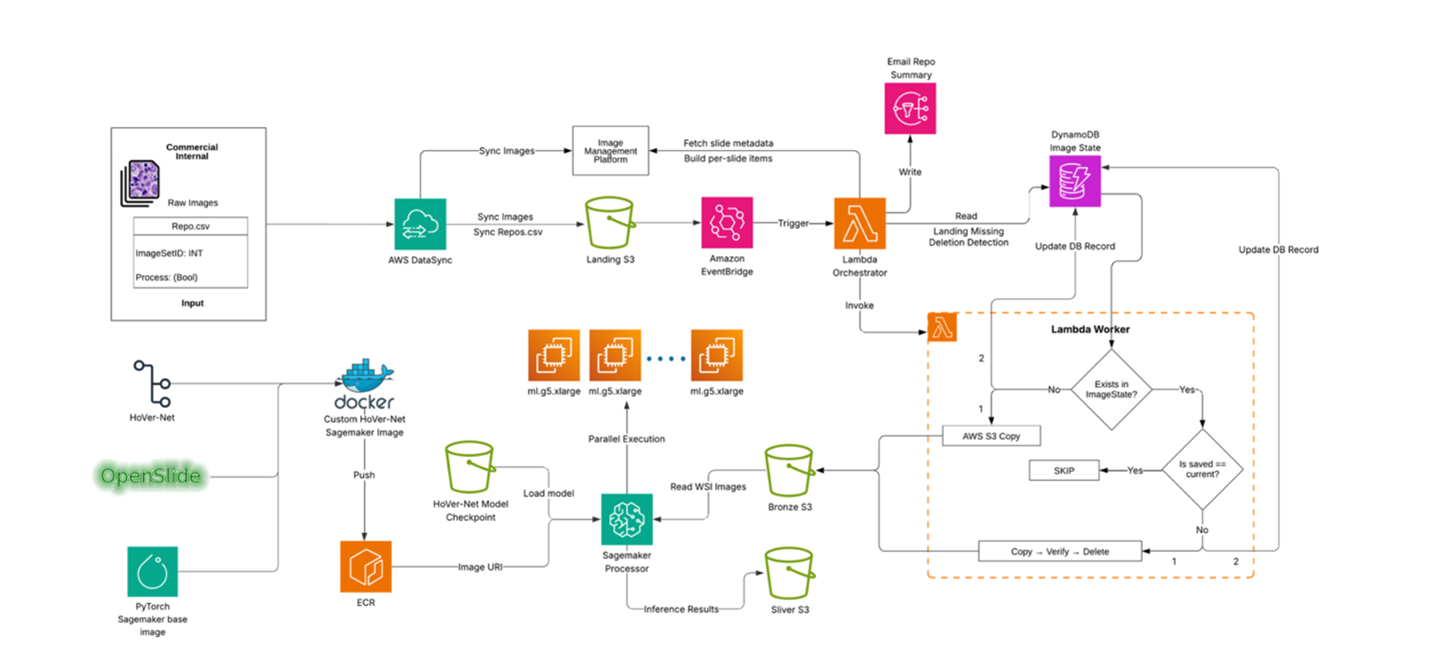
Event-Driven Digital Pathology figure 1

End-to-end Process Flow

Genmab’s digital pathology laboratory continuously writes WSI files to a network drive. The process is triggered when a researcher drops a manifest file (repo.csv) to a network drive, which begins the transfer of files to the Landing Amazon S3 bucket using AWS DataSync.

This S3 event invokes a “coordinator” AWS Lambda function, which retrieves the image metadata from Concentriq based on the manifest and invokes a “worker” AWS Lambda function for each slide.

Each “worker” Lambda copies the large WSI into the Bronze S3 bucket using multipart copy. Any file renaming, moving, or missing data is recorded in Amazon DynamoDB for full lineage and auditing history. The worker Lambda then sends a summary to the researchers via Amazon SNS (Simple Notification Service).

The Bronze S3 event invokes the AI inference in one of two ways:

  • Amazon SageMaker Processing: Pulls slides directly from S3 and processes them in parallel using a custom Docker image (PyTorch + OpenSlide + model code). It scales by sharding S3 keys across instances and multiprocessing per node.
  • SageMaker Batch Transform: Processes pre-tiled WSIs using packaged PyTorch models, creates a SageMaker Model, and runs Transform jobs with concurrency controls, built-in queuing, scaling, and detailed logs.

Both approaches write results to the Silver S3 bucket.

Containerized Runtime: Docker and Amazon ECR

Diving deeper into containerized runtime, once slides are stored in Bronze, they need to be prepared for AI model processing. This is done by packaging the inference code inside a SageMaker-compatible Docker container. The container starts from a PyTorch base image, installs OpenSlide to read WSI formats, and includes the model code. The entry point script loads the model and runs inference. Because the container is portable, it can run in either SageMaker Processing or Batch Transform with minimal changes.

After building, the container image is pushed to Amazon ECR (Elastic Container Registry), making it easy to version, reuse, and swap in new models. This design keeps the pipeline model-agnostic: Genmab can run HoVer-Net today, ResNet50 tomorrow, or an entirely new model later. This flexibility is achieved simply by pointing SageMaker to a different container image.

Option 1: Scalable Inference with SageMaker Processing

SageMaker Processing is used for models that operate on whole slides and can scale horizontally. SageMaker distributes input slides across multiple GPU instances, while each instance parallelizes work internally across CPU and GPU workers. This means hundreds of gigabyte-scale WSIs can be analyzed in parallel without maintaining clusters or manually scheduling GPUs. Jobs can be tuned with parameters like tile size, chunk size, and worker counts to balance GPU memory with throughput. Amazon CloudWatch provides visibility into performance and allows setting adjustments as data or models change.

Option 2: Scalable Inference with Batch Transform

SageMaker Batch Transform is used for models that work with pre-tiled images. Slides are pre-tiled, background regions are filtered out, and the resulting tiles are uploaded to S3. Batch Transform then processes millions of tiles with built-in queuing and concurrency controls.

To use this approach, a model (such as a vision model) is packaged into a model.tar.gz bundle that includes the model weights and inference script. The package is uploaded to S3, a SageMaker Model is created, and a Transform job is launched.

Batch Transform is well suited for high-throughput offline inference on pre-tiled datasets. It can process large tile datasets efficiently using managed batch jobs without deploying or operating real-time endpoints. Metrics like transform latency and queue time in CloudWatch help tune payload sizes and concurrency.

Overall Performance and Cost Tuning

Scaling WSI inference isn’t just about raw compute—it’s about balancing throughput, cost, and GPU (graphics processing unit) constraints, such as accelerator memory limits and, in some cases, account quotas. Here are a few lessons learned along the way:

Tile and chunk sizes matter — Choose tile and chunk sizes carefully. Start small and grow until GPU memory is fully utilized.

Avoid oversubscription — Set thread counts carefully to prevent CPUs from thrashing.

Horizontal scale beats vertical scale — Increasing instance count often gives better throughput per dollar than using larger instances.

Cache smartly — Caching tiles on ephemeral storage avoids costly re-reads of entire WSIs.

These practices allowed Genmab to run thousands of gigabyte-scale slides reliably while staying cost-aware.

Security, Networking, and Governance

Governance is central to this pipeline. Every step follows least-privilege AWS Identity and Access Management (IAM) principles. Lambda functions, SageMaker jobs, and DynamoDB tables only access the resources they need.

Data is encrypted at rest and in transit, and all jobs run inside VPC subnets with S3 interface endpoints for controlled networking.

For auditability, manifests are maintained in S3, detailed lineage is tracked in DynamoDB, and structured logs are stored in CloudWatch. Together, these artifacts create an audit trail that ties any output back to its exact input and parameters. CloudWatch Alarms detect errors, stale control files, or stuck objects in the Landing bucket.

Troubleshooting

To handle common issues, the system detects, retries, and surfaces errors clearly:

Missing slides — If a slide is missing from the Landing bucket, the worker marks it as missing and automatically ingests it later if it reappears.

Failed renames — If a rename fails, the worker retries with a safe fallback.

Duplicate files — If duplicates appear, they can be resolved upstream in the image management system and retried.

Slow Batch Transform jobs — If jobs slow down, adjusting tile payload size or concurrency usually resolves the issue.

These safeguards mean operators don’t need to manually monitor the system—errors are logged, retried, and surfaced clearly through Amazon SNS and CloudWatch.

Conclusion

This solution removes the complexity of working with large pathology images at scale. Lab users don’t need to learn AWS or manage files manually—a simple CSV starts the process. The system moves images into the right location, tracks every change, and reports back automatically.

Genmab’s automated pipeline transformed their digital pathology workflow, reducing manual coordination time by 80 percent and increasing processing capacity from tens to hundreds of slides daily. What previously took hours and was limited to approximately 50 slides per day now runs continuously with near-real-time ingestion and AI inference.

The pipeline is secure, auditable, and built on managed AWS services, giving Genmab a scalable foundation that unifies data governance and large-scale computation. This accelerates analysis cycles and improves reliability across their digital pathology workflows.

To learn more, see Amazon Batch Transform Documentation and AWS SageMaker AI Blogs.