

惯性聚合 高效追踪和阅读你感兴趣的博客、新闻、科技资讯
阅读原文 在惯性聚合中打开

推荐订阅源

H
Hackread – Cybersecurity News, Data Breaches, AI and More
C
Check Point Blog
Hacker News: Ask HN
Hacker News: Ask HN
cs.CL updates on arXiv.org
WordPress大学
WordPress大学
P
Proofpoint News Feed
V
Visual Studio Blog
C
Cyber Attacks, Cyber Crime and Cyber Security
N
Netflix TechBlog - Medium
C
CXSECURITY Database RSS Feed - CXSecurity.com
博客园 - 聂微东
Threat Intelligence Blog | Flashpoint
博客园 - 叶小钗
Cisco Talos Blog
Cisco Talos Blog
S
Schneier on Security
T
Threat Research - Cisco Blogs
腾讯CDC
cs.AI updates on arXiv.org
The Hacker News
The Hacker News
Google DeepMind News
Microsoft Security Blog
奇客Solidot–传递最新科技情报
奇客Solidot–传递最新科技情报
GbyAI
GbyAI
N
News | PayPal Newsroom
L
LINUX DO - 最新话题
酷 壳 – CoolShell
酷 壳 – CoolShell
P
Palo Alto Networks Blog
T
Tenable Blog
S
Secure Thoughts
T
Threatpost
V2EX - 技术
V2EX - 技术
大猫的无限游戏
大猫的无限游戏
Martin Fowler
Martin Fowler
freeCodeCamp Programming Tutorials: Python, JavaScript, Git & More
Vercel News
Vercel News
罗磊的独立博客
P
Privacy & Cybersecurity Law Blog
Engineering at Meta
Engineering at Meta
小众软件
小众软件
Google DeepMind News
N
News and Events Feed by Topic
Y
Y Combinator Blog
CTFtime.org: upcoming CTF events
C
Cybersecurity and Infrastructure Security Agency CISA
P
Proofpoint News Feed
L
Lohrmann on Cybersecurity
P
Privacy International News Feed
H
Heimdal Security Blog
量子位
B
Blog

AWS for Industries

Dynamic Inbound Routing for BYOIP Workloads Using Amazon VPC Route Server | Amazon Web Services How Autel Transformed Charging Station Management with AI Agents on AWS | Amazon Web Services How Danone Simplified Kubernetes at Scale with Amazon EKS Auto Mode | Amazon Web Services Build a Multi-Agent Assessment Workbench with Amazon Bedrock AgentCore | Amazon Web Services Sovereign by design: How AWS helps Nigeria’s financial services industry protect data and drive innovation | Amazon Web Services Scaling ML in production: how BBVA accelerated delivery with MLOps | Amazon Web Services Inside BBVA’s MLOps transformation: from data platform to scalable ML on AWS | Amazon Web Services Blazing a Trail: How Peloton Rebuilt the SDLC for the Agentic Era with Amazon Bedrock | Amazon Web Services Accelerate RISC-V Software Development Before Silicon: Virtual Prototyping with MachineWare’s SIM-V on AWS | Amazon Web Services How retailers deliver hyper-personalization in-store with Personalisation Hub, UST, and AWS | Amazon Web Services Deploy diagnostic-quality imaging globally with MedDream and AWS HealthImaging | Amazon Web Services Coins in Motion: Building agentic blockchain payments for in-vehicle experiences | Amazon Web Services Reduce P&ID analysis time by 80% with hybrid AI maintenance planning | Amazon Web Services Deploying industrial AI on AWS: Building the autonomous factory | Amazon Web Services How Atlantic Health cut legal document search time by 42% with Amazon Bedrock metadata filtering | Amazon Web Services Edge-to-Cloud Architecture for Real-Time Surgical Intelligence with AWS and NVIDIA | Amazon Web Services Reimagining B-Pillar DFMEA: Why Ontology-Grounded AI Is the Future of Automotive Engineering | Amazon Web Services Transforming energy trading by managing complexity and driving growth with Cloud ETRM | Amazon Web Services How Multi-Agent AI Turns Supply Chain Data into Decisions and Actions | Amazon Web Services ​​​Deploy Agentic Bidding Without Sacrificing Speed: ARTF Containers with NVIDIA GPU Acceleration on AWS​​ | Amazon Web Services Next-generation programmatic advertising: How AWS RTB Fabric redefines the game | Amazon Web Services Flexible Telecom AI Workload Deployment Across AWS Hybrid Cloud | Amazon Web Services Building a HIPAA-ready generative AI architecture for healthcare on AWS | Amazon Web Services Highlights from the 2026 AWS Life Sciences Symposium: MedTech Track | Amazon Web Services Multi-Agent Systems for Financial Services on Amazon EKS and AgentCore | Amazon Web Services How AI can help developers migrate embedded codebases between Arm SoCs | Amazon Web Services From Connected to Resilient: Cloud-Native Payment Connectivity on AWS | Amazon Web Services Build an AI-powered 5G Signaling Trace Analyzer Using Amazon Bedrock | Amazon Web Services Medical Legal Regulatory Review Orchestration with AI Agents on AWS | Amazon Web Services AWS showcases the agentic AI future of advertising and entertainment at Cannes Lions 2026 | Amazon Web Services The Road to 180M GRefs/s: Sizing Epic on AWS with R8ib and Enhanced EBS | Amazon Web Services BridgeWise builds responsible AI in FSI with Amazon Bedrock | Amazon Web Services Rethink Everything: Highlights from the 2026 AWS Financial Services Symposium | Amazon Web Services Improving Defect Analysis and Quality Control with AI Diagnostics | Amazon Web Services Building a cloud-based EV charging monitoring platform with real-time AI analytics | Amazon Web Services Introducing the AWS guide to the ECB Guide on outsourcing cloud services to cloud service providers | Amazon Web Services How a Luxury Retailer Accelerates Customer Experience with Amazon CloudFront | Amazon Web Services The Art of the Possible: Building an Intelligent Wealth Management Platform – Part 1 | Amazon Web Services How We Built Healthcare AI You Can Trust: The Science Behind Amazon Connect Health | Amazon Web Services How Everllence Scaled P&ID Intelligence to Improve Plant Operations | Amazon Web Services Rivian accelerates production with second-generation AWS Outposts: Improving resiliency and reducing costs | Amazon Web Services AI-Driven Development Lifecycle for Financial Services | Amazon Web Services How Agentic AI and Digital Twins on AWS Drive Operational Excellence | Amazon Web Services Modernizing Core Banking Systems: A Strategic Guide for Financial Leaders | Amazon Web Services Highlights from the 2026 AWS Life Sciences Symposium: Research and Drug Discovery | Amazon Web Services Discount Tire Uses Cloud WAN and Buffer VPC to Create a Scalable Enterprise Network Centralized third-party connectivity in AWS: Architecture patterns for highly regulated environments | Amazon Web Services FHIR-powered Care Continuum on AWS HealthLake From code to chemistry: using Kiro to tackle ADME-Tox, a key drug discovery challenge | Amazon Web Services How Toyota securely deployed HiveMQ with mTLS on AWS to power Smart Manufacturing | Amazon Web Services From record to intelligence: How EMR systems on AWS become the foundation for generative AI in healthcare | Amazon Web Services How to Connect AWS HealthOmics to Public and Private Network Sources at Runtime | Amazon Web Services Accelerating Android Builds on AWS: From 3 Hours to Under 5 Minutes with SourceFS | Amazon Web Services Closing the Loop with Amazon Bio Discovery’s Integrated Lab Partners | Amazon Web Services Massive Parallel Processing of Financial Transactions with Amazon EKS and Amazon MSK | Amazon Web Services Submit up to 100,000 Bioinformatics Workflow Runs with a Single API Call in AWS HealthOmics | Amazon Web Services Energy HPC Orchestrator powers collaborative, scalable energy computing | Amazon Web Services Automate Investment Research Using Strands Agents on Bedrock AgentCore | Amazon Web Services How OCC Built a Governed Cloud Foundation and Then Stress-Tested It Executive Insights from the 2026 AWS Life Sciences Symposium How Carlsberg’s Traitomic business leveraged AWS HealthOmics to power genetic trait development | Amazon Web Services CME Group MDP multicast data access on AWS using Transit Gateway | Amazon Web Services How retailers solve the customer identity puzzle with Amperity and AWS | Amazon Web Services Exact Sciences Transforms Bioinformatics Infrastructure with AWS HealthOmics | Amazon Web Services Building a Serverless Supply Chain Management Solution for Automotive Customers with AWS AppSync and Amazon Aurora Serverless | Amazon Web Services Accelerating physical AI with AWS and NVIDIA: building production-ready applications with simulation and real-world learning | Amazon Web Services Modernizing life-saving workloads with AWS serverless | Amazon Web Services Transforming Industrial Operations: How AVEVA and AWS drive Cloud Innovation | Amazon Web Services Introducing Amazon Bio Discovery | Amazon Web Services Accelerate Project Delivery with AI-Native Execution System on Amazon Quick | Amazon Web Services Reinvent Telecom Mediation Systems with Amazon Bedrock AgentCore, Strands Agents, and the Model Context Protocol | Amazon Web Services AWS Cloud Connectivity Patterns for Financial Market Infrastructures | Amazon Web Services Event-Driven Digital Pathology: Governed Whole Slide Image Ingestion to Scalable Inference with Amazon SageMaker | Amazon Web Services How Telefonica Germany achieved a centralized tracing solution with VPC Traffic Mirroring | Amazon Web Services AWS Teams Up with Wingstop to Deliver Wings to Millions During March Hoops Tournament | Amazon Web Services How Amazon Connect Health brings agentic AI to the point of care | Amazon Web Services How Liftoff improved conversion performance and reduced infrastructure costs with Cortex using AWS Graviton | Amazon Web Services From Prompt to Pipeline: AI-Powered Bioinformatics Workflow Development with Kiro and AWS HealthOmics | Amazon Web Services Driving Intelligent Quality in the Software-Defined Vehicle Era | Amazon Web Services How Amazon Devices Eliminated Credential Risk to Scale AI across Engineering Tools | Amazon Web Services The Evolution of BMW Group’s 3D Streaming Experience | Amazon Web Services Build ChatGPT Apps with MCP Servers and AWS Infrastructure | Amazon Web Services
Ultra-low-latency cross-Region crypto trading with Avelacom and AWS | Amazon Web Services
Benjamin Hui · 2026-06-12 · via AWS for Industries

AWS for Industries

Introduction

In cryptocurrency trading, achieving ultra-low-latency cross-Region connectivity often translates directly to alpha (excess returns exceeding market benchmarks). When arbitrage opportunities between exchanges might exist for only milliseconds, the difference between profit and missed opportunity depends on network performance.

This post demonstrates how combining AWS Direct Connect (Direct Connect) with Avelacom’s proprietary ultra-low-latency network reduced cross-Region round-trip latency by up to 49% for crypto trading workloads. Based on TCP benchmarks across five routes from Tokyo, you’ll find architecture details, measurement methodology, and guidance on when this approach is the right fit.

Crypto liquidity is globally fragmented. Major exchanges operate across Regions: Binance in Tokyo, Bybit in Singapore, Coinbase in the US, and Deribit in London. For trading firms pursuing cross-exchange strategies like statistical arbitrage, market making, or liquidation hunting, this fragmentation creates a challenge. Moving data between AWS Regions fast enough to act on fleeting opportunities requires specialized infrastructure.

The cross-Region latency problem

Within a single AWS Region, firms optimize every microsecond between Amazon Elastic Compute Cloud (Amazon EC2) instances and exchange matching engines. Common techniques include placement groups, Elastic Network Adapter (ENA) tuning, and kernel bypass. These optimizations can achieve sub-150 µs intra-Region latencies.

Cross-Region is different. When your trading engine in Tokyo needs to pull market data from Singapore or the US, the cross-Region hop dominates your latency budget. It adds tens to hundreds of milliseconds depending on destination, compared to the sub-millisecond intra-Region baseline. AWS provides Amazon Virtual Private Cloud (Amazon VPC) peering for cross-Region connectivity. VPC peering is reliable, private, and uses the AWS global backbone. But AWS optimizes it for resilience and scalability across millions of customers, not for point-to-point latency in trading.

The Avelacom approach

Avelacom operates network infrastructure built specifically for latency-sensitive financial applications:

  • Proprietary routes: Private fiber infrastructure optimized for latency-sensitive market data feeds and order flow
  • Deterministic performance: Controlled network paths that provide predictable, low-jitter data transmission
  • High availability: Multi-layer redundant infrastructure providing high uptime
  • AWS Direct Connect integration: EC2 → Direct Connect → Avelacom network → Direct Connect → EC2 (referred to as Direct Connect with Avelacom throughout this post)

The key difference lies in physical-layer optimization. Avelacom engineers its network to minimize physical distance between Regions through optimized terrestrial and submarine routes, reducing latency for long-haul inter-Region connectivity.

Reference architecture

Figure 1 illustrates the two network paths tested between AWS Regions.
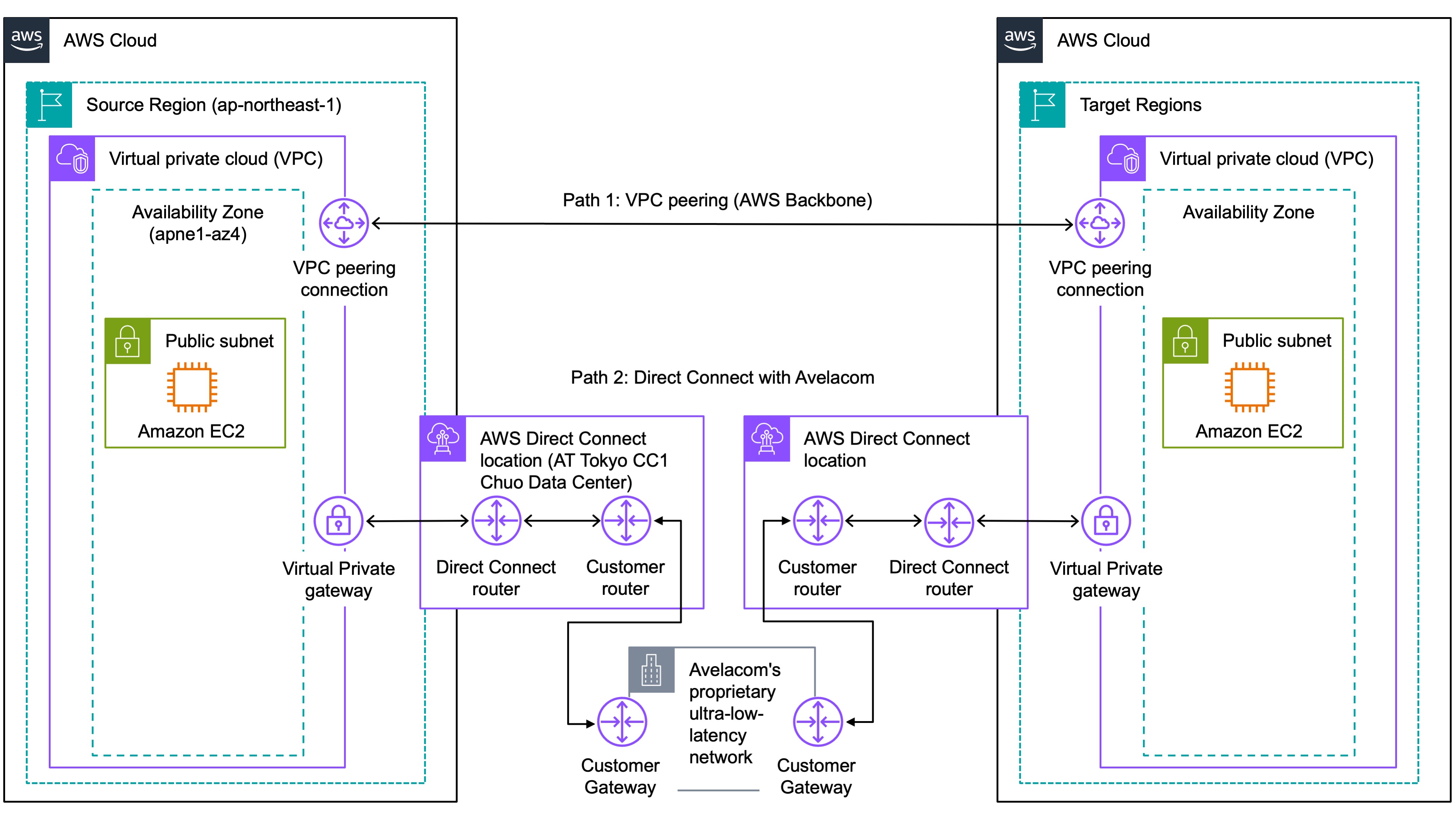
Figure 1. Cross-Region latency architecture comparing VPC peering and Direct Connect with Avelacom paths

Figure 1: Cross-Region latency architecture comparing VPC peering and Direct Connect with Avelacom paths

Tokyo (ap-northeast-1) serves as the primary hub, a logical choice given Binance’s concentration of volume. From Tokyo, the solution connects to:

Route Regions Use Case
Tokyo ↔ Singapore ap-northeast-1 ↔ ap-southeast-1 Binance ↔ Bybit APAC arbitrage
Tokyo ↔ Virginia ap-northeast-1 ↔ us-east-1 APAC ↔ Coinbase US
Tokyo ↔ Frankfurt ap-northeast-1 ↔ eu-central-1 APAC ↔ EU venues
Tokyo ↔ London ap-northeast-1 ↔ eu-west-2 APAC ↔ Deribit/ Polymarket
Tokyo ↔ Stockholm ap-northeast-1 ↔ eu-north-1 APAC ↔ Nordic/EU venues

Network paths compared:

  • VPC peering: EC2 → VPC peering → AWS backbone → EC2
  • Direct Connect with Avelacom: EC2 → Direct Connect → Avelacom network → Direct Connect → EC2

Test methodology

  • Instance type: c7i.large with ENA enhanced networking
  • Measurement tool: sockperf, TCP ping-pong mode, 60 seconds per route, 64-byte messages
  • Sample size: 242–909 observations per route (determined by RTT; shorter routes complete more round-trips in 60s)
  • Control: Identical EC2 instances, same private IPs. Only variable is the network path (route table swap: VPC peering → virtual private gateway)
  • VPC peering test: 2026-04-28 07:59–08:05 UTC
  • Direct Connect with Avelacom test: 2026-04-28 08:16–08:23 UTC

Why sockperf? ICMP ping measures network-layer latency but doesn’t reflect what trading applications experience. sockperf’s TCP ping-pong mode establishes a real TCP connection with 64-byte messages. It measures the time for a message to complete a full round trip through the application layer, making it closer to actual trading message latency than ICMP-based tools.

Results

Figure 2 presents P50 (median) round-trip time across these five routes.

Route VPC peering P50 RTT Direct Connect with Avelacom P50 RTT Improvement
Tokyo → Singapore 68.0 ms 65.4 ms 3.8%
Tokyo → Virginia 150.2 ms 135.4 ms 9.9%
Tokyo → Frankfurt 224.3 ms 136.5 ms 39.1%
Tokyo → London 210.0 ms 139.6 ms 33.5%
Tokyo → Stockholm 245.3 ms 124.3 ms 49.3%

The values represent sockperf TCP ping-pong P50 (median) RTT we measured on 2026-04-28.
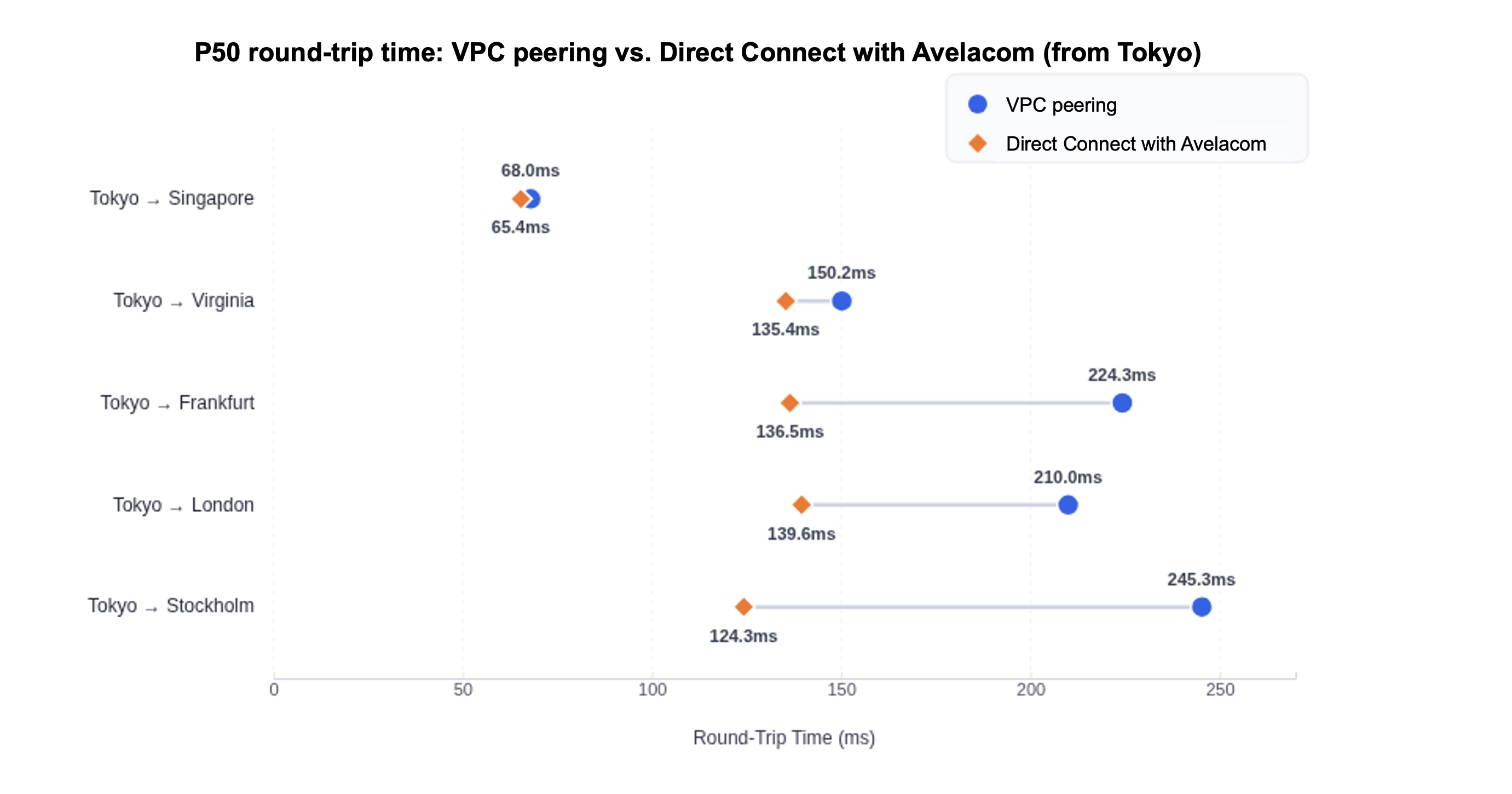
P50 round-trip time comparison across five routes from Tokyo (VPC peering vs. Direct Connect with Avelacom)
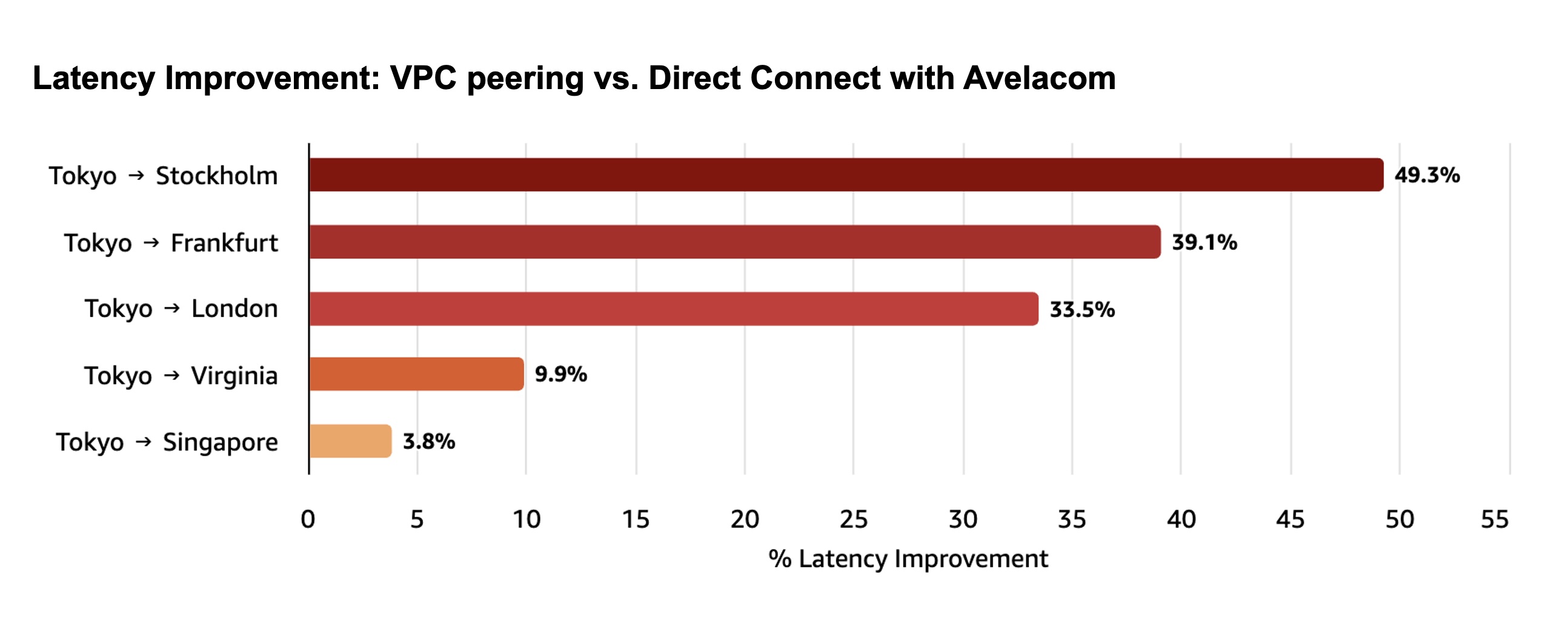
Figure 2: P50 round-trip time comparison across five routes from Tokyo (VPC peering vs. Direct Connect with Avelacom)

Percentage latency improvement using Direct Connect with Avelacom versus VPC peering (sorted by magnitude)

Figure 3: Percentage latency improvement using Direct Connect with Avelacom versus VPC peering (sorted by magnitude)

P99 tail latency

For trading applications, P99 tail latency matters because strategies that work at median but fail at P99 are unusable.

Route VPC peering P99 Direct Connect with Avelacom P99 Improvement
Tokyo → Singapore 68.1 ms 65.6 ms 3.7%
Tokyo → Virginia 150.4 ms 135.6 ms 9.8%
Tokyo → Frankfurt 224.5 ms 136.6 ms 39.1%
Tokyo → London 210.2 ms 139.8 ms 33.5%
Tokyo → Stockholm 245.9 ms 124.5 ms 49.4%

P99 latencies track closely with P50 on both paths, indicating stable, predictable performance. Jitter (standard deviation) remained under 90 µs across these five routes.
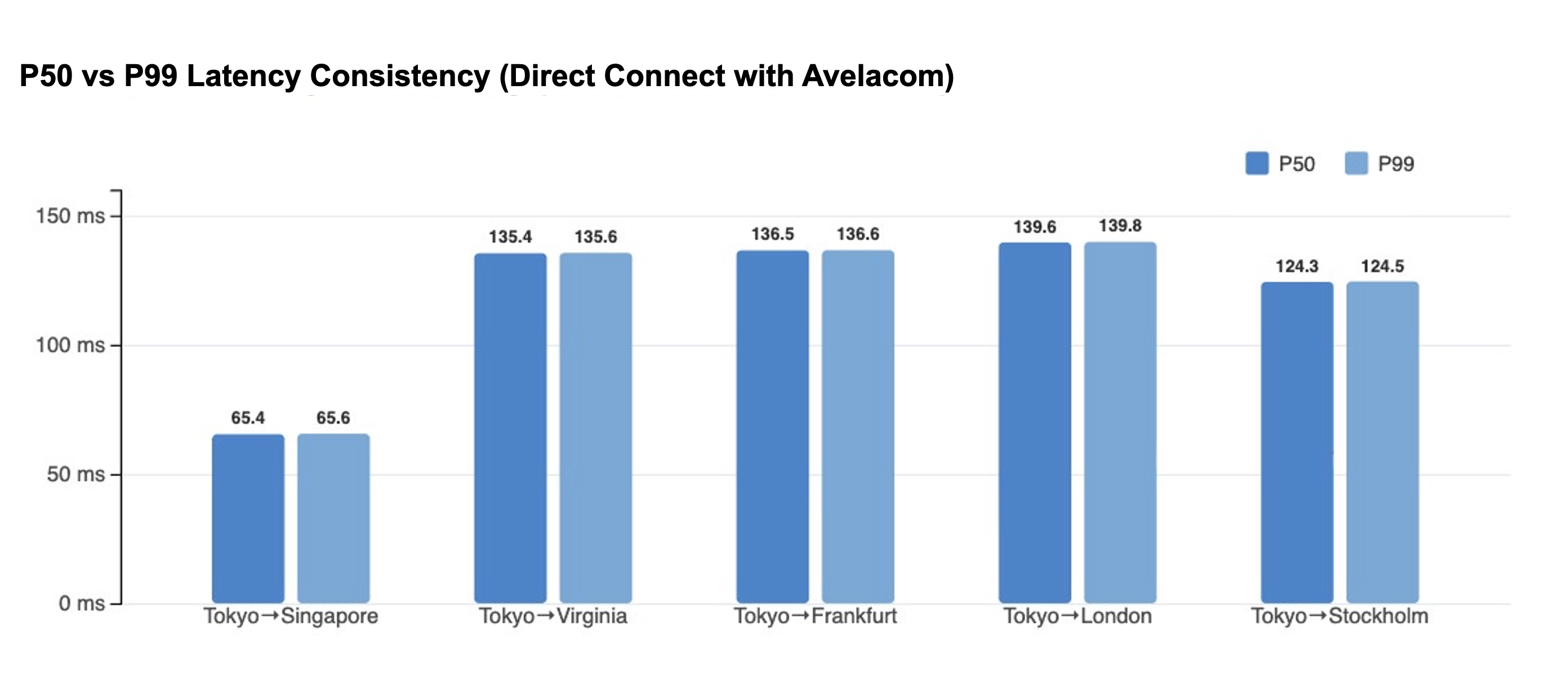
P50 vs P99 latency consistency (Direct Connect with Avelacom)

Figure 4: P50 vs P99 latency consistency (Direct Connect with Avelacom)

Note: Latency results might vary based on time of day, network conditions, and infrastructure changes. We recommend that you conduct your own testing to validate performance for your specific use cases.

Key findings

  1. EU routes show the largest gains. Frankfurt 39.1%, London 33.5%, Stockholm 49.3%. Avelacom’s network takes a physically shorter path to EU than standard AWS routing.
  2. Singapore shows modest gains (3.8%): already a short submarine cable hop with limited physics headroom for further improvement.
  3. Testing showed no packet loss on either path across the tested routes, indicating equivalent reliability.

When Direct Connect with Avelacom makes sense

It’s a good fit when:

  • Your bottleneck is cross-Region latency (not intra-Region)
  • You need predictable, consistent performance for execution strategies
  • You’re running cross-exchange arbitrage, market making, or multi-Region risk management
  • Your trading volume justifies dedicated connectivity costs

Examples of scenarios where native AWS options might suffice include:

  • Latency tolerance is in hundreds of milliseconds
  • Cost optimization is the priority
  • Architecture simplicity is paramount

Cost components

This architecture involves two separate cost dimensions:

  • AWS Direct Connect: Port hour rate and data transfer out. For pricing, see the AWS Direct Connect pricing page.
  • Avelacom network: Route-specific pricing based on bandwidth, SLA tier, and number of Region pairs. Contact Avelacom directly for a quote based on your requirements.

Conclusion

For crypto trading firms where cross-Region latency can translate directly to profitability, Avelacom’s proprietary ultra-low-latency network delivers measurable improvements over standard AWS connectivity:

  • Up to 49% RTT reduction on Tokyo–EU routes
  • Sub-90 µs jitter across the five tested paths, with P99 tracking closely to P50
  • No packet loss on either path during testing
  • Predictable, consistent performance across repeated test sessions

The fragmented nature of crypto liquidity means cross-Region connectivity directly impacts execution speed. For strategies where milliseconds matter, dedicated infrastructure reduced cross-Region RTT by up to 49%. We measured these results using TCP ping-pong benchmarks on 2026-04-28 (see the Test methodology section above).

Next steps

To explore this architecture, contact your AWS account team for Direct Connect design guidance and contact Avelacom to discuss available routes and SLA options. Consider starting with a proof of concept on your highest-priority Region pair before committing to a production deployment.