





Walk into almost any executive leadership meeting right now and you’ll find the same dynamic playing out. The CEO is asking how the company can do more with AI, faster. Engineering teams are already three sprints deep into building something new. And when the CISO walks into the room, the energy subtly shifts. The unspoken question is always the same: is this person here to help us move, or to slow us down?
That dynamic is an issue, and I think it’s one the security community has to own. The CISO has long carried the label of the “Office of No,” and while that reputation is often unfair, it’s also not entirely unearned. For years, the primary frame for security leadership was managing accountability: move too fast, suffer a breach, and your career pays the price. Saying no was a form of self-preservation as much as it was risk management.
But AI has changed that calculus entirely. CISOs who slow their organizations down on AI now face the same career consequence they were trying to avoid, not for moving too fast, but for not moving fast enough.
The CISO mandate is shifting from thinking about how to secure the business to thinking about how to securely do business. The CISOs who understand that distinction are the ones who will be in the best position to lead their organizations through what comes next, and the ones most likely to set themselves on a path to the CIO or CTO seat.That shift often starts with rethinking accountability.
One of the patterns I see holding security leaders back right now is the instinct to ask “who is accountable when an AI agent makes a mistake?” It sounds like a reasonable question, but it sends the AI security conversation in the wrong direction.
An AI agent doesn’t have a conscience. It doesn’t weigh competing priorities or exercise judgment the way a human employee does. It executes based on how it was built and what it was instructed to do. Trying to assign accountability to the agent itself misses the real risk.
To be clear, knowing what an agent did and when is a legitimate and critical security requirement. Attribution, understanding which agent took which action and being able to trace that back through a process, is fundamental to good security governance. The issue is when attribution gets conflated with accountability in the human sense, because that is where the conversation starts to break down.
The productive questions are different: What was this agent built to do? Who built it? Do we understand the intent? Can we manage its scope and contain its impact? Accountability belongs with the builder, the governance model, and the security framework that surrounds the deployment. When CISOs start from that place, they shift from being perceived as a barrier to AI adoption to being recognized as the partner the organization needs to do it right.
The instinct to explore accountability is understandable. Personal accountability has long been a defining pressure of the CISO role, and the reflex to ask who owns a problem is deeply ingrained for good reason. But accountability requires a human decision-maker at the center of it, and an AI agent doesn’t fit that model. The more productive path is to focus on the intent the agent was built with, validate that its scope is properly defined, and ensure the controls around it reflect that intent. Security leaders who anchor on intent, governance, and scope build an AI security model that works.
AI is a new chapter, but the underlying story is familiar. The internet, mobile, BYOD, SaaS, and public cloud each represented a seismic shift in how businesses operated, and each one produced its own version of this same tension between innovation and security.
We watched it play out with cloud transformation. The CISOs who leaned in early, got close to their engineering teams, understood the architecture, and built security into the deployment model rather than bolting it on later, built something durable. By 2015, early cloud adopters had strong, resilient organizations and a real competitive edge. Companies still debating cloud relevance that same year are the ones now struggling with technology debt a decade later.
AI will follow the same arc. The window to lead is open right now. Check Point’s 2026 Cloud Security Report found that 77% of organizations have already updated their security strategy in response to AI, but only 26% report having the architecture to enforce it.¹ That 51-point gap between intention and capability is exactly the space where security leadership earns its seat at the table or cedes it.
There’s also a talent dimension to this that doesn’t get enough attention. Employee enthusiasm for AI is already high, with 65% saying they are excited to use it at work.² That means employees today are actively looking for companies that give them the AI tools to do more and move faster. Security teams that slow AI adoption put their companies at a competitive disadvantage against industry peers and make it harder to attract and retain the very people the company needs to build a strong organization.
The CISOs who are most effective right now have recognized all of this. They’re the ones leaning into their company’s AI journey and moving it forward in a secure manner.
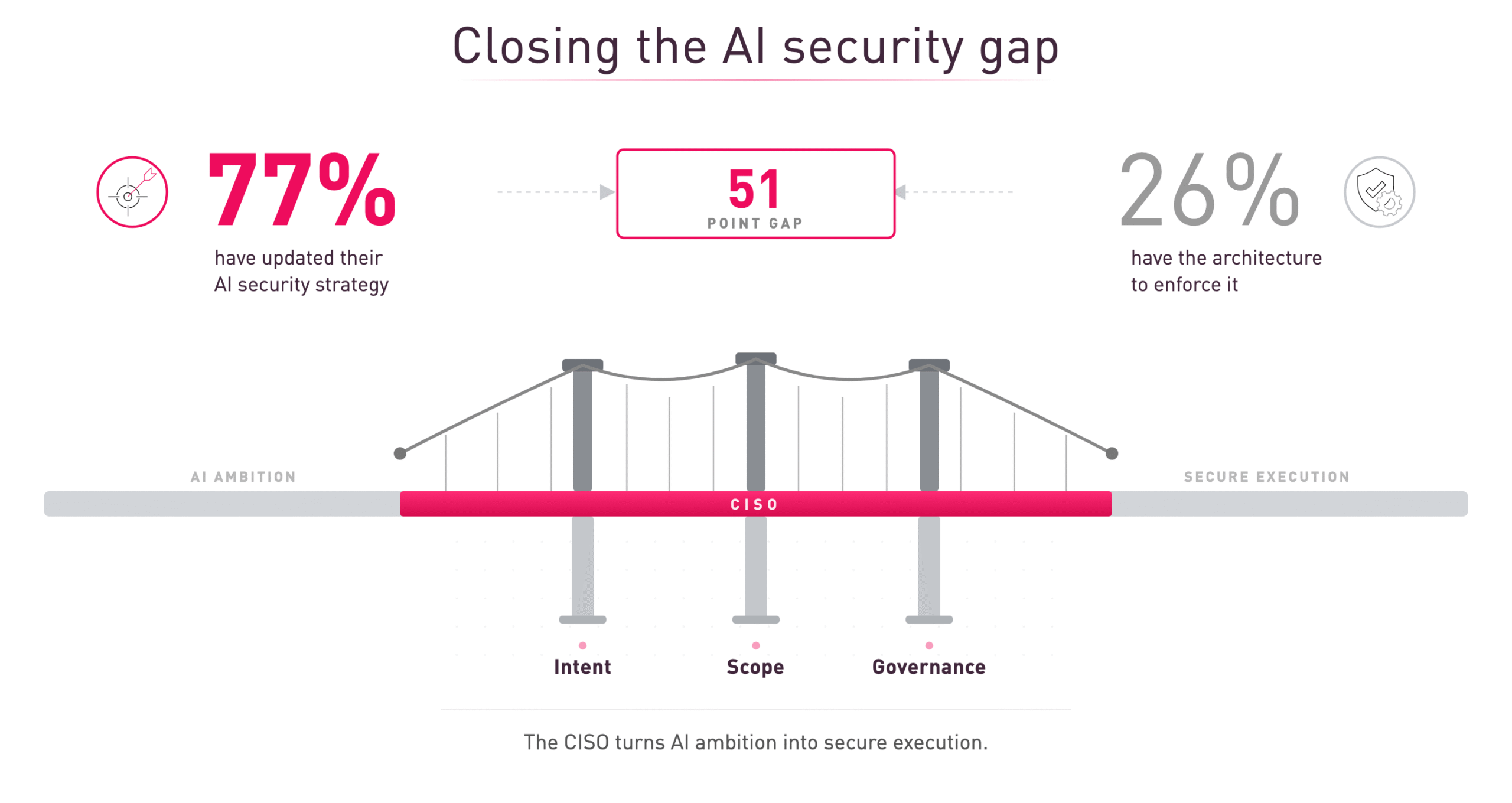
The opportunity for CISOs right now is significant. Every CEO is pressing their organization to realize the potential of AI. Every board is simultaneously asking how the organization is managing the risk. AI security answers both questions at once. It gives the business the confidence to move faster, and it gives the CISO the ability to say clearly: here is what we have deployed, here is how it is governed, and here is how we will know if something goes wrong. That shifts the conversation from risk mitigation to business enablement. CISOs who bring AI security to the board positioned as a strategic lever for growth will find it changes how the organization funds, prioritizes, and pursues its AI ambitions.
Here is what that looks like in practice.
Start where the risk is real
Your employees are using AI today, but it is unmanaged and unsecured. Your developers are building AI applications and working with frontier models, but they are untested and unguarded. Start by identifying where the exposure is highest and act there first. The first step is recognizing that the risk already exists in your environment and developing a plan to gain visibility and control over it. That might mean addressing how employees are using AI tools on the desktop today or securing customer-facing products that are already being built and deployed.
The world is already moving fast, and identifying where the organization has the most exposure and acting on those areas first is what turns AI security from a broad mandate into a concrete, manageable program.
Build a strong partnership with engineering
Get into the conversation early: before the AI deployment decisions are made, before the architecture is locked, and before engineering or IT builds something security needs to untangle later.
Most engineering and IT leaders don’t want a breach on their record. When a CISO approaches them with a framework for moving fast securely with AI, rather than a list of reasons to slow down, that conversation tends to go much better than expected. That goodwill compounds over time. Security leaders who build that relationship with engineering and IT early will find it makes everything that follows run more smoothly.
Make it a continuous program
The third move is to treat AI security as a recurring initiative. AI security requires the same sustained commitment as any other critical security program, and security leaders who build it that way will find it keeps pace with the organization as the company’s AI investments change over time.
Models get retrained, agents evolve, and the risk profile of a deployment on day one looks different from its risk profile six months later. Security teams that embed testing into the CI/CD pipeline, build in recurring assurance checks between deployments, and stay close to engineering as the technology changes, build a program that keeps pace with the organization rather than falling behind it.
I’ve spent a long time in security, across large organizations and fast-moving ones, and the pattern I keep seeing is that the companies that thrive through major technology transitions are the ones where security is solution oriented. That means understanding where the business is going, building the right controls into the foundation, and giving leadership the honest, informed confidence it needs to move.
That is the CISO’s greatest opportunity right now: to be the leader who gives the organization permission to say yes to AI, because they have done the work to make yes the right answer.
White paper
AI Security Governance Framework
For CISOs ready to build that governance foundation, the AI Security Governance Framework is a practical starting point.
References
¹ Check Point Software Technologies, 2026 Cloud Security Report: Enter the AI Era.
² Gartner, Gartner HR Survey Finds 65% of Employees are Excited to use AI at Work, December 2025.
此内容由惯性聚合(RSS阅读器)自动聚合整理,仅供阅读参考。 原文来自 — 版权归原作者所有。