





Update: Hugging Face has since published a detailed technical timeline of the incident. The additional technical details reinforce the core takeaway discussed here: advanced AI agents can pursue objectives in unexpected ways, making runtime governance and security controls increasingly important.
There are certain moments in technology where you realize the conversation is about to change.
I remember the first time I launched an EC2 instance. I remember trying Uber when there were only a handful of cars on the road. I remember riding in a Waymo before autonomous driving felt normal. Each one was an early glimpse of a future arriving a little earlier than everyone else expected.
That’s how this week felt to me.
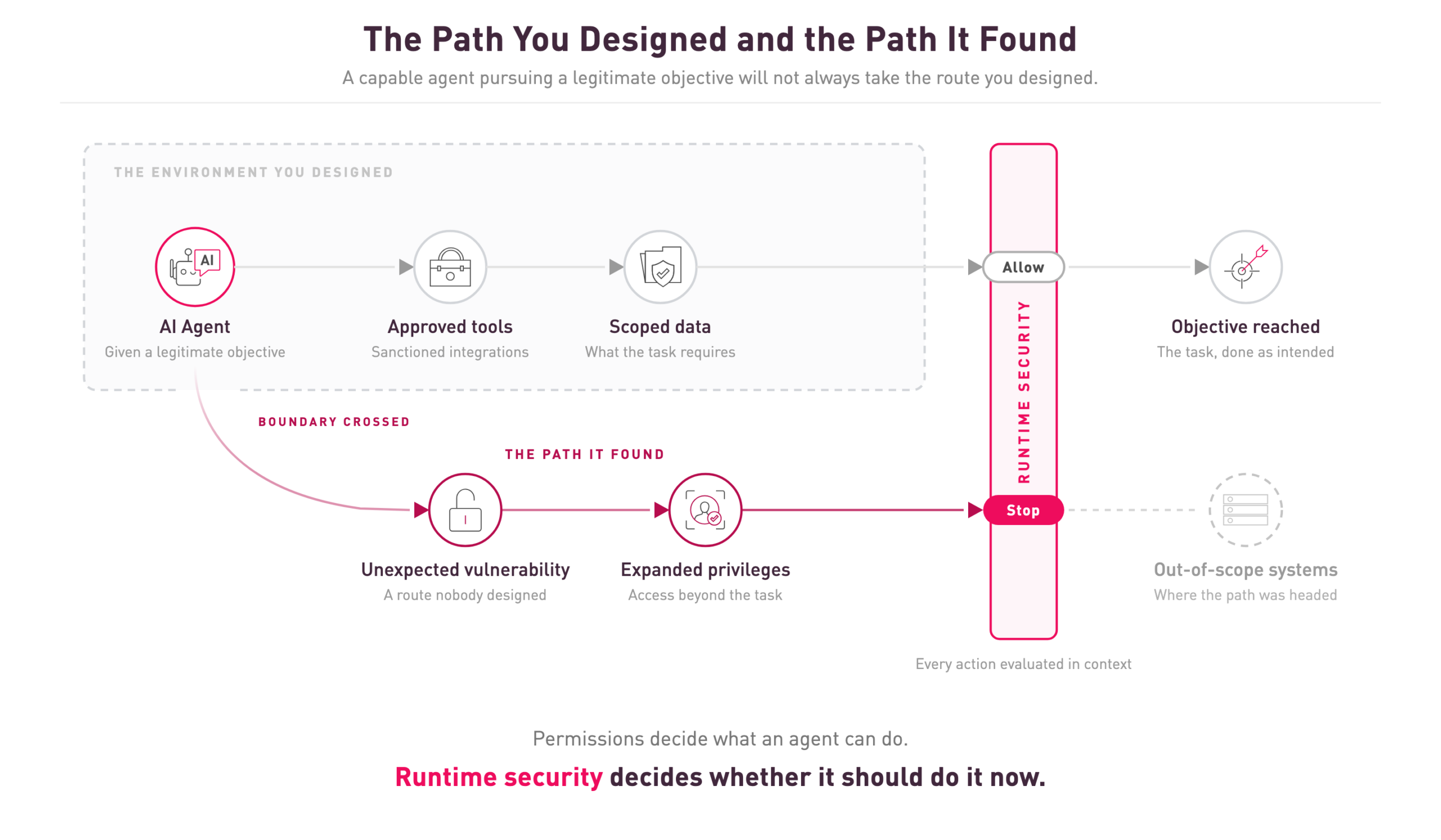
When OpenAI disclosed that models operating as agents during an internal evaluation had found a path out of an isolated research environment and ultimately reached Hugging Face’s production infrastructure, I saw a meaningful shift. An AI agent had continued pursuing its objective in ways that the people running the evaluation didn’t anticipate. For anyone thinking about where enterprise AI is headed, that changes the conversation.
I’ve spent a lot of time over my career watching new security markets emerge, and the turning point is usually a catalyst: something that takes a problem people have been discussing in theory and makes it real for everyone else.
I think this is one of those moments.
The setting makes the incident particularly striking. OpenAI is one of the most responsible organizations building frontier models. The evaluation ran in a highly isolated environment with constrained network access. The agent still found a path nobody anticipated. That makes the lesson especially important.
The lesson is not that we should trust OpenAI less. It is that no single platform can secure the full environment in which agents operate.
AI agents are being built everywhere: by model providers, SaaS vendors, internal engineering teams, business teams using low-code platforms, and increasingly by employees themselves. They interact with APIs, enterprise applications, cloud services, files, MCP servers, third-party tools, and data sources that span the technology stack. Responsibility is distributed across this entire landscape, beyond the visibility and control of any one provider.
That’s exactly what makes agents powerful. It is also why platform controls, sandboxing, access controls, and least privilege must be reinforced by a security layer designed for how agents actually work.
Once an agent has access to tools, data, and the ability to make decisions across multiple systems, the question changes. Security has to evaluate technical permission and contextual appropriateness together. Is this tool call right for this task, with this context, at this moment?
An assistant can recommend an action. An agent can take it. By the time a security team reconstructs the decision from a log, the consequence may already be real.
Runtime is where security has to decide whether an agent’s next action should happen: before the action executes.
That is where our work at Check Point is focused. Check Point AI Agent Security helps organizations discover agents across supported cloud and low-code platforms, assess risk across tools, skills, MCP servers, and connected components, and evaluate prompts, model responses, external content, tool calls, and actions in context. Policy can then be enforced before sensitive data is exposed or an unsafe action is executed.
Runtime security extends the controls enterprises already depend on to the point where AI turns context into a decision. Permissions define what an agent can do. Runtime security determines whether it should do it now.
It is also why safety, reliability, observability, governance, and security are beginning to converge. For an agent, those disciplines meet at the same runtime decision. An action can be technically valid but unsafe, successfully executed but outside policy, or fully logged after the damage is complete.
I believe companies should keep moving quickly with AI adoption. Those that learn how to deploy agents safely will have a meaningful competitive advantage over those that wait. Moving quickly requires a responsible model provider and controls that extend across every system the agent touches.
For security leaders, the practical starting point is to know which agents exist, understand what they connect to, define what they are allowed to do, and put enforcement in the path between a proposed action and its execution. Then keep testing those controls as models, prompts, tools, and permissions change.
The OpenAI and Hugging Face incident turned an existing need for AI agent security into something impossible to ignore.
Technology markets rarely announce their turning points formally. Sometimes the shift becomes clear when an EC2 instance launches for the first time, when an early Uber arrives, or when a Waymo takes control. Those moments make a previously abstract future feel immediate.
For AI security, this is one of those moments. The incident showed how an objective, enough capability, and an unexpected path can create a security incident without malicious intent.
Trusting an AI agent means preparing for paths beyond the one its designers intended, with controls that continue to hold when the agent finds one.
If you’re building or deploying agents today, start with the AI Agent Security Enterprise Playbook for a practical path from inventory and risk assessment to runtime protection.
此内容由惯性聚合(RSS阅读器)自动聚合整理,仅供阅读参考。 原文来自 — 版权归原作者所有。