





Vulnerability remediation has become an execution problem. Security teams are generating more findings than ever, but too often those findings do not translate into timely risk reduction. The gap between newly introduced exposure and effective remediation continues to widen.
Addressing that gap requires more than improved scanning, better dashboards, or additional tooling. It requires a dedicated operating model. This is the role of the Vulnerability Operations Center, or VOC. As Dr. Natalie Foster Johnson, Executive Director of the CyberMINDS Research Institute, explains, “Operationalizing a VOC is a maturity step that allows organizations to address exposure concerns earlier, reducing risk before incidents occur rather than reacting afterward.”
A VOC centralizes how organizations qualify, prioritize, and drive remediation. Its purpose is not simply to observe exposure, but to actively reduce it through coordinated action.
The security industry has faced a similar inflection point before. When threat detection became continuous and alert volumes overwhelmed decentralized response models, organizations formalized the Security Operations Center. Vulnerability remediation is now reaching the same inflection point. Volume, speed, and complexity have outgrown distributed ownership. The VOC emerges as the response.
Industry data reflects that this shift is already underway, with many organizations adopting or planning VOC‑aligned models.
Traditional vulnerability management was built for a slower environment. Teams scanned periodically, assigned severity scores, opened tickets, and remediated in cycles. That approach worked when infrastructure was stable and findings were manageable.
That environment no longer exists. Cloud and hybrid architectures change continuously, and rapid deployment introduces new weaknesses faster than periodic workflows can absorb.
At the same time, remediation ownership has fragmented. Infrastructure, cloud, endpoint, identity, and application teams each control parts of the attack surface. Vulnerabilities may be identified centrally, but remediation depends on coordination across teams that operate with different priorities.
This fragmentation contributes to prioritization challenges, but it is not the only cause. Prioritization also breaks down when teams lack context such as threat activity, business impact, compensating controls, or exploitability. Severity scores alone become a blunt instrument, and remediation tends to focus on what is easiest to fix rather than what reduces risk.
Backlogs grow, and high‑risk exposures remain open longer than they should.
This structural mismatch has only intensified as CVE disclosures have continued to grow year over year.
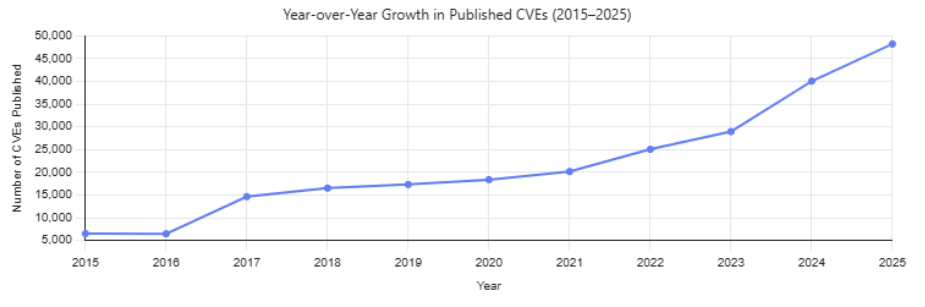
Source: https://www.cve.org/About/Metrics
Once remediation becomes an execution challenge, the unit of work must change. Managing vulnerability lists is no longer sufficient. Organizations must manage exposure.
A vulnerability in isolation provides limited insight. Risk materializes only when a weakness is reachable, exploitable, and connected to systems or identities that matter to the business. A lower‑severity issue on an internet‑facing asset may represent greater risk than a critical vulnerability that is isolated.
This reflects how attackers operate. Exploitation is selective, which means prioritization must be grounded in reachability, exploit activity, and business impact, not severity scores alone.
The Continuous Threat Exposure Management (CTEM) framework formalizes this shift by treating exposure management as a continuous discipline across discovery, prioritization, validation, and action. However, exposure insight alone does not reduce exposure. Without clear ownership, it remains theoretical.
As organizations adopt CTEM, vulnerability management is evolving from a technical function into a coordinated operational discipline.
This is where the Vulnerability Operations Center becomes essential.
A mature Vulnerability Operations Center functions as an operational control tower for vulnerability and exposure management. It does not replace existing security or delivery teams. Instead, it coordinates their efforts through a centralized, accountable model.
“A VOC shifts the focus from simply finding vulnerabilities to operationalizing exposure reduction, with clear ownership, coordination, and measurable remediation outcomes.”
— Dr. Natalie Foster Johnson, CyberMINDS Research Institute, Cybersecurity and Critical Infrastructure Resilience Strategist.
One of the most critical roles the VOC plays is establishing governance. It bridges the gap between security teams that identify vulnerabilities and operational teams responsible for remediation by introducing structured workflows, prioritization criteria, escalation paths, and accountability aligned to business risk.
Recent industry research confirms that organizations are moving in this direction. In a 2025 survey of enterprise security leaders, 65% reported having a VOC or VOC‑aligned model in place. Among those organizations, most rated it as delivering medium to high value, and 14% indicated active plans for adoption.
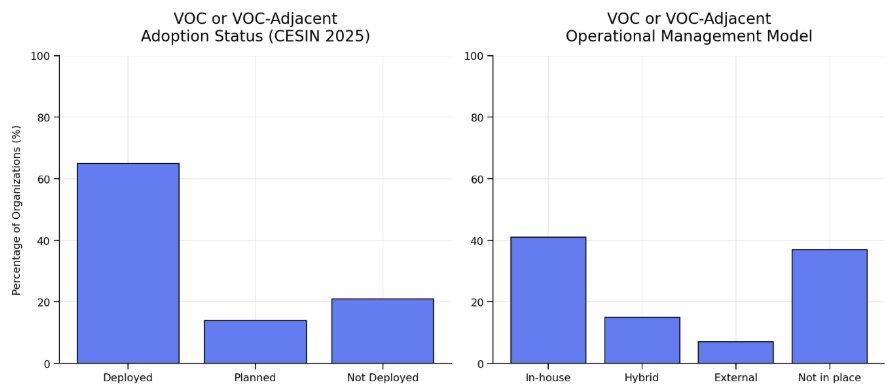
Source: CESIN “Baromètre de la cybersécurité des entreprises” Rapport d’étude – Vague 11 Janvier 2026
In practice, VOC adoption varies significantly by organizational maturity. Larger enterprises with established CERT or vulnerability response teams are more likely to formalize a dedicated VOC function.
Smaller organizations often struggle to staff even a basic CERT. In these environments, vulnerability remediation typically sits with SOC, infrastructure, or managed service teams, and is often treated as a periodic audit activity rather than a continuous operational discipline. While many reference exposure frameworks such as CTEM, execution remains assessment‑driven rather than ongoing.
These constraints have led to the rise of VOC‑adjacent models, where coordination and remediation steering exist, but without a formally defined VOC structure.
When organizations do implement a formal VOC, the function typically focuses on five core missions:
To operate effectively, VOC teams focus on KPIs that reflect execution rather than discovery volume. These include remediation timelines, exposure backlog reduction, SLA performance across asset classes, and indicators of sustained progress versus one‑time cleanup. Mature teams may also monitor responsiveness and remediation follow‑through across owning teams to reinforce accountability.
Operational ownership patterns further reinforce this shift. Survey data shows that 41% of organizations now manage their VOC (or similar organizational group) in house, up from 30% in the previous survey cycle, signaling a clear move toward centralized internal accountability rather than outsourced or informal remediation models.
The VOC works alongside the Security Operations Center. While the SOC focuses on detection and response, the VOC focuses on prevention through remediation.
By centralizing prioritization and remediation steering, the VOC provides the structure required to act on exposure continuously instead of reacting after exploitation. This is where exposure management plays a critical role. By bringing findings into a single, prioritized view and enabling teams to act directly, it helps close the gap between identifying risk and reducing it in practice.
Learn how Continuous Threat Exposure Management supports exposure‑driven security operations: Exposure Management Solutions – Check Point Software
此内容由惯性聚合(RSS阅读器)自动聚合整理,仅供阅读参考。 原文来自 — 版权归原作者所有。