

惯性聚合 高效追踪和阅读你感兴趣的博客、新闻、科技资讯
阅读原文 在惯性聚合中打开

推荐订阅源

GbyAI
GbyAI
O
OpenAI News
Jina AI
Jina AI
腾讯CDC
让小产品的独立变现更简单 - ezindie.com
MongoDB | Blog
MongoDB | Blog
J
Java Code Geeks
钛媒体:引领未来商业与生活新知
钛媒体:引领未来商业与生活新知
T
Tailwind CSS Blog
CTFtime.org: upcoming CTF events
WordPress大学
WordPress大学
F
Full Disclosure
Microsoft Azure Blog
I
InfoQ
Cyber Security Advisories - MS-ISAC
www.infosecurity-magazine.com
SecWiki News
SecWiki News
F
Fortinet All Blogs
C
Check Point Blog
H
Hacker News: Front Page
H
Help Net Security
G
Google Developers Blog
The Cloudflare Blog
Google Online Security Blog
K
KPMG report finds enterprise disconnect between AI and its ROI | CIO
A
About on SuperTechFans
S
Secure Thoughts
U
Unit 42
L
LINUX DO - 最新话题
博客园 - 【当耐特】
量子位
酷 壳 – CoolShell
酷 壳 – CoolShell
博客园 - 叶小钗
TaoSecurity Blog
TaoSecurity Blog
Recorded Future
Recorded Future
Apple Machine Learning Research
AI
AI
aimingoo的专栏
aimingoo的专栏
Security Archives - TechRepublic
H
Heimdal Security Blog
Y
Y Combinator Blog
月光博客
月光博客
Hacker News: Ask HN
Hacker News: Ask HN
D
DataBreaches.Net
Webroot Blog
Webroot Blog
T
Troy Hunt's Blog
Exploit-DB.com RSS Feed
Schneier on Security
Cisco Talos Blog
Cisco Talos Blog
Last Week in AI
Last Week in AI

Check Point Blog

The State of Hybrid SASE: Built-In vs. Bolted-On - Check Point Blog AI Appreciation Day: Let's Be Honest About What We're Appreciating - Check Point Blog AI Security Is Never Finished: Building the Continuous Red Teaming Loop  - Check Point Blog AI Security Threats in 2026: Annual Insights from Check Point Research - Check Point Blog AI Agents are Only As Effective as Their Harness - Check Point Blog Email Agent Hijacking: The Hidden Threat That Breaks Post-Delivery Security - Check Point Blog How Check Point Email Security Stopped a Student Job Scam Before It Reached the Inbox - Check Point Blog Redefining the CISO Contract: From Securing the Business to Securely Doing Business - Check Point Blog A New Ransomware Leader Emerges as June 2026 Attack Volumes Climb Worldwide How Unified Policies Close Security Gaps - Check Point Blog Under Pressure: Insights from the 2026 Exposure Gap Report - Check Point Blog When AI Invents the Attack: Browser-Native Ransomware - Check Point Blog Check Point and the AWS European Sovereign Cloud: Securing Europe’s Digital Future - Check Point Blog Shadow AI Is Not a Tool Problem. It's a Timing Problem. - Check Point Blog AI Is Changing Cyber Careers. NICE 2026 Showed What Students Need Next - Check Point Blog 90% of the World's Businesses are SMEs and MSMEs and AI Is Reshaping Both Their Future and Their Risk - Check Point Blog Prevention Before the Inbox: Reading the Microsoft Defender Benchmark Report in Context - Check Point Blog ClickFix: The Attack That Turns Users Into Their Own Attackers - Check Point Blog From Prompt Testing to AI Red Teaming at Enterprise Scale - Check Point Blog AI Has Moved From Assistance to Action. Is Your Security Model Ready? AI Security Governance: How to Secure AI Agents, Copilots, and Autonomous AI in 2026 - Check Point Blog OpenAI Frontier AI Models Powering Check Point's Leading Cyber Security Solutions The Operational Reality of Zero Trust- And How You Can Change It - Check Point Blog Securing AI Agent Behavior with Amazon Bedrock AgentCore and CheckPoint AI Security - Check Point Blog What Successful Exposure Management Deployments Had in Common in 2026 - Check Point Blog From Stars to Upvotes: The Fake Reputation Economy Behind a Crypto Clipboard Hijackers - Check Point Blog AI Red Teaming Makes the Unknowns Known - Check Point Blog Check Point and Illumio Expand Partnership to Secure Hybrid Environments - Check Point Blog The NCSC Patch Wave Is Coming. Do You Know Where Your Risk Lives? - Check Point Blog NCSC Warns of AI-Driven Patch Wave: Is Your Attack Surface Ready? Energy, Healthcare, and Finance: Why Midwest Industries Are Facing Surging Cyber Attacks - Check Point Blog Midwest Cyber Attacks Surge in 2026: Energy, Healthcare, and Finance Under Growing Threat Travel Phishing and Cyber Attacks are Surging in 2026, Growing 122% over the last 3 years. Here's What Cyber Criminals Are Actually Doing - Check Point Blog Travel Phishing Scams Surge 122%: How Cybercriminals Are Targeting Travelers in 2026 The AI Your Security Team Can’t See Is the One You Should Worry About Check Point Engage Public Sector 2026: AI Is the New Battlefield Check Point Joins OpenAI’s Trusted Access for Cyber Program and Daybreak Initiative When Your AI Agent’s Memory Becomes a Security Liability AI Agents Are Becoming Enterprise Workers. Who Secures Them? Global Cyber Attacks Ease in May 2026, But Ransomware Surges 48% As Threats Reorganize Security Advisory – Action Required – Active Exploitation of Check Point VPN Authentication Bypass (CVE-2026-50751) Fraud, Ransomware, and Fake Apps Are Already Targeting FIFA 2026 The AI Defense Plane: Securing the New Enterprise Execution Layer The Meta AI Account Recovery Incident Wasn’t Just a Chatbot Problem Check Point Lays the Groundwork for the Future of AI Factory Security with NVIDIA - Check Point Blog Check ... The 2026 U.S. Midterms Have a Cyber Problem, But it’s Not at the Ballot Box The Server Seizure That Affects Also Iran’s Cyber Operations The Autonomous Security Platform Built for Attacker Speed Check Point Frontier AI Models Readiness Program – Security Update 2026 Cloud Security Report: Why Traditional Network, Cloud, and Security Architecture Are Lagging Behind t ... AI Attacks Are No Longer Experimental: Key Findings from the March-April 2026 AI Threat Landscape - Check ... Protect GenAI Chatbots with Check Point WAF The Network Security Problem No One Could Solve – Until Now. Hacktivists, Ransomware, and a 124% Surge Across DACH The Case for a Vulnerability Operations Center Before the First Whistle: How Cyber Criminals Are Targeting World Cup 2026 - Check Point Blog World Cup 20 ... When the Ransomware Gang Gets Hacked: What the Gentlemen Leak Reveals About Modern Ransomware Risk - Check ... Cyber Threats Spike in April 2026 as Ransomware Expands and Attack Volumes Climb After Short-Lived Moderation Q1 2026 Ransomware Report: Fewer Groups, Higher Impact - Check Point Blog World Password Day 2026: Why "Strong Passwords" Can’t Save You from AI, Infostealers, and the Telegram Underground - Check Point Blog Resilient by Design: When the Network Itself Becomes the Target AI Threat Readiness: Defending Against Attacks Powered by Frontier AI Models Check Point Cyber Security Now Available Across All Levels of U.S. Government - Check Point Blog Check Poi ... VECT Ransomware: Why Paying Won’t Get Your Files Back Check Point WAF Leads Application Security-Validated by Frost & Sullivan Check Point WAF Leads Application ... From Access Control to Outcome Control: Securing AI Agents with Check Point and Google Cloud Experience AI-Powered Check Point Firewall at Google Cloud Next AI Finds Every Gap: How Many Can Your Network Survive? The Gentlemen RaaS Is Surging in 2026 The Phishing Paradox: The World’s Most Trusted Brands Are Cyber Criminals’ Entry Point of Choice World Quantum Day 2026: The Harvest Has Already Begun, Are You Prepared? Why Manufacturing Cyber Security is Becoming More Complex as Cyber Attacks Accelerate March 2026 Cyber Threat Report: Ransomware & GenAI Risk PS Private Training: Turning Cyber Complexity into Operational Control Tax Season 2026: How Cyber Criminals Are Preparing Their Attacks Months in Advance Claude Mythos Wake-Up Call: What AI Vulnerability Discovery Means for Cyber Defense Iran-nexus Password Spray Campaign Targeting Cloud Environments, with a Focus on the Middle East ROI of Hybrid Mesh Network Security (IDC Study 2026) Operation TrueChaos: TrueConf Zero‑Day Supply‑Chain Attack ChatGPT Data Leak (Fixed Feb 2026): Key Takeaways Spring Cleaning Has Arrived: Meet the New Check Point Portal Experience North America’s Cyber Security Threat Reality in 2026
Amazon Prime Day 2026: Bargains Begin June 23 — and So Do the Scams - Check Point Blog
Check Point Research · 2026-06-19 · via Check Point Blog

When Amazon Prime Day returns on June 23–26, 2026, more than 25 countries will take part in one of the largest shopping windows of the year. Spanning millions of products and generating billions of dollars in transactions in just 96 hours, the event is as lucrative for cyber criminals as it is anticipated by consumers. Major retail moments bring together the three ingredients’ attackers exploit most: a globally trusted brand, time-limited urgency, and massive purchase intent at scale. The result is predictable — phishing emails, fake websites, fraudulent offers, smishing campaigns, and account takeover attempts impersonating Amazon all surge during this period. What stands out in 2026 is the scale of the infrastructure Check Point Research (CPR) has already observed in the months leading up to the event.

Industries on the Front Line

The pressure isn’t only on shoppers. The sectors that power Prime Day checkouts are seeing some of the year’s sharpest increases in attack activity. In May 2026, Financial Services organizations recorded an average of 1,939 weekly attacks per organization — an 8% year-over-year increase, four times the all-industry baseline of +2%. Consumer Goods & Services organizations — including internet retailers and online storefronts — recorded 1,809 weekly attacks, up 4% year-over-year.
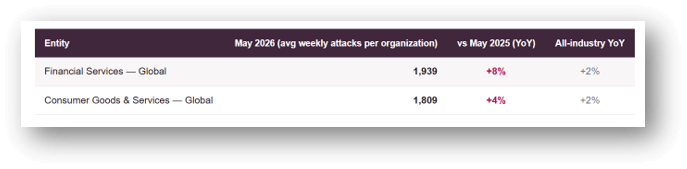
The message for businesses: Prime Day isn’t just a marketing moment — it’s a measurable spike in attempted intrusions across the entire retail value chain.

A Six-Month Build-Up of Malicious Infrastructure

Prime Day fraud isn’t improvised on the day of the event. It’s a calendar-driven operation. Between December 2025 and May 2026, 6,843 new Amazon-themed domains were registered worldwide. Activity ramped sharply in early 2026 and peaked in April 2026 at 1,446 new domains in a single month — roughly two months ahead of Prime Day, giving attackers exactly the window they need to “age” malicious domains so they slip past reputation-based filters by the time the event goes live. May 2026 added another 1,267 domains to the pile.
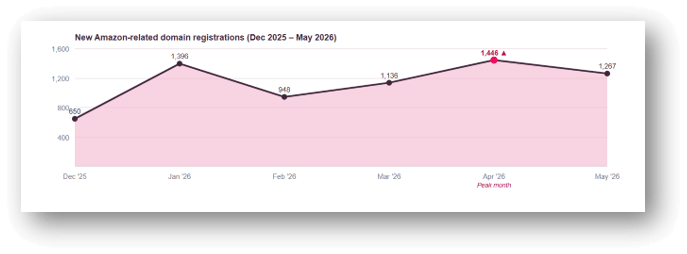
How risky are these new domains? In May 2026, 9.2% — roughly 1 in every 11 — were already classified as malicious or suspicious by Check Point Research. Even in the first week of June 2026, when only 241 new domains appeared, about 1 in every 13 was already flagged.

This pattern reflects a broader build-up of malicious infrastructure ahead of the event, with multiple Amazon-themed domains designed to exploit brand trust, urgency, and high purchase intent at scale.

Two Coordinated Campaigns Targeting Prime Members

CPR has identified two organized domain-squatting operations specifically engineered for Prime Day-style interception.

  1. The “Amazon Prime” multi-TLD campaign registered six domains following the template amazon-prime.[TLD] — varying only the extension (.help, .cam, .cc, .club, .app and .buzz). Five of the six are already classified as malicious, and the .buzz variant was registered fresh in June 2026 as the event window opened. The goal is simple: intercept Prime members no matter which extension they type, and keep phishing pages alive even if individual domains are taken down.
  2. The “amazoncredito” multi-TLD campaign is larger and regionally targeted. Forty-six domains were registered in May 2026 around the core name amazoncredito“Amazon credit” in Spanish and Portuguese — designed to lure Latin American and Spanish shoppers with a fake Amazon promotional credit. A parallel set of domains uses the IDN-encoded variant xn--amazoncrdito-ieb, which renders in browsers as amazoncrédito with an accent — making the spoof significantly more convincing to native speakers. TLDs span .com, .credit, .deals, .money, .shopping, .gratis, .cl, .vip and more.

Fake Storefronts and Counterfeit Product Pages: What Shoppers Are Really Seeing

Beyond fake sign‑in pages, cybercriminals are now creating entire fake shopping experiences that look and feel like Amazon — making them especially dangerous during Prime Day, when shoppers expect discounts, vouchers, and limited‑time offers. In several cases observed ahead of Prime Day 2026, attackers built full lookalike Amazon storefronts designed to trick shoppers into browsing, clicking, and buying on fraudulent sites:
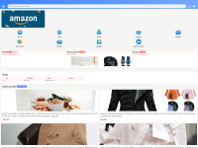

  • amazonashop[.]shop (registered May 2026) copies the full Amazon marketplace experience — including the familiar orange branding, category menus, product banners, and item listings — to intercept shoppers who click on ads, social posts, or mistype a web address.
  • amzn-buono[.]click (registered January 2026) targets Italian Prime members, presenting a fake Buoni propositi promotional voucher page timed around Prime Day announcements to lure users with the promise of special credits or rewards.


amazonashop[.]shop                    amzn-buono[.]click

A second group of scams goes one step further by copying individual Amazon product pages, aiming to steal payment details the moment shoppers think they are completing a legitimate purchase:
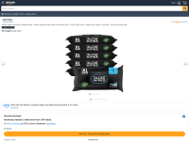

  • amazon-express[.]click (registered May 2026) displays a convincing product page but injects fake urgency messages such as “Anniversary Special: Limited to the first 1,000 claims” alongside a suspicious “Get Free — Priority For Existing Users” button, pushing shoppers to act quickly without double‑checking.
  • amazon-club[.]click (registered April 2026) closely mirrors a real Amazon skincare listing, complete with star ratings, review counts, Prime delivery messaging, and even an “Amazon’s Choice” badge — all designed to build trust before quietly capturing payment information.

                     
amazon-express[.]click                      amazon-club[.]click

These same tactics also appear in SMS scams and account takeover attempts that surge during major shopping events. Shoppers may receive texts claiming “your delivery is delayed” or “verify your 2FA code”, or emails urging them to log in urgently — all designed to steal credentials and take control of real Amazon accounts.

How Consumers Can Reduce Prime Day Cyber Risk

Prime Day scams succeed because they mimic normal shopping behavior so closely: familiar branding, convincing checkout pages, delivery alerts, and last-minute urgency. That is why the safest approach is not only to spot suspicious messages, but to slow the purchase journey down just enough to verify what is real before clicking, logging in, or paying.

 A few simple habits can make a significant difference during high-traffic retail events:

  • Verify the web address. Many fraudulent domains closely imitate Amazon’s real URL. Look out for extra characters, hyphenated brand names, or unusual endings such as .top or .online.
  • Avoid clicking links in emails. If you receive a message about your Amazon account, open your browser and navigate directly to the official Amazon website, or use the Amazon app.
  • Do not rely on the padlock alone. HTTPS only confirms that the connection is encrypted, not that the website is legitimate. Always double-check the full URL.
  • Use strong, unique passwords and enable two-factor authentication (2FA). A password manager can help generate and store strong credentials, while 2FA adds an essential layer of protection against account takeover.
  • Be cautious of urgency or pressure. Messages threatening account suspension, refund problems, or time-limited offers are common tactics used to push users into acting without thinking.
  • Be skeptical of unrealistic discounts. Offers that appear far below market value—particularly outside Amazon’s official platform—are often used as bait, especially for luxury goods or electronics.
  • Use secure payment methods. Whenever possible, choose credit cards, virtual cards, or trusted payment services. These options offer stronger fraud protection and easier dispute processes.

For consumers, Prime Day should remain about convenience and value—not unnecessary exposure to fraud. A few extra seconds spent checking a URL, ignoring a suspicious message, or using a safer payment method can be enough to avoid a costly mistake. In a threat landscape built on speed and impersonation, caution remains one of the most effective forms of protection.