


惯性聚合 高效追踪和阅读你感兴趣的博客、新闻、科技资讯
阅读原文 在惯性聚合中打开

推荐订阅源

AI
AI
GbyAI
GbyAI
Blog — PlanetScale
Blog — PlanetScale
F
Fortinet All Blogs
Microsoft Azure Blog
L
LangChain Blog
CTFtime.org: upcoming CTF events
U
Unit 42
aimingoo的专栏
aimingoo的专栏
N
Netflix TechBlog - Medium
H
Hackread – Cybersecurity News, Data Breaches, AI and More
A
About on SuperTechFans
B
Blog
I
InfoQ
T
The Exploit Database - CXSecurity.com
H
Heimdal Security Blog
cs.CV updates on arXiv.org
L
LINUX DO - 最新话题
Google Online Security Blog
D
Darknet – Hacking Tools, Hacker News & Cyber Security
Help Net Security
Help Net Security
Stack Overflow Blog
Stack Overflow Blog
OSCHINA 社区最新新闻
OSCHINA 社区最新新闻
T
Threat Research - Cisco Blogs
量子位
P
Privacy & Cybersecurity Law Blog
Cyber Security Advisories - MS-ISAC
SecWiki News
SecWiki News
S
Security @ Cisco Blogs
Cisco Talos Blog
Cisco Talos Blog
博客园_首页
The Last Watchdog
The Last Watchdog
奇客Solidot–传递最新科技情报
奇客Solidot–传递最新科技情报
小众软件
小众软件
有赞技术团队
有赞技术团队
NISL@THU
NISL@THU
WordPress大学
WordPress大学
K
Kaspersky official blog
D
DataBreaches.Net
Hugging Face - Blog
Hugging Face - Blog
Vercel News
Vercel News
雷峰网
雷峰网
Webroot Blog
Webroot Blog
B
Blog RSS Feed
W
WeLiveSecurity
Scott Helme
Scott Helme
A
Arctic Wolf
阮一峰的网络日志
阮一峰的网络日志
G
Google Developers Blog
K
KPMG report finds enterprise disconnect between AI and its ROI | CIO

Futurism

Astronomers Thrilled After Discovering Best Spot Yet to Look for Alien Life You'll Never Guess What Tasty Molecule Astronomers Just Detected In Space Astronomers Horrified by Enormous Mirror Satellite That Reflects Sunlight Back Down to Earth at Night Scientists Say They've Identified an Earth-Like Planet Right Next Door NASA Prepping to Launch Extremely Risky Rescue Mission NASA Has a Major Problem Threatening Its Entire Moon Plans NASA Rover Finds "Complex Organic Matter" on Mars Scientists Building World's Most Powerful Radio Telescope Deep in the Nevada Desert NASA Loads Moon Rocket onto Giant Trump-Branded Train NASA’s Next Moon Mission Is a Rube Goldberg Machine of Corporate Failure Points Scientists Release Results After Scanning 3I/ATLAS for Alien Signals Catholic Church Boots Exorcist After He Said UFOs Are Demons NASA’s James Webb Discovers That 3I/ATLAS Let One Rip as It Passed Through Solar System Scientists Find Chunk of Lost Planet in Desert Paper Claims the “Asteroid” Japan’s Probe Is Approaching Is Actually a Derelict Spacecraft Scientists Say They’ve Cracked Mystery Behind a Dozen Strange Signals From Deep Space Scientists Say They’ve Found Fungi That Turn Dead Martian Soil Into Fertile Cropland The Blue Moon Is Fake. You Are Being Deceived Jeff Bezos’ Rocket Explodes Into Mushroom Cloud, Dealing Massive Blow to NASA’s Moon Plans NASA Releases Sweeping Plans for Moon Base SpaceX Announces Plans to Put Billionaire on First Rocket to Mars James Webb Spots Strange Structure at Core of Distant Galaxy Scientists Detect Weird Anomalies in Clouds of Venus Visitor Approaches From the Edge of the Solar System NASA Rover Gets Arm Stuck Inside Mars Rock, Struggles to Break Free Scientists Detect Atmosphere on Planet-Like Object Beyond Pluto Jeff Bezos’ Moon Lander Just Completed a Key Test Scientists Say There’s Something Huge Buried Inside Our Galaxy NASA’s Moon Landing Schedule Slipping Horrendously Under Trump NASA Fires Up Futuristic Plasma Thruster Designed to Take Us to Mars An Out of Control SpaceX Rocket Is Going to Smash Into Moon, Astronomer Says There’s a Hidden Shortcut to Mars, Scientific Paper Finds Head of NASA Calls for Pluto to Be Made a Planet Again Scientists Scan Gigantic Structure Hiding Behind Our Galaxy Video Shows NASA Astronaut Struggling to Walk After Journey Around the Moon Astronomers Discover Major Clue About 3I/ATLAS’ Origins Scientists Puzzled by Huge Shadowy Blight Spreading Across Surface of Mars Jeff Bezos’ Botched Space Launch Was So Bad It Could Threaten NASA’s Entire Moon Program Guess What This Creepy Underwater Thing Is That Was Photographed by US Navy Divers for NASA NASA’s Mars Rover Comes Across Formation That Looks Like the Scales of a Massive Cosmic Reptile Physicists Have a Major Problem With the Universe Earth Now Flying Through a Debris Field, Paper Finds There’s Something Extremely Shady About Trump’s Disastrous New NASA Budget Moon Denialists Are So Pathetic That They’re Using AI to Fake Artemis Footage Space Scientists Wince as Astronauts’ Lives Depend on Artemis 2’s Controversial Heat Shield During Plunge Back to Earth The Moon Astronauts Have Been Working Out With a NASA Rowing Machine in Space As Astronauts Visit the Moon, NASA Insider Says Agency Is in Shambles Behind the Scenes NASA Scientists Screamed With Delight When They Saw Something Smashing Into the Moon Las Vegas Sphere Turns Into Huge Moon to Celebrate NASA Mission The Moon Spacecraft’s $30 Million Toilet Has Been a Bit of a Disaster We’re In Utter Disbelief About the Photos the Moon Astronauts Just Sent Back Trump Has Call With Moon Astronauts So Awkward That They May Turn Around and Disappear Into the Void of Space Lone Jar of Nutella Drifts Around Cabin of Moon Spacecraft The Moon Astronauts Just Broke the Record for the Farthest Any Human Has Ever Traveled From Earth Moon Astronauts Forced to Do It in Bags as “Burning Odor” Emanates From Toilet Astronomers Found Something Strange In Giant “Forbidden” Planet Nearly the Size of Its Star Trump Fans Furious That NASA Is Allowing a Canadian on the Moon Mission NASA Spacecraft’s Toilet Fails Hours Into Ten-Day Journey to Moon Conspiracy Theorists Are Going to Have a Field Day as NASA Gears Up to Launch Historic Moon Mission on April Fools’ Day SpaceX Files for IPO
Saturn's Icy Moon Is the Perfect Place to Settle, NASA Scientist Argues
Victor Tangermann · 2026-06-20 · via Futurism

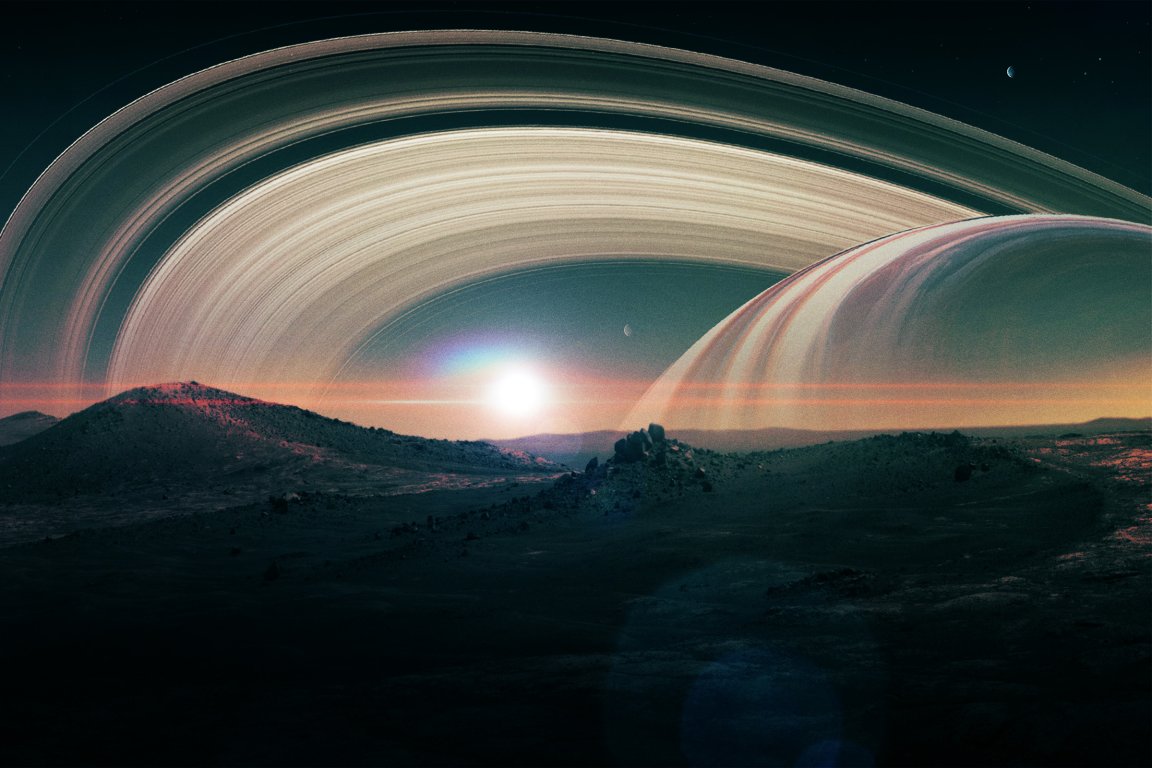
An illustration featuring a view of Saturn from the surface of its moon, Titan.

Shutterstock / Futurism

Sign up to see the future, today

Can’t-miss innovations from the bleeding edge of science and tech

Saturn’s largest moon, Titan, is the only known satellite in the solar system to feature an atmosphere, which is almost 50 percent bigger than the Earth’s.

And while NASA’s Dragonfly mission is still many years from launch, the space agency’s scientists are already wondering how the moon could fit into our distant future efforts to move beyond our home planet.

In a new paper currently being peer reviewed, a team of scientists led by NASA Goddard Space Flight Center astronomer Conor Nixon explored the many potential uses for the abundant “useful resources” on Titan. It’s such a lucrative source of complex hydrocarbons — both in their liquid and solid forms — it could serve as an extremely valuable rest stop during trips into deep space.

That’s even compared to establishing a permanent presence on the Moon or Mars, which are worlds where such hydrocarbons like methane are far more difficult to come by.

“This combination of abundant reduced carbon, along with available nitrogen and oxygen makes Titan an enticing world rich in resources that can be readily used to make food, fuel, building materials and more — potentially mission-enabling for long-duration voyages or habitats in the outer solar system,” Nixon’s team wrote.

The concept of in situ resource utilization (ISRU) is almost as old as space travel itself. The idea is to take advantage of local resources instead of going through the effort and expense of bringing them all the way from Earth. While scientists have intensely studied the potential for ISRU on the Moon and Mars, Titan remains a bit of an outlier.

That’s despite its unbridled potential, Nixon says.

“Titan is gushing with hydrocarbons — what we call oil and natural gas on Earth,” he told Universe Today.

The paper makes the case that the vast reservoirs of hydrocarbons and other organics on Titan could make it an ideal location for the fabrication of rocket fuel and plastic products. On the Moon and Mars, creating both would entail complex, multi-step processes.

“On the surface, we can find heavier hydrocarbons, such as propane used in BBQ tanks, butane used in lighters, and heavier liquids like kerosene and gasoline,” Nixon told Universe Today. “Besides burning these hydrocarbons, we can also make a lot of products from them: plastics, synthetic rubber, and feedstocks for everything from solvents to pharmaceuticals, and even foods.”

Of course, setting up shop on the surface of Titan would still be far from easy. For one, temperatures average a cryogenic negative 290 degrees Fahrenheit, allowing for liquid rivers of methane and ethane to flow. The atmospheric pressure is also 50 percent higher than on Earth, while the force of gravity is just one seventh of what we’re accustomed to.

Oxygen, which is required for human survival, is also not nearly as easy to come by, requiring its production via electrolysis.

Nonetheless, if not a permanent habitat, Nixon argued Titan could still be an excellent stopover for spacecraft to refuel or restock a variety of raw materials, “from printer ink to fertilizer.”

In short, it’s an enormous wealth of resources that shouldn’t be ignored, his team argued.

“While current and future planned robotic missions do not require any resources from Titan (e.g. Dragonfly), eventually more ambitious missions will require use of local resources,” the paper concludes. “While such visions are speculative for the time being the unique resources available on Titan in the outer solar system imply that eventually missions will be be developed to take advantage of them.”

More on Titan: Titan Covered With Fragments of Obliterated Moons, Scientists Say