



惯性聚合 高效追踪和阅读你感兴趣的博客、新闻、科技资讯
阅读原文 在惯性聚合中打开

推荐订阅源

MyScale Blog
MyScale Blog
Apple Machine Learning Research
H
Help Net Security
雷峰网
雷峰网
V
Visual Studio Blog
G
Google Developers Blog
Microsoft Azure Blog
Hugging Face - Blog
Hugging Face - Blog
爱范儿
爱范儿
IT之家
IT之家
Engineering at Meta
Engineering at Meta
Microsoft Security Blog
aimingoo的专栏
aimingoo的专栏
大猫的无限游戏
大猫的无限游戏
M
MIT News - Artificial intelligence
月光博客
月光博客
A
About on SuperTechFans
B
Blog RSS Feed
奇客Solidot–传递最新科技情报
奇客Solidot–传递最新科技情报
The GitHub Blog
The GitHub Blog
N
Netflix TechBlog - Medium
J
Java Code Geeks
云风的 BLOG
云风的 BLOG
Blog — PlanetScale
Blog — PlanetScale

Futurism

Scientists Baffled by Bizarre "Anomaly" Deep Beneath the Surface of Mars NASA's Powerful New Space Telescope, Just Cleared for Launch, Was Developed by an Intelligence Agency to "Spy on America's Adversaries" Scientists Warn That New Satellites Could Cause Eye Damage for People on the Ground SpaceX Achieves Its First Moon Landing by Accidentally Crashing Into It at 5,400 Miles Per Hour, Causing Huge Explosion and 60-Foot Crater NASA Mars Rover Discovers Field of Mesmerizing Polygons Scientists Discover Massive Alien "Exosatellite" Astronomers Thrilled After Discovering Best Spot Yet to Look for Alien Life You'll Never Guess What Tasty Molecule Astronomers Just Detected In Space Astronomers Horrified by Enormous Mirror Satellite That Reflects Sunlight Back Down to Earth at Night Scientists Say They've Identified an Earth-Like Planet Right Next Door NASA Prepping to Launch Extremely Risky Rescue Mission NASA Has a Major Problem Threatening Its Entire Moon Plans NASA Rover Finds "Complex Organic Matter" on Mars Saturn's Icy Moon Is the Perfect Place to Settle, NASA Scientist Argues Scientists Building World's Most Powerful Radio Telescope Deep in the Nevada Desert NASA Loads Moon Rocket onto Giant Trump-Branded Train NASA’s Next Moon Mission Is a Rube Goldberg Machine of Corporate Failure Points Scientists Release Results After Scanning 3I/ATLAS for Alien Signals Catholic Church Boots Exorcist After He Said UFOs Are Demons NASA’s James Webb Discovers That 3I/ATLAS Let One Rip as It Passed Through Solar System Scientists Find Chunk of Lost Planet in Desert Paper Claims the “Asteroid” Japan’s Probe Is Approaching Is Actually a Derelict Spacecraft Scientists Say They’ve Cracked Mystery Behind a Dozen Strange Signals From Deep Space Scientists Say They’ve Found Fungi That Turn Dead Martian Soil Into Fertile Cropland The Blue Moon Is Fake. You Are Being Deceived Jeff Bezos’ Rocket Explodes Into Mushroom Cloud, Dealing Massive Blow to NASA’s Moon Plans NASA Releases Sweeping Plans for Moon Base SpaceX Announces Plans to Put Billionaire on First Rocket to Mars James Webb Spots Strange Structure at Core of Distant Galaxy Scientists Detect Weird Anomalies in Clouds of Venus
Earth May Have Had a Larger Cousin that the Sun Devoured
Frank Landymore · 2026-09-13 · via Futurism

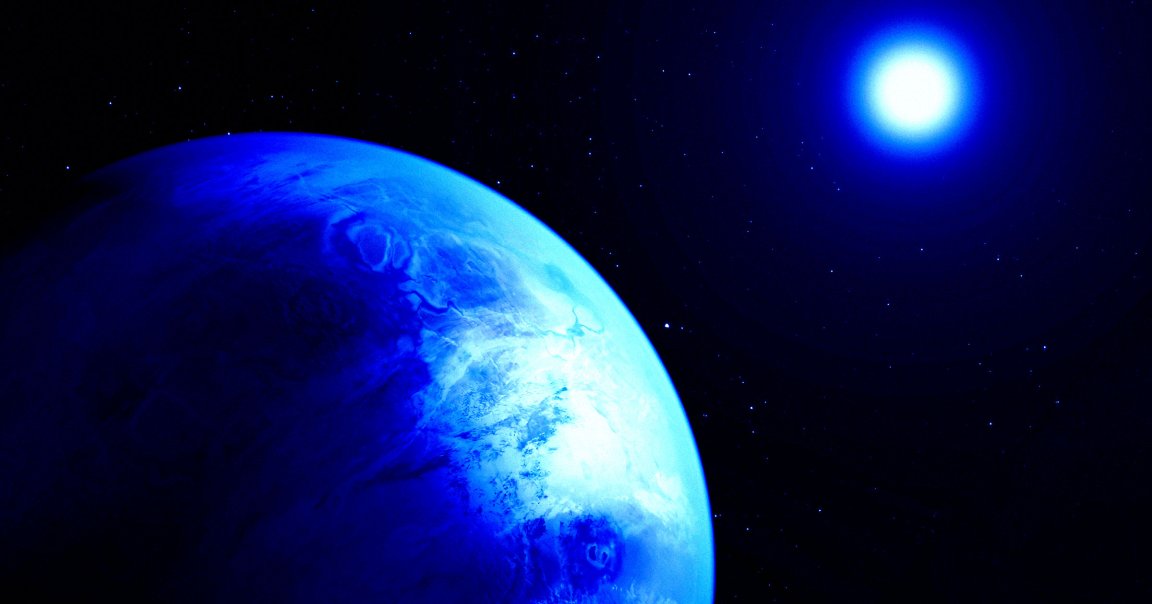
A photo illustration of an Earth-like exoplanet.

Shutterstock / Futurism

Did the Earth once have a larger cousin that was devoured by the Sun? And more importantly: would we have any way of knowing it did?

A team of astronomers believe that the answer to both of those questions is “yes.”

Like investigators at a crime scene, a team of researchers say they’ve discovered a method to dust for “fingerprints” in the Sun to find strong evidence of planetary filicide in its past.

Their resulting study, published in the Monthly Notices of the Royal Astronomical Society, suggests that the devoured rocky world — which is believed to have been a so-called super-Earth several times more massive than our own — may have left a “lasting chemical imprint deep inside” our star, according to coauthor Mutlu Yildiz.

“By modeling the sun’s evolution and comparing the results with precise observations of its interior,” Yildiz, a professor at Ege University in Turkey, said in a statement about the work, “we find that the ingestion of a super-Earth could help explain long-standing differences between standard solar models and observations, including subtle changes in the Sun’s internal structure and its depleted lithium abundance.”

These discrepancies are likely connected, according to the researchers.

Explained Yildiz, “young stars are surrounded by protoplanetary disks, where substantial amounts of material can move between the disk and the star.”

“Since planets are made of material that is chemically different from the gas in the disk,” he added, “we wondered whether the early engulfment of a planet could have left a chemical signature inside the young Sun.”

To explore this, the researchers used an open-source stellar evolution software called Modules for Experiments in Stellar Astrophysics, or MESA for short, to create different solar models based on how the Sun’s accretion history — how it gathered matter over time and what materials it ingested — and compared them with present-day acoustic measurements of the Sun’s internal structures.

Their work supported the idea that a nascent Sun swallowed a super-Earth between five to ten times the mass of our planet, which they say could explain the Sun’s low lithium levels. If true, the dissolved planetary material is hidden somewhere below the Sun’s convection zone, a turbulent layer that sits between the star’s core and its outer atmosphere.

This scenario could also explain another mystery: why super-Earths are commonly found in other star systems, while ours have none. While the paper falls short of finding the smoking gun, it tells us where to look.

“The next step is to see if these fingerprints can be independently detected,” Yildiz said.

More on space: Scientists Baffled by Bizarre “Anomaly” Deep Beneath the Surface of Mars