





Sign up to see the future, today
Can’t-miss innovations from the bleeding edge of science and tech
NASA is gearing up for its extremely ambitious next Moon mission, which will see a crew of astronauts taking two separate Human Landing Systems spacecraft being developed by Blue Origin and SpaceX for a joyride in Earth’s orbit to test their docking capabilities.
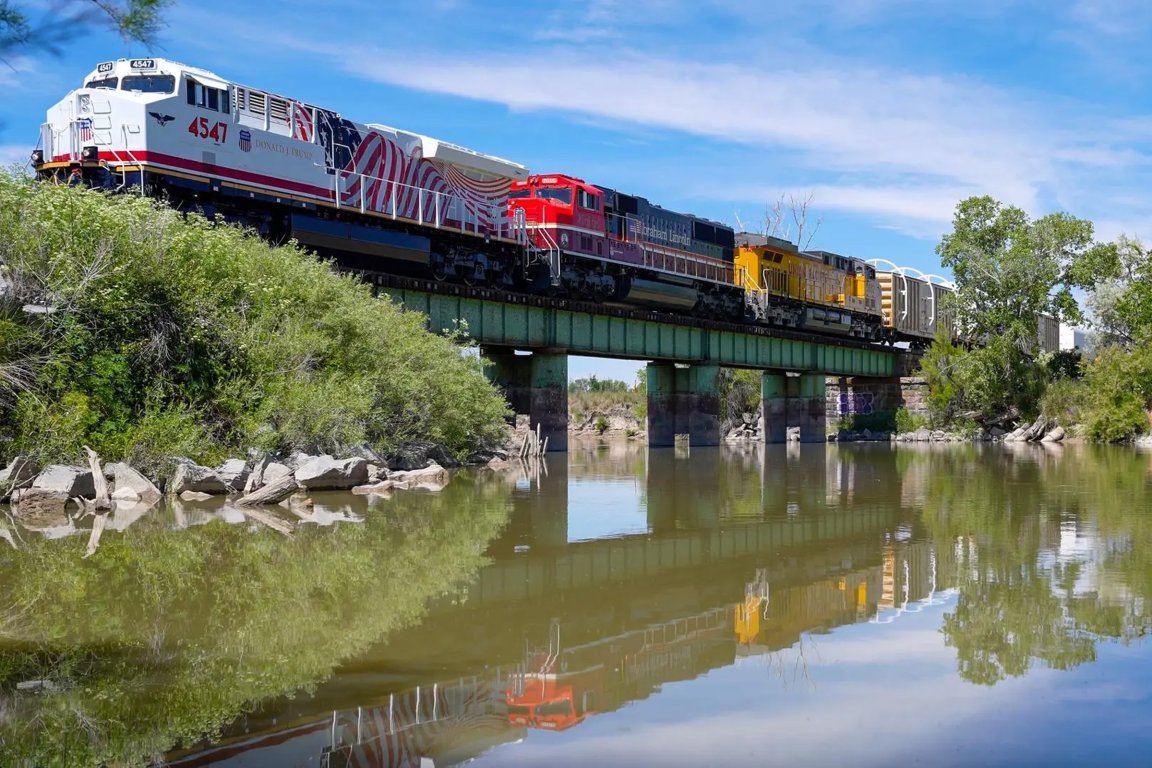
The mission, dubbed Artemis 3, will set the stage for the first crewed Moon landing attempt in 2028. To prepare, though, the agency fell back on some distinctly terrestrial transportation: by loading parts of its enormous Space Launch System rocket onto a massive train.
The train was spotted rolling through Wyoming earlier this week, as local publication Cowboy State Daily reports.
The train, which featured a commemorative, star-spangled Union Pacific locomotive celebrating President Donald Trump, departed from its point of origin at Northrop Grumman’s Railyard Shipping Facility in Corinne, Utah, on June 2, arriving at Florida’s Space Coast six days later.
“Later this year, teams will begin stacking the boosters that create 75 percent of the thrust needed at launch,” NASA’s Artemis X account wrote.
The train was carrying the last two of eight solid rocket-booster motor segments. All together, the rocket’s iconic twin solid rocket boosters will generate 7.2 million pounds of thrust during liftoff.
The core stage of the rocket arrived at NASA’s Vehicle Assembly Building (VAB) at NASA Kennedy in late April and is awaiting integration with its two 17-story-tall boosters. The core stage’s four RS-25 rocket engines produce 8.8 million pounds of thrust alone.
It’s an already proven design. NASA successfully used its Space Launch System rocket to send a crew of four astronauts around the Moon and back as part of its Artemis 2 mission earlier this year, as well as an uncrewed mission in late 2022.
Artemis 3 is currently still scheduled to launch sometime next year. However, delays — and massive explosions — plaguing its key contractors, SpaceX and Blue Origin, could force NASA to once again push back the date.
The first crewed landing attempt, Artemis 4, is tentatively scheduled for 2028. Interestingly, instead of using the SLS to get to the Moon to rendezvous with SpaceX’s Starship, NASA has seemingly changed its mind. According to an official Artemis announcement earlier this week, NASA revealed that it will be using Starship, not the SLS, to execute the trans-lunar injection burn for Artemis 4, a critical maneuver that pushes the spacecraft away from the Earth and towards the Moon.
The Trump branding on the train could be as close as the president gets to the lunar surface. The further the timeline slips, the more unlikely it feels that a crewed landing will actually take place before his second term is up at the beginning of 2029.
The news comes after years of criticism of the SLS design, which has seen massive budget overruns and formidable delays. NASA’s administrator, Jared Isaacman, also has a long history of working with Musk’s SpaceX — even becoming the first private astronaut to perform an extravehicular spacewalk when he clambered outside of a SpaceX Crew Dragon in September 2024.
More on Artemis: NASA’s Next Moon Mission Is a Rube Goldberg Machine of Corporate Failure Points