









Sign up to see the future, today
Can’t-miss innovations from the bleeding edge of science and tech
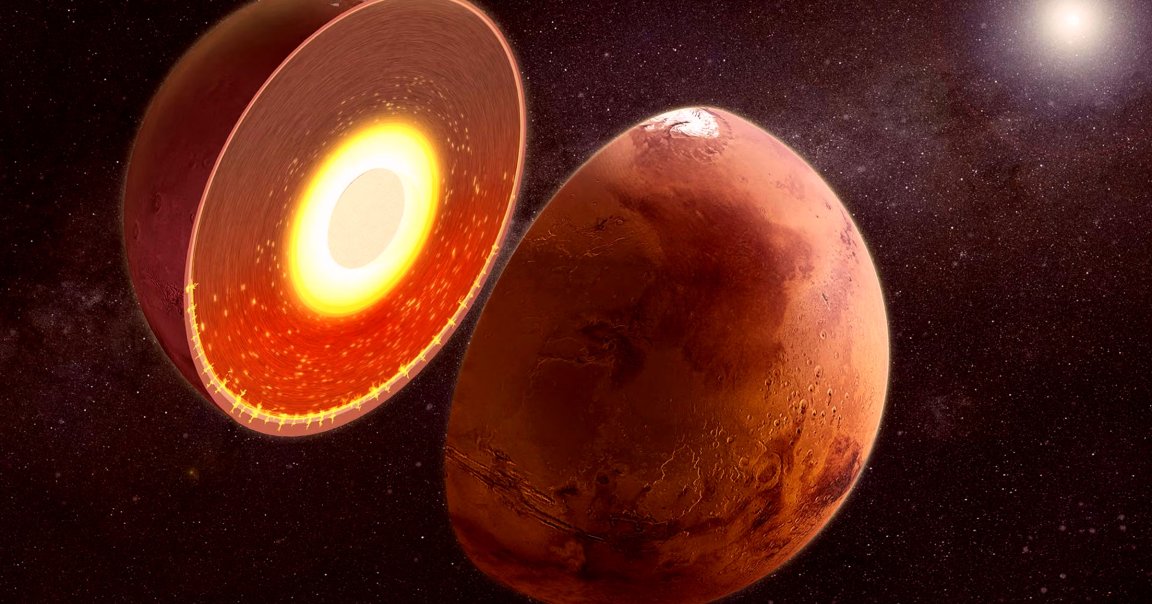
Scientists have detected an unusual “thermal asymmetry” buried deep beneath the surface of Mars’ southern hemisphere — and they’re only beginning to postulate potential explanations for its existence.
As detailed in a new paper published in the journal Nature, the team found that the interior of the Red Planet’s southern half is roughly 400 to 750 degrees Fahrenheit warmer than its northern half. The unexpected discrepancy could give scientists important clues about the period during which the planet was warm enough to host life billions of years ago.
The surfaces of the planet’s two halves are dramatically different. The south is densely cratered and stands several miles higher, while the northern half is relatively smooth and dotted with plains.
“Scientists usually assume that the interiors of planetary bodies are generally spherically symmetric, but this is not necessarily true,” said lead author and University of Arizona planetary scientist Alexander Berne in a statement. “As we get more gravity data, we can determine the three-dimensional intricacies of a planet’s interior structure.”
“These inferences in turn give us a blueprint for designing future missions and scientific exploration of these worlds,” he added. “Understanding the interior structure of planetary bodies helps us unravel the processes that shaped their formation and evolution.”
The considerable “thermal anomaly” could indicate that the planet’s southern mantle was once covered in a magnetic field strong enough to trigger changes particular to Mars’ southern hemisphere.
It may have also “influenced the hydrology of Mars, including the formation of basins that may have held water,” as coauthor and Caltech postdoctoral scholar Amirhossein Bagheri explained in the statement.
The scientists are only starting to unravel possible explanations. One hypothesis suggests a giant impact forced the heat to escape the northern hemisphere, random convection currents in the past, and the southern hemisphere’s massive mountains trapping excess heat.
“This temperature variation could reflect regional mantle convection or insulation by the thick southern highlands crust of Mars that has persisted over several billion years,” the scientists conluded int heir paper.
It’s part of a much larger puzzle that will require many years to unpack.
“There are still questions to be answered,” Washington University in St. Louis planetary scientist Paul Byrne told Scientific American. For one, he questioned why the planet’s largest volcanic province sits ont he margins between the north and south, not the south, where the mantle is far hotter.
The origin is “still an ongoing question in Mars science, and a pretty fundamental one,” as coauthor and Brown University planetary scientist Nick Wagner told 404 Media. “This study doesn’t provide an answer to it, but adds another line of evidence to figure out what is actually going on underneath Mars.”
More on Mars: NASA Fires Up Futuristic Plasma Thruster Designed to Take Us to Mars