






When I was young graduate student at the MIT Media Lab, I came across this quote from computer scientist Alan Kay:
The best way to predict the future is to invent it.
That was a heady idea in the mid-1990s, a time when digital utopianism was on the rise. There was no need to stick to historical patterns: creativity and ingenuity could be our guides, helping us create the future we want!
Thirty years on, I still admire Alan Kay’s sentiment, though it looks hopelessly out of date. Today’s tech industry is run by monopolies with no interest in true creativity, favoring instead AI slop factories that spew out vapid content derived from plagiarism and surveillance.
Perhaps someday we’ll return to a tech industry where true ingenuity is rewarded, but it could take years, if not decades, to get there.
For now, the tech monopolies aren’t creating a new future as much as calcifying the world as it is – by feeding their AI platforms with data from the past.
Whether it’s criminal justice, finance, education, insurance, or any of the many other systems being taken over by AI, actions taken by predictive models use past data to inform a “best guess” approach to decision-making.
One risk of this approach, of course, is that data from past eras often reflects discriminatory or racist practices. Meredith Broussard’s book More than a Glitch: Confronting Race, Gender, and Ability Bias in Tech explains how it happens. (We spoke about it on Techtonic, too.)
Just as pernicious is another aspect about prediction: it can help shape the future.
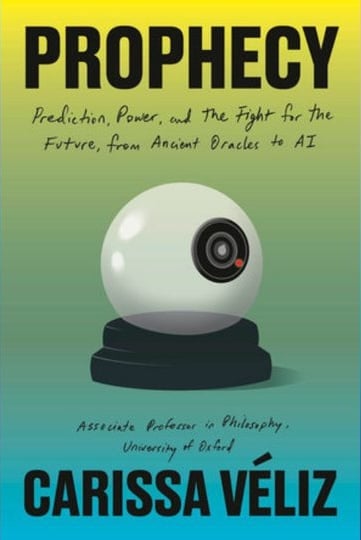
I spoke to Carissa Véliz this week on Techtonic, discussing her new book Prophecy: Prediction, Power, and the Fight for the Future, from Ancient Oracles to AI. It’s a wide-ranging book that has a lot to say about the act of prediction, what she calls “prophecy” – from oracles and seers up to present-day Big Tech predictive AI systems.
Listen to the show:
Mastodon user Anthony posted this helpful summary of the main themes:
The future doesn’t get predicted; it gets produced by prediction.
Prophecies are, more often than not, power plays in disguise.
There is a very close connection between surveillance, prediction, and authoritarianism.
Surveillance sheds a light on everything but itself.
When you make a decision on the basis of a prediction, you cannot challenge that decision, and that goes against the fundamental principle of due process.
The act of prediction is more than just an objective, educated guess about the future: it’s often an exercise of power that can help bend the future toward a desired outcome. Véliz puts it this way:
When the CEO of a tech company says “In the future, everyone will use AI,” he is trying to bend reality toward that vision . . . his prophecy is therefore not descriptive, but prescriptive, in that he is proposing a certain course of action. People who listen to that prophecy and act as if it were true, say, by buying the AI for fear of missing out, might think that what they are doing is getting ahead of the curve, but what they are actually doing is akin to obeying an order.
Now think of the predictive systems from Silicon Valley, which are being given decision-making power in systems (criminal justice, finance, etc.) throughout the country. If an AI deems you a credit risk, for example, the algorithms can take actions – restricting your access to funds – that can help make that prediction come true. It’s a self-fulfilling prophecy of the worst kind, and it’s all automated – and happening, at scale, across the country, across the world – thanks to Big Tech AI.
As it turns out, Alan Kay’s quote isn’t just outdated: today’s tech industry has made just the opposite to be true. To put it succinctly:
The best way to invent the future is to predict it.
All is not lost, however. Near the end of our conversation, Véliz and I discuss ways to resist. I encourage you to listen to the interview (via the episode page or podcast) to hear more – but I will share one tip: read more books. Last week’s essay, My reading odyssey – with Odysseus, offers one possible journey.
You’re on a free subscription. If you enjoy my writing, please join Creative Good to show your support. You’ll also get access to the members-only Forum, where we post and discuss LOTS more articles, posts, games, and memes about what’s happening in tech.
Until next time,
-mark
Mark Hurst, founder, Creative Good
Host, Gel conference
Radio show/podcast: techtonic.fm
Email: [email protected]
Follow me on Bluesky or Mastodon
此内容由惯性聚合(RSS阅读器)自动聚合整理,仅供阅读参考。 原文来自 — 版权归原作者所有。